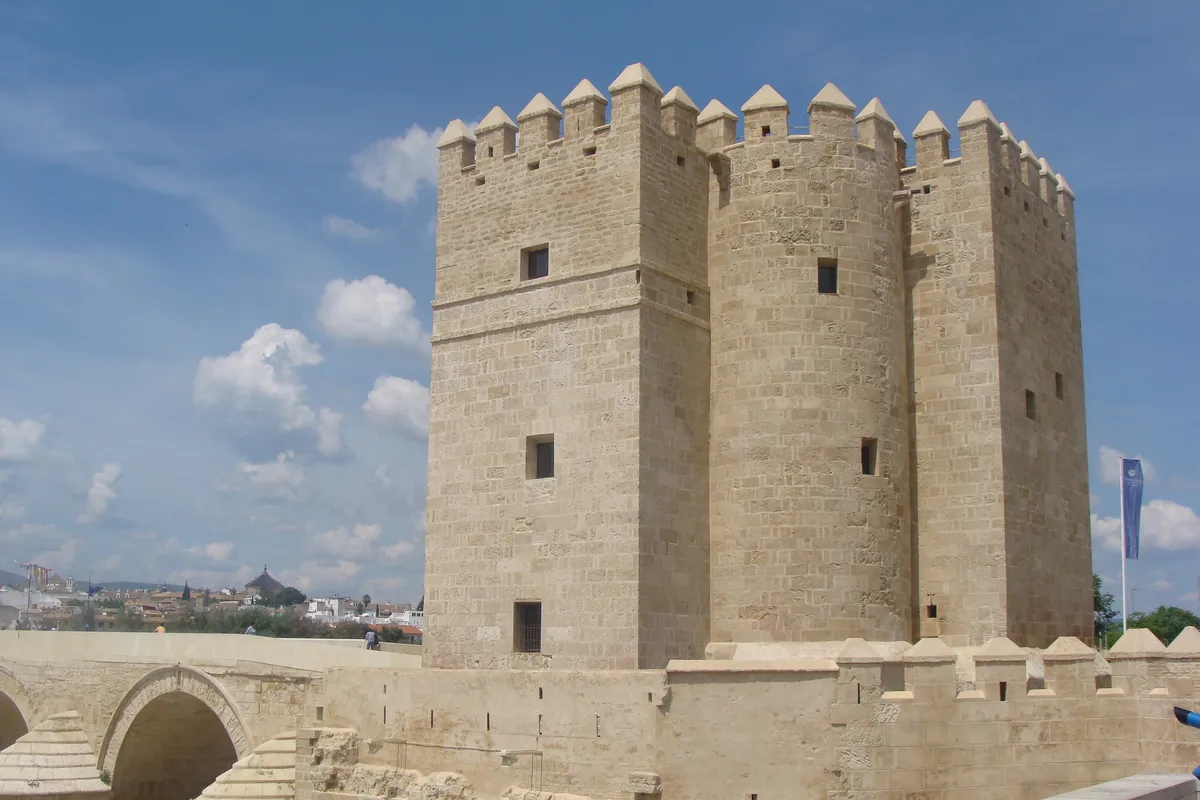

The Torre de la Calahorra was first erected in 1333, under the Almohad-era ruler Abu'l-Hasan, to defend the southern approach to the Roman Bridge -- and the museum inside it doesn't treat that history as a stage set. The Museo Vivo de Al-Andalus turns eight circular rooms, stacked up the tower's original defensive stairway, into a room-by-room argument: that the Islamic Golden Age in Córdoba rested as much on intellectual exchange between three faiths as it did on military control of the river crossing below.
You enter the Torre de la Calahorra from the same gate that once separated Córdoba from the road south, at the southern end of the Roman Bridge. Inside, the circular floors have been converted into eight themed rooms connected by narrow stone stairways -- a layout built for defense, not for crowds, which shapes the visit in ways a purpose-built gallery never would. Spain declared the tower a historical artistic monument in 1931, and in 1985 national heritage law granted it the highest protection category available.
- 1333
Tower erected
Abu'l-Hasan's Almohad-era forces build the Calahorra Tower to defend the Roman Bridge
- 1931
Monument status
Spain declares the tower a historical artistic monument
- 1985
Highest protection
National heritage law grants the tower its top protection category
- Present
Fundación Paradigma
The tower serves as headquarters for the foundation promoting Córdoba's three-culture legacy
What the museum argues
The central claim here is convivencia: the coexistence of Muslim, Jewish, and Christian scholars in Córdoba during the Umayyad Caliphate. The museum makes this concrete through three figures. Averroes (Ibn Rushd), the 12th-century Córdoba-born philosopher whose commentaries on Aristotle shaped European scholasticism for three centuries. Maimonides, the rabbi and physician born a few streets away in 1138, whose Guide for the Perplexed drew on Islamic theology as much as Jewish tradition. And Alfonso X, the Christian king who commissioned translations of Arabic scientific texts into Castilian after the Reconquista, preserving knowledge that might otherwise have been lost.
The museum makes these connections legible without reducing them to a feel-good narrative. The panels acknowledge the political violence of the period alongside the cultural achievement. That honesty makes the argument more persuasive. It's fitting, then, that the tower also serves as headquarters for the Fundación Paradigma Córdoba para la Convivencia, a foundation whose stated mission is to keep the memory of that three-faith symbiosis active rather than filed away as medieval history.
The visit in practice
An infrared headphone system delivers the audioguide in six languages (Spanish, English, French, German, Italian, Arabic) as you move through the rooms. The technology is more immersive than a handheld audio device: you hear the narration as ambient sound rather than holding a phone to your ear. The system is included in the entry price.
The rooms cover caliphate science and medicine, the architecture of knowledge (the library of Al-Hakam II reportedly held 400,000 volumes), and the daily life of 10th-century Córdoba. Scale models reconstruct the original Medina Azahara palace complex and the city at its peak population of roughly 300,000, making it easier to grasp the scale of what existed here before the civil wars of the 1000s dismantled it.
Budget 60 to 90 minutes. The stairways are steep and the rooms are small -- this is a medieval tower, not a gallery. The summit offers a 360-degree panorama across the Guadalquivir, the old city roofline, and the Mezquita-Catedral on one side and the open countryside to the south on the other.
Around the museum
The Roman Bridge itself -- 16 arches, originally built under Augustus -- leads directly to the old city. The Calahorra Tower and the Alcázar Gardens are visible from the summit. Across the river, the Ribera neighborhood runs along the bank.
The museum sits on the Three Cultures Route, which connects the key sites of Islamic, Jewish, and Christian Córdoba in sequence. Visiting the Museo Vivo first gives you a useful framework before walking north to the Mezquita-Catedral, the Synagogue, and the Casa de Sefarad.
Practical information
Entry costs €4.50 for adults, €3.00 reduced (students, seniors), €2.00 for local residents, and €3.00 per person for groups of 15 or more. The audioguide is included. Opening hours vary by season: October and March to May, 10:00 to 19:00; June to September, 10:00 to 14:00 and 16:30 to 20:30; November to February, 10:00 to 18:00. The museum is on the south bank of the Guadalquivir, a ten-minute walk from the Mezquita.