
Most of what draws visitors to Córdoba is old. The C3A is deliberately, aggressively not.
Opened on 19 December 2016 on the banks of the Guadalquivir, the Centro de Creación Contemporánea de Andalucía is less a museum than a working lab. Where the city's fine-arts museum hangs finished canvases and the Museo Vivo de Al-Andalus reconstructs the past, the C3A concerns itself with process: what artists are making right now, how they make it, and what happens when disciplines collide. Hombre Río’s unauthorised river intervention offers another perspective on contemporary art in Córdoba. Entry is free.
What the C3A actually is
The C3A is the Córdoba extension of the Centro Andaluz de Arte Contemporáneo (CAAC) in Seville, Andalusia's flagship contemporary institution, and its stated mission is to become the region's cultural reference point for artistic creation and production. This is not a rhetorical distinction: unlike a conventional gallery, the C3A's main business is showing the public the process behind the work, not only the finished result. Artistic production residencies have been a cornerstone of the institution since it opened, and residents get access to more than 1,000 square metres of visual-creation workshops and audiovisual labs -- painting and sculpture studios, digital media equipment, even a 3D printer and scanner. A permanent programme called C3Aula (Night School) runs workshops on top of that, and the Black Box, a dedicated multidisciplinary performance space, hosts its own annual line-up of experimental music, dance, and live performance alongside the visual-arts galleries.
The programming spans visual and audiovisual arts, drama, dance, contemporary circus, and live performance -- sometimes in the same week. Rotating exhibitions mean there is no permanent collection to tick off. What you see depends entirely on when you go. The website (c3a.es) publishes the current programme, and it is worth checking before you visit rather than showing up blind.
An architecture built to talk to the Mezquita
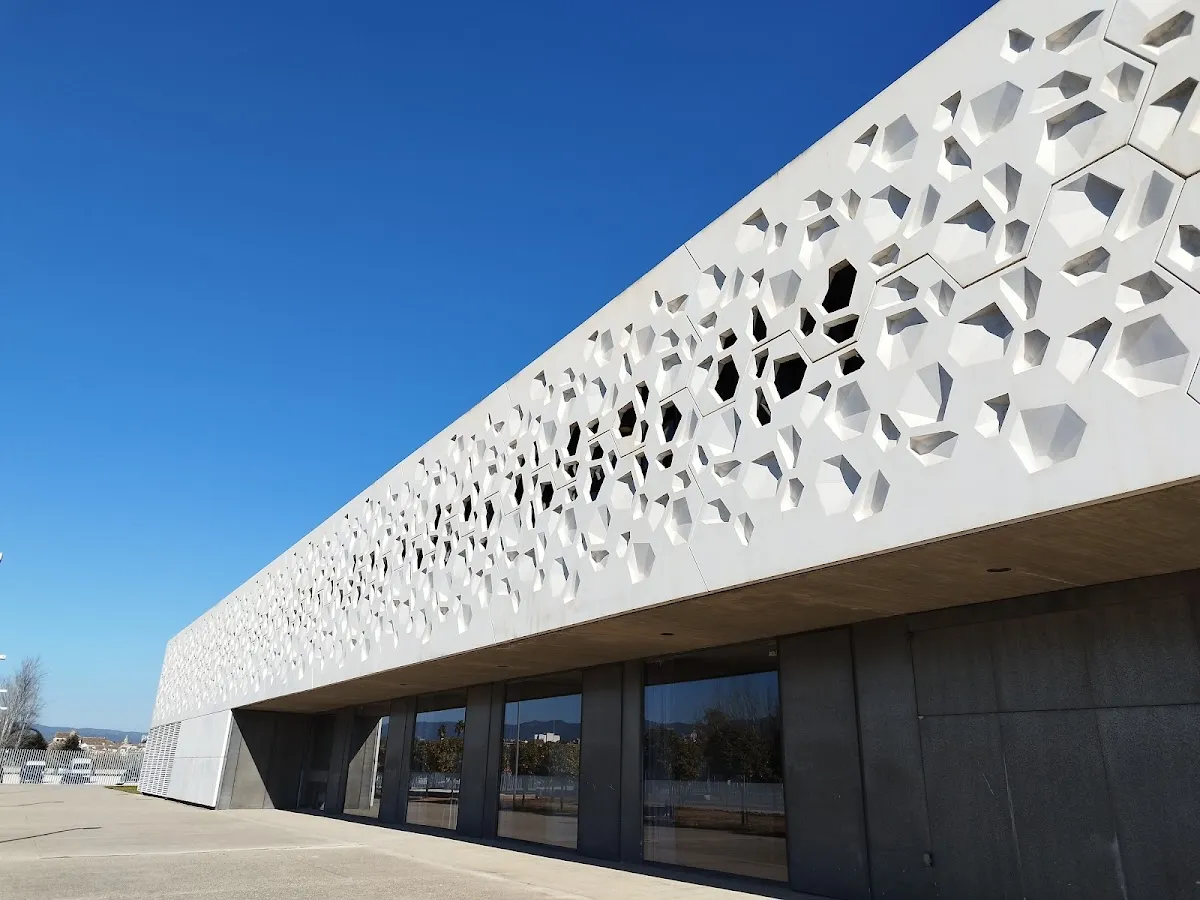
The building itself, designed by Nieto Sobejano Arquitectos, is the first thing most visitors notice, and it is deliberately in conversation with the city's Islamic past. Its Brutalist concrete form is organised around a hexagonal geometric pattern that the architects derived from the hidden proportional logic of the Mezquita-Catedral's own multi-columned interior -- a contemporary building quoting a Caliphal one in its bones rather than its ornament.
That hexagon reappears, at far larger scale, on the riverfront facade: a 100-metre screen pierced by 1,319 hexagonal holes, each backed by an individually controlled LED lamp. Different artists programme the wall using a computer automation system, and the resulting low-resolution grey-scale animations play every night after sunset, visible across the river to the whole city. The facade was engineered in collaboration with the German studio realities:united, and the 1,319 pre-fabricated fibreglass-reinforced cement bowls that carry the lights double as reflectors, turning what could have been a flat screen into something closer to a kinetic sculpture.
The visit in practice
The building sits close to the Guadalquivir, roughly a 15-minute walk south from the Mezquita along the river path. The Roman Bridge and the Torre de la Calahorra are visible to the northwest as you approach. The architecture is purpose-built and contemporary -- a deliberate contrast to the historic stone that dominates the city centre. The Córdoba architecture guide explains the 15-metre height restriction that applies across the city centre and how the C3A's designers worked within it while still creating a building that reads as a counterpoint to the Mezquita's skyline.
Exhibitions typically run for several weeks. On days when rehearsals or residency work are in progress, the building has a particular energy: you may hear music from a rehearsal room, or pass a studio with an artist working. This is not incidental -- it is the point.
Workshops and public programmes accompany most exhibitions. Some are ticketed, others free. Check the schedule on the website if you want more than a passive visit, and come back after dark at least once for the media wall -- it is a different building at night.
The C3A as counterweight
Spending two or three days in Córdoba entirely inside mosques, palaces, and Roman ruins can feel slightly airless by the end. The C3A reorients the visit. It is a reminder that Córdoba has a present tense, not just a past one -- and that Andalusia has a functioning contemporary arts infrastructure that extends beyond Seville and Málaga.
If the current exhibition does not grab you, the building and its riverside position are worth the walk on their own. Give it 45 to 90 minutes depending on the programme. Combine with the Roman Bridge and the south riverbank for a half-day loop that balances old and new.