
Two Million and Counting: The Record and the Slowdown
The Cabildo Catedral de Córdoba, the cathedral chapter that owns and runs the monument, closed 2025 at 2,191,731 visitors, a new all-time record published on 10 March 2026.[1] The previous best, 2,186,774 in 2024, was beaten by just 4,957 people, a rise of +0.23%.[2] After the post-pandemic rebound years, the two-million mark is now a level the building holds rather than a target it chases.
That plateau is not a post-pandemic invention. The two-million mark was first reached in 2019, collapsed to 473,040 in the Covid year of 2020, and was re-established in the post-pandemic years.[3]
The first half of 2026 shows the level being tested. Between January and June the monument received 1,099,223 visitors, the third consecutive year above a million in H1 — but that is down 7.35% on the same period of 2025, which the chapter blames on the rail disruption after the Adamuz accident of 18 January, cuts on the Málaga line, heavy rains and the Middle East conflicts.[4]
That annual total also hides how unevenly the year is spread: January is reliably one of the Mezquita's quietest months, a gap our guide to Córdoba's off-season covers in full.
Where the Mezquita Ranks: Third, Sixth, or Just Busy
The 'third most-visited monument in Spain' label travels with a source attached. For 2025 the Cabildo's own framing puts the Mezquita-Catedral third nationally, surpassed only by the Alhambra of Granada and the Sagrada Família of Barcelona.[5] ABC's 2024 ranking of paid monuments, which excluded museums, placed it sixth, behind the Alcázar and the Catedral of Seville and the Alcazaba–Gibralfaro complex of Málaga.[6]
Either way, the company is right: the Mezquita sits in the same national tier as the buildings that anchor their cities' tourism economies. What differs is density: one prayer hall absorbing what most Spanish monuments manage across whole walled complexes.
For the national backdrop (record arrivals, regional splits, where this figure fits against Spain's national totals), see our Spain travel statistics 2026 roundup.
Where the Queues Live: The Patio de los Naranjos and the Free Window
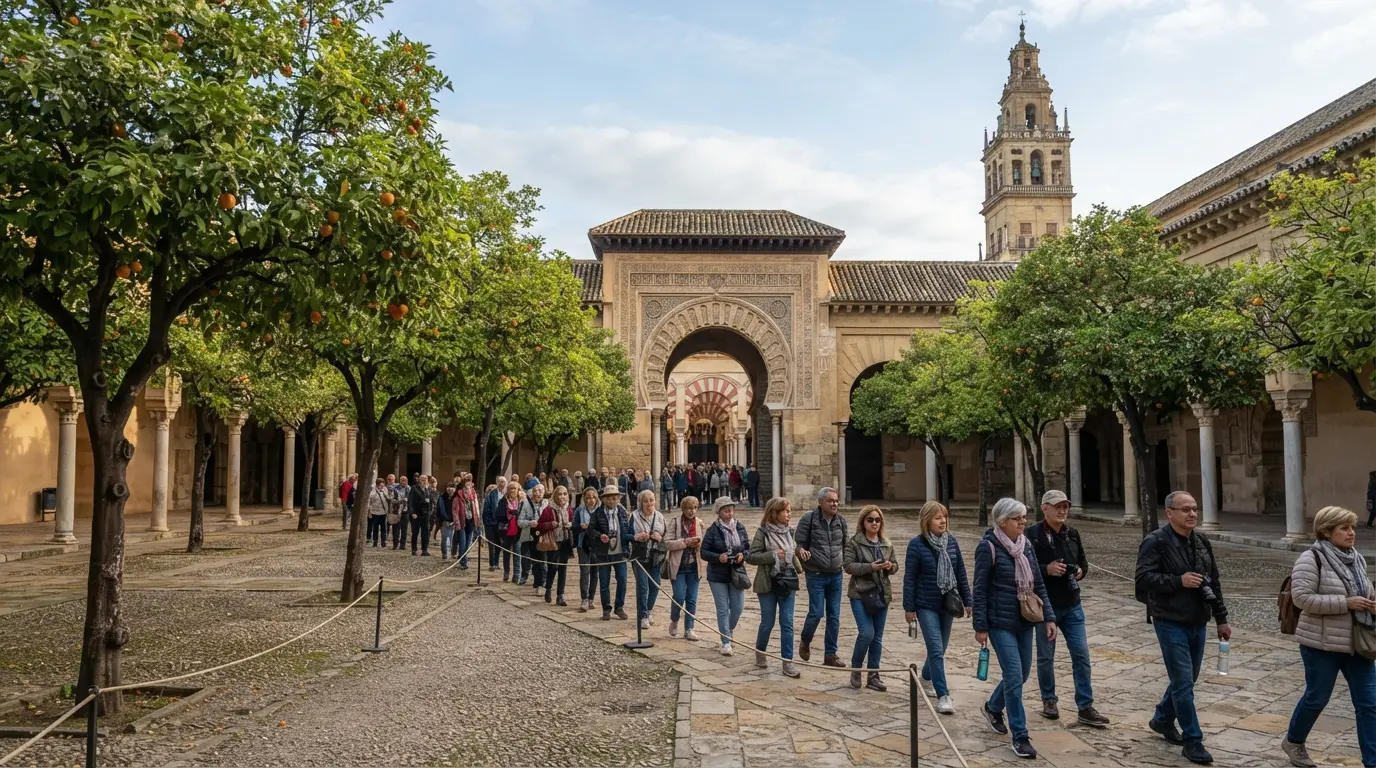
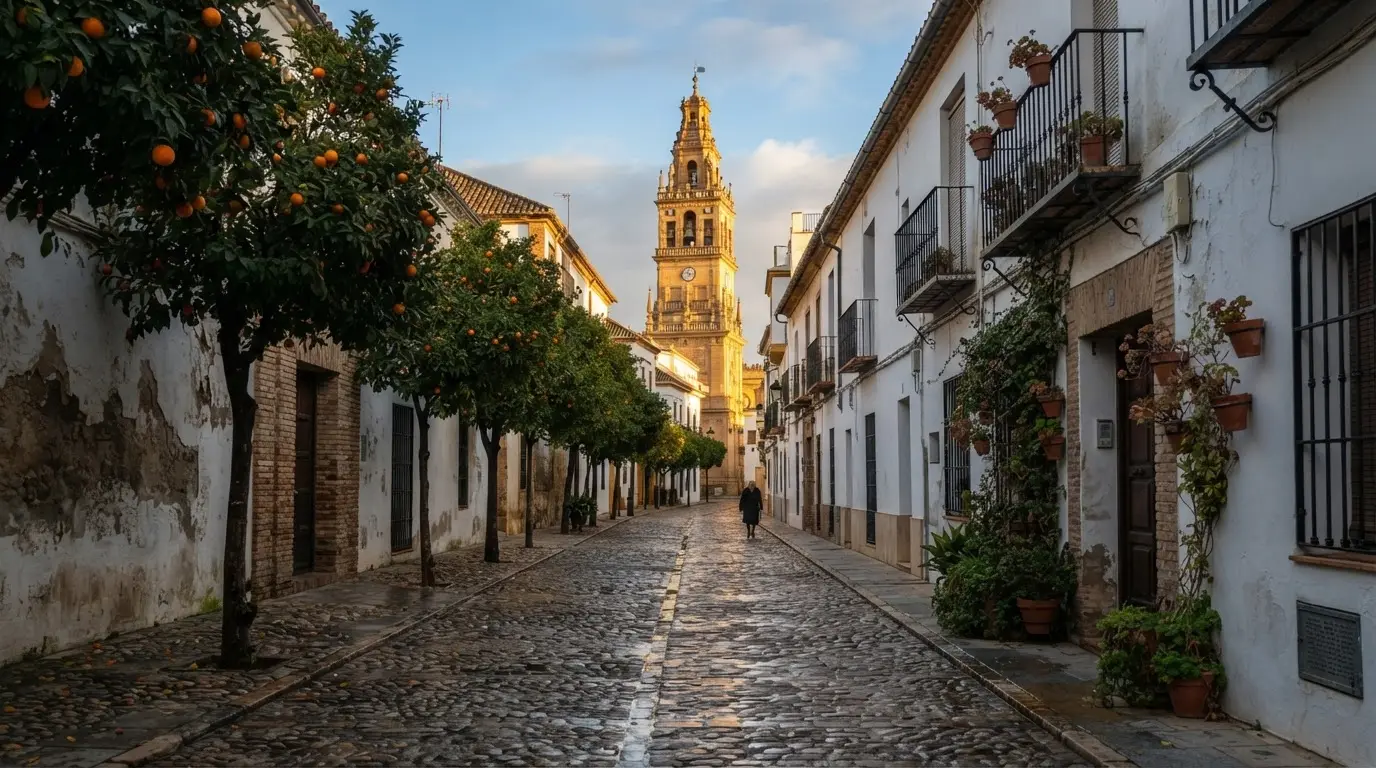
The queue lives in the Patio de los Naranjos, the former ablutions courtyard whose trees and palms are planted in rows, in the Cabildo's own words, «orange trees, palms and cypresses are planted in rows, as if they were the outward continuation of the columns found in the prayer hall».[7] In practice it is the monument's staging area: the same gravel that fed the faithful in the tenth century now processes ticket holders, tour groups and Mass-goers every morning.
The free-entry window runs Monday to Saturday, 08:30–09:30, for individual visitors only: no groups, access barred at 09:20 as the exit begins.[8] It is the cheapest ticket in the city and the most contested: 190,050 people used it in 2025, up 11.10% on the year before.[9]
Explore nearby · Monument
Mezquita-Catedral de Córdoba
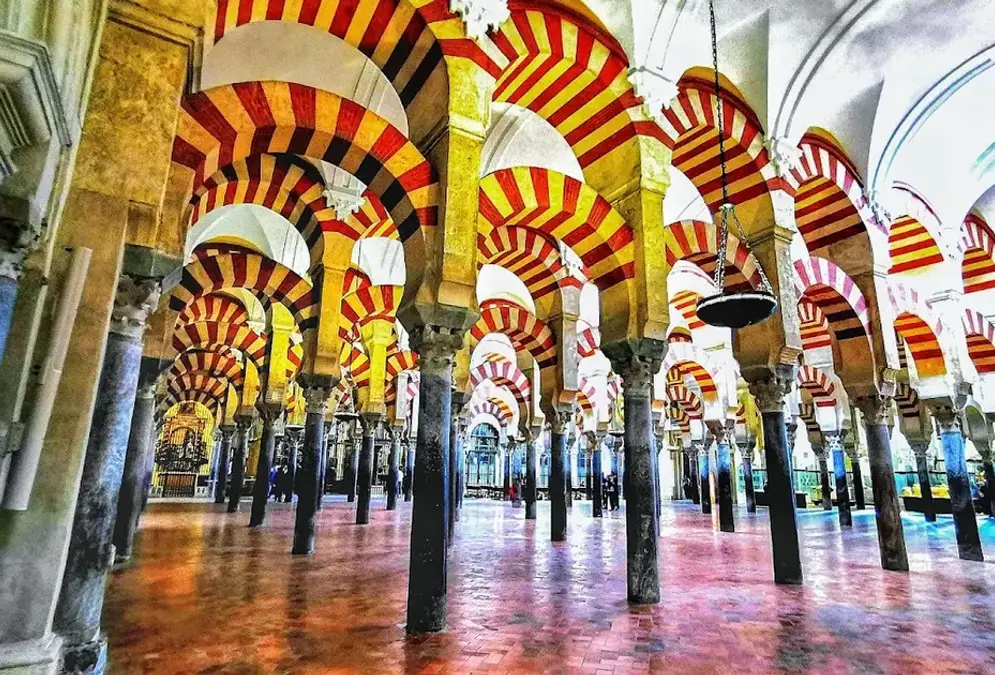
856 columns, 1,300 years of Islamic and Christian history. UNESCO monument in Córdoba, Andalusia. Red-and-white arches, Byzantine mosaics, a Renaissance nave.
A queue that forms before 8:30 in the peak months of April and October is the expected price, and it is a separate line from the paid queue. The Cabildo frames the slot as a deliberate 'open-door' policy that its spokespeople argue proves the monument serves everyone, not only paying visitors. The building's own story, from Umayyad construction to the inserted cathedral, is told on the Mezquita-Catedral page.
How Entry Works: Continuous Capacity Control, Not Timed Slots
The most useful thing to know about entry is what it is not: the Alhambra model. Granada admits by fixed-minute slots; Córdoba runs continuous capacity-controlled admission, reported at a calculated 825 admissions per 30 minutes.[10] Tickets are sold until 30 minutes before closing, and after that no one enters.[11]
Inside, the chapter's own numbers are generous. The interior «has the possibility of maintaining with normality up to near 4,000 people per hour», although the Cabildo prefers not to exceed 2,000, and its busiest-ever day reached 8,000.[12] Those are the working parameters of a building that is also a parish church: Mass and tourism share the same floor.
Digitalisation is the other half of flow management. 64.30% of 2025 tickets were bought online through the official website, against 25.03% at box offices and 10.66% at self-service machines.[13] Booking ahead is the queue-management lever the visitor actually controls: see our Mezquita tickets guide for the full walkthrough, prices and the times that fill first.
Once through the door, the crowd disperses. A building that can hold 4,000 people an hour[12] swallows them into its forest of columns, the acoustic drops, the shuffling spreads out, and the queue you fought is suddenly a distant concern. That is the trick of the place: the capacity problem is at the threshold, not inside.
The Caps Debate: Flow Management vs Fixed Limits
The visitor cap is the question Córdoba keeps not answering. The Mezquita is not cap-free, though: its own Normativa del Conjunto Monumental sets an annual ceiling comfortably above current demand, in contrast to the Alhambra's ceiling of 2,763,500 visitors a year.[14] The chapter's position, stated in the same interview as the capacity figures above, is that the monument has no saturation problem; its response has been flow, not limits.
What changed instead, in January 2026, was the queue itself: the CIR Patio de San Eulogio, a visitor reception centre opened in the Palacio Episcopal a few metres from the monument, took over ticket sales and information with the stated purpose of removing the elements that distort the view of the Patio de los Naranjos and «better organising the queues».[15]
| Mezquita-Catedral | Alhambra | |
|---|---|---|
| Entry model | Continuous, capacity-controlled | Fixed timed slots |
| Admission rate | 825 per 30 minutes (reported) | Fixed per-slot quotas |
| Annual cap | 2,555,000 (normativa) | 2,763,500 |
| Visitors 2024 | 2,186,774 | 2,720,000 |
The centre has been adopted fast: 263,985 accesses and 177,977 visits to its museographic spaces by mid-July 2026.[16] That is the chapter's chosen answer to the aforo debate — infrastructure and digital flow instead of a number on a cap.
Recommended tours
Tours are selected for quality, not commission. We earn a small fee if you book — at no extra cost to you.
Córdoba is not Barcelona. The crowding here is a concentrated, six-hour day-trip pattern around a single building, not the housing-and-protest crisis of the coast — for the full comparison, read our analysis of Córdoba and overtourism.
Autosostenibilidad: What the €15 Ticket Pays For
The price change effective 1 April 2026 was the first in three years: general daytime entry rose from €13 to €15.[17] Reduced rates cover over-65s and students, and children under 10 and Córdoba residents enter free. The chapter's accounting for the money is blunt: the monument runs on a self-funding model in which ticket income covers conservation, running costs and staff, without dependence on public funding, with a large part of the proceeds reinvested in social and charitable projects across the city.[17]
The night visit is part of the same arithmetic, stretching demand beyond daylight hours. El Alma de Córdoba drew 32,600 attendees in 2025, down 5.28% from its 2024 peak but up 491% since the product launched in 2010.[18]
Deep dive · Article
Córdoba Off-Season: Why the Quiet Months Are the Smart Visit
Córdoba's Mezquita drew a record 2,186,774 visitors in 2024, yet January stayed nearly empty. Here's the data behind why Nov–Mar is the smartest time to visit.
The proof the loop works is what it funds. By 21 July 2026, 80% of the roof and chapel zone damaged in the August 2025 fire had been recovered.[19] The fire closed the monument for one day, and it reopened the next morning, but the repair bill, like the maintenance of a 1,200-year-old building, is paid by the tickets, not the state.[20]