A liberal's son in Cabra
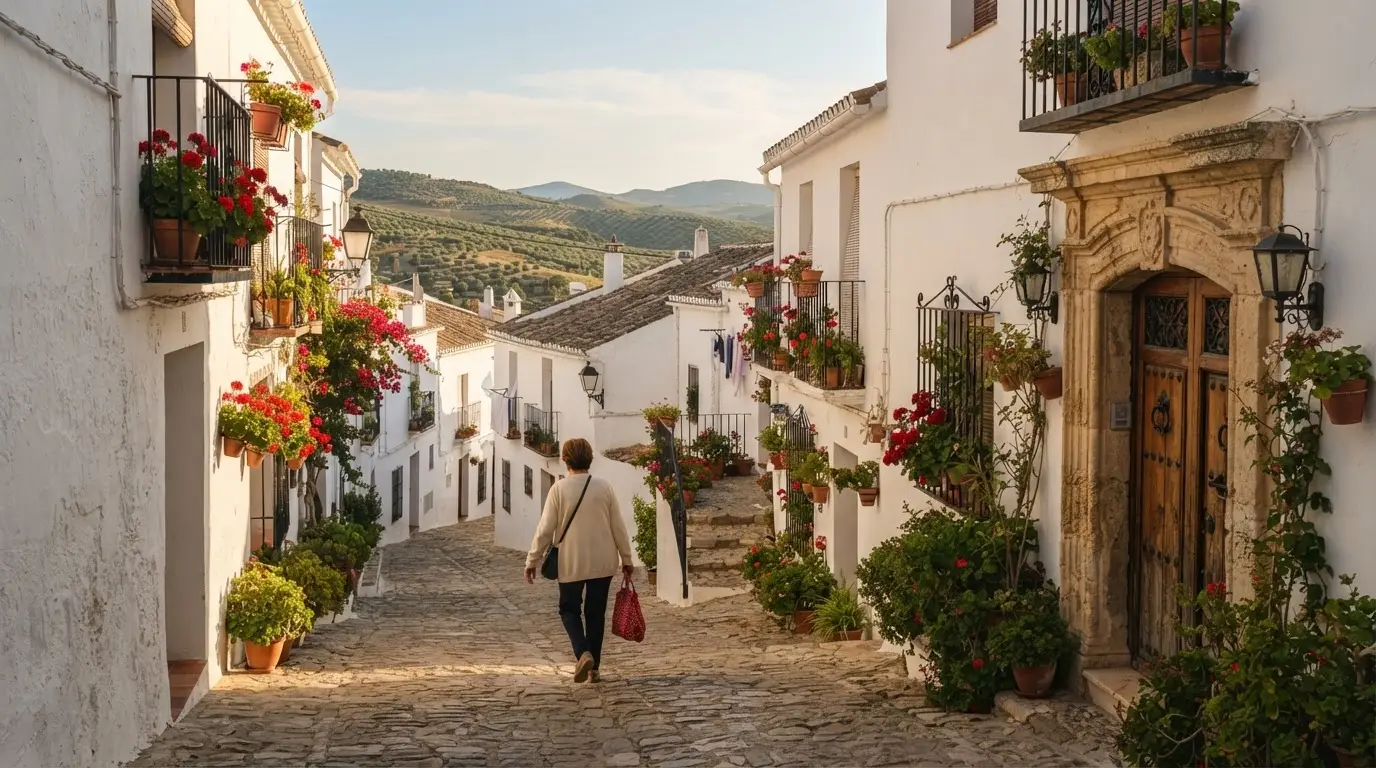
Valera was born in a town that sounds like livestock but, as the origin of Cabra's name shows, is not named for the goat. It sits in the south of Córdoba province, inside the Sierras Subbéticas Natural Park.[5]
His childhood there lasted until 1833.[6] His father, José Valera, was a retired naval officer persecuted for his liberal ideas,[7] and his mother, Dolores Alcalá Galiano y Pareja,[8] was the marquesa de La Paniega, who had married José as her second husband;[9] her Alcalá-Galiano line survives in his own full name, Juan Valera y Alcalá-Galiano.[1]
The schooling took a clerical-then-legal route. He studied philosophy at the seminary in Málaga from 1837 to 1840, moved on to Granada and Madrid, and took a law degree in 1846.[10] Decades later, a seminarian sits at the centre of his best-known novel.
Doña Mencía is where the visitor's trail runs: Valera's family came from the town, his properties were there and he had many friends there, as the town's own chronicle puts it.[11] Cabra, where he was born, is the quieter of the two stops.
From Naples to Vienna: the diplomat's long detour
Valera entered diplomacy in 1847 as an attaché at the Spanish embassy in Naples,[12] but left at the end of 1849 and went back to Madrid,[13] and the postings that followed took him to Russia in 1857, where he had the chance to see several European cities.[14] In 1858 he was elected a deputy to the Cortes for Archidona.[15]
The Real Academia Española gave him his seat on 16 March 1862, welcoming him as both writer and diplomat.[16] He married Dolores Delavat in Paris, in the church of San Pedro de Chaillot.[17]
- 1847
Attaché in Naples
- 1858
Deputy for Archidona
- 1862
Takes his seat in the Real Academia Española
- 1868
Undersecretary of state
- 1871-1872
Director General of Public Instruction
- 1881
Minister in Lisbon
- 1883
Minister in Washington
- 1886-1888
Ambassador in Brussels
- 1893-1895
Ambassador in Vienna
Politics took over after Isabella II's exile: he was named undersecretary of state in 1868, and the Real Academia Española dates his election as Director General of Public Instruction to 1871,[18] while Cervantes Virtual's biography gives the appointment as 24 February 1872.[19] He returned to diplomacy as minister in Lisbon in 1881 and went on to Washington in 1883.[20] Lisbon was familiar ground, since he had first been posted to the legation there in 1850.[21] His career closed with ambassadorships in Brussels (1886-1888) and Vienna (1893-1895).[22]
So Pepita Jiménez came from a man who had already seen Naples, Russia and Paris, and who still chose a cast as small as a widow and a seminarian.
Pepita Jiménez and the novels that go home
Pepita Jiménez appeared in instalments in the Revista de España from March to May 1874,[3] a psychological novel about a young widow and the seminarian Luis de Vargas. The setup fits on a postcard; what carries it is the argument inside the characters' heads, which is why it reads as a novel of ideas wearing village clothes. It was printed as a book the same year in Madrid by the Imprenta de J. Noguera.[23]
F. Serrano Puente, writing in a University of La Rioja journal, counts it among works that fit Spanish realism.[24] He notes that its letters have a single sender, Luis, and a single receiver, the Deán,[25] and reads Luis as standing to Pepita as spirit to flesh.[26]
Explore nearby · Monument
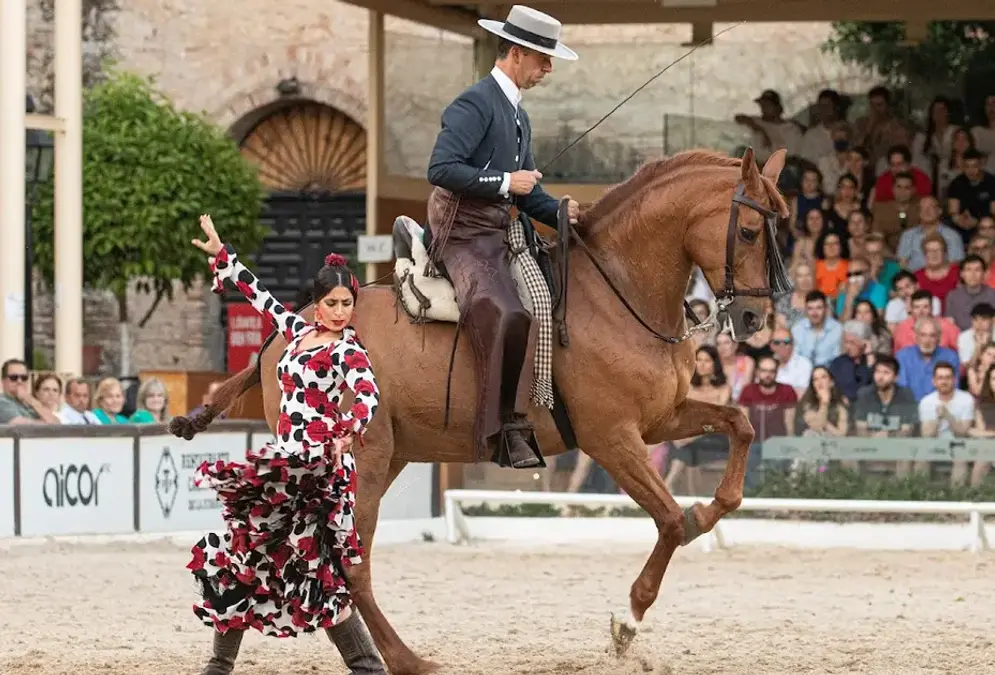
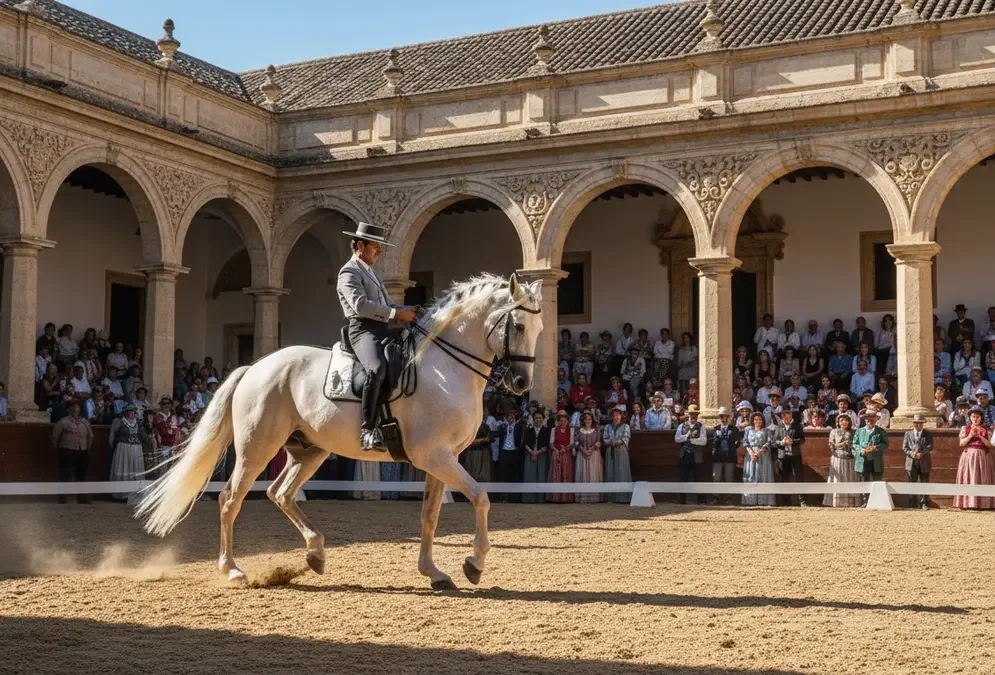
Caballerizas Reales de Córdoba
Philip II's 1568 Royal Stables, birthplace of the Andalusian horse. Evening show combining classical dressage, vaquera riding and flamenco. UNESCO heritage.
Las ilusiones del doctor Faustino followed in the same magazine months later, and critics have read its hero as a portrait of Valera himself;[27] it reached book form in Madrid, from Noguera, in 1875.[28] El comendador Mendoza, printed in Madrid in 1877,[29] is more useful for a visitor to Córdoba province: its protagonist's return to his village mirrors Valera's own return to Cabra and Doña Mencía, and its late marriage anticipates Juanita la Larga.[4]
Three more novels closed his career in quick succession:[30]
- Juanita la Larga (1895)
- Genio y figura (1897)
- Morsamor (1899)
Córdoba's older literary names, Lucan and Ibn Zaydun, belong to other worlds. Valera's Córdoba province is a nineteenth-century one, of village returns, late marriages and a seminarian at the centre of the plot.
If you read only one of these before visiting, make it Pepita Jiménez, the book Valera is most closely identified with.[2]
Blind in Madrid, with a man from Cabra at his side
In his last years Valera led a literary tertulia at his home on Madrid's Cuesta de Santo Domingo, and he died in that house, old, ailing and blind, in April 1905: the Real Academia Española gives the 19th,[31] while other references give the 18th.[32]
Pedro de la Gala, a fellow native of Cabra, acted as his secretary and companion in those blind years.[33] A man who had spent decades at foreign courts ended up with a countryman at his elbow.
He also left a vast correspondence, the epistolario that sits alongside his poems, novels and critical writing.[34] For a reader who knows him only through Pepita Jiménez, the letters show the diplomat as well as the novelist.
Seeing Valera country in Cabra and Doña Mencía
Andalusia's heritage institute lists the Casa natal de Juan Valera in Cabra alongside the Aguilar y Eslava secondary school and the church of Nuestra Señora de la Asunción y Ángeles.[35] The Isaac Albéniz music conservatory is identified as occupying the birth house today,[36] so it is a working school: look at it from the street and do not plan on going in.
Cabra hosted the Third International Congress on Valera in October 2024, and one participant took part on 18 October.[37] That is a sign of how seriously the town takes him, not an event to plan around.
Doña Mencía offers more on foot, and the place names reflect his ties to it:
Recommended tours
Tours are selected for quality, not commission. We earn a small fee if you book — at no extra cost to you.
Deep dive · Article
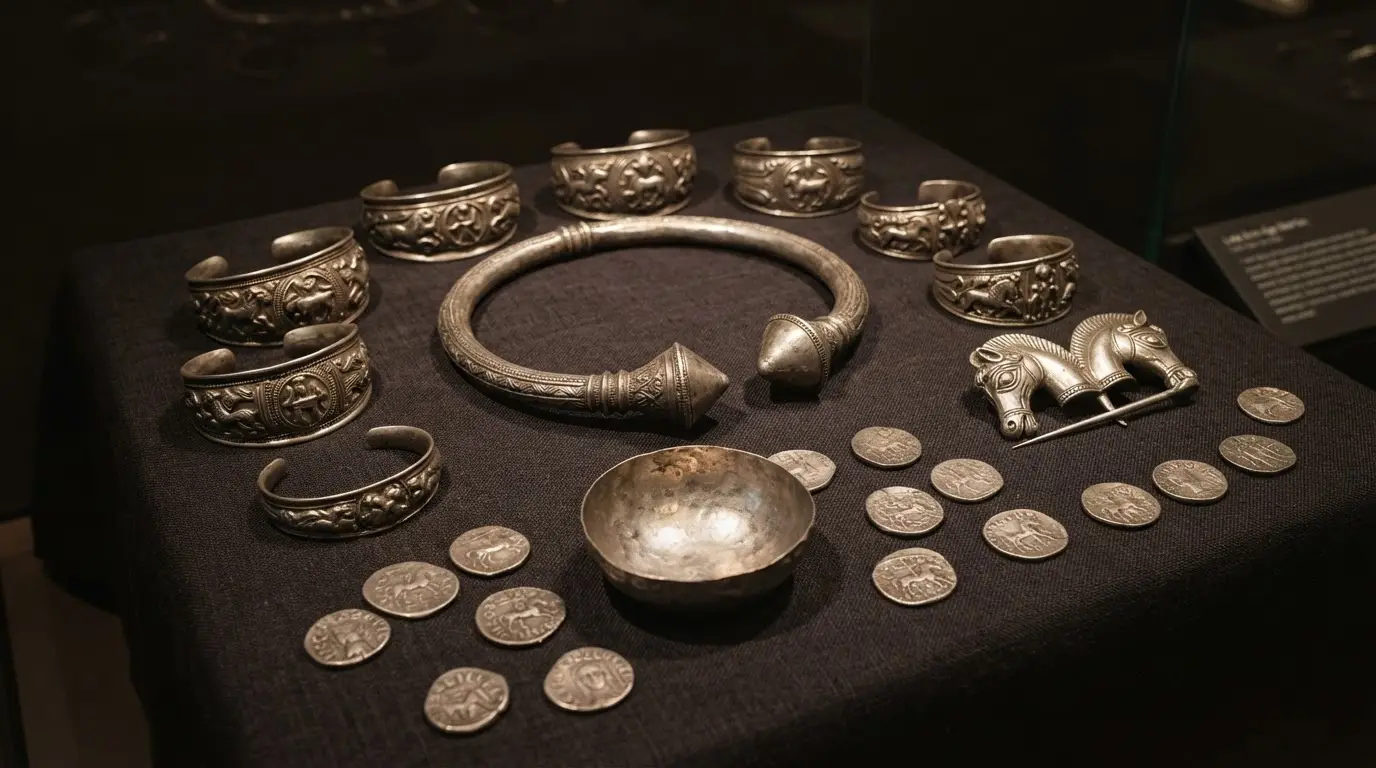
An Andalusian Treasure Has Sat in the British Museum Since 1932
A silver hoard dug up in Córdoba in 1915 left Spain against the law and has been in the British Museum since 1932. Here is how, and what a 2026 study found.
Doña Mencía's town council ran a guided, theatrised Ruta Valeriana on 26 October 2024 during the bicentenary programme,[40] and a regional walking guide notes that such routes follow the places and corners Valera recreated in his books.[41] Treat that walk as an occasional event, not a standing tour, and ask at the castle tourist office before you go.
Anyone building a Subbética day around Cabra can pair it with the castle village of Zuheros. Valera's own places are quieter and more bookish.
The bicentenary in October 2024 was widely noted as two centuries since the birth of the novelist, letter-writer and essayist from Cabra.[42] A sensible plan is to start in Cabra, where the birth house and its heritage neighbours give the biography a location, and to finish in Doña Mencía, where the street names, the cultural centre and the occasional guided route give the fiction a place to walk.