art-lovershistory-buffs
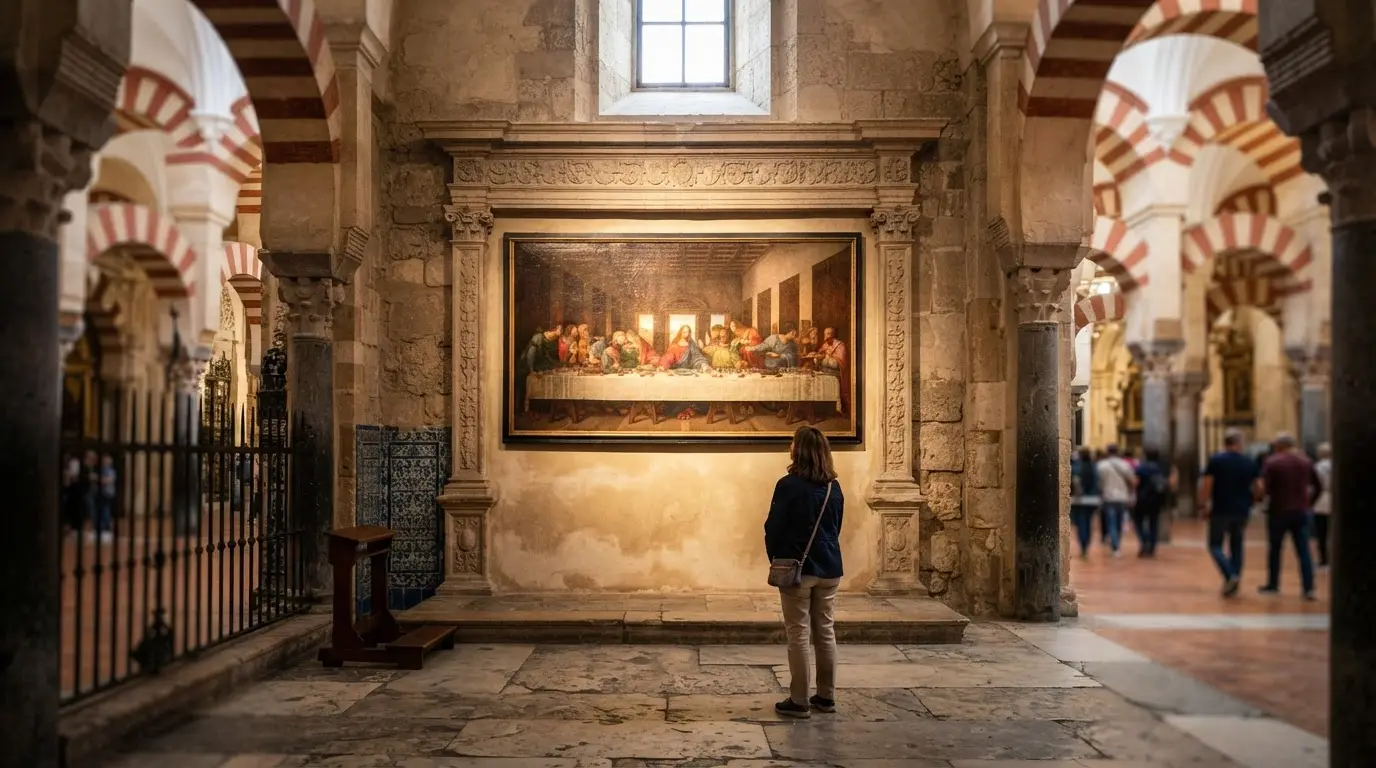
Photorealistic view of a Renaissance altarpiece canvas of the Last Supper on a stone wall inside the Mezquita-Catedral of Córdoba, red-and-white striped arches beside it, soft raking light, evoking pablo de cespedes cordoba and the Roman manner brought home

Pablo de Céspedes: Córdoba's Renaissance Polymath
Pablo de Céspedes was a Córdoba prebendary who painted in Rome, then the Santa Cena in the Mezquita-Catedral, and wrote a poem on painting. Where to see him.

Portrait of Sophie Marchand
Written by

Art history background with eight years writing interpretive content on Córdoba's Caliphal heritage.

Published
Early modern1492–1808
Look at the western wall of the Mezquita-Catedral and the Santa Cena in the former chapel of San Clemente is the work of one of the cathedral's own prebendaries.[3] Pablo de Céspedes spent years in Rome and came home in September 1577 to take up his cathedral post.[2] Only the frescoes of the Bonfili chapel in Rome survive from his Italian years,[4] so in Córdoba he is met mostly through that canvas, a poem on painting and an essay that scholars still dispute.
Roman chapel frescoes
1571–1575
Painted with Cesare Arbasia at Santa Trinità dei Monti[1]
Return to Córdoba
Sept 1577
Took up his cathedral post after the Roman years[2]
Santa Cena's chapel
San Clemente
Former chapel on the Mezquita-Catedral's western wall[3]

Born in Córdoba, raised among canons

Céspedes was born in Córdoba around 1538, though some biographers put it nearer 1548, and the exact date of his birth is unknown.[5][6] He grew up in the house of his father's maternal uncle, Francisco López de Aponte, a canon of the cathedral, and received a learned education there.[7]
He went on to Alcalá de Henares to study theology and Oriental languages.[8] An odd start for a painter, and the oddity runs through his reputation. The Real Academia de la Historia's biography finds him more humanist than painter or poet,[9] and the art historian Díaz Cayeros reads his late theory of painting through his Roman training.[10] Much of what is known about his life goes back to Francisco Pacheco, the painter and theorist who taught Velázquez.[11]
The list of trades is long. He is catalogued as painter, sculptor, architect, art theorist, humanist and poet, and each label fits one part of the record.[5] None is wrong. None is the whole man.
For a visitor the practical consequence is simple. Expect traces rather than a studio: a canvas in the cathedral, a chapel altarpiece, and writing that other people rescued and edited long after his death.

Rome and the Bonfili chapel, 1571 to 1575

Céspedes was in Rome by 1571 at the latest, although the year he left Spain is not known.[6] Between 1571 and 1575 he worked with the painter Cesare Arbasia on the fresco decoration of a chapel in the church of Santa Trinità dei Monti.[1] That is the Bonfili chapel, also called the chapel of the Annunciation,[12] and the Spaniard Antico Bonfili was the patron who commissioned its paintings.[13] Its frescoes are the only works from his Italian period that survive.[4]
The Descent label that some Spanish entries attach to the chapel is a different matter: Daniele da Volterra's Descent from the Cross is the painting that now occupies the altar wall.[14]
The two painters shared a home and a workshop until 1576, when the Córdoba prebendary decided to go back to his city.[15] Rome was not a short episode: his absence from Córdoba is put at seven, nine or perhaps 18 years, depending on which departure date a historian accepts.[16]
He took his seat in the cathedral in September 1577,[2] with a prebend attached, and Córdoba kept him there until his death in 1608.[17][5] Thirty-one years in one chapter is long enough to explain why the Roman painter who left came back as a prebendary, an antiquarian and a writer.
The partnership mattered beyond Rome. Córdoba's reception of Italian art owed much to the Piedmontese Cesare Arbasia, his partner in the Roman workshop.[18]
Timeline
  1. c. 1538 (some sources: c. 1548)

    Born in Córdoba

    The exact date is unknown.[5]

  2. 1571 to 1575

    Frescoes at Santa Trinità dei Monti

    Worked with Cesare Arbasia in Rome.[1]

  3. 1576

    Decides to return to Córdoba

    The partnership's shared workshop ends.[15]

  4. September 1577

    Takes up his cathedral post

    Back in Córdoba as prebendary.[2]

  5. 1595

    Santa Cena dated

    The canvas now in the former chapel of San Clemente.[19]

  6. 1608

    Dies in Córdoba

    Shortly after writing his Janus essay.[40][27]

The Santa Cena and what Rome left in the cathedral
The painting most visitors can actually find is the Santa Cena, an oil on canvas in the former chapel of San Clemente on the western wall of the Mezquita-Catedral.[3] It is dated 1595, eighteen years after his return.[19] Stand in front of it with the Roman years in mind and the question is not whether it is good but what it is doing in a building of striped arches.
The cathedral's own account reads the canvas as clearly Italian, painted after his stay in Rome.[20] The art historian Angulo went further and placed Céspedes among the followers of the Michelangelesque tendency of Daniele da Volterra.[21] Bring that lens to the wall: a Roman manner, learned in a chapel on the Trinità dei Monti, hung on an Andalusian wall.
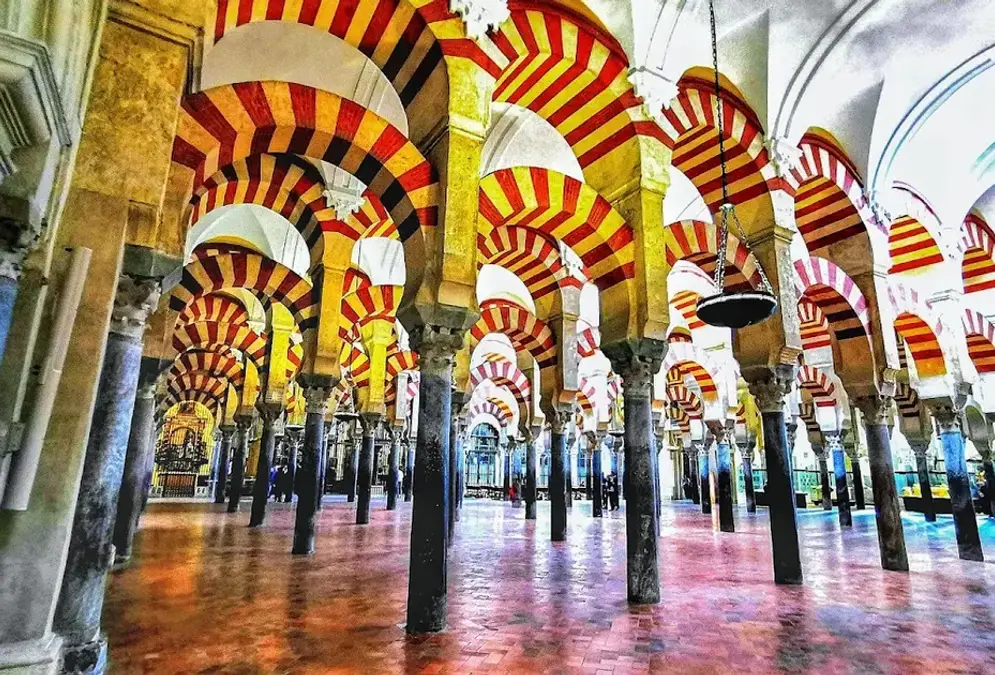
Interior of the Mezquita-Catedral de Córdoba with its iconic red-and-white arches and forest of columns

Explore nearby · Monument

Mezquita-Catedral de Córdoba

856 columns, 1,300 years of Islamic and Christian history. UNESCO monument in Córdoba, Andalusia. Red-and-white arches, Byzantine mosaics, a Renaissance nave.

The canvas hangs inside the Renaissance cathedral that rose within the mosque, a building story told in the Ruiz dynasty of Córdoba's Renaissance architects. Céspedes painted; others built.

The humanist: a poem, a Temple of Solomon and a Janus essay

The writing is where Céspedes carries the most weight. His poem on painting, known in Spanish as the Poema de la Pintura, sets out how to reach technical excellence in the art.[22] It is hard to judge as a unit, because Pacheco printed in his Arte de la pintura only the fragments that supported his own arguments.[23]
Céspedes wrote on antiquarian subjects too, among them the architecture of the Temple of Solomon, and he befriended Benito Arias Montano.[24] His Discourse on the Temple of Solomon, which treats the origin of painting, has been studied and edited by Rubio Lapaz.[25] The Museo de Bellas Artes tells the same story: the humanist painter returned to the city with the style of Raphael and Michelangelo, after training in Italy.[26]
Shortly before his death in 1608 Céspedes wrote a short essay on the antiquity of the cathedral of Córdoba, arguing that the site had first been a temple of Janus.[27] He did not start the idea: he was answering an antiquarian tradition begun in the late 16th century by Ambrosio de Morales.[28] Céspedes began from two Roman milestones that he read as naming a temple to Janus Augustus and closed by identifying Janus with Noah, a step that pulled the pagan temple into biblical history.[29][30] Stylow's reading of the inscriptions turned the temple into a phantom born of a misreading,[31] and Robert Knapp had already dismissed it as speculation in 1983.[32] The milestones name a monumental border arch of Ianus Augustus, and Bellón Ruiz and colleagues identified the foundations of an arch and monumental platform at Mengíbar, in Jaén province, as that monument, not anything in Córdoba.[33] The Janus temple of the Mezquita is therefore a story about the building, not a fact about it.
Much of the rest survives because others rescued it. A large number of his original writings were taken to Granada by his companion and continuator Bernardo de Aldrete and came to light long after his death, which is one reason Pacheco's biography stayed the foundation of what is known about him.[34]
Keep the proportion in mind. The Janus essay is one piece in a body of work on painting, the Temple of Solomon and antiquity. It travels furthest because it is about the Mezquita. Nor is it the best of him.

Where to find Céspedes in Córdoba today
Céspedes is a trail rather than a single stop. These are the places where the record puts his work, with one caveat about the museum:
Cordoba treasure British Museum: AI-generated illustration of a silver torc, penannular armlets, a horse-head brooch and scattered Roman and Iberian silver coins on dark cloth under museum lighting

Deep dive · Article

An Andalusian Treasure Has Sat in the British Museum Since 1932

A silver hoard dug up in Córdoba in 1915 left Spain against the law and has been in the British Museum since 1932. Here is how, and what a 2026 study found.

  • Santa Cena: the former chapel of San Clemente, on the western wall of the Mezquita-Catedral.
  • Santa Ana chapel: he also painted the paintings on its altarpiece, in the same cathedral.[35]
  • Museo de Bellas Artes: the museum's own story presents his Virgin with angels (1578/1580), so check with the Museo de Bellas Artes de Córdoba what is on view before you build a visit around it.[36]
  • Seville cathedral: the Virtues in the chapter house, dated 1592, if you are travelling on.[37]
His face survives in a bust-length drawing that shows him in maturity, dressed in the fashion of the late 16th century.[38]

Recommended tours

Tours are selected for quality, not commission. We earn a small fee if you book — at no extra cost to you.
The honest way to read him on the spot is to start with the Santa Cena, then walk the nave with the Janus essay in mind. In the modern era only Pedro Díaz de Ribas contradicted that essay, pointing to its lack of serious historical argument.[39] A temple that never existed, a Roman manner brought home and a poem on painting all come from the same prebendary, and the cathedral that holds the canvas is the one he spent thirty-one years serving.

Frequently asked questions

Who was Pablo de Céspedes?

Pablo de Céspedes was a Córdoba-born painter, sculptor, architect, art theorist, humanist and poet who lived from about 1538 until 1608. He studied theology and Oriental languages at Alcalá de Henares, worked in Rome for several years, and returned in 1577 to a prebend in Córdoba cathedral, where he stayed until his death.

When was Pablo de Céspedes born?

The exact date is unknown. Most reference works give about 1538, while others put it nearer 1548. He died in Córdoba in 1608, so the two dates imply either a life of about 70 years or one of about 60.

Where can you see Pablo de Céspedes in Córdoba?

The Mezquita-Catedral holds his Santa Cena in the former chapel of San Clemente on the western wall, and the paintings on the altarpiece of its Santa Ana chapel. The Museo de Bellas Artes presents a Virgin with angels by him in its own story of the collection, so confirm with the museum what is on display before you go.

What did Pablo de Céspedes do in Rome?

Between 1571 and 1575 he worked with the painter Cesare Arbasia on the fresco decoration of a chapel in Santa Trinità dei Monti, the Bonfili chapel, also called the chapel of the Annunciation. The two men shared a home and workshop until 1576. Those frescoes are the only works from his Italian period that survive.

When did Pablo de Céspedes return to Córdoba?

He was back in September 1577 and took up a cathedral post with a prebend. His absence from Córdoba is estimated at seven, nine or perhaps 18 years, depending on when historians think he left Spain, a date that is not known.

What is Céspedes's Poema de la Pintura?

It is a didactic poem on how to reach technical excellence in painting. It is hard to judge as a whole, because Pacheco printed in his Arte de la pintura only the fragments that supported his own arguments.

Sources

40 references Show
  1. historia-hispanica.rah.es — 3006 cesare arbasia (opens in a new tab)

    “Entre 1571 y 1575 colabora con Céspedes en los trabajos de decoración de los frescos de la capilla del Descendimiento en la iglesia de Trinitá dei Monti de Roma.”

  2. revistaseug.ugr.es — 10914 (opens in a new tab)

    “Sabemos que Pablo de Céspedes volvió a Córdoba en el mes de septiembre de 1577”

  3. mezquita-catedraldecordoba.es (opens in a new tab)

    “Location: Altarpiece of the Holy Supper, former chapel of San Clemente (western wall)”

  4. Wikipedia — Pablo de Céspedes (opens in a new tab)

    “His only surviving works from that period are the frescoes he painted in the Bonfili chapel at the Santa Trinità dei Monti church in Rome.”

  5. nueva.fundaciongoyaenaragon.es (opens in a new tab)

    “Pablo de Céspedes (ca. 1538/1548-1608) fue un pintor, escultor, arquitecto, tratadista de arte, humanista y poeta español nacido en Córdoba.”

  6. scielo.org.mx (opens in a new tab)

    “Se desconoce la fecha exacta en que nació Céspedes, así como el año en que dejó España.”

  7. Wikipedia — Pablo de Céspedes (opens in a new tab)

    “Pablo was born and brought up in the house of his father's maternal uncle, Francisco Lopez de Aponte, Canon of Cordoba, where he received a learned education.”

  8. Britannica (opens in a new tab)

    “Céspedes was educated at Alcalá de Henares, where he studied theology and Oriental languages.”

  9. historia-hispanica.rah.es — 11702 pablo de cespedes (opens in a new tab)

    “se comprueba que es más un humanista que un pintor o un poeta.”

  10. scielo.org.mx (opens in a new tab)

    “permitirá dar una nueva imagen del humanista, de su formación en Roma y del impacto que tuvo ésta en su teoría tardía.”

  11. scielo.org.mx (opens in a new tab)

    “El conocimiento de la vida y obra de Pablo de Céspedes se debe en primer lugar a Francisco Pacheco, el pintor y teórico español que igualmente fue maestro de Diego Velázquez.”

  12. scielo.org.mx (opens in a new tab)

    “La capilla de la Anunciación o capilla Bonfili”

  13. scielo.org.mx (opens in a new tab)

    “Finalmente, el espacio se le dio al español “Antiquus Bonfilus” (o Antico Bonfili)”

  14. scielo.org.mx (opens in a new tab)

    “Por último, habrá que mencionar que el Descendimiento de la cruz , de Daniele da Volterra, que actualmente ocupa la pared del altar”

  15. historia-hispanica.rah.es — 3006 cesare arbasia (opens in a new tab)

    “ambos van a compartir vivienda y taller hasta que en 1576 el racionero cordobés decide volver a su ciudad.”

  16. scielo.org.mx (opens in a new tab)

    “Regresó a Córdoba en 1577 con el puesto de racionero de la catedral, después de una ausencia de siete, nueve o tal vez 18 años.”

  17. Britannica (opens in a new tab)

    “He returned to Spain a little before 1577 and received a prebend of the Cathedral at Córdoba, where he lived until his death.”

  18. revistas.unileon.es (opens in a new tab)

    “En este proceso de recepción artística italiana desempeñó una influencia vital el pintor de origen piamontés Cesare Arbasia”

  19. mezquita-catedraldecordoba.es (opens in a new tab)

    “The work shows a clear Italian influence. Not surprisingly, this painting was produced by Céspedes after his stay in Rome.”

  20. scielo.org.mx (opens in a new tab)

    “Para Angulo, Céspedes fue un seguidor de la tendencia miguelangelesca de Daniele da Volterra mucho más que un”

  21. scielo.org.mx (opens in a new tab)

    “El “Poema de pintura” de Céspedes describe cómo obtener excelencia técnica en el arte de la pintura.”

  22. scielo.org.mx (opens in a new tab)

    “El “Poema” es especialmente difícil de analizar como una unidad ya que lo que Pacheco introdujo en su Arte de la pintura fueron los fragmentos que sostenían sus propios argumentos.”

  23. Wikipedia — Pablo de Céspedes (opens in a new tab)

    “He continued to write books on antiquarian topics such as the architecture of the temple of Solomon. He befriended Arias Montano.”

  24. revistaseug.ugr.es — 31292 (opens in a new tab)

    “EL «DISCURSO SOBRE EL TEMPLO DE SALOMÓN, ACERCA DEL ORIGEN DE LA PINTURA» DE PABLO DE CÉSPEDES. ESTUDIO Y EDICIÓN”

  25. artsandculture.google.com (opens in a new tab)

    “In Córdoba, the Humanist painter Pablo de Céspedes returns to the city with the style of Raphael and Michelangelo, after training in Italy.”

  26. muyinteresante.okdiario.com (opens in a new tab)

    “escribió un pequeño ensayo titulado Discurso sobre la antigüedad de la catedral de Córdoba, y cómo antes era templo del Dios Jano.”

  27. muyinteresante.okdiario.com (opens in a new tab)

    “Céspedes respondía a una tradición anticuaria sobre este edificio, iniciada en el último tercio del XVI por el reverenciado Ambrosio de Morales”

  28. muyinteresante.okdiario.com (opens in a new tab)

    “El punto de partida de la argumentación de Céspedes eran dos miliarios romanos, que mencionaban la existencia de un templo dedicado a Jano Augusto.”

  29. muyinteresante.okdiario.com (opens in a new tab)

    “Céspedes remataba la argumentación con un análisis de fuentes literarias que le llevaba a postular la identificación de Jano con Noé”

  30. dialnet.unirioja.es (opens in a new tab)

    “fantasma surgido a base de un mal entendido de las inscripciones de los miliarios allí encontrados”

  31. Wikipedia — Mosque–Cathedral of Córdoba (opens in a new tab)

    “However, Robert Knapp, in his 1983 study of Roman-era Córdoba, dismissed this claim as speculation based on a misunderstanding of Roman milestones found in the area.”

  32. rujapre.ujaen.es (opens in a new tab)

    “The interprovincial border monument thus acted as the beginning marker for a stretch of the Via Augusta, with the ocean as its end.”

  33. historia-hispanica.rah.es — 11702 pablo de cespedes (opens in a new tab)

    “a fines del siglo pasado apareció un gran número de sus escritos originales que su compañero y continuador Bernardo de Alderete (o Aldrete) se había llevado a Granada”

  34. mezquita-catedraldecordoba.es (opens in a new tab)

    “In 1577 he returned to Cordoba to hold the position of prebendary of the Cathedral, where he also created the paintings on the altarpiece in the chapel of Santa Ana”

  35. artsandculture.google.com (opens in a new tab)

    “The Virgin with angels (1578/1580) by Pablo de Céspedes”

  36. historia-hispanica.rah.es — 11702 pablo de cespedes (opens in a new tab)

    “Virtudes de la Sala Capitular, catedral, Sevilla, 1592”

  37. nueva.fundaciongoyaenaragon.es (opens in a new tab)

    “Este dibujo, que muestra al personaje de busto, en plena madurez y vestido a la moda de finales del siglo XVI”

  38. muyinteresante.okdiario.com (opens in a new tab)

    “Durante la Edad Moderna, sólo Pedro Díaz de Ribas se atrevió a contradecirlo, apuntando a la falta de argumentos históricos serios en su razonamiento.”

  39. Britannica (opens in a new tab)

    “died July 26, 1608, Córdoba”