
The palace Abd al-Rahman III built — and why
Abd al-Rahman III broke ground on Medina Azahara around 936 CE, seven years after declaring himself Caliph in the Great Mosque of Córdoba[1]. The site, on terraced hillside 8 km west of the city, was chosen for reasons that had nothing to do with defence. It had unobstructed views toward Córdoba. It had reliable water from the Sierra. And it was, crucially, blank: no existing urban fabric to demolish, no rival claims to navigate.
The scale was deliberate and legible from a distance. The complex covered roughly 112 hectares (about 275 acres) across three ascending terraces[1]:
- Royal apartments and reception halls at the top
- Administrative quarters and the congregational mosque in the middle
- Markets and workers' housing at the base
Each residential quarter of the complex had its own hammam — a reflection of the same urban logic that gave Córdoba more than 300 public baths at the caliphate's peak. The Islamic hammam culture of Caliphal Córdoba made bathing infrastructure as foundational to a functioning quarter as the mosque itself.
Contemporary accounts record thousands of workers quarrying and hauling stone; the building program ran for roughly forty years, through Abd al-Rahman III's reign and into his son al-Hakam II's.
The cost was extraordinary. Medieval sources record that construction consumed approximately one-third of the caliphate's annual revenues[1]. That figure may be rhetorical, but it points at something real: this was not a palace in any modest sense. It was a political statement in limestone and carved stucco, designed to receive ambassadors from Constantinople, Leon, and the German court, and to make clear, before a word was exchanged, that the ruler they were meeting was not a provincial lord.
Chroniclers record that Abd al-Rahman III transferred the mint and the full apparatus of state from Córdoba to the new city by 947 CE[1]. For the next six decades, Medina Azahara was the administrative brain of the western Islamic world.
The Salón Rico and what al-Maqqari recorded
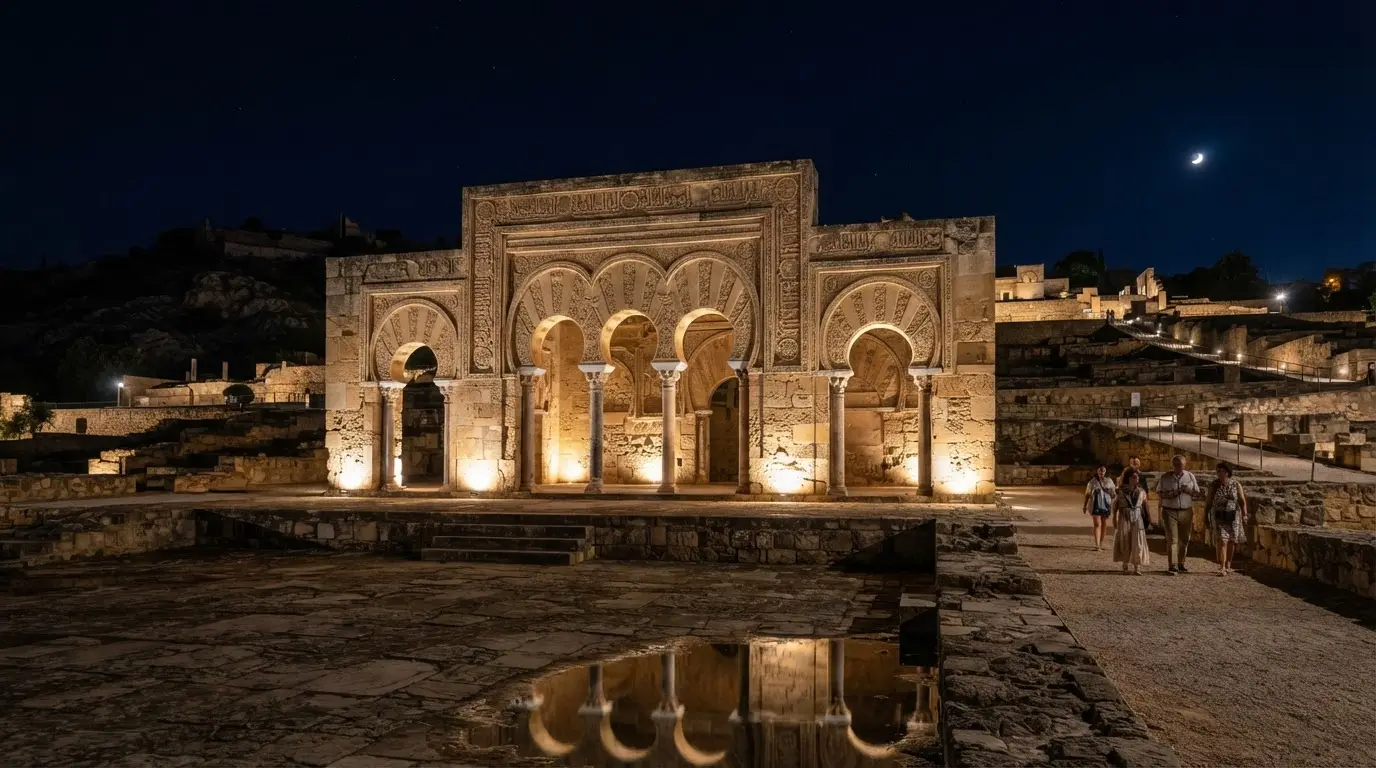
The Salón Rico — the Rich Salon, or Throne Hall — sits on the upper terrace of Medina Azahara, and it is the room around which the most detailed medieval accounts cluster[2]. Its carved stone panels survive in fragments; some of the most complete sections have been reconstructed and are on display at the site museum.[2] The interlacing vine-and-leaf ataurique that covers these panels was a deliberate demonstration of craft: the first thing a foreign ambassador saw before being admitted to the caliph's presence. Not every decorative plan for the hall went ahead as intended: the chief judge of Córdoba reportedly talked Abd al-Rahman III out of covering one of its ceilings in gold and silver. For a full account of Medina Azahara's history and excavation, including the decades of work since 1911, there is a companion article that covers the site in depth.
Al-Maqqari, writing in the 17th century but drawing on earlier Arabic sources, describes a basin of mercury (quicksilver) in the throne room[3]. According to his account, servants could agitate the basin on the caliph's command; the metal surface would ripple and fracture, throwing reflected light in unpredictable patterns across the walls, the columns, and the ceiling. The effect, al-Maqqari writes, made it appear as though the entire chamber was moving.
This claim requires a careful reading. Al-Maqqari is a compiler, not an eyewitness. The account comes to us filtered through several centuries of transmission and may describe a single event, a standing feature, or a conflation of different sources[3]. Modern excavators have not yet confirmed the location of the specific hall described, and the precise role of mercury in the architecture remains an open archaeological question.
Explore nearby · Monument
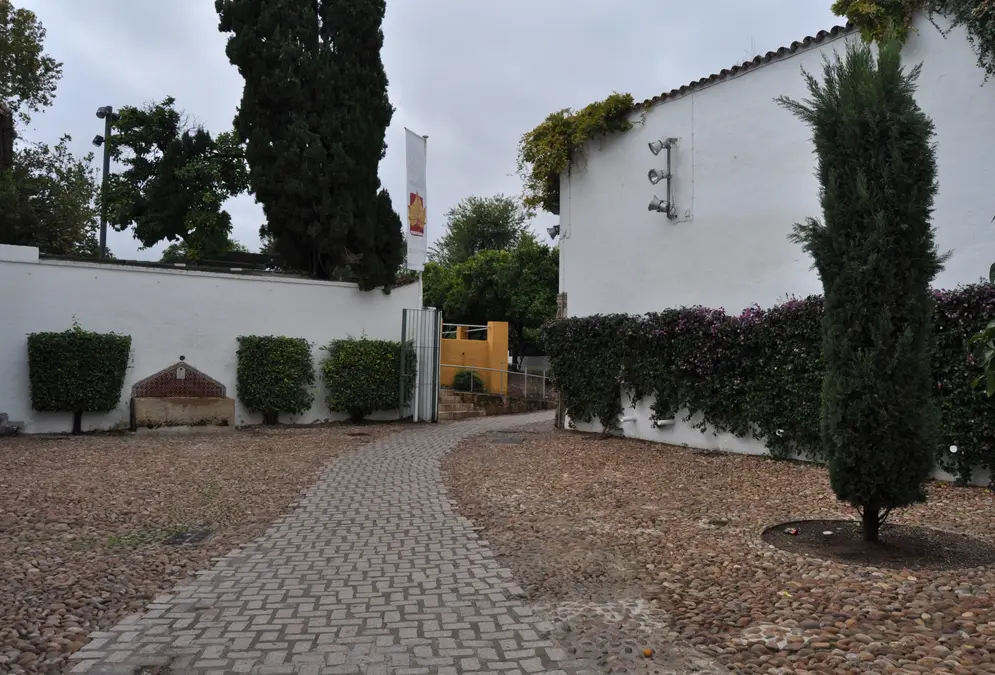
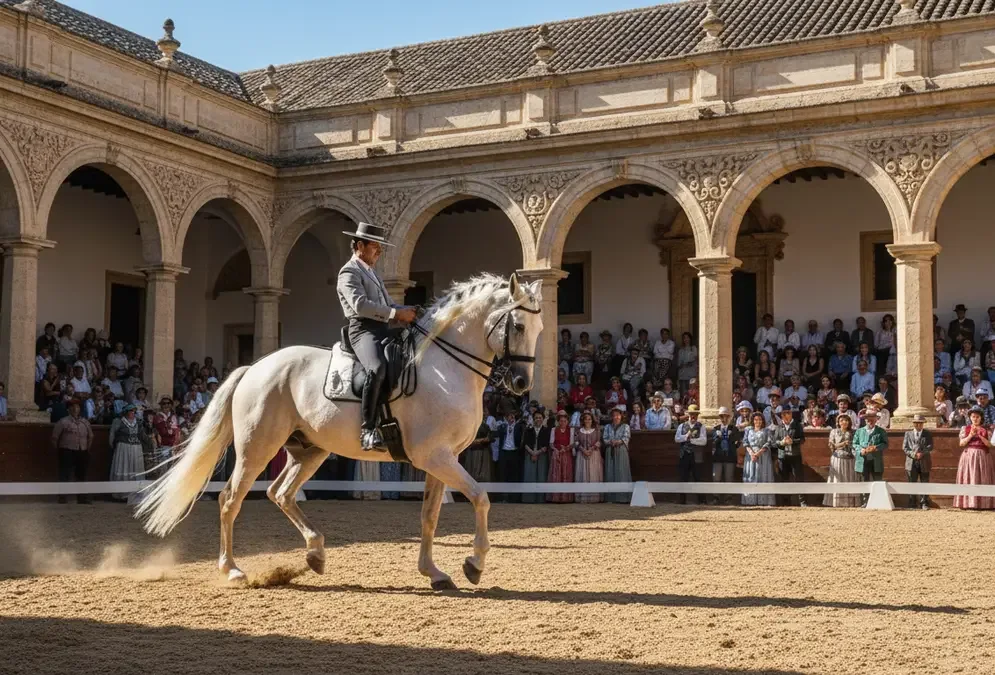
Palacio de Orive
Córdoba's finest Renaissance palace, designed by Hernán Ruiz II in 1560. Free courtyard, exhibition halls, and the only public gardens in the historic centre.
What excavation has confirmed is that the water systems at Medina Azahara were sophisticated and intentional[2]. Water was brought to the site from the Sierra Morena, distributed through a network of pipes and channels, and held in cisterns and basins positioned at specific points on the terraces.[2] The upper garden contains a rectangular pool roughly 19 metres by 19 metres[2], placed at a height and angle where its surface would catch and redirect light into the reception rooms beneath it. That is not accident. It is architectural design with light as the material.
How the architecture weaponized water and light
Medina Azahara was the ceremonial center of a caliphate that understood theater. Abd al-Rahman III received embassies in stages: each level of the approach, from the gate through the garden, the colonnaded walkway, the antechamber, and into the hall, was calibrated to increase the sense of grandeur before the audience itself began. Light was part of that sequence.
Water basins positioned on the upper terrace did more than irrigate the gardens[2]. At certain times of day, and presumably at night with artificial light, their surfaces acted as secondary light sources, bouncing reflections from the courtyard into the archways and through the clerestory openings of the reception rooms. Marble surfaces were polished, not merely carved. Gold-leaf inlay caught and scattered what came through the arches. The room did not need to glow on its own; it was designed to multiply whatever light entered it.
Recommended tours
Tours are selected for quality, not commission. We earn a small fee if you book — at no extra cost to you.
Al-Maqqari's mercury-basin account, true or embellished, fits this broader logic[3]. Mercury has a higher reflectivity than still water. A disturbed mercury surface would have behaved like a rapidly changing mirror, fracturing a single light source into dozens of moving reflections. A caliph who could make the walls of his throne room appear to shimmer and move was a caliph who controlled phenomena his visitors could not explain.
The architectural vocabulary here is not simply decorative. The muqarnas (honeycomb vaulting), the ajimeces (paired arched windows), the layered archways that the Salón Rico's reconstruction reveals: all of these interact with light in ways that change with the hour and the season. A room that reads as austere white stone at noon reads entirely differently by the last light of an Andalusian evening. The architects of Medina Azahara knew this.
A caliph who could make the walls of his throne room appear to shimmer and move was a caliph who controlled phenomena his visitors could not explain.
What chroniclers recorded: Ibn Hayyan's lament
The medieval Arabic sources that survive about Medina Azahara fall into two groups: administrative records and accounts written after the palace was already destroyed. The second group is the more vivid, because it was written by people who had either seen the palace in its final years or who were recording the testimony of those who had.
Ibn Hayyan of Córdoba, who worked in the 11th century and is considered one of the most reliable Arabic historians of the period, described Medina Azahara in terms that were already elegiac by the time he wrote[4]. His most-quoted line describes the palace's destruction as a cosmic loss: "that carpet of the world was folded, and that beauty that had been the terrestrial Paradise was disfigured."[4] The city he mourned was the physical heart of the caliphate that Abd al-Rahman III built from scratch in the first half of the 10th century.
Ibn Hayyan was not a romantic chronicler. He was a political historian who recorded dates, campaigns, and administrative decisions. When he reached for the image of a folded carpet and a disfigured paradise, he was describing what had happened to the physical site after 1010: the systematic dismantling of Medina Azahara's marble columns, carved panels, and gilded ceilings by successive looters who stripped the palace to its foundations for reuse across Andalusia. The loss he mourned was not just architectural. It was the loss of the material record of a civilization.
Al-Maqqari, writing six centuries later, drew on Ibn Hayyan and on other sources now lost. His account of the mercury pool is part of a longer description of the Salón Rico as an environment designed to overwhelm the senses of visiting dignitaries[3]. He describes the carved marble walls, the ataurique panels, the gold inlay, and the water systems together as a unified program. In this reading, the mercury was the punctuation mark at the end of a sentence that had been building since the visitor passed through the outer gate.
The fall: from capital to quarry
Medina Azahara functioned as the caliphal seat for roughly 65 years. The civil war that destroyed it, the fitna of the early 11th century, was not primarily a military assault on the palace itself. It was a collapse of the Umayyad Caliphate's political structure, and Medina Azahara was the most visible casualty.
In 1010, Berber troops sacked the palace[1]. What followed over the next century was arguably worse: systematic quarrying. The carved marble columns were pulled down and transported. Entire portal frames were relocated to mosques in Seville and to the Alcázar in Córdoba. The gilded and painted panels were dismantled, their component pieces dispersed. By the 12th century, the site had been so thoroughly stripped that travelers passing the hillside could not be certain where the city had stood. Ibn Hayyan's image of the folded carpet was, by then, literally accurate.
The physical site was not identified with certainty until 1910–1911, when a local landowner digging on the Córdoba hillside uncovered carved stone. Systematic excavation began in 1911 under Ricardo Velázquez Bosco[1]. Excavations have continued, with interruptions, ever since. As of the most recent surveys, roughly 9–10 percent of the original 112-hectare site has been excavated[1]. The rest remains underground, under olive trees and scrubland.
Deep dive · Article
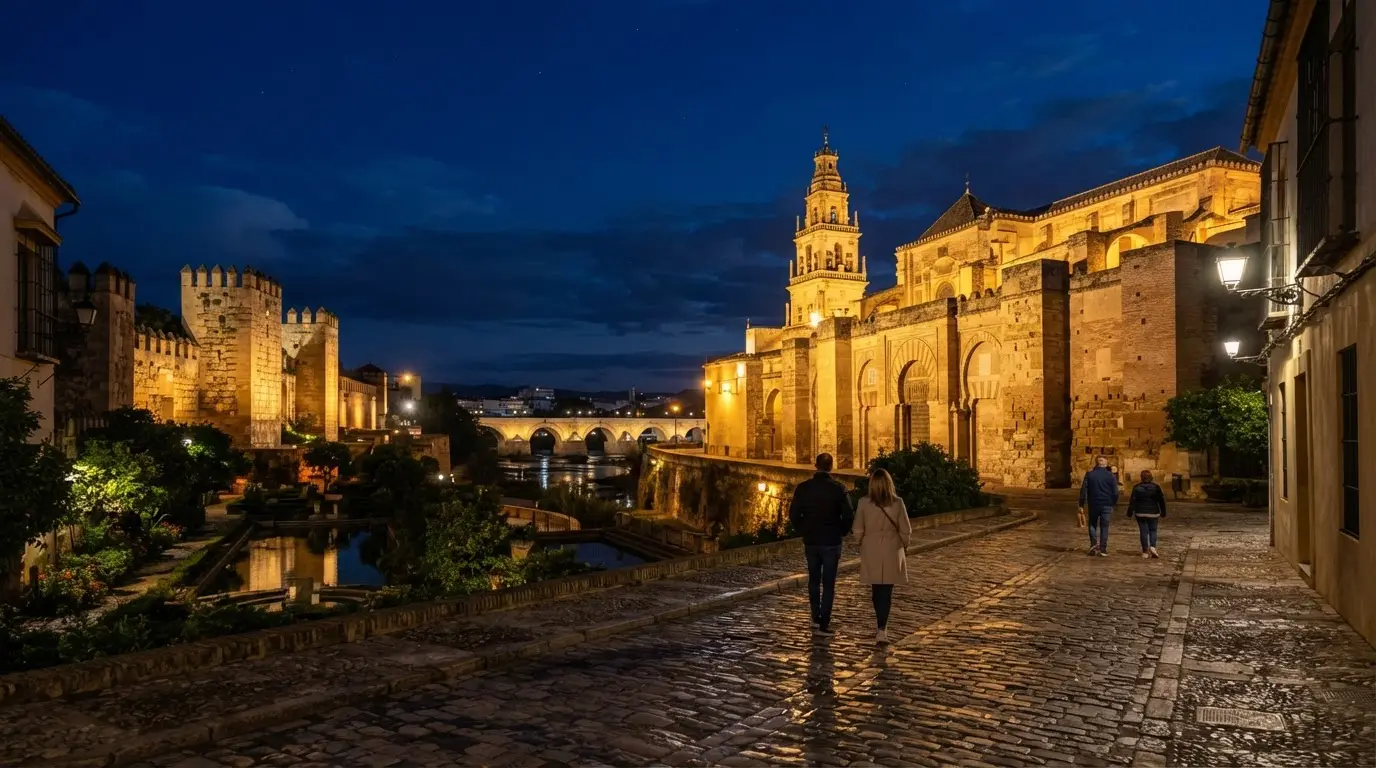
Córdoba Monuments at Night: Why the City Glows After Dark
Córdoba's monuments are switching their lights on after dark: extreme summer heat and a deliberate city strategy to sell nights, not just survive them.
The site museum, opened in 2009 about 2 km from the excavated area, holds the best-preserved carved stone panels, reconstructed portal sections, and archaeological finds from the palace[2]. Visitors cannot walk between the two: a mandatory shuttle bus run by the site carries you from the museum up to the ruins, and back down again at the end of the visit. For visitors trying to imagine the mercury-pool throne room as al-Maqqari described it, the museum's display of ataurique panels is the most concrete evidence available: carved marble that would have lined those walls, still showing the marks of the tools that made it.
The night visit: what to expect
The Medina Azahara night visits started in October 2017[5]. They run on Fridays and Saturdays at 9 p.m. from October through May, extended to Tuesday through Saturday in summer months. Groups are capped at 20 people per tour. Tickets cost €15 for adults, €6 for children aged 6–12; children under 6 are free[5]. Advance booking is strongly recommended; slots sell out, particularly in spring and on weekends. The booking platform is at amedinacordoba.com.
The route covers the main excavated zone: the Puerta Norte, the gardens and water terraces, the approach to the Salón Rico, and the reconstructed sections of the upper palace. The itinerary takes roughly 90 minutes. Illumination is deliberately minimal — focused spotlights on the carved portals and archways, with large sections of the site in near-darkness between them. This is not an oversight. The contrast between lit and unlit sections mirrors, in a rough way, the effect the original architects were working toward.
| Visit type | Days & hours | Price (adult) | Booking |
|---|---|---|---|
| Day visit | Tue–Sun, 10:00–18:30 (varies by season) | €10 | Not required |
| Night visit (Oct–May) | Fri–Sat, 9:00 p.m. | €15 | Advance required |
| Night visit (summer) | Tue–Sat, 9:00 p.m. | €15 | Advance required |
What the visit makes concrete, in a way that daytime visits to a busy site can obscure, is the geometry of the terraces. The palace climbs the hillside in a series of platforms, each set back from the one below, each with a different relationship to the horizon and to the lights of Córdoba visible to the east. At night, with the modern city glowing behind you and the carved arches of the Salón Rico lit ahead, the spatial logic of the place becomes legible. The caliph's reception rooms sat above the city, looked down on the city, and were visible from the city. The hierarchy was built into the topography. That city glow is also the thing standing between you and an actual starfield; for genuinely dark, unlit skies rather than reflected light, stargazing near Córdoba covers the certified Starlight Reserve an hour further north.
For the practical visit: the site is about 8 km west of Córdoba city centre, accessible by car (free parking on site) or by the tourist shuttle from the city (bus 01 from Plaza de Colón, running times vary by season — check ahead, as it doesn't always serve the evening slot). Bring a jacket; the terrace gets cold after dark in spring and autumn, regardless of how warm the afternoon was. The site closes promptly at the end of the tour.