
The theology behind the water: tahara, wudu, and ghusl
The Arabic word tahara means ritual purity, and in Islamic law it is not optional. Quran 5:6 specifies the conditions of purity required before prayer; the hadith tradition elaborates at length on when purification is required, what form it must take, and what invalidates it[2]. The hammam existed to serve this framework.
There are two levels of ablution:
Quran 5:6
- Wudu (minor ablution) — washing the face, hands, forearms, head, and feet before the five daily prayers[7]. A domestic basin could serve for wudu, though many preferred a hammam.
- Ghusl (major ablution) — full-body washing required after sexual intercourse, menstruation, postnatal bleeding, and other states[3]. Ghusl cannot be completed adequately at a domestic water source; it requires immersion or a thorough poured wash of the entire body. The hammam existed primarily to make ghusl possible for an urban population.
Hadith literature also touches on a general recommendation for regular bathing, particularly around the Friday prayer, though scholars differ on how prescriptive that guidance actually is. In practice, in al-Andalus, bathing several times a week was common — not as a formal religious obligation beyond ghusl, but as the cultural norm that emerged when a city takes its purification infrastructure seriously.
The distinction matters. Visitors sometimes encounter the claim that Córdoba's Muslims were required to bathe three times a week by religious law. The actual prescription is ghusl when juristically required plus the Friday bath. What al-Andalus produced was a culture of frequent bathing that went beyond the strict minimum — built on theological foundations, but not reducible to them.
A dense network of bathhouses: what that meant for a medieval city
At its 10th-century peak, the Umayyad Caliphate made Córdoba the largest city in western Europe, with a population historians estimate between 100,000 and 1,000,000 inhabitants[8]. Medieval Arabic sources describe a hammam network of that scale, though no single figure for the exact count is reliably supported. For comparison, Paris at the same moment was a city a fraction of that size.
The hammams were not evenly distributed across the city. Medieval Islamic urban planning conventionally paired a mosque and a hammam within each residential quarter[1] — a pattern historians associate broadly with Islamic cities of the period, Córdoba included, though the precise number and placement of its individual bathhouses is not fully documented. The mosque anchored the quarter; where a hammam was present, it served the neighbourhood's ritual and social needs.
The network required infrastructure. Córdoba's hammams drew on a sophisticated water-supply system built around devices such as the Albolafia noria, the great waterwheel that lifted water from the Guadalquivir into the city's distribution channels[4]. This system, refined over centuries of Roman, Visigothic, and Islamic engineering, helped sustain bathhouse operation across the city. When the Reconquista era disrupted parts of that infrastructure, it was not just the hammams that were affected — an entire urban water logic was undermined with them.
Medina Azahara, the palace-city Abd al-Rahman III built 8 km west of Córdoba in the 930s, illustrates the scale of caliphal bathing infrastructure: the complex included at least one large hammam, part of the same building programme that Abd al-Rahman III's successors continued at court. The palace-city's own bath complex, expanded under al-Hakam II (r. 961–976), reflects that same architectural ambition, though it is a separate structure from the Caliphal Baths described below.
Explore nearby · Monument
Mezquita-Catedral de Córdoba
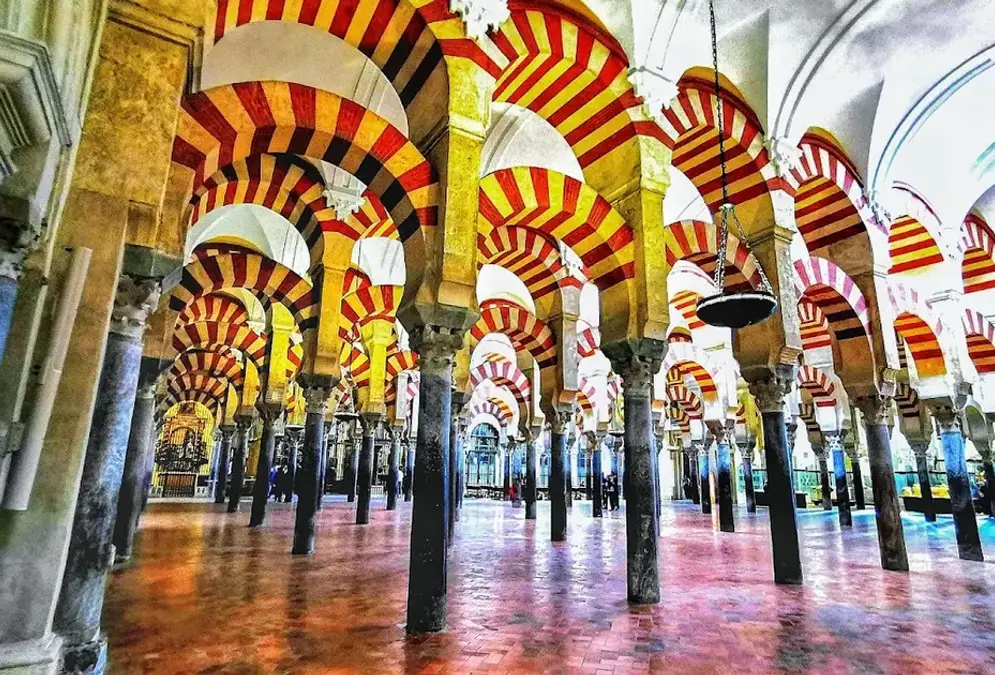
856 columns, 1,300 years of Islamic and Christian history. UNESCO monument in Córdoba, Andalusia. Red-and-white arches, Byzantine mosaics, a Renaissance nave.
The Caliphal Baths of Córdoba (Baños del Alcázar Califal) sit on Plaza Campo Santo de los Mártires, facing the Alcázar across the square — a separate, independently-ticketed site rather than part of the Alcázar itself. Partially reconstructed and now open to the public as a museum, they are a well-preserved example of 10th-century hammam architecture[5], and give the clearest picture in the city of what the system looked like at scale.
Inside a Córdoba hammam: from the cold room to the hypocaust
Every hammam in Caliphal Córdoba followed the same basic sequence of rooms, derived ultimately from the Roman bath but adapted for Islamic use and the local climate:
- Bayt al-barid (cold room) — the entry hall, where bathers undressed, stored clothing, and cooled down before leaving. Temperature matched the outside air.
- Bayt al-wastani (warm room) — the largest of the three heated chambers, the social heart of the hammam. Temperature around 35–40°C. This was where most time was spent.
- Bayt al-sakhun (hot room) — the innermost chamber, the hottest, used for deep sweating. Adjacent to the furnace room.
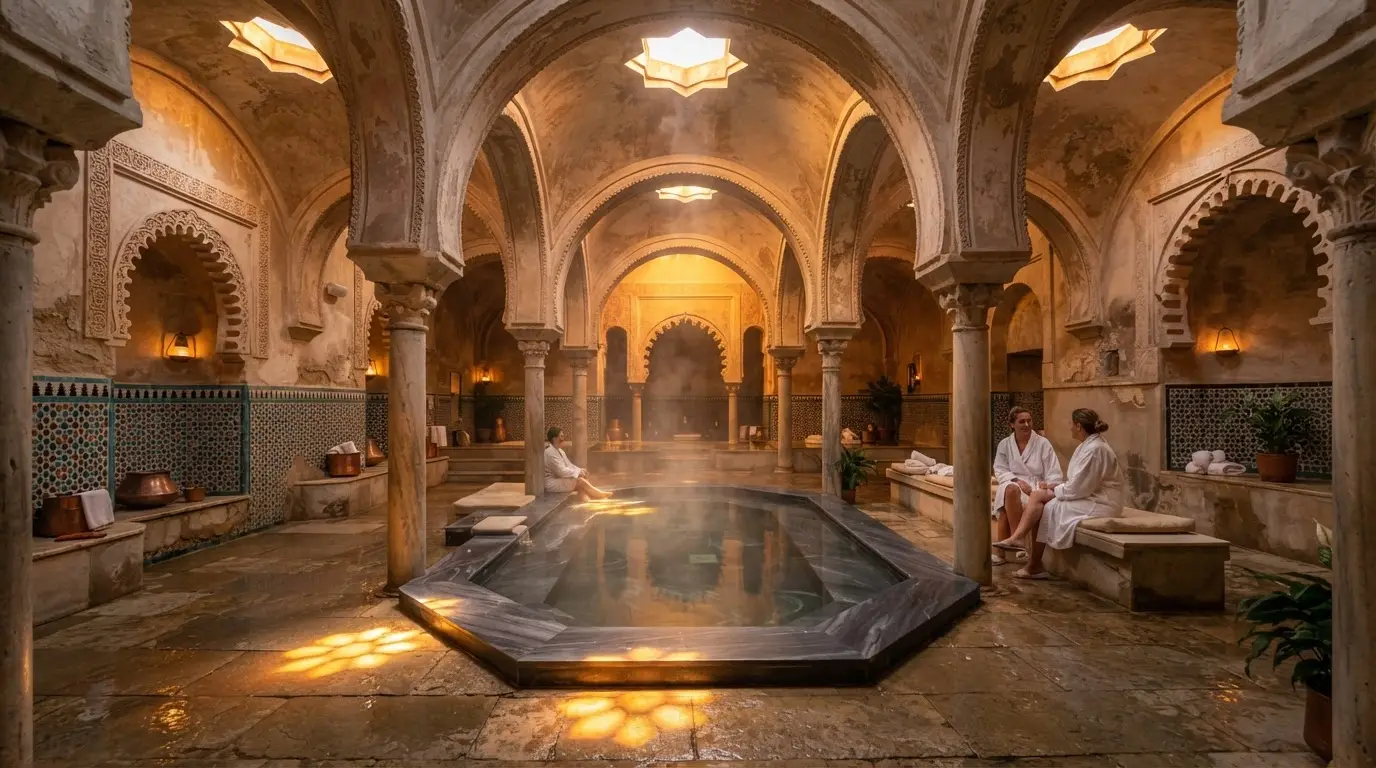
The heating came from a hypocaust beneath the floor: a system of clay pillars raising the stone pavement above a network of channels through which hot air from a wood-fired furnace circulated[5]. The floor itself became the radiator. Bathers who lay or sat on it felt heat rising through the stone. The same system had heated Roman bathhouses; Islamic engineers in al-Andalus inherited it, maintained it, and adapted it.
Light entered through the ceiling. Star-shaped and circular openings in the domed vaulting admitted sunlight during the day, the light shifting across the water and steam as the hours changed[5]. These oculi also vented steam. At night the openings were covered. The star shapes were not merely decorative — the geometry controlled temperature by regulating airflow.
Recommended tours
Tours are selected for quality, not commission. We earn a small fee if you book — at no extra cost to you.
Water was heated in large copper or lead boilers beside the furnace and carried or piped into the pools and basins. Bathers used small wooden buckets to pour water over themselves; full immersion pools were less common in Islamic hammams than in Roman baths. The focus was on the pouring of water over the body, aligned with the requirements of ghusl.
Soap (jabun) is often cited among al-Andalus's contributions to European material culture. Córdoban soap-makers are said to have combined olive oil or tallow with plant ash to produce solid soap of a quality uncommon in northern Europe at the time, and the hammam was where most people would have used it. The transfer of this kind of technical knowledge is generally associated with the broader contact the convivencia period enabled, though the specific routes of transmission are harder to document than the practice itself.
Córdoba and Christian Europe: the real contrast
The popular narrative — that medieval Christians never bathed while Muslims bathed constantly — is a modern invention. Medieval European elites bathed regularly; the church in many periods encouraged bathing for the soul as much as for the body[6]. The contrast between Caliphal Córdoba and, say, 10th-century León was not between a clean city and a filthy one.
The real difference was institutional and theological. In al-Andalus, bathing was encoded in the religious law that governed daily life. The hammam network was state infrastructure in the same way as roads or mosques. Local rulers were obligated to maintain it. Charitable endowments (waqf) funded bathhouse construction and maintenance in perpetuity. The result was a density and regularity of bathing access uncommon among Christian European cities of the period, whatever the hygiene practices of individual elites.
Bathing in Christian Europe was more private, more seasonal, and more dependent on individual means. Public baths existed in medieval European cities, particularly those with Roman heritage, but they operated without the theological mandate that made the hammam a communal institution rather than a commercial one. The difference was not cleanliness per person but reach and regularity: Córdoba's hammam network brought bathing infrastructure to a large share of its urban population, sustained by state funding and religious endowment[6].
Deep dive · Article
Almanzor — The Man Who Dismantled the Caliphate From Inside
Almanzor ran Córdoba for 25 years without claiming the caliphate. Fifty-seven undefeated campaigns, the bells of Santiago, a purged library — and civil war.
The soap gap reinforced this. Córdoba's jabun was available to any bathhouse customer. Hard soap remained expensive and uncommon in much of northern Europe until well into the 12th century, after knowledge from al-Andalus is thought to have begun circulating. The hammam's soap was as much a public health intervention as a luxury good.
After the Reconquista: how Córdoba's hammams disappeared
Ferdinand III took Córdoba on 29 June 1236. Within a generation, the hammam network — a highly developed urban bathing system — had largely ceased to function.
The destruction was not purely incidental. For Ferdinand and Isabella's administration, the hammam was associated with Muslim identity in a direct and visible way. After the forced conversions following 1492, attendance at a hammam was taken as evidence of continued Muslim practice — a marker of non-assimilation that the Inquisition tracked and prosecuted. Moriscos (nominally converted Muslims) who maintained bathing practices were reported and interrogated. The bathhouses became, from the perspective of royal authority, infrastructure for the persistence of a religious and cultural identity the Crown wanted to eliminate.
Many hammams were converted to other uses: churches, private houses, tanneries, olive presses. The Caliphal Baths, facing the Alcázar across Plaza Campo Santo de los Mártires, survived partly because the site was incorporated into royal property and ceased to be a public institution. Others were demolished for building material. The waterwheel-and-channel system that had supplied them fell into disrepair without the institutional maintenance that the caliphate had provided; once the infrastructure degraded, individual bathhouses could not operate anyway.
What survives in Córdoba today is fragmentary. The Caliphal Baths, on the square facing the Alcázar, are the most complete example. The modern hammam near the Mezquita, a few minutes' walk away, recreates that historical bathhouse experience inspired by historical bathhouse culture, reviving the thermal circuit — cold, warm, and hot rooms in sequence — and giving visitors a practical experience of what the system felt like. It is not a museum; it is a working bath, which is a different kind of access to the history.
The systematic erasure of the hammam network was one of the less-noticed casualties of the Reconquista. It dissolved something that had worked: a city-scale bathing infrastructure serving hundreds of thousands of people, theologically mandated, publicly funded, and organized around a consistent spatial logic. No equivalent civic bathing network re-emerged in the city for several centuries.