
The historian named for a Gothic grandmother
His full name ran nine generations deep: Muhammad ibn Umar ibn Abd al-Aziz ibn Ibrahim ibn Isa ibn Muzahim. Córdoba remembered him by the epithet that came after it instead: Ibn al-Qutiyya, 'son of the Gothic woman.' The woman in question was Sara al-Qutiyya, his ancestor and a granddaughter of Witiza, the last king to rule a unified Visigothic Spain before the conquest of 711[4]. A leading historian at the Umayyad court carrying a Visigothic queen's name as his own byline was not an accident; it was a claim some of his ancestors and descendants carried too[4].
Sara's Arab husband, Isa ibn Muzahim, is named directly in Ibn al-Qutiyya's own history as the ancestor of the entire al-Qutiyya lineage[4]. Their descendants did not bury the Gothic half of that marriage. They built an identity around it, generation after generation, until it became the one fact about the caliphate's leading grammarian that everybody in Córdoba already knew before they knew anything else about him. It is the same blended inheritance the city's own convivencia history keeps producing: families that were simultaneously Visigothic by blood and Umayyad by allegiance, feeling no contradiction in holding both.
The backstory carries a wrinkle worth untangling before it causes confusion. Decades before Córdoba's own Umayyad court existed, Sara reportedly sailed east to Damascus to petition the reigning caliph over estates confiscated from her father — Hisham ibn Abd al-Malik, who ruled the original Umayyad caliphate from 724 to 743[5]. That is a different Hisham, a different century, and a different continent from any ruler later crowned in Córdoba. Sara's journey belongs to the Syrian Umayyad caliphate her family eventually left behind, not to the Andalusian one her descendants would go on to serve two centuries later.
A qadi's son between Seville and Córdoba
Exactly where and when Ibn al-Qutiyya was born is genuinely unsettled, and the sources disagree in a way worth stating plainly rather than smoothing over. General reference accounts place his upbringing squarely in Seville. Historian María Jesús Viguera Molins hedges further, giving his birth as 'perhaps in Seville, or already in Córdoba,' sometime in the last decade of the ninth century, the 890s[6]. What is fixed is his death: Córdoba, 367 AH, 977 CE[1]. Between those two dates, no full accounting of his early life survives.
What is documented is the family's standing in Seville. His father served as a qadi (judge) in Seville and in nearby Écija, and the family held the patronage of the Qurayshi tribe, the Prophet Muhammad's own tribe and a marker of status regardless of a family's actual bloodline[7]. Their cousins, the Banu Hajjaj of Seville, were close relatives who made the identical claim to Visigothic royal descent[7]. Mixed Gothic-Arab ancestry among Seville's judicial elite was not a novelty confined to one household; it was a feature of the class that produced them, the same layered society Abd al-Rahman III would later rule as caliph.
Explore nearby · Monument
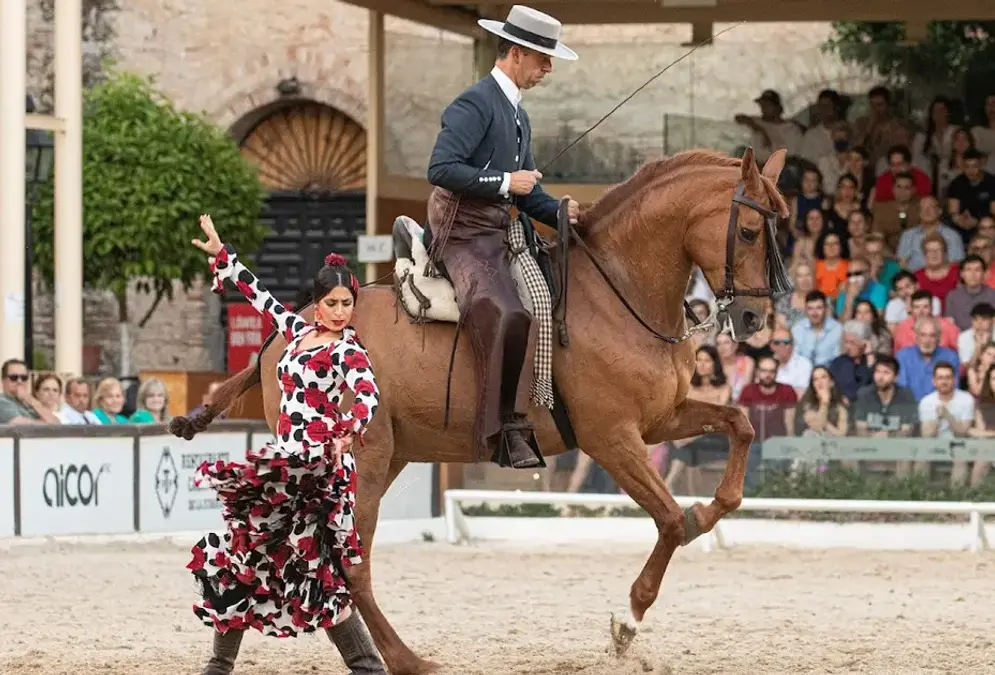
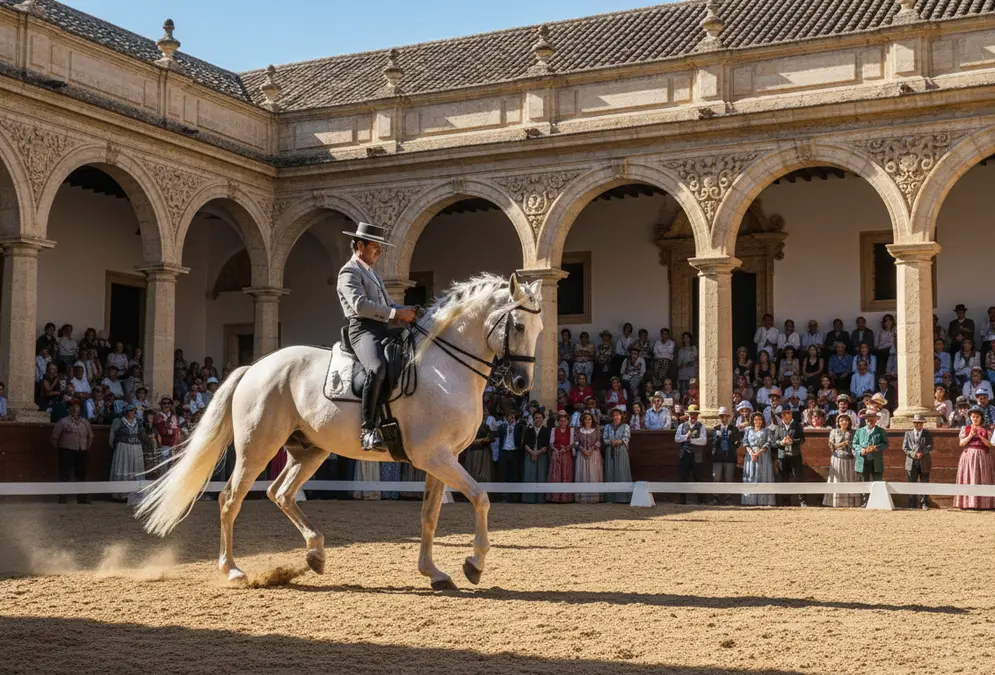
Caballerizas Reales de Córdoba
Philip II's 1568 Royal Stables, birthplace of the Andalusian horse. Evening show combining classical dressage, vaquera riding and flamenco. UNESCO heritage.
By the time he reached the Umayyad court in Córdoba, contemporaries described him with a specific triple label: el gramático, poeta y narrador — the grammarian, poet, and storyteller[8]. History-writing came third, after two other trades. That ordering matters for how his one surviving history should be read: not as the output of a professional chronicler, but as the sideline project of a philologist whose day job was grammar and verse for the court of Caliph al-Hakam II.
The History of the Conquest of al-Andalus
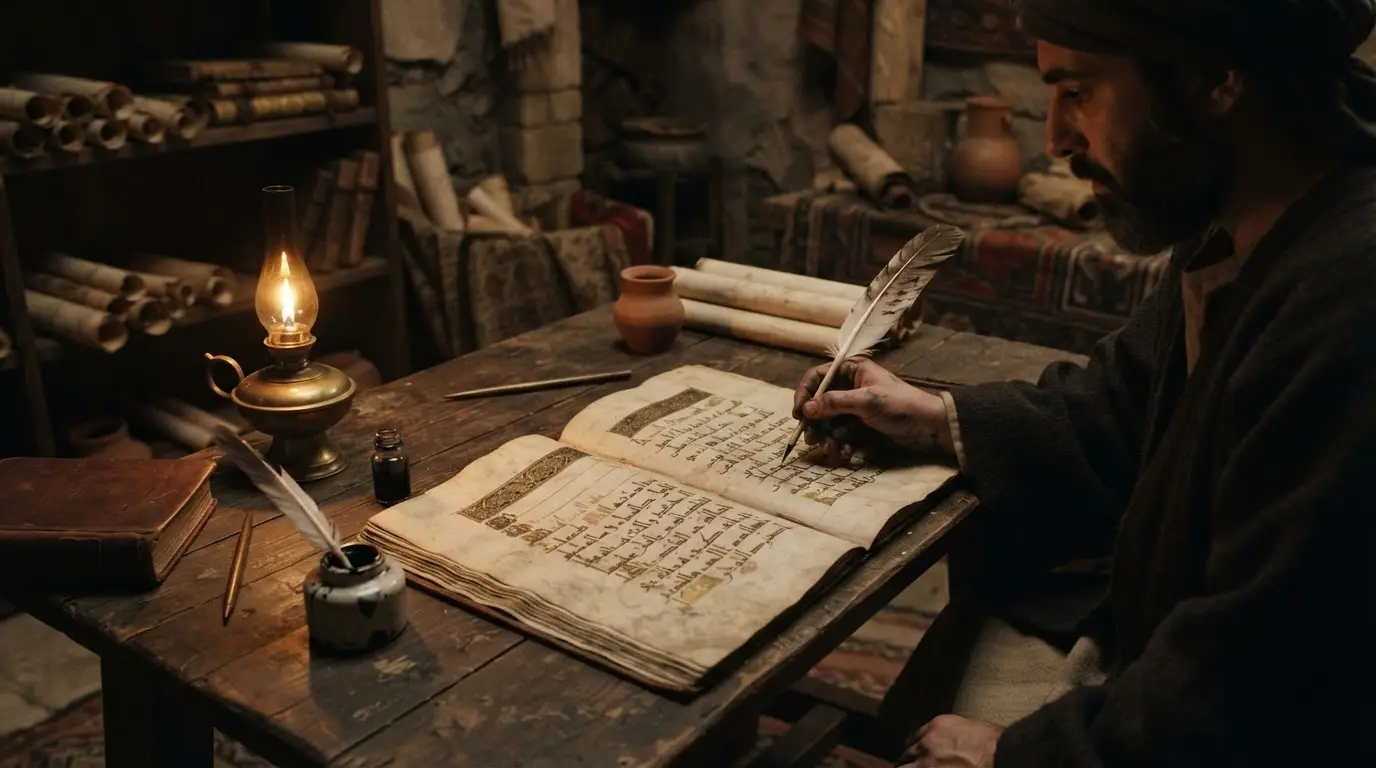
Ibn al-Qutiyya's one surviving work is Ta'rikh Iftitah al-Andalus (the History of the Conquest of al-Andalus), an account compiled from orally transmitted reports and probably committed to writing around the middle of the tenth century[9]. In its original form it ran to 18 volumes, covering roughly the first 250 years of Umayyad rule in Iberia[2]. What survives today is a single manuscript, held at the Bibliothèque Nationale de France under shelfmark No. 1867[3]. Every modern edition and translation of this history, in Spanish, English, or any other language, traces back to that one copy.
18 volumes
The scale of the loss is easy to miss. Eighteen volumes shrank, through war, neglect, and the ordinary attrition of manuscript transmission, down to one. The only reason anything is known about the man himself, and not just his book, is a second stroke of luck: his own student, al-Faradi, wrote a short biographical sketch of his teacher for a biographical dictionary, and that sketch survived only in a late medieval manuscript rediscovered in Tunis in 1887[10]. Ibn al-Qutiyya very nearly vanished twice, as an author and as a person, and was saved from both by a single surviving copy each time.
Is his account reliable? A partisan's history of the conquest
Ibn al-Qutiyya's version of the conquest is vivid, personal, and, by his own student's account, not to be mistaken for rigorous history. Al-Faradi drew a specific distinction about his teacher's work: it was akhbar (anecdotal tales), not ta'rikh (serious, disciplined history)[11]. That is a caution from inside the tradition, not a modern historian second-guessing a medieval source after the fact.
The anecdotal quality shows most clearly in the story Ibn al-Qutiyya tells about Witiza's three sons: Olmundo, Aquila, and Ardabasto. In his account, the brothers struck a private deal with the invading general Tariq ibn Ziyad on the eve of the decisive battle, agreeing to abandon King Roderic in exchange for keeping their father's confiscated estates[12]. Ibn al-Qutiyya places the battle itself at the Wadi Lakka, the Guadalete, in the district of Sidonia, where Roderic, weighed down by his own armor, was defeated and never found[13].
None of this reads like disinterested reporting, and it is not meant to. Ibn al-Qutiyya's own royal Gothic ancestry runs directly through the story: a narrative in which Visigothic aristocrats struck deals with the conquerors and kept their estates is also, not coincidentally, the origin story of his own family's continued privilege under Umayyad rule[14]. His history defends exactly the kind of treaty that let families like his keep their land, because his family was one of them.
Grammarian first: the legacy that outlasted the history
History was not what won Ibn al-Qutiyya his reputation among later Arabic scholars; grammar was. His treatise Kitab al-Af'al (Book of the Conjugation of Verbs) is the oldest extant manuscript of an Arabic dictionary, and its reach went further than Córdoba. A copy survived through a Sicilian scholar's compendium and is held today in the Biblioteca Lucchesiana in Agrigento, Sicily[15], proof that his grammatical work was still being read and copied in Norman-era Sicily, a continent away from the Umayyad court that first employed him.
Recommended tours
Tours are selected for quality, not commission. We earn a small fee if you book — at no extra cost to you.
His pupils reached further than his books did. Research into Sicilian-Andalusian grammarian networks records Ibn al-Qutiyya, alongside the poet-grammarian Abu Ali al-Qali, among the teachers of the man who became Almanzor, the chamberlain who ruled al-Andalus as its de facto strongman from 978 to 1002[16]. Ibn al-Qutiyya died in 977. The student who studied under him took control of the caliphate within a year of his teacher's death.
Deep dive · Article
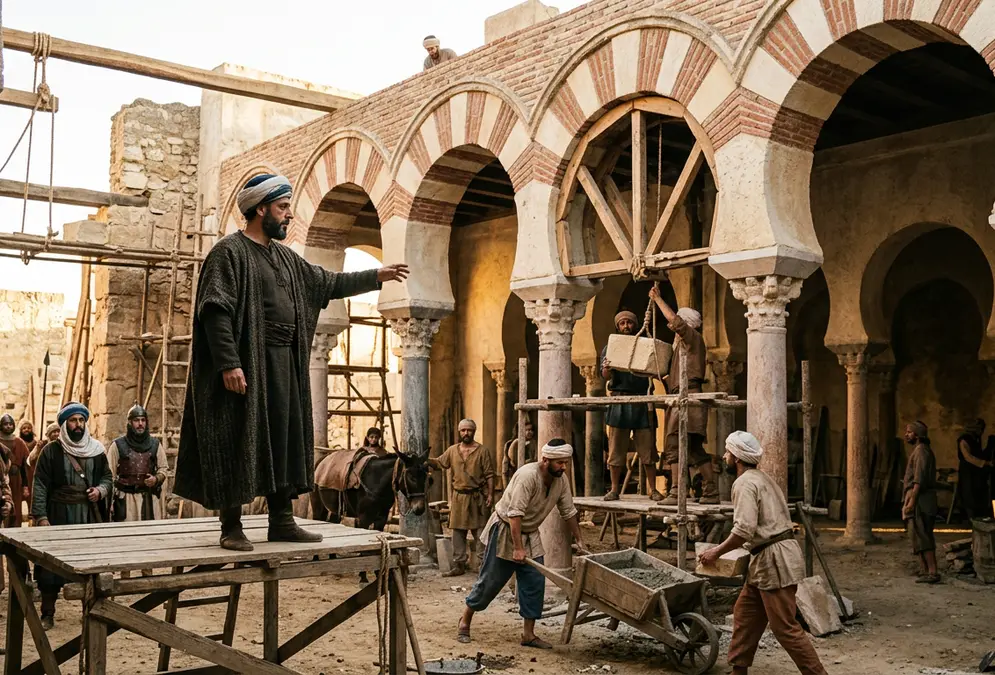
Abd al-Rahman I: The Fugitive Who Founded Córdoba
Abd al-Rahman I survived the massacre of his Umayyad family in 750 CE, fled six years across North Africa, and founded the Emirate of Córdoba at just 25.
Modern scholarship still runs through that same single Paris manuscript. Pascual de Gayangos produced the first critical Arabic edition in 1868, with Eduardo Saavedra and Francisco Codera; Julián Ribera's Spanish translation followed in 1926 for the Real Academia de la Historia; and David James's Early Islamic Spain: The History of Ibn al-Qutiyya (Routledge, 2009) remains the standard English translation and study[17]. María Fierro's 1989 article in the journal Al-Qantara is the closest thing to a definitive modern assessment of what the history actually is, and isn't[18]. Eleven centuries on, a philologist who considered history-writing his third trade is still, translation after translation, one of the only witnesses to how his own world explained its own conquest.