Ferdinand III's Córdoba Fuero: The Charter That Shaped the City
Ferdinand III granted Córdoba the Fuero Juzgo on 10 March 1241 — a Visigothic code in Castilian. It created 14 parishes and governed the city 600+ years.
Art history background with eight years writing interpretive content on Córdoba's Caliphal heritage.
Published
history-buffs
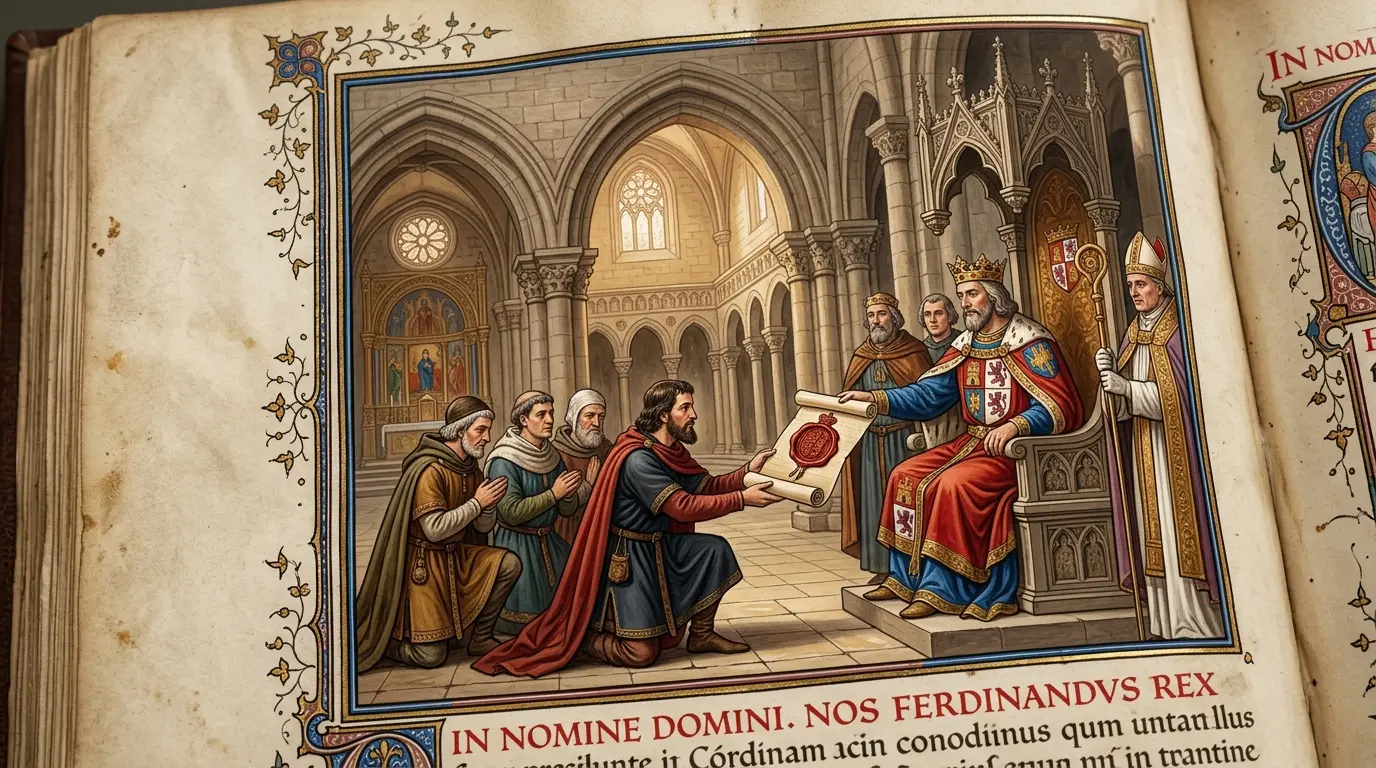
The Cordoba fuero Ferdinand III granted on 10 March 1241 was not a new law drafted for a conquered city. It was the Liber Iudiciorum — the Visigothic legal code first published in 654 by King Recceswinth — translated from Latin into Castilian Spanish and declared the municipal law of Córdoba[1]. By reviving a 7th-century legal text for a 13th-century frontier city, Ferdinand was making an argument about legitimacy and administrative continuity that the military conquest of 1236 could not, by itself, deliver.
In this article
Jump to a section
⌄
The text behind the charter: what the Fuero Juzgo actually was
On 10 March 1241, Ferdinand III did not commission a new legal code for Córdoba. He reached for a text that was already 587 years old — the Liber Iudiciorum, the Visigothic legal code begun by King Chindasuinth in 642-643 and published by his son Recceswinth in 654[1]. Ferdinand had it translated from Latin into Castilian Spanish and promulgated it as the Fuero Juzgo — literally the Book of Judgments — making Córdoba the first major conquered city where this ancient code was applied as a local fuero[2].
The Liber Iudiciorum was a comprehensive civil and criminal code covering property, marriage, contracts, inheritance, and criminal penalties across twelve books[4]. Its structural innovation was territorial jurisdiction: one law for everyone within a territory, whether Roman or Visigothic. That distinction was not academic. It meant that when Ferdinand applied the Fuero Juzgo to Córdoba, he was asserting a single legal order over a city whose population now included Castilian settlers, converted Muslims, and the Church.
The charter did not operate in isolation. Alongside the law code, Ferdinand established Córdoba's concejo (municipal council), an alcalde (mayor-judge), and jurados — sworn councilmen who administered daily governance[2]. This was an imported institutional apparatus: the concejo model had developed in northern Castilian towns during the 12th century. Dropping it into a city that had been administered under Islamic governance for more than five centuries was a deliberately transformative act. The legal framework that took effect in 1241 was the administrative engine of Córdoba's Christian repopulation. Without it, the military conquest of 1236 would have been a raid that could not hold.
The Fuero Juzgo granted settlers rights that had no equivalent in Islamic Córdoba: property tenure, inheritance guarantees, and representation through the concejo. These were not gestures. They were population policy. Ferdinand needed Christian families to move south into a city the departing Muslim population had emptied, and property rights backed by a written code were the strongest inducement the Crown could offer.
The Fuero Juzgo granted settlers rights that had no equivalent in Islamic Córdoba: property tenure, inheritance guarantees, and representation through the concejo. These were not gestures. They were population policy.
Why a 7th-century Visigothic law code?
The choice of the Liber Iudiciorum was not bureaucratic convenience. Ferdinand III, who had united Castile and León under a single crown in 1230 through the Treaty of Benavente, understood that conquest required a legal argument as much as a military one[3]. The Visigothic kingdom — which had ruled most of the Iberian Peninsula from the early 6th century until the Muslim conquest of 711-712 — was the last unified Christian polity on Iberian soil before the arrival of Islam. By adopting its law code, Ferdinand was positioning himself as the legitimate successor to that kingdom.
The genealogy of the text itself carried weight. Chindasuinth began the Liber Iudiciorum in 642-643 with a clear legislative aim: eliminate the dual legal system that had governed Visigothic Spain since the kingdom's foundation[4]. Before the code, Visigoths followed one set of laws and Hispano-Romans another. Recceswinth replaced both with a single territorial code in 654 — an achievement of legal unification that no medieval kingdom in western Europe had matched at the time. The text was revised under subsequent Visigothic kings, and its continued use in the Christian north during the early Reconquista meant it was never entirely forgotten.
What Ferdinand added — and this is the detail most general histories skip — was the translation into Castilian. The Liber Iudiciorum was written in Latin. The Fuero Juzgo is Castilian. That decision had two effects. First, it made the code legible to the settlers Ferdinand was trying to attract, most of whom could not read Latin. Second, it established Castilian as a language of law, a status it had not held before this translation. The Fuero Juzgo is one of the earliest monuments of Castilian legal prose.
This was not a case of discovering a useful old text and pressing it into service. The translation was an act of legal repurposing. Where the Latin original referred to the Visigothic kingdom's Gothic identity, the Castilian version often substituted references to Castilian identity. A legal code written by kings who ruled a unified peninsula before Islam was being adapted for a kingdom engaged in the slow reconquest of territories that had been Muslim for half a millennium.
The repartimiento: who got what after 1236
Conquest produced a city without inhabitants. After the surrender on 29 June 1236, Córdoba's Muslim population departed under terms that allowed them to leave with movable possessions but not real property[5]. They left behind houses, workshops, farmland, and an urban infrastructure maintained through five centuries of Islamic rule. The question facing Ferdinand was not whether to redistribute these assets — it was how to do it fast enough to prevent administrative collapse.
From 1237 to 1244, a council of partidores (distributors) worked through the inventory[3]. Their task was the repartimiento: the systematic division of conquered lands among three categories of recipient:
Knights and military orders received strategic positions, fortifications, and agricultural estates. The orders of Santiago, Calatrava, and Alcántara were granted extensive territories along the frontier.
The Church received endowments, urban property, and the right to establish the fourteen parochial districts that would physically reorganise the city.
Noble families received substantial latifundia (large estates) in the surrounding countryside, a distribution pattern that would define Andalusia's agrarian economy for the next six centuries.
Recommended tours
Tours are selected for quality, not commission. We earn a small fee if you book — at no extra cost to you.
The latifundia pattern — vast estates held by a small number of aristocratic families — was not an accident of geography. It was an administrative decision made in the 1240s by a council of partidores distributing land that had belonged to the Caliphate's aristocracy to a new Christian aristocracy that owed its position to the Crown. The inequality that characterised rural Andalusia through the 19th and 20th centuries has a direct root in these distribution decisions.
The repoblación (repopulation) proceeded alongside the repartimiento. Land grants meant nothing without settlers to work them. Ferdinand offered incentives: property rights, tax exemptions for new residents, and the legal protections of a written code. Settlers came from León, Galicia, and the Basque provinces, as well as from the Castilian heartland. The demographic reordering was nearly complete by the end of the 13th century[5].
Fourteen parishes, one new city: the colaciones that rebuilt Córdoba
The most visible consequence of the fuero — visible to anyone walking through Córdoba's old centre today — was the 14 colaciones, or parochial districts, established by Ferdinand III and known collectively as the Fernandine churches (Iglesias Fernandinas)[6]. These were not simply places of worship. Each colación was an administrative unit that collected taxes, mustered local militias, maintained roads and fountains, and registered births, marriages, and property transactions. The parochial grid functioned as Córdoba's municipal government at the neighbourhood level.
The placement of the fourteen churches was not random. They were mapped onto the existing Islamic city's districts, often occupying former mosques or sites that had held public buildings under the Caliphate. San Nicolás de la Villa, for example, occupies what was likely a mosque in the old Medina. San Miguel stands on a site that may have been a mosque or a public square under Islamic rule. The church of San Juan de los Caballeros preserves Visigothic capitals in its structure — a deliberate material citation of the pre-Islamic Christian past. Several Fernandine churches incorporated Roman and Visigothic spolia into their walls, an architectural argument about continuity that paralleled the legal argument the Fuero Juzgo was making in text.
Timeline
642—643
Chindasuinth begins the Liber Iudiciorum
The Visigothic king initiates the comprehensive legal code designed to replace the dual Roman-Visigothic legal system with a single territorial code for the Iberian Peninsula.
654
Recceswinth publishes the Liber Iudiciorum
The completed code enters force. Its twelve books cover property, contracts, marriage, inheritance, and criminal penalties. The territorial-jurisdiction model is unprecedented in western Europe.
711—712
Muslim conquest of Iberia
The Visigothic kingdom collapses. The Liber Iudiciorum survives in fragmentary use in the Christian north but ceases to govern most of the peninsula.
29 June 1236
Córdoba surrenders to Ferdinand III
The city falls after a five-month siege that began with an almogávar infiltration of the Axerquía suburb. The Muslim population departs under negotiated terms.
10 March 1241
Ferdinand III enacts the Fuero Juzgo for Córdoba
The Liber Iudiciorum is translated into Castilian and granted as municipal law. Córdoba becomes the first major city where the Fuero Juzgo is applied as a local fuero. The concejo and 14 colaciones are established.
1237—1244
Council of partidores redistributes land
A council of partidores divides conquered lands among knights and military orders, the Church, and noble families. The latifundia pattern that shapes Andalusia's agrarian economy is set.
1348
Ordenamiento de Alcalá grants the Fuero Juzgo preeminence
Alfonso XI's legal reform formally places the Fuero Juzgo at the top of the hierarchy of Castilian law. Córdoba's 1241 municipal charter becomes a kingdom-wide legal authority.
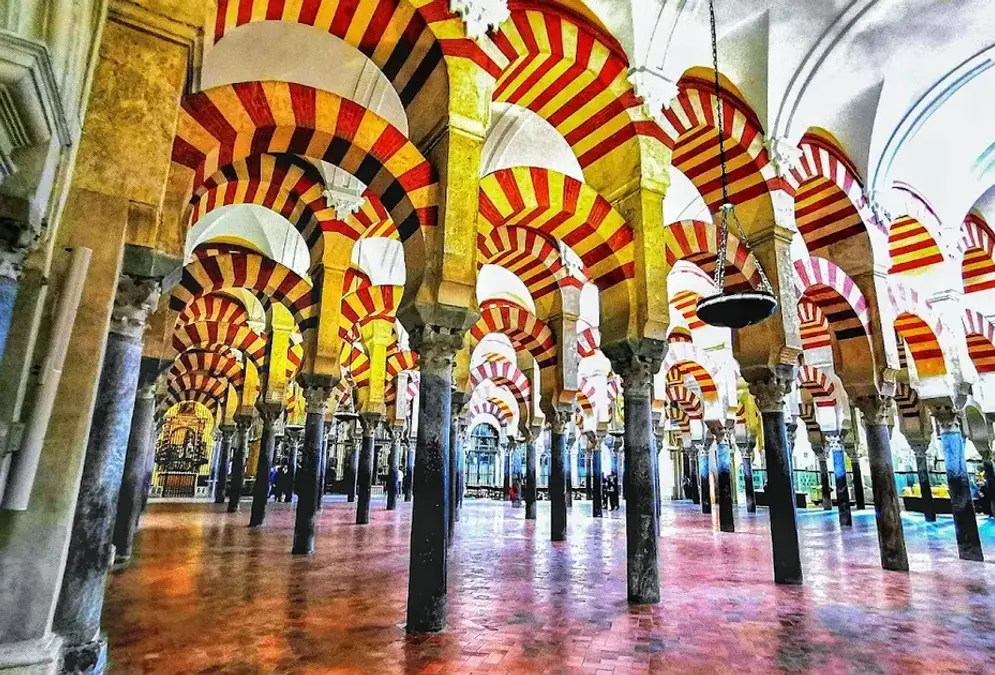
A visitor walking from the Mezquita-Catedral north through the old Medina is crossing colación boundaries with every block, though none are marked. The street pattern, the irregular plazas, the parish churches anchoring certain corners: these are the fossilised skeleton of a 13th-century administrative decision that recast an Islamic city into a Christian one without demolishing the underlying fabric[6]. The buildings changed — the urban structure was adapted rather than replaced.
The colaciones remained the fundamental unit of Córdoba's urban administration until the municipal reforms of the 19th century. For roughly six hundred years, if you were born, married, taxed, or buried in Córdoba, the colación was how the state knew you existed.
The template: how Córdoba's fuero strategy spread
Córdoba was the first major city where the Fuero Juzgo was applied as a local fuero after conquest, but it was not the last. The model — grant the Fuero Juzgo as municipal law, establish a concejo with an alcalde and jurados, carve the city into colaciones — was exported to Seville after its fall in 1248, to Jaén (surrendered 1246), to Murcia, and to dozens of smaller towns across Andalusia and the former taifa territories[2][3]. What had been improvised for Córdoba in 1241 had become, by Ferdinand's death in 1252, the standard legal protocol for incorporating conquered Muslim cities into the Crown of Castile.
The strategic logic is straightforward to reconstruct. Each conquered city presented the same administrative problem: a Muslim population that had either departed or been reduced to Mudéjar status (Muslims living under Christian rule), an urban infrastructure designed for Islamic governance, and a surrounding countryside that needed agricultural settlers. The Fuero Juzgo answered all three: it provided the legal framework, the repartimiento supplied the settlers, and the colaciones reorganised the urban space. The repetition was not coincidence. It was policy.
In 1348, the Ordenamiento de Alcalá — a comprehensive legal reform promulgated by Alfonso XI — formally granted the Fuero Juzgo preeminence in the hierarchy of Castilian law[2]. When conflicts arose between different legal codes, the Ordenamiento specified that the Fuero Juzgo should take precedence. This elevated what had been Córdoba's municipal charter in 1241 to the status of a kingdom-wide legal authority. The document that had governed a single conquered city was now, in theory, the default law for Castile.
The Córdoba precedent also clarified what the fuero could not do. Córdoba's Muslim population had departed under negotiated terms in 1236; later conquests, particularly Seville in 1248, involved larger-scale expulsions that the fuero's framework had to absorb. Each application modified the template. But the core structure — Visigothic law code as municipal charter, concejo as local government, colaciones as parochial-administrative units — remained stable through every iteration.
Six centuries in force: the fuero's long afterlife
Legal documents that remain operative for over six hundred years are rare. The Fuero Juzgo governed Córdoba and other Castilian cities from 1241 until the Spanish Civil Code was enacted in the late 19th century[2]. That span — roughly 640 years — exceeds the entire duration of Roman rule in Iberia and covers the period from the High Middle Ages to the threshold of the 20th century. The code was amended, supplemented, and partially superseded by later legislation, but it was never formally abolished until the Civil Code replaced it. Ferdinand III's 1241 charter was, in the most literal sense, the law under which generations of Córdobans were born, married, owned property, and died.
The administrative structures the fuero created outlasted the fuero itself. The Kingdom of Córdoba — one of the Four Kingdoms of Andalusia, alongside Seville, Jaén, and Granada — functioned as a distinct administrative unit from the 13th century until 1833, when Spain's provincial reorganisation abolished the medieval kingdoms[7]. The boundary Ferdinand defined on 10 March 1241, establishing seven outposts to mark his new province's perimeter, is recognisably the antecedent of the modern provincial boundary.
Ferdinand III's canonisation in 1671 — more than four centuries after his death — placed the entire Reconquista project within a framework of sanctified kingship[3]. The king who had translated the Visigothic law code and applied it to Córdoba was now a saint; the legal apparatus he had built acquired, by association, a kind of retrospective divine approval. Whether this mattered to Córdoba's 17th-century jurists is debatable. It mattered to the Crown's narrative.
What survives for a visitor today is the city's physical skeleton. The street pattern in the old Medina and the Axerquía, the location of the Fernandine churches, the irregular boundaries between neighbourhoods that still echo the medieval colaciones — these are not primarily Roman or Islamic inheritances. They are the footprint of a 1241 charter that decided, in practical administrative terms, where Córdoba's Christians would live, worship, pay taxes, and bury their dead. The text of the Fuero Juzgo is largely unread today outside specialist circles. But a person walking through Córdoba's old centre is moving through its operational consequences at every step.
FAQ about Cordoba fuero Ferdinand III
What exactly was the Fuero Juzgo?
The Fuero Juzgo was a Castilian translation of the Liber Iudiciorum, the Visigothic legal code first published in 654 by King Recceswinth. Ferdinand III commissioned the translation and granted it as municipal law to Córdoba on 10 March 1241, making it the first major conquered city where this ancient Visigothic code was applied as a local fuero. The text covered property, contracts, marriage, inheritance, and criminal penalties across twelve books.
When did Ferdinand III grant Córdoba its fuero, and what did it include?
Ferdinand III enacted the Fuero Juzgo for Córdoba on 10 March 1241, five years after the city's surrender. The charter established a concejo (municipal council), an alcalde (mayor-judge), jurados (sworn councilmen), and fourteen colaciones (parochial districts) centred on the Fernandine churches. It also granted property rights, inheritance guarantees, and tax exemptions to Christian settlers as incentives for repopulation.
Why did Ferdinand III choose a 7th-century Visigothic law code instead of writing a new one?
The choice was a political argument about legitimacy. The Visigothic kingdom had been the last unified Christian polity on the Iberian Peninsula before the Muslim conquest of 711-712. By adopting and translating its law code, Ferdinand was positioning himself as the legitimate successor to that kingdom — asserting that Córdoba was not being conquered so much as restored to a Christian legal order that predated Islam. The translation into Castilian also established the vernacular as a language of law for the first time.
What were the 14 colaciones, and how did they change Córdoba?
The 14 colaciones were parochial districts established by Ferdinand III, each centred on a Fernandine church (Iglesias Fernandinas). They functioned as administrative units that collected taxes, mustered militias, maintained infrastructure, and registered births, marriages, and property transactions. The churches were deliberately placed on former mosques or Caliphal public buildings, physically reordering the Islamic city's districts into a Christian parochial grid. This 13th-century skeleton still shapes Córdoba's old-town street pattern today.
How did the fuero affect Córdoba's Muslim population?
The fuero itself did not govern Muslims directly; it was a charter for Christian settlers. Córdoba's Muslim population had already departed under the negotiated terms of the 1236 surrender, leaving with movable possessions but not real property. Those who remained lived under Mudéjar status — Muslims under Christian rule — with limited legal protections that operated outside the fuero's framework. Later conquests, particularly Seville in 1248, involved larger-scale expulsions.
Did Córdoba's fuero model influence other conquered cities?
Yes, Córdoba was the prototype. The model — Fuero Juzgo as municipal charter, concejo for local government, colaciones for urban organisation — was exported to Seville after 1248, Jaén after 1246, Murcia, and dozens of smaller towns across Andalusia. By Ferdinand's death in 1252, what had been improvised for Córdoba had become the standard legal protocol for incorporating conquered Muslim cities into the Crown of Castile. The 1348 Ordenamiento de Alcalá later elevated the Fuero Juzgo to preeminence in Castilian law.
How long did the Fuero Juzgo remain in force in Córdoba?
The Fuero Juzgo governed Córdoba from 1241 until the Spanish Civil Code was enacted in the late 19th century — roughly 640 years. It was amended and partially superseded by later legislation over the centuries, but it was never formally abolished until the Civil Code replaced it. The Kingdom of Córdoba, established as one of the Four Kingdoms of Andalusia after the conquest, functioned as an administrative unit until 1833, outliving the fueros it had been built on.
Can visitors see evidence of Ferdinand III's fuero in Córdoba today?
Yes, though most of it is in the urban fabric rather than in displayed documents. The street pattern of the old Medina and Axerquía follows the colación boundaries established in 1241. Several of the fourteen Fernandine churches still stand — San Nicolás de la Villa, San Miguel, and San Juan de los Caballeros among them — some incorporating Visigothic and Roman spolia as deliberate citations of pre-Islamic Christian continuity. The provincial boundary defined by Ferdinand's seven outposts in 1241 is recognisably the antecedent of Córdoba's modern provincial limits. Manuscript copies of the Fuero Juzgo are held in the Biblioteca Nacional de España.
What was the repartimiento, and how did it work in Córdoba?
The repartimiento was the systematic redistribution of conquered land and property carried out by a council of partidores between 1237 and 1244. The partidores divided assets among three categories: knights and military orders (who received strategic positions and agricultural estates), the Church (urban property and the right to establish parochial districts), and noble families (who received latifundia — large estates — in the countryside). This distribution created the concentrated land ownership pattern that defined Andalusia's agrarian economy until the 20th century.