Córdoba Paper Mill History: How Al-Andalus Made Books
How rag-paper mills reached Córdoba and al-Andalus: Xàtiva's 1056 works, the hemp-and-linen method, and the supply chain that fed al-Hakam II's copyists.
Art history background with eight years writing interpretive content on Córdoba's Caliphal heritage.
Updated Published
history-buffsart-lovers
Paper reached Córdoba as an industrial product, not a curiosity: by the mid-10th century, rag paper made from linen and hemp rags was arriving in al-Andalus in quantity. That cheap, fast supply of writing material is what fed the city's copying workshops and the catalogues of al-Hakam II's library. Córdoba was a consumer before it was a producer, though: the peninsula's first documented mill belongs to Xàtiva, and it opened long after the library's peak.
The story most people know starts with a battle. Popular history credits the Battle of Talas in 751, where Arab forces are said to have captured Chinese papermakers and carried the secret west. The historian Jonathan Bloom doubts that direct transfer: Chinese paper was made mostly from bast fibres, while Islamic paper was made from waste material, chiefly rags[4]. The raw materials are different enough that the technology, whatever route it took through Samarkand and Khurasan, was rebuilt rather than simply copied.
By the end of the 8th century papermaking had reached Baghdad, and there it scaled. The Abbasid capital ran human- and animal-powered paper mills as early as 794–795[2], not the water mills of later European paper towns but mills all the same, applying rotary power to the beating of pulp. The state moved in early: under Harun al-Rashid, the use of paper in administration was consolidated, and papyrus and parchment ceased to be used for it[5]. The order to manufacture paper to replace parchment is attributed, through Ibn Khaldun, to the grand vizier Al-Fadl ibn Yahya[6], and production sat under the supervision of his brother, the vizier Ja'far ibn Yahya[7].
Baghdad also made the industry efficient. A method was invented there for producing a thicker sheet of paper, the step that turned papermaking from a craft into a major industry[8]. The trade got its own street, the Suq al-Warraqin, or paper market.
None of this was academic; it was a supply chain, and it is this version of paper, cheap, abundant, made from rags, that travelled west to the Iberian peninsula. The same Abbasid cultural current that carried the technique had already brought Ziryab, the Baghdad-trained musician, to the Umayyad court in Córdoba a generation before the caliphate existed.
100+
Shops that lined Baghdad's Suq al-Warraqin, the paper market street: papermaking at industrial scale had its own district and its own bazaar, a thousand years before Córdoba's library existed[9].
Xàtiva: the peninsula's first mill
The first documented paper mill on the Iberian peninsula was not in Córdoba. It was at Xàtiva, the hill town south of Valencia, where a water-powered works was established in 1056 by Abu Masafiya next to the main irrigation ditch, employing more than twenty workers and making paper from rags and old rope shredded by the mill wheel[1].
Xàtiva's output was linen rag paper, and by the 11th century the town was the peninsula's major production centre for it[1]. Its reputation outlived the caliphate; for centuries afterward, Xàtiva paper was praised and exported across the western Mediterranean, and the town's name became shorthand for good paper.
The water mattered as much as the rags. Before mechanised mills, Islamic paper was beaten by hand or with simple trip hammers, a slow, muscle-bound step that capped how much any workshop could turn out. Xàtiva's mill sat beside the town's main irrigation ditch precisely so a wheel could drive the beating, and its twenty-plus workers suggest the first Iberian mill ran as a proper factory rather than a craft bench. What matters for Córdoba's story is the precedent: Xàtiva proved that the Islamic papermaking technique, the one that had run from Samarkand through Baghdad and the Maghreb, worked on Iberian water with Iberian rags.
The Cordoban writer Ibn 'Abd Rabbihi, who lived from 860 to 940, had described paper and its use in the peninsula long before Xàtiva's mill opened[13], evidence that paper was already circulating in al-Andalus as an import for decades before anyone built a mill to make it locally. The distinction matters. A mill is a production site; paper itself had been bought, sold and written on for a generation or more before the peninsula's first mill turned a wheel.
How al-Andalus made rag paper
The recipe that reached Córdoba was built on waste. Across the Islamic world, the major input materials for paper pulp were bast, meaning hemp and flax, along with cotton, old rags and discarded rope[10]. Arab papermakers then went a step further and developed a pure rag paper, a pulp made entirely from linen rags; this is the paper that supplanted papyrus and parchment for most uses by the 11th century[11]. Papyrus carried three practical strikes against it:
it was geographically limited to Egypt
it was more expensive and laborious to produce
it was fragile and sensitive to moisture, breaking apart in damp conditions[16]
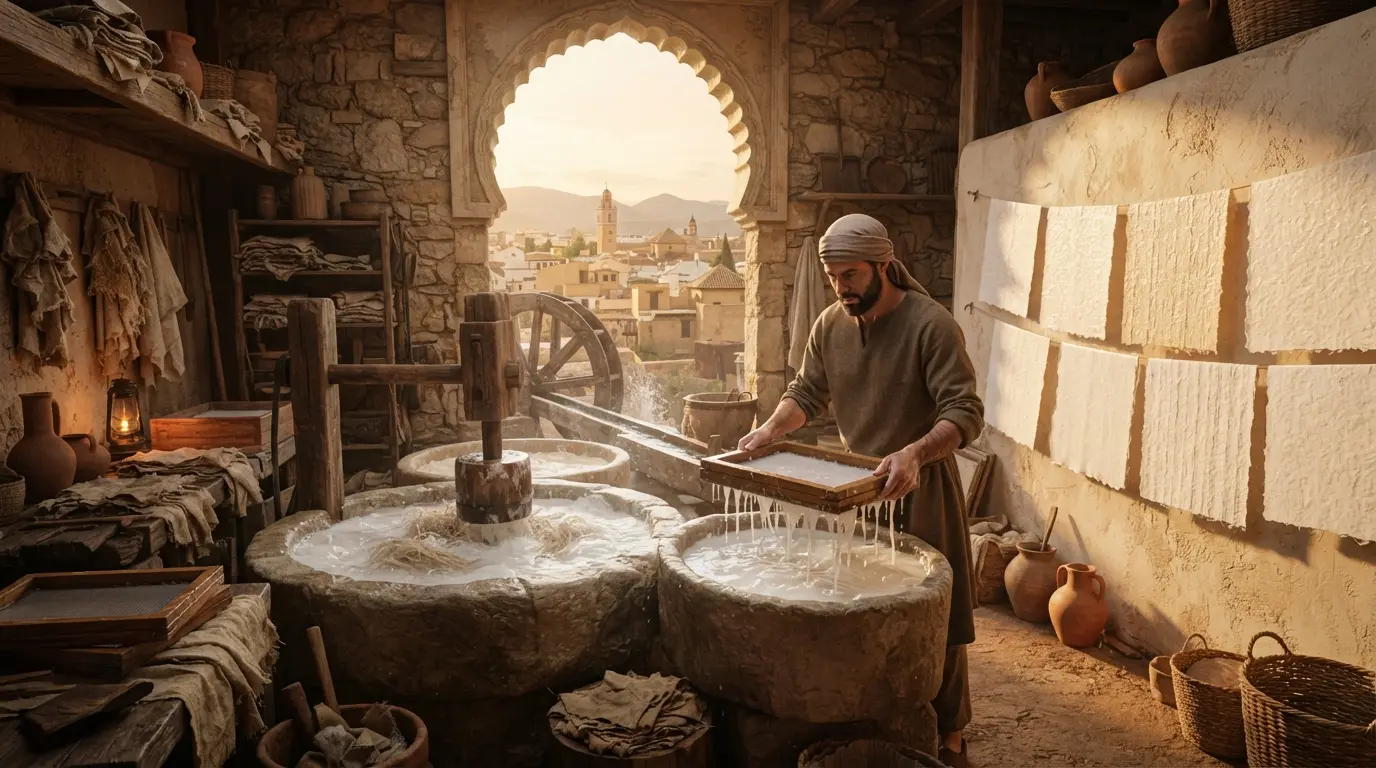
The process itself was slow and wet. Rags and rope were sorted, washed, and left to ret, the fibres softening as they fermented. The softened stock was then beaten to pulp, at Xàtiva by the mill wheel driving hammers or an edge mill, elsewhere by hand, until it became a milky furnish suspended in water in a vat.
From the vat, a papermaker pulled each sheet by hand. He dipped a mould, a wooden frame strung with a fine wire screen and fitted with a removable deckle, into the furnish and lifted it, catching a thin, even layer of fibre as the water drained through. The wet sheet was couched off onto felt, stacked with more felts, and pressed to squeeze out the remaining water, then hung to dry.
The mark of a good sheet showed in the light. Handmade rag paper carries laid lines and chain lines, the faint parallel and crosswise impressions left by the mould's wire mesh, and the deckle left irregular feathered edges on every sheet. Once dry, the sheet was sized with starch or gum so ink would sit on the surface instead of bleeding, then polished with a burnisher. It is paper you can feel the moment you touch it: slightly rough, warm, absorbent, nothing like the slick machine stock of a modern ream.
The rag-paper recipe in six steps
Sort and wash rags, hemp and linen cloth, and old rope
Ret the fibres, leaving them to ferment until they soften
Beat the stock to pulp in a water- or hand-driven mill
Lift a sheet on a wire-screen mould fitted with a deckle
Couche the sheet onto felt, press, and hang it to dry
Size with starch and burnish so ink sits on the surface
That last word is a debt paper owes to Arabic. Ream descends from the Arabic rizma, a bundle of sheets, and the word for paper itself, kāghad (from the Persian kāghaz), travelled with the trade across half a continent. By the 9th century Muslims were using paper routinely, though the Qur'an was still copied on vellum out of reverence[12], a preference rather than a limitation.
Did Córdoba run its own mills?
Here the record thins, and the honest answer is that we do not know exactly when Córdoba began milling its own paper. The cultural-heritage sources are confident: after Xàtiva's founding, other large cities installed paper mills, among them Córdoba, Valencia and Toledo[14]. What they do not give us is a date, and the documentary or archaeological evidence for a tenth-century Córdoban mill has not survived. The historian Jonathan Bloom, who has argued the question most carefully, treats the idea that Córdoba manufactured paper in quantity during the caliphate with caution.
The likeliest picture is a mix. During the library's peak, some paper was probably milled locally, but a good share was imported, carried along the same routes that brought books and scholars west. Córdoba was a consumer before it was a producer, and the demand side is what made the difference.
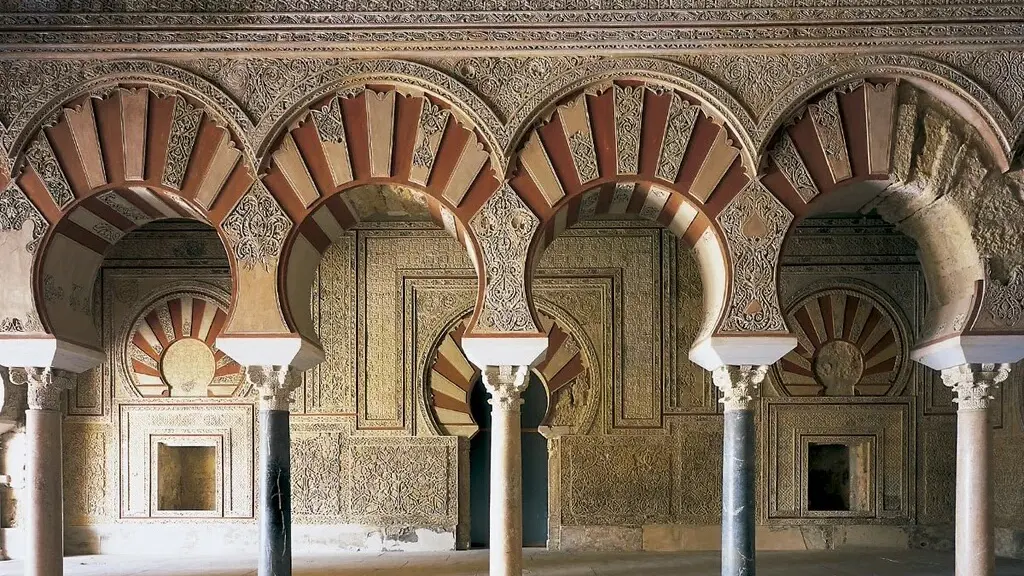
That demand was enormous and centralised. The caliph's library at Medina Azahara, the palace-city outside Córdoba, was one of the largest book collections in the western world in the 960s, and its catalogue, the tool that told the caliph what he owned, was itself kept on paper, compiled in notebooks of twenty sheets each[3]. Paper was not incidental to al-Hakam II's library; it was the raw material the entire operation ran on. A parchment library of that scale would have needed a herd of livestock for the catalogue alone.
What a city does with paper is write on it, and al-Andalus built an entire economy around that act. Alongside the paper trade grew a class of booksellers, the al-kutubiyyin, and whole neighbourhoods given over to the book trade, with every supporting trade under one roof[15]:
scribes and copyists
bookbinders
ornamental artists
librarians
The Arabic word warrāq covered the range of it, paper seller, stationer, copyist, and it is the root of Baghdad's Suq al-Warraqin. In Córdoba the same figure sat at the end of the supply chain, the person who took a fresh sheet and turned it into a page.
The copying workshops were the largest consumers of all. A library like al-Hakam II's did not buy its books ready-made; it commissioned copies, and a single long work could run to hundreds of sheets of paper before one binding was sewn. The copyists of Córdoba, among them Lubna of Córdoba, who rose from the palace household to run the library's transcription, worked through paper at a rate no parchment economy could have sustained. Paper made the copy cheap; the copy made the collection possible.
This is where the two stories, the mill and the library, join. Papermaking arrived in al-Andalus as an industrial technique and found its most famous customer waiting: the mills supplied the sheets, the sheets supplied the copyists, the copyists supplied the shelves. The volume was the point. Paper made a copy cheap enough that a library could afford copies of copies, working texts that a parchment economy, where every sheet was a scraped and stretched animal skin, simply could not have supported. What became of those shelves is another article's story. What survives of the supply chain is the technique itself, rag, water, a wire mould, and the patience to pull a sheet, still worked today by the world's handful of surviving hand papermakers. Paper was one thread in a wider caliphal economy of hand skill, alongside the leather, silver and ivory work told in the guide to Córdoba's caliphal crafts.
Frequently asked questions
Where was the first paper mill in Spain?
The first documented paper mill on the Iberian peninsula was at Xàtiva, south of Valencia, established in 1056 by Abu Masafiya. It employed more than twenty workers and made paper from rags and old rope shredded by the mill wheel, driven by water from the town's main irrigation ditch.
Did paper reach al-Andalus by the 10th century?
Yes. Rag paper made from linen and hemp spread to al-Andalus by the mid-10th century, precisely the period of al-Hakam II's library in Córdoba. Xàtiva became the major production centre for linen rag paper by the 11th century, but paper was already circulating in the peninsula as an import for decades before that, as the Cordoban writer Ibn 'Abd Rabbihi recorded between 860 and 940.
How did papermaking reach the Islamic world from China?
Popular history credits the Battle of Talas in 751 with handing the secret to the Islamic world, but historians like Jonathan Bloom doubt that direct transfer. Chinese paper was made from bast fibres, while Islamic paper was made from rags, a different enough material that the technique was effectively rebuilt. It spread through Samarkand and Baghdad, then west through the Maghreb to Muslim Spain.
What is rag paper and how was it made in al-Andalus?
Rag paper is paper made from discarded textiles and rope. In the Islamic world the pulp was made from bast (hemp and flax), cotton, and old rags and ropes, which were retted, beaten to a milky furnish, then formed sheet by sheet on a wire-screen mould with a deckle, pressed, sized with starch and burnished. The result was cheaper and faster to produce than parchment, which is why it fed the bulk copying of libraries.
Why did paper replace papyrus and parchment?
Papyrus was geographically limited to Egypt, more expensive and laborious to make, and fragile in damp conditions. Paper was cheaper and faster to produce in bulk, and Arab papermakers' 'pure' rag paper supplanted papyrus and parchment for most uses by the 11th century, making mass copying affordable.
Did Córdoba have paper mills?
Cultural-heritage sources say that after Xàtiva's 1056 founding, other large cities including Córdoba, Valencia and Toledo installed paper mills, but they give no dates, and firm documentary evidence for a tenth-century Córdoban mill has not survived. The likeliest picture is a mix of local milling and imported paper, with Córdoba a consumer before it was a confirmed producer.
What was a warrāq?
A warrāq was a paper seller, stationer or copyist in the medieval Islamic book trade. The word survives in Baghdad's Suq al-Warraqin, the paper market street lined with more than a hundred shops. In al-Andalus the booksellers of the same trade were known as al-kutubiyyin, and they formed whole neighbourhoods devoted to books, copying, binding and librarianship.
“The paper factory of Xàtiva, the first in the peninsula, established in 1056 by Abu Masafiya, next to the main irrigation ditch, had more than 20 workers and manufactured paper from rags and ropes, shredded by the mill wheel.”
“Bloom argues that based on differences in Chinese and Central Asian papermaking techniques and materials, the story of Chinese papermakers directly introducing paper to Central Asia is probably metaphorical. Chinese paper was mostly made of bast fibers while Islamic paper was primarily made of waste material like rags.”
“According to Ibn Khaldun, a renowned Muslim historiographer, parchment was rare, and a great increase in the number of correspondents throughout Islamic territories, resulted in an order issued by Al-Fadl ibn Yahya, the Abbasid's Grand Vizier, for the manufacture of paper to replace parchment.”
“Production began in Baghdad, where a method was invented to make a thicker sheet of paper, which helped transform papermaking from an art into a major industry.”
“In Baghdad, particular neighborhoods were allocated to paper manufacturing and in Bazaar paper merchants and sellers owned distinct sectors being called Paper Market or Suq al-Warraqin, a street which was lined with more than 100 paper and booksellers' shops.”
“Arab papermakers developed 'pure' rag paper, made from an alternative pulp entirely constituted from linen rags; this paper supplanted papyrus and parchment for most uses by the 11th century.”
“The flourishing of the book was also accompanied by the emergence of booksellers, al kutubiyyin, and entire neighborhoods devoted to the book trade, which also included the services of scribes and copyists, bookbinders, ornamental artists, librarians, etc.”
“It was geographically limited to a plant primarily grown in Egypt; it was both more expensive and laborious to produce compared to paper; and it was more fragile and sensitive to moisture, making it prone to break apart in damp conditions.”