Al-Andalus Tourism Boom: What It Means for Córdoba
Why the Al-Andalus travel segment is booming in 2026: 16 million Muslim arrivals to Southern Europe, the caliphal origin story, and what it means for Córdoba.
Art history background with eight years writing interpretive content on Córdoba's Caliphal heritage.
Published
history-buffs
The Al-Andalus travel segment is booming in 2026, and caliphal Córdoba is the origin story the boom keeps returning to. Muslim arrivals to Southern Europe reached 16 million in 2025 and keep rising, and the heritage routes that package that history begin in the city that ruled the Caliphate of Córdoba from 929 to 1031.[1][2] The demand is already measurable here: the Mezquita-Catedral closed 2025 at a record 2,191,731 visitors, and what the city does with that interest decides what the boom becomes.[3]
2025 Mezquita visitors
2,191,731
Record year for the Mezquita-Catedral, up from 2,186,774 in 2024[3]
Caliphate of Córdoba
929–1031
The Umayyad caliphate's span, ruling al-Andalus from 929 to 1031[2]
Muslim arrivals, S. Europe
16 million
CrescentRating's 2025 count for the region, still rising[1]
In this article
Jump to a section
⌄
The Boom in Numbers: 16 Million Muslim Arrivals and Rising
The headline figure for the 2026 segment is 16 million: Muslim international arrivals to Southern Europe in 2025, counted by CrescentRating's Muslim Travel Intent Tracker and marked in its Halal Travel Trends report as «continuing to rise».[1] The same dataset places Spain inside the Mediterranean–Balkan corridor, the axis European Muslims are re-engineering their travel toward to keep holidays faith-aligned without crossing volatile airspaces.[4] For Córdoba that is not abstract geography; it is the demand arriving at its gates.
The report names two demand drivers that land squarely on al-Andalus. Whycation is its term for purpose-led journeys «where the 'why' is more important than the 'where'».[5]Ancestry Travel describes diaspora Muslims returning to ancestral lands, a pull the report calls «one of the most powerful trip-design motivators of the decade».[6] Both treat heritage as the organising logic of a trip rather than a backdrop.
The al-Andalus Opening
That logic points at al-Andalus, the Muslim-ruled Iberia whose name survives in modern Andalusia, and at the state that turned it into a civilisation with a capital: the Caliphate of Córdoba. A traveller asking where that culture actually lived ends up in the Guadalquivir valley, on the same ground the Umayyads chose.
The local demand curve shows the interest is already real. The Mezquita-Catedral closed 2025 at a record 2,191,731 visitors, beating its previous best by a narrow margin.[3] Nobody counts those visitors by religion, so the segment's share stays invisible in the official statistics; what the record shows is that Córdoba's Umayyad heritage sells at record volumes.
The Measurement Gap
One caveat keeps the picture honest: Spain's official statistics do not measure this segment. Frontur, the national arrivals survey, counts nationalities rather than motivations, so no public number separates Muslim-heritage travellers from the general crowd. The evidence for the boom is therefore indirect: trend data at the regional level, the growth of the routes, and the visitor records of the monuments themselves. That is worth remembering whenever a percentage for «halal tourists in Córdoba» is quoted.
The test of the boom is not another record year but whether the ecosystem grows with it: routes that frame the story, kitchens and prayer rooms that serve the traveller, and a city that treats its caliphal layer as an origin story rather than a curiosity.
Why Caliphal Córdoba Is the Origin Story
Every heritage segment needs an origin story, and the origin story of al-Andalus tourism is the Caliphate of Córdoba. It began in 929, when Abd al-Rahman III took the caliphal title in rivalry with the Fatimids of North Africa, elevating the Umayyad emirate his ancestor had founded in 756 into a state that claimed religious authority for the western Mediterranean.[7][2]
The scale that followed is why the caliphate still structures travel itineraries. Córdoba surpassed 100,000 inhabitants in the 10th century, making it the largest city in Europe alongside Constantinople.[8] Tertius Chandler's higher estimate of around 450,000 people circa 1000 CE is the number historians still argue with; either way, this was a city whose water supply, libraries and suburbs had no parallel west of Byzantium.[9] A city that size changed what urban life meant in Europe, and the aqueducts, gardens and markets it ran on are the infrastructure today's visitors walk across without noticing.
“
“Neither Rome nor Paris, the most inhabited cities in the Christian Medieval West, were never even close to the splendour of Cordoba, the largest town in Medieval Europe[14]”
Ch. E. Dufourq, via El Legado Andalusí
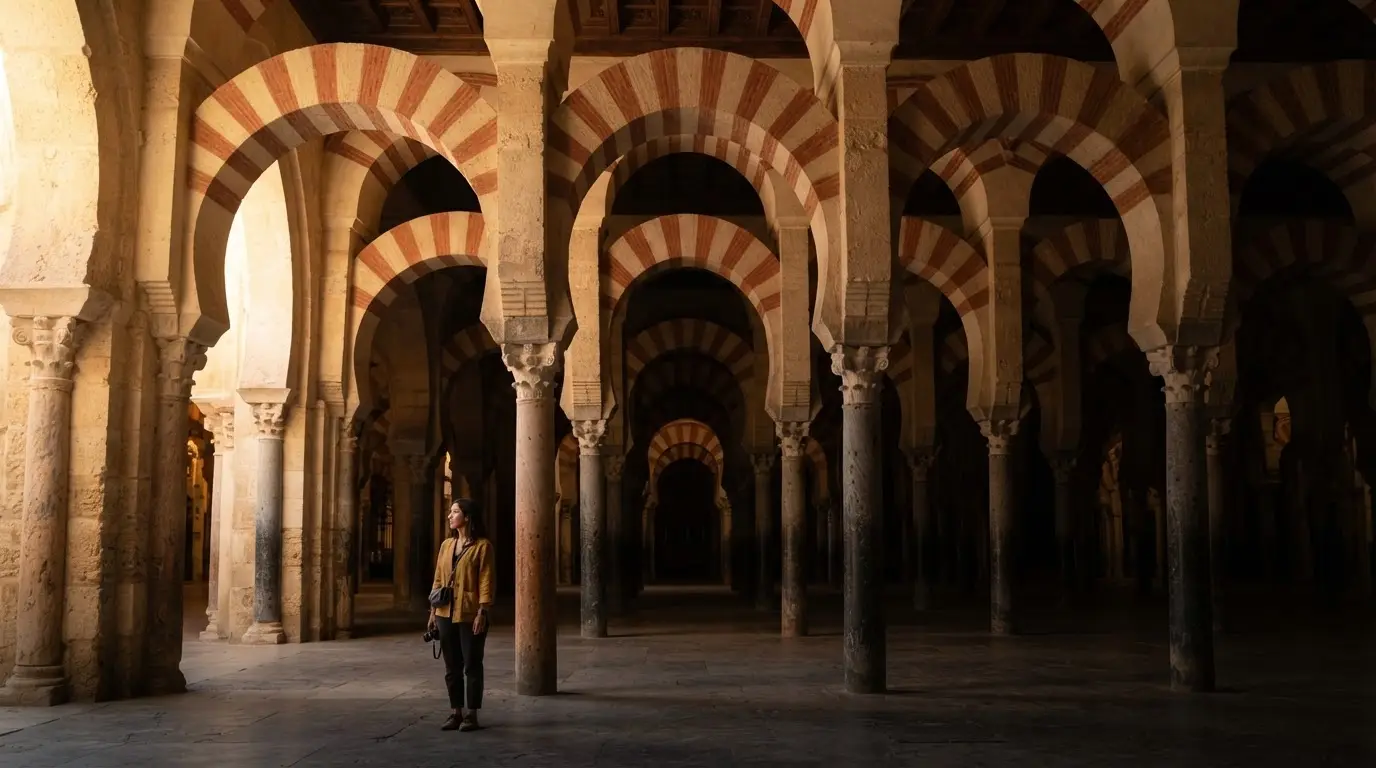
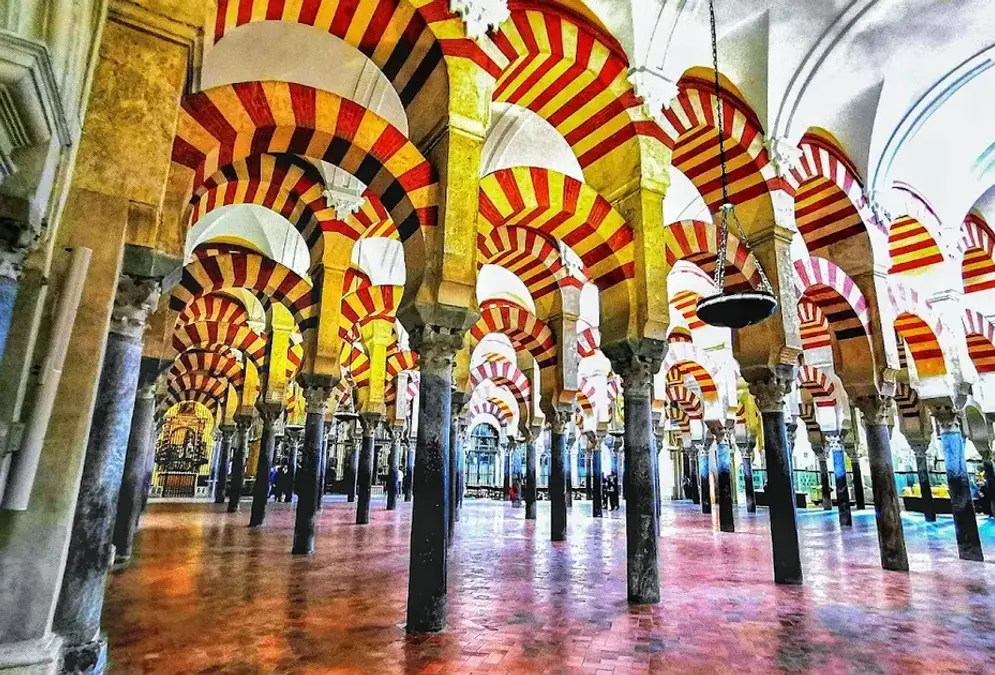
The great survivor of that city is the Mezquita-Catedral, begun under Abd al-Rahman I in the late eighth century and expanded by every ruler until the fall. It is the one building that lets a visitor stand inside the caliphate's architectural logic, a forest of reused columns and double horseshoe arches that reads as pure Umayyad engineering. Its full story, from prayer hall to cathedral, is told on the mosque-cathedral's own page.
Medina Azahara: A City Built to Project Power
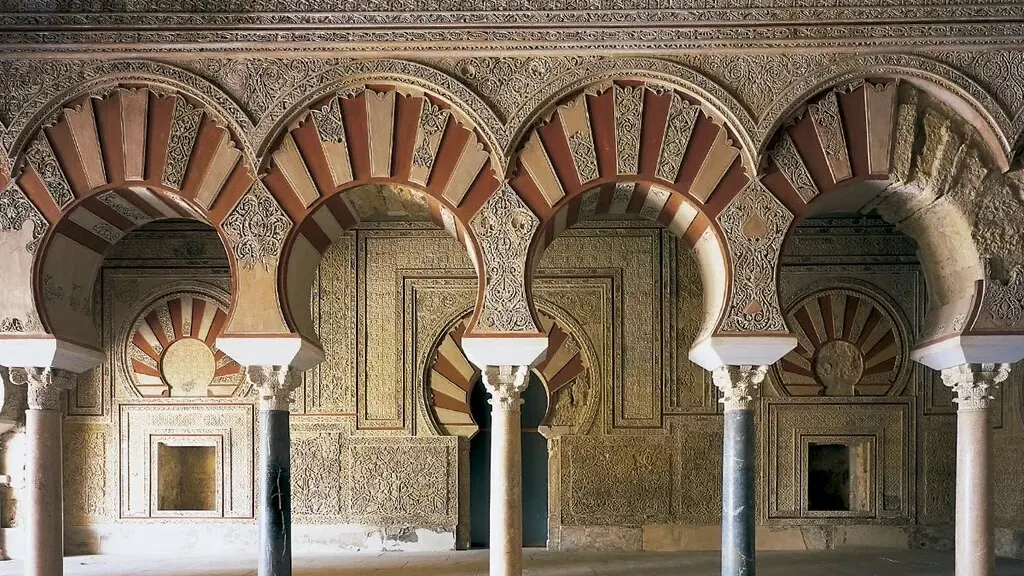
The most literal statement of that logic lies 5 km west of Córdoba: Medina Azahara, the palace-city Abd al-Rahman III founded in 936 as the seat of the caliphate.[10][12] Córdoba's tourism board is blunt about the motive: the caliph founded it «to promote the new image of the recently-created independent western Caliphate».[13] Inscribed in 2018 as the UNESCO World Heritage Caliphate City of Medina Azahara, the excavated site is the clearest surviving evidence of what the segment travels to see.[11] The Caliphate City's page covers the visit in full.
The Two Dates to Keep Apart
The city's fall is worth dating precisely because the two moments are routinely merged. Medina Azahara was laid waste in 1009–1010, during the civil war that tore the caliphate apart; the caliphate itself dissolved in 1031.[12][2] A century of splendour followed by a generation of collapse gives the caliphal layer a complete arc, with a beginning, a peak and an ending, which is exactly the shape a heritage narrative needs.
The Infrastructure That Proves the Point
A travel segment is only as real as its ecosystem, and the ecosystem for Muslim-heritage travel in Córdoba now exists on the ground. The markers are specific: halal certification, prayer space, and a hammam culture that descends from the same caliphal period the visitors have come to see.
The dining anchor is Noor, Paco Morales' Michelin-starred restaurant built on al-Andalus cooking, which Halalbooking singles out as «a form of halal haute cuisine».[15] In the hills above the city, Los Almendros holds halal certification and runs its own prayer room, a combination rare even in Andalusia.[16] Neither kitchen markets itself at the segment; both simply serve it.
Baths, Hammams and the Caliphal Layer
The wellness side of the segment plugs into the same history. The Hammam Al Andalus in the old town runs a traditional Arab bathing circuit in a restored building, while the Baños del Alcázar Califal, the caliphal baths beneath the Alcázar, are the actual infrastructure the Umayyads built. Together they let a visitor rehearse the bath culture that Córdoba exported across the Mediterranean.
The Official Signal
The institutional side is moving too. Turespaña's 2025 report on Moroccan outbound tourism notes that Spanish halal offerings «are progressing» and have become one of the arguments used to attract Moroccan travellers.[17] That is the official channel catching up with demand the private sector already serves. For the practical layer, where to pray and which hotels to book, our halal travel guide covers Córdoba in full; this essay is about the demand behind the segment, not its logistics.
The Routes: El Legado Andalusí and the Route of the Caliphate
The segment's institutional backbone is El Legado Andalusí, the Andalusian public foundation that built the footprint of al-Andalus into a travel product. Its network of routes has been a Cultural Route of the Council of Europe since 1997 and reaches more than 200 villages, many far from the usual tourist circuits.[20][21] That designation matters because it makes the routes recognised heritage infrastructure, not marketing.
The flagship is the Route of the Caliphate, which connects Córdoba and Granada, the capital cities of caliphal and Nasrid al-Andalus.[18] It follows the old caliphal road through the towns that fed the two capitals:
Madinat al-Zahra (Medina Azahara), the excavated palace-city and the route's first stop
Espejo and Baena, white towns of the olive country
Lucena and Priego de Córdoba, the latter the gateway to the Sierras
The road itself carried the meaning before the tourists did: one of the busiest paths of the Iberian Peninsula in the Middle Ages, used by traders from all around the known world, and, in El Legado Andalusí's framing, «the route of knowledge, sciences and arts».[19][22] The traveller today walks a corridor of exchange rather than a museum trail.
Recommended tours
Tours are selected for quality, not commission. We earn a small fee if you book — at no extra cost to you.
That distinction is what the segment is buying. A heritage pilgrimage treats the route as a story to inhabit, from the caliphate's capital to the last Muslim kingdom's; a checklist treats it as monuments to tick. The route works as a self-drive itinerary, a guided excursion, or a staged journey with stops for the region's food and the towns' own festivals, and it ends in Granada, whose Alhambra gives the Nasrid chapter its own climax. Córdoba's role in that story is to be the beginning, and the two poles frame a narrative arc that no single monument could carry.
What the Boom Means for Córdoba
The first consequence is a change in who visits and why. The city's traditional tourism is the six-hour day trip from the coast, a crowd that arrives at the Mezquita and leaves the same afternoon; the heritage segment stays longer, moves along the routes, and books halal dining and the hammam. That is a different economic profile, spread across the province rather than stacked at one threshold.
The pressure points are real and documented. The Mezquita-Catedral's record 2,191,731 visitors in 2025 arrived without any religious breakdown, and the two-million level is now the building's operating baseline rather than a peak.[3] Córdoba is not Barcelona: crowding here concentrates around one monument for a few hours a day, not across the housing stock. How the city manages that threshold, without either a hard cap or a theme park, is the argument our two-million visitors analysis and the overtourism overview both take up.
The third consequence is interpretive, and it is the one the city controls. The boom pays Córdoba to tell the caliphal story properly, and the material is unusually complete:
the Mezquita-Catedral, the standing monument
Medina Azahara, the excavated palace-city
the Route of the Caliphate and the caliphal baths What the city says with that material, and to whom, decides whether the segment deepens into repeat heritage travel or drifts once the novelty passes.
There is also a risk worth naming. Heritage segments that grow fast attract two responses: packaging the story into a theme park, or freezing it behind glass. Córdoba's advantage is that its caliphal layer was never a museum piece; it is the ground the city is built on, and the boom simply asks the city to keep saying so.
Where the Segment Goes Next
The drivers behind the boom are compounding rather than fading. Whycation journeys and diaspora Ancestry Travel both deepen as identity searches intensify, and both keep pointing at al-Andalus as the origin point of a European Muslim heritage.[5][6] CrescentRating's tracker marks Southern Europe as continuing to rise, which is as close as the segment comes to a forecast.[1]
Córdoba's position in that growth depends on the story it tells beyond the Mezquita. The three-cultures heritage gives the segment a fuller itinerary than any single monument could, and its components all sit within walking distance of each other:
the Judería and its synagogue
the mosque-cathedral and the Alcázar
the Museo Vivo de Al-Andalus in the Torre de la Calahorra The three-cultures guide maps that territory in full, and the golden age of caliphal scholarship supplies the layer for travellers who want the intellectual history, not only the walls.
None of this asks Córdoba to invent a product. The city already holds a surviving fabric of al-Andalus that runs from mosque to palace-city to baths, and the segment is already arriving on it. The choice is presentation: a list of monuments, or the origin story it actually is. For a capital built to project a caliphate's power, the historically accurate option is the second one.
Frequently asked questions
What is the Route of the Caliphate and where does it go?
The Route of the Caliphate is the flagship itinerary of El Legado Andalusí, linking Córdoba and Granada, the capital cities of caliphal and Nasrid al-Andalus. It follows the old caliphal road through Madinat al-Zahra (Medina Azahara), Espejo, Baena, Lucena and Priego de Córdoba, ending at the Alhambra.
What are the Routes of El Legado Andalusí?
A network of themed itineraries run by the Andalusian public foundation El Legado Andalusí, tracing the footprint of al-Andalus across the region. The network has been a Cultural Route of the Council of Europe since 1997 and reaches more than 200 villages, many far from the usual tourist circuits.
Why is Córdoba the origin of Al-Andalus heritage tourism?
Because the segment's itinerary logic begins with the Caliphate of Córdoba (929–1031), the state that made al-Andalus a civilisation with a capital city. Córdoba was Europe's largest city in the 10th century, home of the Caliphate City of Medina Azahara, and the starting point of the Route of the Caliphate. The Al-Andalus tourism boom of 2026 keeps returning to that founding story.
How big is the Muslim travel market in Europe?
CrescentRating's Halal Travel Trends 2026 counts 16 million Muslim international arrivals to Southern Europe in 2025, a figure it marks as continuing to rise. The same report identifies the Mediterranean–Balkan corridor as the axis European Muslims are re-engineering their travel toward. Spain sits inside that corridor, with its halal offering cited as a recruiting argument for Moroccan travellers.
Is Córdoba a good destination for Muslim travellers?
Yes, and the ecosystem is growing: halal-certified dining at Noor and Los Almendros, a restored hammam, the caliphal baths of the Alcázar, and prayer facilities in the historic centre. The deeper draw is heritage, since Córdoba is where the Caliphate of Córdoba ruled. For practical logistics, our halal travel guide covers the current options.
Where can halal food be found in Córdoba?
Noor, Paco Morales' Michelin-starred restaurant, serves halal haute cuisine built from al-Andalus cooking, and Los Almendros holds halal certification and runs its own prayer room. Beyond those two anchors, the city's dining scene is increasingly halal-aware; the practical guide lists the full current range.
When was the Caliphate of Córdoba and why does it matter?
The Caliphate of Córdoba ran from 929, when Abd al-Rahman III took the caliphal title, to its dissolution in 1031. In that century Córdoba became Europe's largest city and built Medina Azahara, the UNESCO-listed Caliphate City. For heritage travel, that period is the origin story of Al-Andalus tourism.
“La Mezquita-Catedral de Córdoba ha cerrado el pasado año 2025 con 2.191.731 visitantes, superando así el anterior máximo histórico registrado en 2024”
“The population of the capital city Córdoba most likely surpassed 100,000 in the 10th century, making it the largest city in Europe alongside Constantinople, capital of the Byzantine Empire.”
“The Caliphate city of Medina Azahara is an archaeological site of a city built in the mid-10th century CE by the Umayyad dynasty as the seat of the Caliphate of Cordoba.”
“the real reason for the Caliph founding Medina Azahara was to promote the new image of the recently-created independent western Caliphate as a one of the strongest, most powerful kingdoms in Medieval Europe”
“Neither Rome nor Paris, the most inhabited cities in the Christian Medieval West, were never even close to the splendour of Cordoba, the largest town in Medieval Europe”
“An interesting local restaurant is Noor in Cordoba, whose Michelin-starred chef Paco Morales, is renowned for having created a form of halal haute cuisine.”
“According to the 2025 Turespaña report on Moroccan outbound tourism, Spanish halal offerings are progressing and becoming one of the arguments used to attract Moroccan travelers.”
“It was one of the busiest paths of the Iberian Peninsula during the Middle Ages, because it was used by traders from all around the known world, who supplied and traded in these important population centres”