
Lucena, Córdoba: The Jewish Town That Governed Itself
Lucena's Jewish community had an elected rabbi, a famous yeshiva and a cemetery found in 2006. What the sources say about its autonomy, and what you can visit.
Art history background with eight years writing interpretive content on Córdoba's Caliphal heritage.
Updated Published
history-buffscouples
Lucena, in Córdoba province, was never governed by Jews alone, but its Jewish community ran its own courts under an elected rabbi. A letter of 853 already described it as a place without a single gentile, and the legend has grown from there. What the sources support is narrower than the legend, and the best evidence is a cemetery nobody knew about until 2006.
First record of Lucena
853
Natronai Gaon calls it a Jewish place with no gentiles[1]
Graves catalogued
346
Largest Jewish cemetery ever excavated in Spain[2]
Visitable Jewish necropolis
1 in Spain
The Andalucía tourism board's claim for Lucena's site[3]
In this article
Jump to a section
⌄
An 853 letter and a town with no Gentiles
The earliest record is a rabbi's, not a chronicler's. In 853 Natronai Gaon, answering a legal question, called Lucena (Alisana in Arabic) a place without a single gentile.[1] A scholar writing from a distance is not a census, but the label stuck.
Later writers kept calling Lucena "the entirely Jewish city", and a tradition even says Jews founded it.[4] The regional tourism literature goes further, naming the old Jewish town Eliossana and describing it as "almost an independent republic" under the Caliphate of Córdoba and the taifa kingdoms.[5]
The modern branding is the Pearl of Sepharad. Andalucía's tourism board says few Jewish communities in Al-Andalus became as famous.[6] I found no medieval source for the epithet itself, so read it as a promotional phrase resting on a real reputation.
That reputation had an economic base. Lucena's Jews worked olive groves, vineyards, farmland, trade and crafts,[7] and an Arabic writer, as the Jewish Encyclopedia relays him, thought them richer than the Jews of any other city.[8] Rulers noticed.
Self-governed, but never independent
Here the legend and the record part ways. Idrisi describes a town divided by its walls: Muslims lived outside, while Jews generally lived in the fortified part within.[9]
Inside, the community ran its own justice. Its rabbi was chosen by the whole community, held special privileges and judged both civil and criminal cases.[10] That is real self-government of a legal kind. It is not sovereignty.
Sovereignty stayed with Muslim rulers, and they used it. Around the turn of the 12th century the Almoravid ruler Yusuf ibn Tashfin came to Lucena to press its Jews to honour promises made by their ancestors.[11] Many of Lucena's Jews went north to Navarre and settled near Tudela, where they called their new settlement Lucena.[12]
Then the Almohads ended the experiment. The Jewish Encyclopedia says they forced the community to accept Islam, and that "the flourishing and wealthy city, the seat of Jewish science" was destroyed.[13] Castile took the original town in 1240.[15]
The community that rivalled Córdoba's, and its academy
Lucena's Jewry measured itself against Córdoba's early. By the 10th century it already rivalled the importance of the community in Córdoba, home of Hasdai ibn Shaprut.[16]
Three names carry the 11th-century story of its academy:
Isaac Alfasi, whom the sources place between the other two
Joseph ibn Migash, who inherited the headship and kept it for 38 years[17][18]
Lucena also took in people fleeing trouble elsewhere. After the anti-Jewish violence in Granada in 1066, the widow and son of Joseph ben Samuel ha-Nagid were among the refugees who arrived.[19] The poets Moses and Abraham ibn Ezra and Judah Halevi are recorded as active in Lucena at some point in their lives.[20]
The Maimonides connection, and its limit
The route from Lucena to Córdoba's most famous Jewish thinker runs through Ibn Migash. Maymun, the father and teacher of Maimonides, is probably Ibn Migash's best-known student.[21]
Maimonides himself was not a pupil in any literal sense. He was three years old when Ibn Migash died,[22] so anything he took from Lucena reached him, if at all, through his father.
It is easy to flatten this into "Maimonides's teacher". The sources support something narrower and more interesting: his father's teacher, in a town that had been training scholars for generations.
The cemetery and what you can visit today
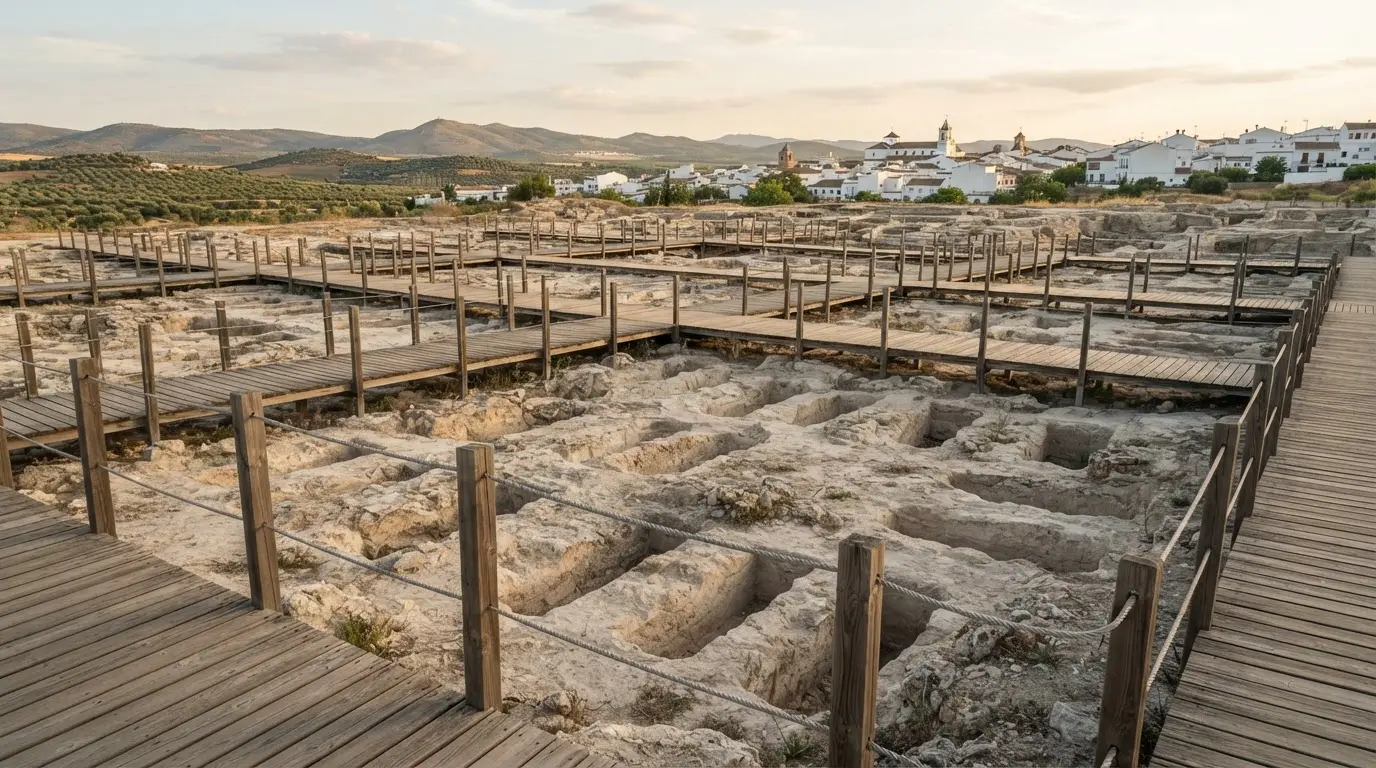
The necropolis was found in 2006 during construction of Lucena's southern ring road.[23] It holds 346 catalogued graves and is the largest Jewish cemetery ever excavated in Spain.[2] The Andalucía tourism board calls it the only Jewish necropolis that can be visited in the country,[3] and in 2014 the city was building wooden paths suspended over the graves in a grid.[24]
Beyond the cemetery, the town offers a short circuit:
The Palace of the Counts of Santa Ana Interpretation Center, whose "Jews" room shows the burial types used in the necropolis[25]
The Vela Tower, a remnant of the walls that protected the Jewish quarter[26]
A bust of Joseph ibn Migash in Plaza de Santiago[27]
El Moral Castle, now the Archaeological and Ethnological Museum[28]
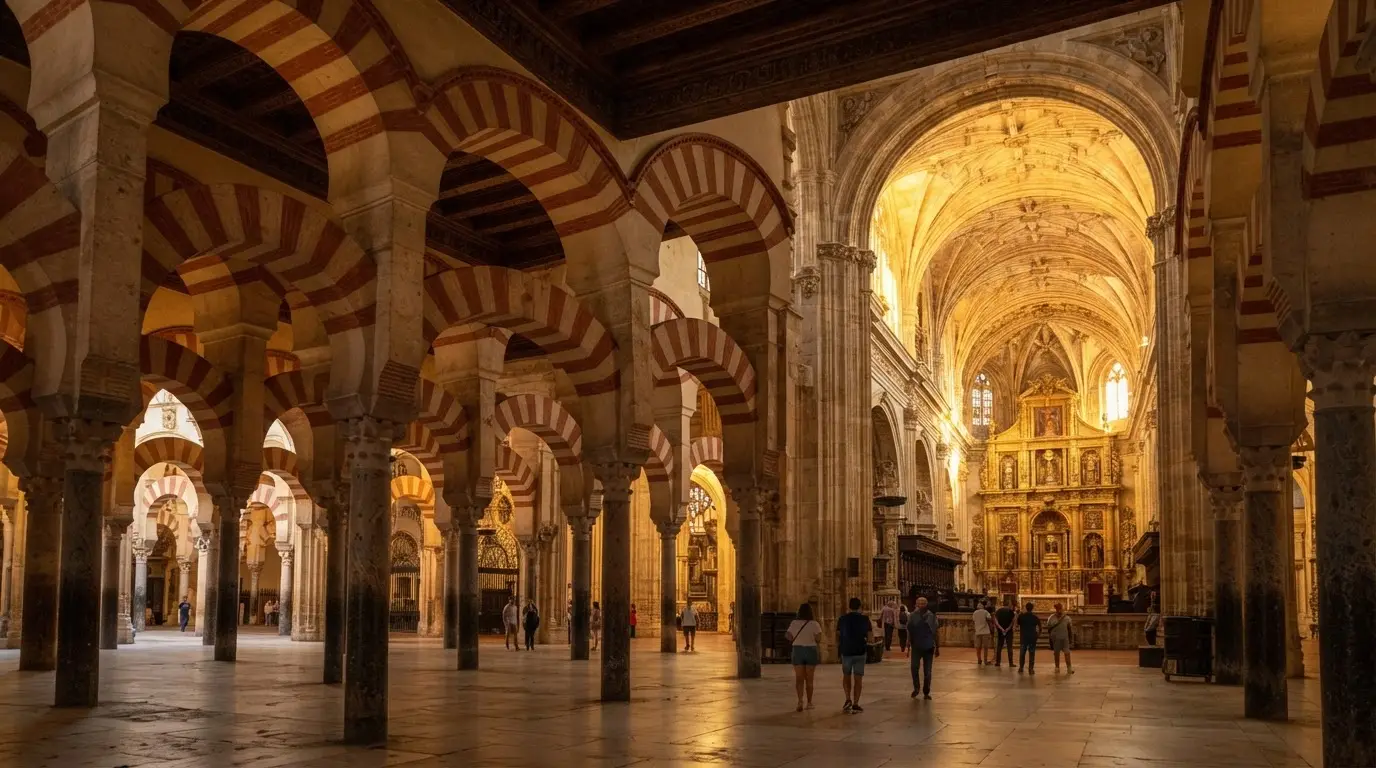
Do not expect a standing medieval synagogue. In Córdoba the Synagogue on Calle Judíos survives; Lucena's evidence is mostly underground and in display cases, which makes the interpretation centre more useful than it sounds.
I could not source opening hours or ticket prices for the necropolis, so confirm them with Lucena's tourist office before you go. If you are building a wider route, pair it with a day in Córdoba's Judería and our guide to Jewish heritage in Córdoba. Lucena also has a far older layer: Cueva del Ángel, an open-air site 5 km south of the town, with a disputed Neanderthal label.
Frequently asked questions
Why was Lucena called the "Pearl of Sepharad"?
The phrase comes from modern Andalucía tourism text, which says few Jewish communities in Al-Andalus became as famous as Lucena. The reputation rests on real things: an elected rabbi with judicial powers, a Jewish community that rivalled Córdoba's in importance by the 10th century, a Talmudic academy that flourished in the 11th, and a reputation for wealth. I found no medieval source for the epithet itself, so treat it as heritage branding rather than a period title.
Was Lucena really governed entirely by Jews?
No. The community governed its own affairs: its rabbi was elected by everyone and judged civil and criminal cases, and Jews lived inside the walls while Muslims lived outside. But Lucena stayed under Muslim rulers, who intervened, as when the Almoravid Yusuf ibn Tashfin pressed the Jews around the turn of the 12th century and when the Almohads destroyed the community. The tourism board's "almost an independent republic" is rhetoric; self-governed under Muslim rule is the accurate phrase.
What is the Lucena Jewish cemetery and when was it excavated?
It is a medieval Jewish necropolis found in 2006 during construction of Lucena's southern ring road. It holds 346 catalogued graves and is described as the largest Jewish cemetery ever excavated in Spain. Counts vary slightly between sources. In 2014 wooden walkways were being built over the graves so visitors could see them without stepping on them.
How does Lucena relate to Maimonides and Córdoba's Jewish heritage?
Maymun, the father and teacher of Maimonides, is probably the best-known student of Joseph ibn Migash, head of the Lucena academy. Maimonides was only three when Ibn Migash died, so he was not a literal pupil. Lucena's Jewish community also rivalled Córdoba's in importance by the 10th century, which makes the two towns parts of one Andalusian Jewish world.
Can you visit Lucena's Jewish quarter today?
You can visit the Jewish necropolis, the Palace of the Counts of Santa Ana Interpretation Center with its "Jews" room, the Vela Tower from the old walls, the Ibn Migash bust in Plaza de Santiago and the museum in El Moral Castle. I could not source opening hours or prices, so check with Lucena's tourist office first. There is little surviving medieval Jewish architecture, so the experience is archaeological and interpretive.
Where does Lucena Cordoba Jewish history begin?
The earliest record is a legal responsum of 853 by Natronai Gaon, which called Lucena (Alisana in Arabic) a Jewish place with no gentiles. Tradition holds that Jews founded the town, but that is tradition rather than documented fact. By the 10th century its Jewish community was important enough to compete with Córdoba's.
When did Lucena's Jewish community end?
The Almohads destroyed it in the mid-12th century and forced its Jews to accept Islam. The Jewish Encyclopedia gives 1146; Wikipedia dates the Almohad conquest of Lucena to 1148, and the sources do not agree. Castile conquered the original town in 1240. Separately, many Lucena Jews moved north to Navarre near Tudela and named their settlement Lucena.
“The necropolis is the largest Jewish cemetery ever excavated in Spain, and it contains 346 catalogued graves, many of them centuries old, according to Europa Press.”
“Their rabbi, who was elected by the entire community, was granted special privileges, and acted as judge in the civil and criminal cases arising in the community.”
“In the 11 th century Isaac b. Judah *Ibn Ghayyat taught in the yeshivah of Lucena. He was succeeded by Isaac *Alfasi who was followed by Joseph *Ibn Migash.”
“In 1066 the widow of *Joseph b. Samuel ha-Nagid and her son Azariah were among the refugees who came to Lucena in the wake of the anti-Jewish outburst in Granada”
“The grammarian Jonah ibn Janāh and the poets Moses and Abraham *Ibn Ezra, *Judah Halevi, and Joseph *Ibn Sahl were active in Lucena at some time during their lives.”