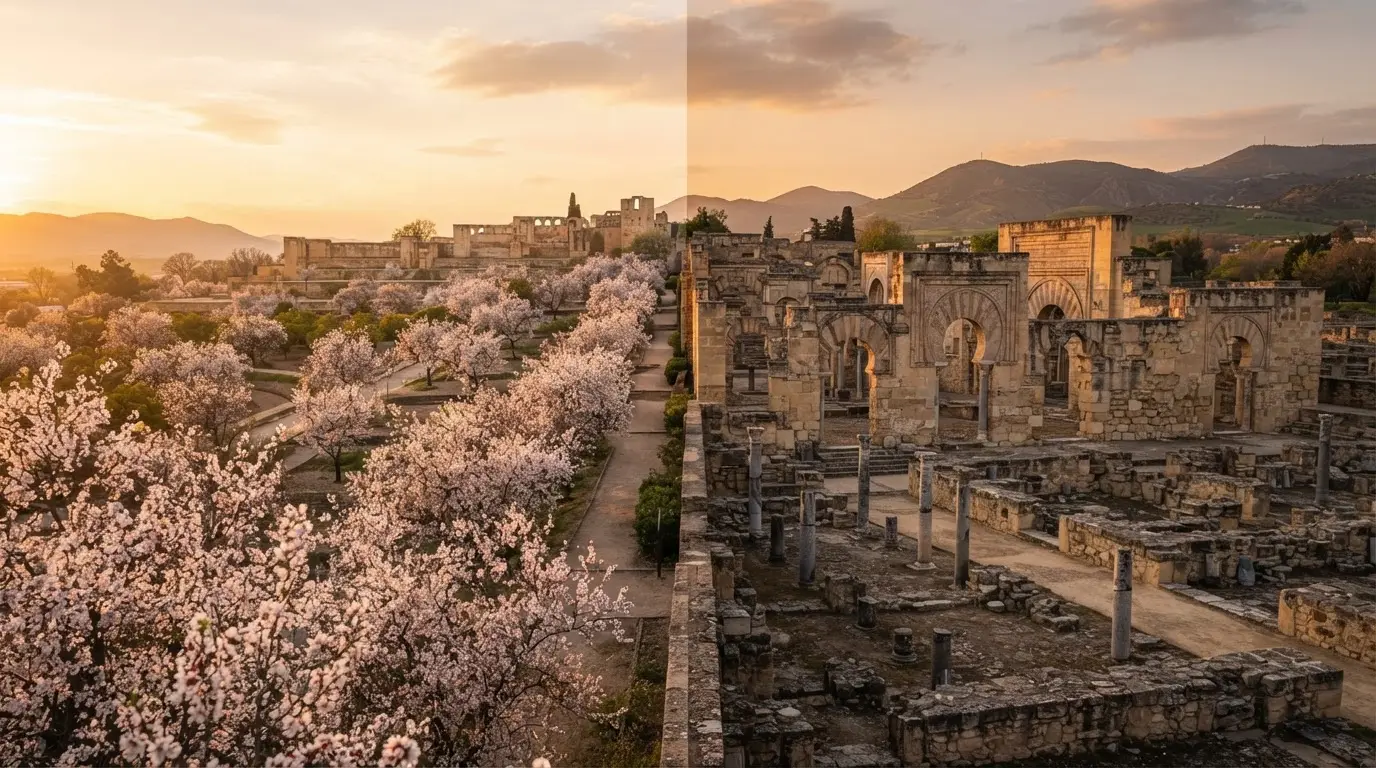

The legend, as it's told
Medina Azahara's own official tourism page still prints the version most visitors hear first: that Abd al-Rahman III, in 936[12], built the city-palace "in honour of his favourite, Azahara."[1] Guides on-site repeat it. Travel blogs run with it. It has the shape of a good story: a ruler besotted enough to raise an entire capital for one woman. Good stories survive scrutiny far longer than they deserve.
The fuller version, assembled from later medieval retellings and still circulating in tourist literature today, adds specifics no single primary source actually confirms:
- The caliph's favorite, called Az-Zahra ("the bright one"), is said to have come from a cold, mountainous region in the north; some modern retellings guess Navarre[4]
- Homesick, she is said to have missed the snow she would never see again in Córdoba
- The caliph supposedly ordered an entire hillside planted with almond and fig trees, so their blossom each January through March would give her something resembling snow
- A statue of her, in some versions, stood over the city's main gate
It is, admittedly, a better story than "the caliph needed a capital." That is also the problem with it.
Who recorded it, and what doesn't survive scrutiny
The legend has an actual paper trail, just not a strong one: medieval writers "such as al-Maqqari" repeated the tale of a favorite wife and a gate-side statue long after Medina Azahara had already been built, sacked, and forgotten. Al-Maqqari, the compiler most often named as the source, was working from material centuries removed from the events he described. Marianne Barrucand, surveying the site's surviving statuary, finds no basis for the specific figure the story describes.[5]
Even the popular sources that keep the romance alive can't quite commit to it as fact. One retelling hedges even as it repeats the tale, calling Azahara only "believed to be a reference to the caliph's favorite concubine"[6] — a guess dressed as biography. No inscription from the site, no court chronicle, and no administrative record names a specific woman the city honors.
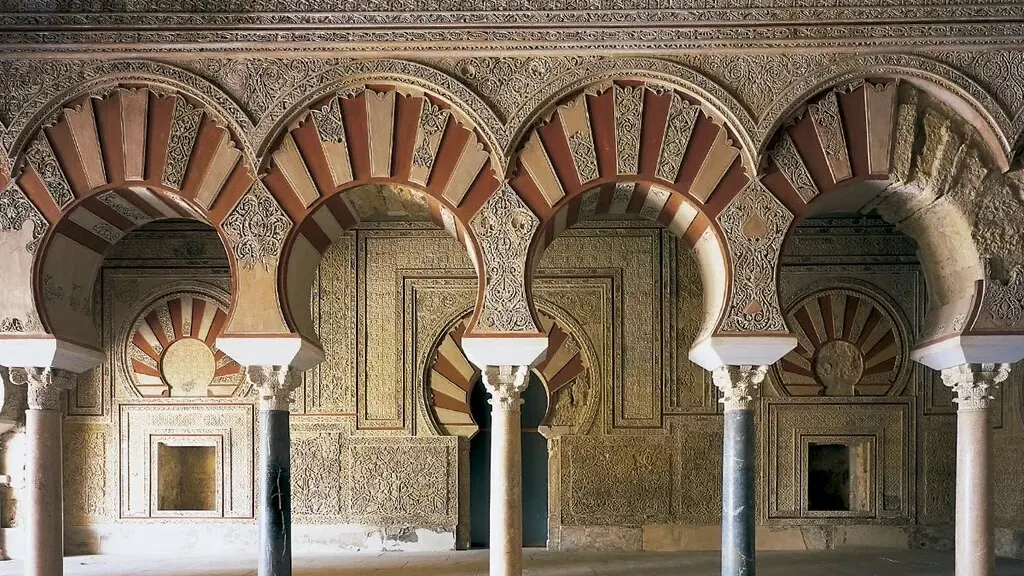
Explore nearby · Monument
Medina Azahara
Medina Azahara is Córdoba's UNESCO listed Caliphate City: a 10th century palace 8 km from town, with the Salón Rico and award-winning museum. Plan your visit.
What the sources agree on is more mundane and, to anyone who has actually walked it, more interesting: Medina Azahara is real, its scale is documented in exhaustive archaeological and administrative detail, and none of that documentation mentions a wife.
What the name actually means, and who it was for
Strip the woman away and the name still does real work. Madīnat az-Zahrāʾ is most often translated as "the radiant city," though one independent reference glosses the same palace-city more plainly, with "literal meaning 'the shining city.'"[7] Az-Zahra' shares its root with the Arabic word for blossoming: radiance, brightness, flowering, which is why some translations render it "the flowering city" instead. None of these translations require a person behind them. They describe light.
The architectural historian Felix Arnold reads the choice of name as following a pattern, not commemorating a person. Two other 10th-century capitals had already used the same trick: a brand-new caliphal seat with a name that announced the caliphate's character before a visitor set foot inside it.[2] Córdoba's rivals had gotten there first. Set the three side by side and the pattern is hard to miss:
| Caliphate (new capital) | Name given to it | What the name announced |
|---|---|---|
| Abbasids, Baghdad | Madinat al-Salam ("City of Peace") | A caliphate secure enough to promise peace |
| Fatimids, Cairo | al-Qahira ("The Victorious") | A caliphate that conquers |
| Umayyads, Córdoba | Madinat az-Zahra ("The Radiant City") | A caliphate as dazzling as both rivals |
A ruler declaring himself equal to Baghdad and Cairo does not build a monument to a housewife's homesickness. He builds a city whose very name says: we belong on this list too.
The Fatimid rivalry, and the politics behind 929
There's a sharper theory still, from the art historian Jonathan Bloom. The Fatimid dynasty, Abd al-Rahman III's rivals in North Africa, traced its legitimacy to Fatimah, the Prophet Muhammad's daughter, who carried her own honorific: az-Zahra, "the Radiant." Bloom argues the chosen name for the new capital doubled as a religious rebuttal, claiming that title for the Umayyads before the Fatimids could treat it as a dynastic trademark.[8] Read this way, the name isn't a love letter. It's a counter-punch.
A Córdoba tourism magazine ran the same reversal under a "Myth & Reality" header: politics, not romance, is what "drove the Caliph to build so magnificently."[9]
In 929, Abd al-Rahman III went further than any Umayyad ruler before him: he declared himself "utterly independent"[10] and took the caliphal title outright, a claim covered in full in our profile of Abd al-Rahman III. The habit of naming a new capital to make a political point outlived him, too. Half a century later, the strongman Almanzor built his own rival palace-city east of Córdoba and gave it a name close enough to cause confusion ever since: Madinat al-Zahira, not to be mistaken for Madinat az-Zahra.
Recommended tours
Tours are selected for quality, not commission. We earn a small fee if you book — at no extra cost to you.
UNESCO's own inscription documents agree with the political reading, for what it's worth. The site's Outstanding Universal Value statement ties it to the decade the Umayyad caliphate was "proclaimed in the Islamic West"[11], not to any private commission.
Why the legend keeps getting told
None of this makes the legend malicious. UNESCO's own listing text, plain and administrative, states only that the site served "as the seat of the Caliphate of Cordoba"[3]: accurate, useful, and far less interesting to a tour group than a lovesick caliph. Guides tell the story that keeps people listening; marketing departments repeat what guides say. Córdoba's tourism apparatus already leans on one grand myth of interfaith romance (see our piece on Córdoba's convivencia story), so a second one costs nothing and keeps the walking tour interesting.
The building itself is the better story anyway: a caliph proving his new title mattered by raising a functioning capital from nothing, then losing it to Berber mercenaries within a century of the first stone being laid. That story, told in full in how Medina Azahara was built, sacked, and rediscovered, doesn't need a wife in it to be worth the visit. For where this era fits into a longer trip, our guide to Córdoba for history lovers has the rest of the itinerary.
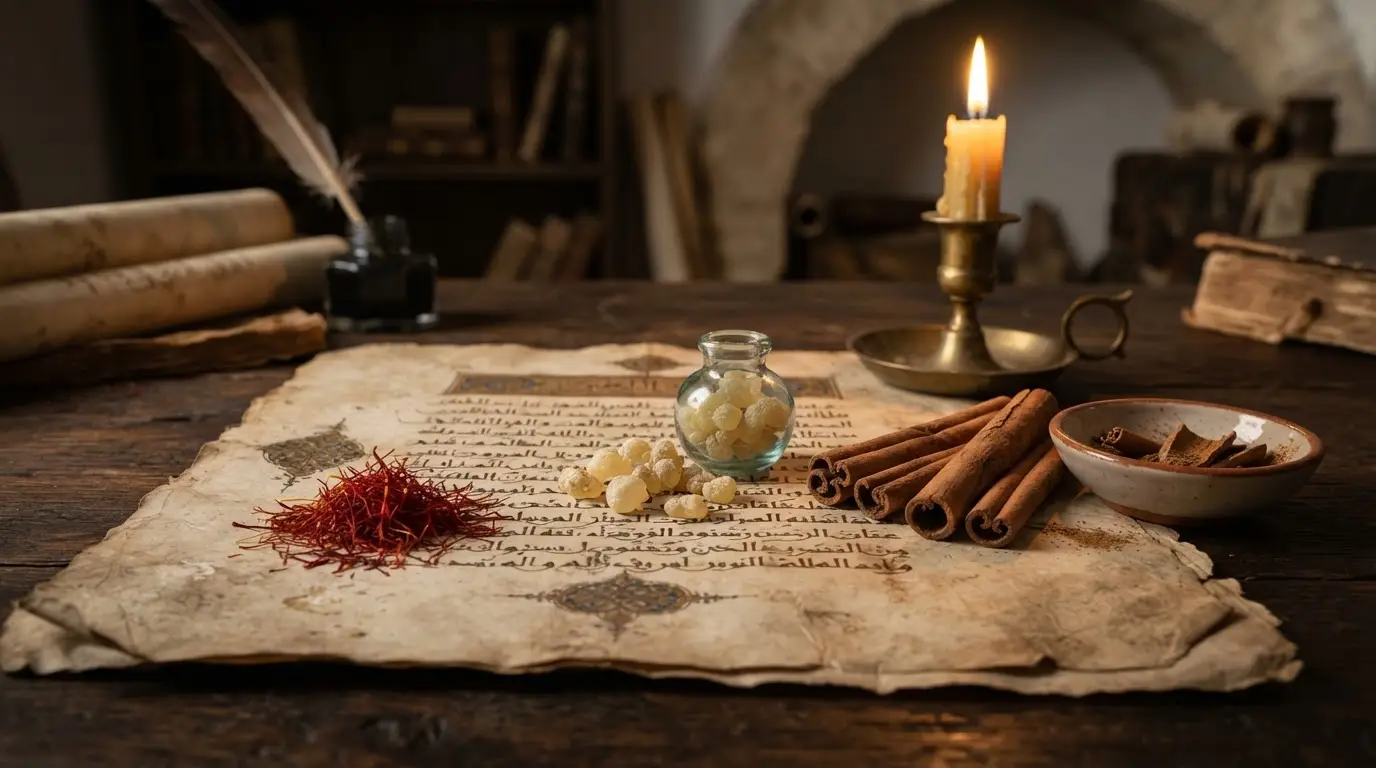
Deep dive · Article
Caliphate Food in Córdoba: How Noor Rebuilt a Lost Kitchen
Paco Morales spent years in medieval manuscripts before opening Noor. What caliphate food córdoba actually was — and how he rebuilt it without a single tomato.