
Queues at the Mezquita reach two hours in summer. This guided tour solves that problem with skip-the-line access and adds what solo visits miss: understanding what you're actually looking at.
What a guide changes
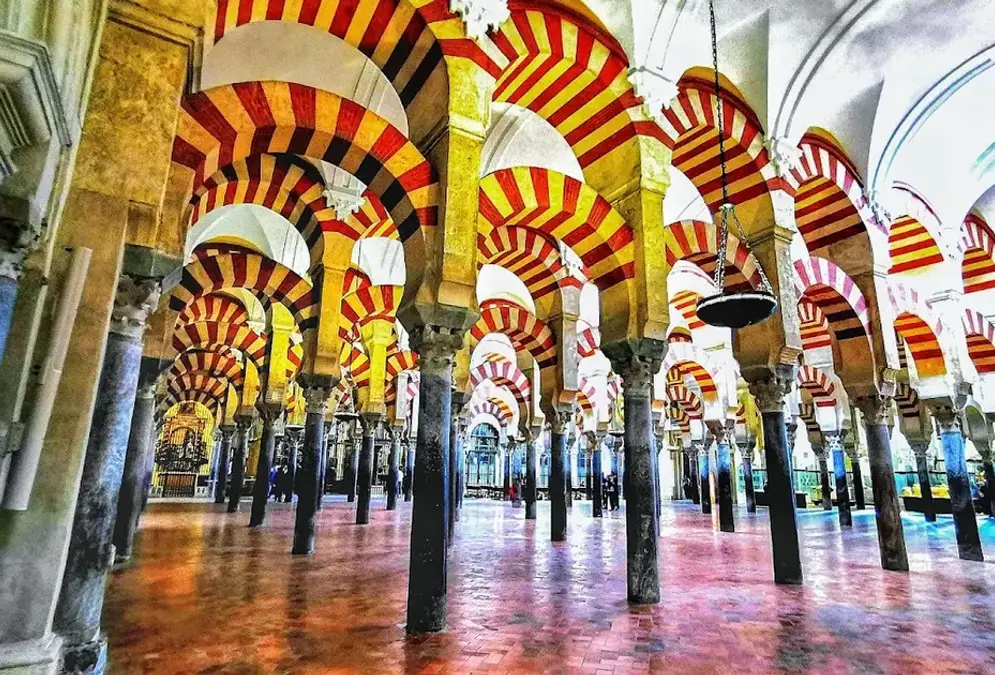
The Mezquita-Cathedral is one of those places that bewilders without context. You walk into a forest of 856 columns, striped red-and-white arches disappearing in every direction, and you have almost nothing to anchor the experience. A good guide gives you that anchor.
The columns themselves are the first lesson. Abd al-Rahman I built the original mosque in 784 CE by recycling materials from a Visigothic church that stood on the same site. Look closely at the capitals: some are Roman, some Visigothic, some simply improvised to make mismatched shafts reach the same height. Your guide points this out; most solo visitors walk straight past it.
Deeper into the prayer hall, the Capilla de Villaviciosa is where the strangeness becomes legible. It sits under Al-Hakam II's 10th-century dome, where the first Christian altar was installed in 1236 after the Reconquest; the Gothic nave followed in 1489. The ribbed vaulting sits above horseshoe arches that belong to a different civilisation entirely. Neither element fights the other. A guide explains exactly why: the Christian builders kept the mosque's vocabulary deliberately, to signal continuity of power without destruction.
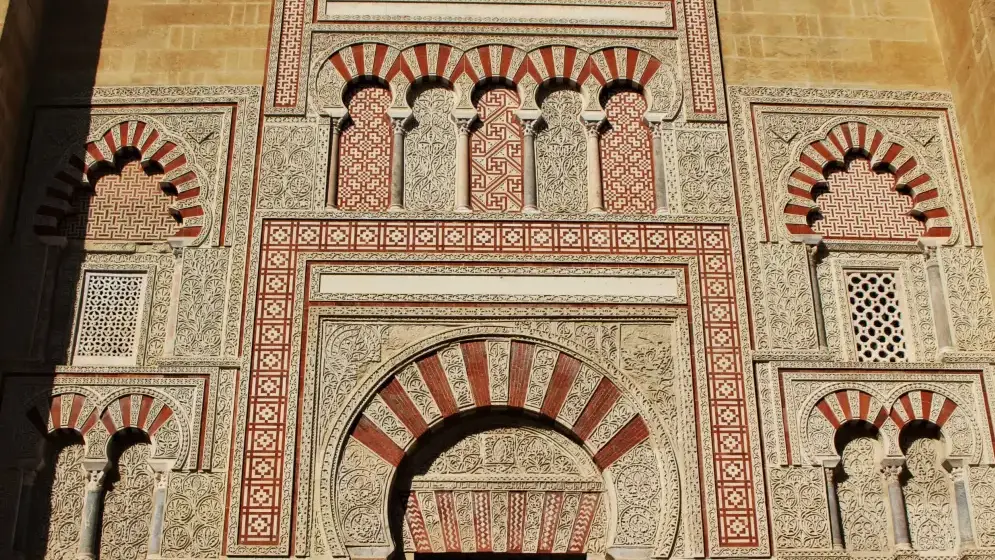
The mihrab, at the southern end of the prayer hall, is the tour's centrepiece. Built under Caliph Al-Hakam II between 961 and 976, its facade is covered in Byzantine mosaics: gold, green, and blue tesserae sent by the Emperor in Constantinople as a diplomatic gift. The niche itself is carved from a single block of marble. Stand at the threshold and you can hear it: the dome shape focuses sound back onto the reciter, a built-in amplifier in stone. Your guide demonstrates this. You cannot replicate that moment with an audio guide.
The Christian cathedral nave, added in 1523 over the protests of the city council, punches through the centre of the mosque. Charles V, on seeing the result, reportedly said the builders had destroyed something unique to create something ordinary. The guide explains what was lost and what has survived, which transforms what might otherwise seem like architectural damage into a coherent story about power, time, and competing visions of the sacred.
Tour format
The tour meets at the Patio de los Naranjos, the walled courtyard of orange trees on the north side of the Mezquita. Arrive 10 minutes early: the courtyard itself is worth a few minutes before you enter. The irrigation channels that run between the orange trees follow the same lines as the original 8th-century ablution pools. It is a quiet place in the morning, before the day-trippers arrive.
Official tours cap groups at 10 people maximum, which means you can actually ask questions without holding up 40 people. All guides are certified and accredited by the Junta de Andalucía, which requires specialist training in the monument's history. Several speak real, fluent English.
Timing, crowds, and combo tickets
Duration: 1h15 to 1h30 depending on the group. Daily departures from 10 am to 6 pm except public holidays.
Crowd patterns matter here. July and August bring peak queues, but even in shoulder season, mid-morning arrivals (10:00–12:00) see the longest waits. The monument is busiest on Saturdays. If you have flexibility, a mid-week morning in late spring or October gives you lighter crowds and softer light through the clerestory windows.
The Torre Campanario (bell tower) requires a separate ticket but is worth the addition if the heat allows for it. It was built around and over the original minaret, and the views over the Casco Histórico and the Roman Bridge below are the best elevated perspective in the city. Combine it with your guided visit ticket at the desk or book online for a small discount.
Booking in advance is strongly recommended. Official small-group English tours fill fast, particularly from March through October. Book at least 48 hours ahead. Without a booking, you risk ending up in a larger third-party group of up to 45 people.
After the visit
You're in the Judería. Your ticket also gives access to the Episcopal Palace directly opposite. Its Diocesan Museum holds Islamic and early Christian art (allow 45 min). Walk through the lanes to the Synagogue (5 minutes on foot), one of three surviving medieval synagogues in Spain, built in 1315.
For something completely different, the Mezquita Night Tour opens the monument after closing time with atmospheric lighting. If budget is tight, the Córdoba free walking tour gives a free introduction to the historic centre including a pass in front of the Mezquita (entry not included). In May, the flowering patios tour in the Judería and San Basilio makes an ideal follow-up.