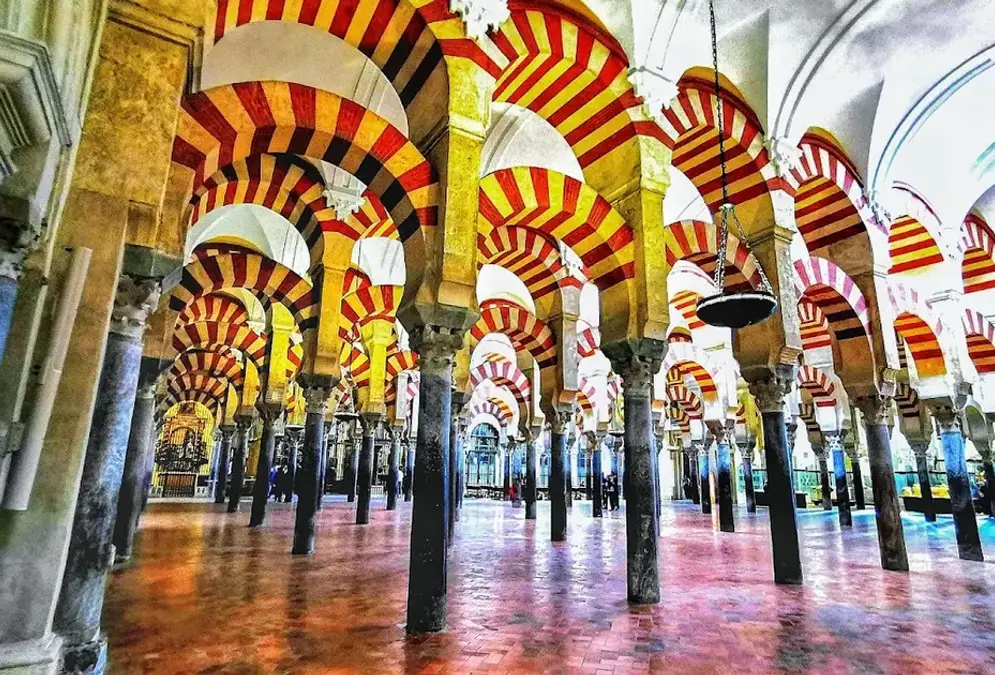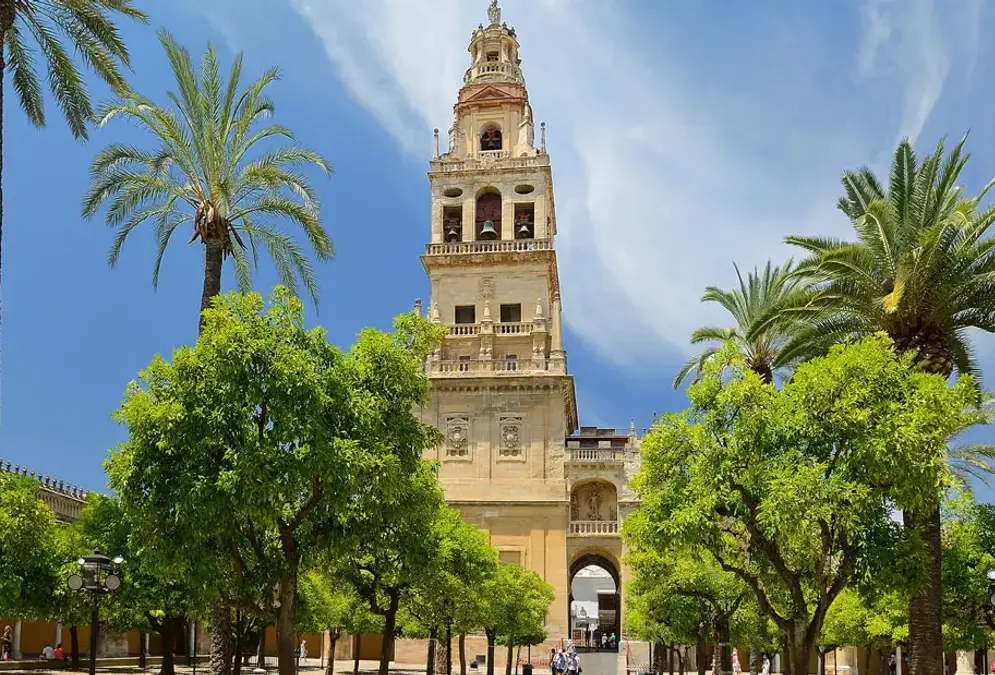

The Torre Campanario of the Mezquita-Catedral is the best viewpoint in Córdoba — and also one of its most overlooked. Visitors queue for the mosque below, pay the €4 supplement for the tower, and often find themselves with a third of the space and a tenth of the crowds. At 54 metres, the views take in the full spread of the old city: the Roman Bridge arching over the Guadalquivir, the Alcázar de los Reyes Cristianos to the south-west, the rooftops of the Judería, the Sierra Morena hills in the distance.
When to Visit
Best season
October to May (afternoon tours suspended in July–August)
Quietest hours
First tour of the day (9:30)
Visit duration
40 minutes (including ascent, time at top, and descent)
Minaret, bell tower, earthquake, and reconstruction
The tower's history runs deeper than its current form suggests. The original structure was built as an Islamic minaret between 951 and 958 CE under Abd ar-Rahman III, during the height of the Umayyad Caliphate. From its top, the muezzin would have called the faithful to prayer five times a day across a city of perhaps 100,000 people — one of the largest in 10th-century Europe.
After the Reconquista in 1236, the minaret was converted into a bell tower, with Christian bells installed to serve the newly consecrated cathedral. The transition was not uncommon: Islamic minarets across Andalusia were repurposed rather than demolished. The Giralda in Seville followed the same logic.
In 1589 an earthquake damaged the tower severely. The repair commission fell to Hernán Ruiz III, who took the unusual approach of encasing the surviving Moorish minaret within an entirely new Renaissance shell rather than rebuilding from scratch. The visible exterior today — with its Renaissance stone decoration, octagonal lantern, and cupola topped by a bronze statue of San Rafael — is therefore a kind of architectural Russian doll: a 16th-century tower around a 10th-century minaret. Inside, as you climb, the transition between the original brickwork and the later stonework is visible in places.
The 360-degree view from the top is the single best panorama of Córdoba
After 150 steps, the rooftop gives you the Roman Bridge, the Alcázar gardens, the river, the Sierra Morena foothills and the rooftops of the Judería in one sweep. No other viewpoint in the city comes close. Bring a wide-angle lens.
The climb
Access is via guided tours only, departing every 30 minutes from 09:30 to 17:30 (afternoon tours suspended July and August). Groups are capped at 20 people. Children under 7 are not admitted, and the climb involves narrow, steep spiral stairs — not suitable for anyone with significant mobility limitations.
The ascent has 150 steps. It is not particularly demanding, but the staircase is tight enough that there is no room to pass someone coming the other direction, which is why the timed group system exists. At the top you emerge onto an open platform beneath the lantern. The bells are close enough that you feel the vibration when they ring — timing your visit around the hour is worth considering, both as an experience and as a warning.
A €4 ticket gets you into the tower; this is separate from the main Mezquita-Catedral entry fee. You buy it at the Mezquita ticket office and join the next available tour group.