
Packing guide
What to Pack for Córdoba
A practical packing list built around Córdoba's realities: cobblestone streets, summer heat, dress codes and the gear that actually earns its luggage space.

Written by
María Fernanda González Ten years covering Córdoba's UNESCO heritage sites, sourcing from Junta de Andalucía documentation.
Updated Published
At a glance
- Summer temp
- July avg 37°C — one of Europe's hottest inland cities
- UV index
- Up to 9 (very high) Jun–Aug — reapply SPF 50+ every 90 min
- Street surface
- Cobblestones throughout the historic centre and Judería
- Dress code
- Shoulders + knees covered at Mezquita — strictly enforced
- Power outlets
- Type F (Schuko), 230V — bring adapter if non-EU
- Luggage tip
- 2-wheel trolley or backpack — spinner wheels jam on cobblestones
Most generic "Spain packing lists" are written for Barcelona in spring. Córdoba operates by different rules: medieval streets built for mules, not wheeled luggage; a summer climate that ranks among Europe's most extreme; and monuments with real dress codes, strictly enforced at the door. The sections below address each of those realities directly.
In this guide
Jump to a section
Spring & autumn packing (Mar–May, Sep–Oct)
The best seasons to visit Córdoba. Spring runs 18–27°C; autumn 26–31°C in September before cooling to 26°C by October. Both seasons cool sharply in the evenings — layering is more practical than packing a heavy jacket.
Clothing
- Light jeans or chinos (versatile day-to-evening)
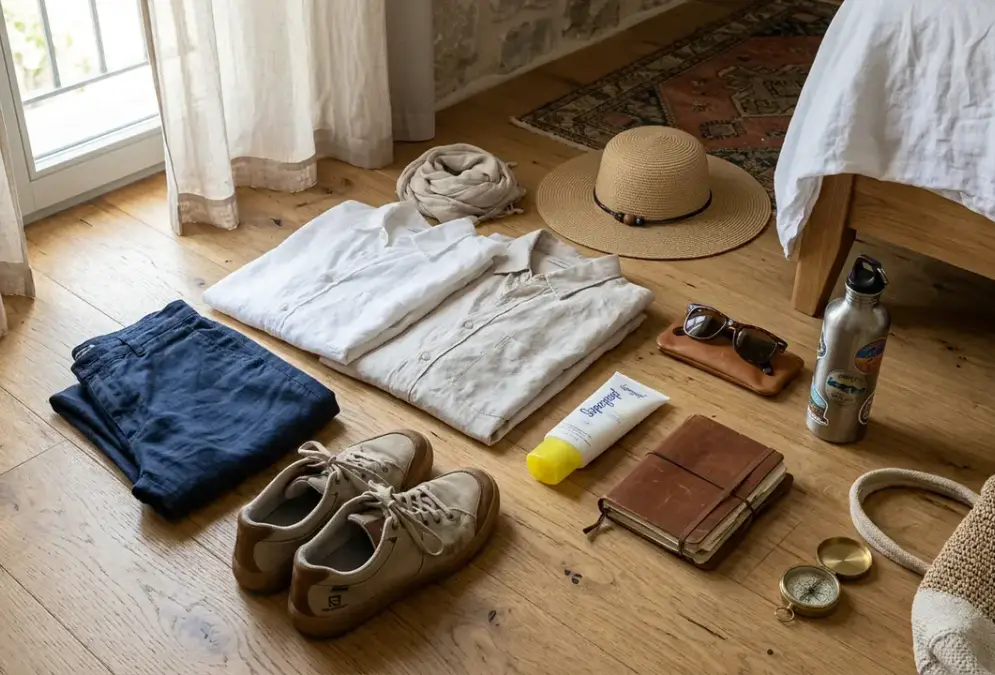
- 3–4 breathable tops (linen or cotton)
- Light jacket or cardigan for evenings
- One smart-casual outfit for restaurants
- Walking shoes with rubber soles — non-negotiable for cobblestones
- Comfortable sandals for hotel evenings only
Essentials
- SPF 30+ sunscreen (UV still strong Apr–May, Sep)
- Sunglasses
- Lightweight scarf or pashmina (dress code + cool evenings)
- Refillable water bottle
- Small day bag — crossbody or backpack, not a dangling tote
- EU power adapter if coming from UK, US or Australia
May Patio Festival
If visiting during the Patio Festival (early May), comfortable shoes matter more than ever — you may be on your feet for 4–6 hours walking between competing patios in the Judería. Plan your footwear around the festival, not around dinner.
Summer packing (Jun–Aug)
Córdoba averages 36–37°C in July and August — peaks above 40°C are common. It sits in an inland basin with low humidity, which makes the heat feel dry but is deceptively dangerous for dehydration. The Mezquita's marble courtyard and open plazas amplify UV. Pack defensively: heat illness ruins trips faster than anything else.
Clothing
- Loose, light-coloured breathable tops (linen or moisture-wicking)
- Lightweight trousers or midi skirt (sun protection + dress code in one)
- Very light cardigan for air-conditioned museums
- Closed-toe walking shoes — sandals slide on hot, smooth cobblestones
Heat survival kit
- SPF 50+ sunscreen — minimum 200ml per person per week outdoors
- Portable folding fan or compact USB fan (locals use them — they work)
- Refillable insulated water bottle — cold water is non-negotiable
- Lip balm with SPF
- After-sun lotion
- Sunglasses — polarised for marble and stone glare
- Lightweight hat or cap
Marble reflects UV upward
The white marble of the Patio de los Naranjos and the Alcázar gardens reflects ultraviolet radiation upward from below. Standard single sunscreen application is not enough — reapply every 90 minutes outdoors, including on overcast summer days.
Winter packing (Nov–Feb)
Mild by northern European standards — 13–19°C by day — but Córdoba can surprise. December through February is the wettest season (combined ~265mm), and the wind off the Guadalquivir adds a chill. Many sunny days mean UV is still present; layers work better than one heavy coat.
Clothing
- Medium-weight jacket or trench coat
- Fleece or knit layer underneath
- Rain-resistant outer layer or compact travel umbrella
- Jeans or warmer trousers
- Walking shoes — waterproof if possible, cobblestones get slippery when wet
- Light scarf for monument dress code
Essentials
- Compact travel umbrella — packs flat, earns its space Dec–Feb
- SPF 20+ even in winter (UV still present on clear days)
- Portable power bank — shorter days mean longer evenings with devices
Packing by activity
Monuments & culture
- Scarf or shawl — shoulders covered is strictly enforced at the Mezquita
- Comfortable walking shoes — monument floors are uneven historic stone
- Light layer for air-conditioned interiors
- Printed or downloaded tickets — mobile signal is poor inside the Mezquita
Day trips & hiking
- Hiking boots or trail shoes — Medina Azahara has uneven archaeological terrain
- High-capacity water bottle (2L) for Sierra Subbética day hikes
- Sun hat — no shade on open archaeological sites
- Light rain layer — mountain weather changes quickly in shoulder seasons
Nightlife & dining
- Smart-casual clothes — Córdoba dresses up in the evening, jeans and a clean top at minimum
- Shoes that work on cobblestones — heels on uneven stone are a liability
- Light layer for outdoor terrace evenings — temperatures cool after midnight even in summer
Córdoba-specific essentials
These are the items most often absent from generic Spain packing lists — things Córdoba specifically demands because of its streets, its monuments, and its climate.
Cobblestone-ready footwear
The Judería, the streets around the Mezquita, and most of the historic centre are paved with smooth, round cobblestones worn slippery by centuries of foot traffic. Avoid heeled sandals, smooth leather soles, and flip-flops. Pack rubber-soled trainers, city walking shoes, or low-heeled boots. A typical tourist route through the old town covers 3–5km daily — footwear choice is not a minor decision.
Break in new shoes before the trip. Blisters on cobblestones are especially punishing.
Hand fan (abanico)
Locals carry them from May to September as practical tools, not tourist souvenirs. A folding fan needs no battery, fits in any pocket, and outperforms a small USB fan for spot cooling during outdoor queues. Buy a quality abanico on arrival at a souvenir shop rather than packing a cheap tourist version — locally-made fans are sturdier and worth the few euros extra.
Modesty layer
A lightweight scarf or pashmina does four jobs: Mezquita and Alcázar dress code compliance, sun protection on exposed streets, warmth in aggressively air-conditioned restaurants, and improvised cover-up for day trips to the river. One item, four uses. Pack one regardless of season.
Power adapter
Spain uses Type F (Schuko) outlets at 230V/50Hz. UK travelers need a Type F adapter. US and Canadian travelers need a Type F adapter — check whether your devices are dual-voltage (100–240V is printed on the charger brick). Most modern phones, laptops and cameras are dual-voltage; older appliances and some hair dryers may be single-voltage and need a converter.
Travelling with a dog
Andalusia mandates a non-extendable leash of maximum 1 metre in public spaces, stricter than the national 2-metre default. Pack a short leash, a collapsible water bowl (park fountains are not guaranteed at every stop), and a muzzle if your dog is a Potentially Dangerous breed. Full guidance: pet-friendly Córdoba guide.
What you don't need to pack
Córdoba has pharmacies on almost every block in the historic centre. Sunscreen, basic medicines, moleskin for blisters, and standard toiletries are easy to buy locally if you forget them. You don't need to over-pack toiletries — that space is better used for a quality pair of walking shoes.
Luggage recommendations for Córdoba
Spinner suitcases (four small wheels) are designed for airport floors and hotel lobbies — their 2–2.5 inch wheels jam and crack on cobblestone joint patterns. Two-wheel trolleys (inline wheels, tilted back on rear wheels) and rigid backpacks handle Córdoba's streets significantly better.
| Luggage type | On cobblestones | Best for |
|---|---|---|
| 2-wheel trolley (carry-on) | Excellent | Trips up to 10 days, solo and couple travel |
| Travel backpack (40–50L) | Excellent | Active travelers, hostels, multi-city trips |
| 4-wheel spinner (carry-on) | Manageable | OK if hotel has direct road access |
| 4-wheel spinner (large, 26"+) | Difficult | Avoid unless hotel has step-free road access |
Brands worth researching
These brands are frequently recommended for European cobblestone travel. We have no affiliate arrangements with any of them — check current prices and availability before buying.
- Osprey Farpoint / Fairview — travel backpacks with lockable zips, carry-on compliant
- Travelpro Maxlite — 2-wheel trolleys with large-diameter wheels proven on cobblestones
- Peak Design Travel Backpack — modular design, carry-on compliant, 45L
- Rimowa Classic Check-In — 2-wheel aluminium, rolls smoothly on uneven surfaces
Packing FAQs
What shoes should I wear in Córdoba?
Comfortable closed-toe walking shoes with rubber soles are essential. The historic centre — especially the Judería and streets around the Mezquita — is paved with centuries-old cobblestones. Flip-flops and heeled sandals are uncomfortable and increase ankle-twist risk. Lightweight trainers or city walking shoes work well year-round. Break in new shoes before the trip — blisters on cobblestones are especially punishing.
Do I need to cover my shoulders at the Mezquita?
Yes. The Mezquita-Cathedral requires shoulders and knees to be covered — this is strictly enforced. A light scarf or pashmina takes up almost no luggage space and doubles as sun protection on hot days. The Alcázar gardens have no enforced dress code, but the same scarf is useful for museum interiors where air conditioning can be fierce.
What type of luggage works best on Córdoba's cobblestones?
Two-wheel trolley cases (inline wheels) handle cobblestones much better than four-wheel spinner cases. Spinner wheels (typically 2–2.5 inch diameter) jam and crack on uneven stone joint patterns. A carry-on two-wheel trolley or a 40–50L travel backpack is the most practical option. If you must bring a large suitcase, look for models with oversized wheels for better cobblestone clearance.
How much sunscreen should I bring for Córdoba in summer?
Bring more than you think you need. July and August average 36–37°C with a UV index regularly reaching 9 (very high). The white marble of the Patio de los Naranjos and the Alcázar gardens reflects additional UV upward. SPF 50+ is the baseline; reapply every 90 minutes outdoors. A full 200ml bottle per person per week is a reasonable estimate for summer visitors spending time outdoors.
Do I need a power adapter for Córdoba?
If you're coming from the UK, US, Canada or Australia: yes. Spain uses Type F outlets (Schuko — two round pins) at 230V/50Hz. Most modern electronics (phone chargers, laptops, cameras) are dual-voltage (100–240V) — check the label. UK visitors need a Type F adapter; US visitors need a Type F adapter and should verify dual-voltage on older appliances before packing a voltage converter.
Is a portable fan worth packing for Córdoba?
Absolutely for visits between May and September. Córdoba is one of Europe's hottest inland cities, with July and August averaging close to 37°C. A compact handheld USB fan (60–90g) or a traditional folding abanico takes up almost no space and makes outdoor queues and walking breaks significantly more bearable. Locals have used hand fans as practical tools for centuries — there's a reason the tradition persists.
Ready to plan your trip?
Once your bag is sorted, check the best time to visit and what to expect from Córdoba's climate month by month.
Further reading
Sources & further reading
3 references Show Hide
- AEMET — Córdoba climate data (opens in a new tab)
Spain's national meteorological agency — official temperature and UV index data for Córdoba
- Turismo de Córdoba — Visitor information (opens in a new tab)
Official Córdoba tourist office: monument access, dress codes and practical visitor guidance
- Mezquita-Cathedral — Official visitor guidelines (opens in a new tab)
Official dress code and access rules for the Mezquita-Cathedral