The Iglesia de San Francisco y San Eulogio is a Fernandine church in the Axerquía that hides a 13th-century foundation behind an 18th-century Baroque rebuild. It began as the Franciscan convent of San Pedro el Real, and its grey marble façade carries the only public sculpture of Ferdinand III in Córdoba. Come for the Baroque interior and the layered story. Do not expect a fixed timetable: no church-specific opening hours are published.
From San Pedro el Real to San Francisco
Córdoba surrendered to Ferdinand III on the day of St Peter and St Paul in 1236, and the king founded two convents soon after: San Pablo for the Dominicans and San Pedro for the Franciscans. The Franciscan house took the nickname el Real and kept it, with the friars in residence, until the 19th-century disentailment of Church property. That royal foundation is why the church counts among the Fernandine churches, the group tied to the conquest.
The convent did not survive the sale. It became a textile and chair factory, and the cloister was partly pulled down. Its materials were reused for the Café Gran Capitán and, in the case of the cloister's marble stair, for a manor house in Écija. In 1877 the church became the parish of San Francisco y San Eulogio, taking in the heritage of the church of San Nicolás de la Axerquía, which vanished that same year. That double name is the answer to the question most visitors ask at the door.
What the city did with the cloister
In 1982 the city council turned part of the old cloister into a public square, to a project by Carlos Luca de Tena y Alvear. The open ground around the church is still called the compás de San Francisco, a word for the walled forecourt of a convent.
Look up at both fronts
The 1731 marble façade has Ferdinand III, and the 1782 side portal on the street has a stone St Francis in a niche on its upper storey. Most visitors photograph only one.
What to look at
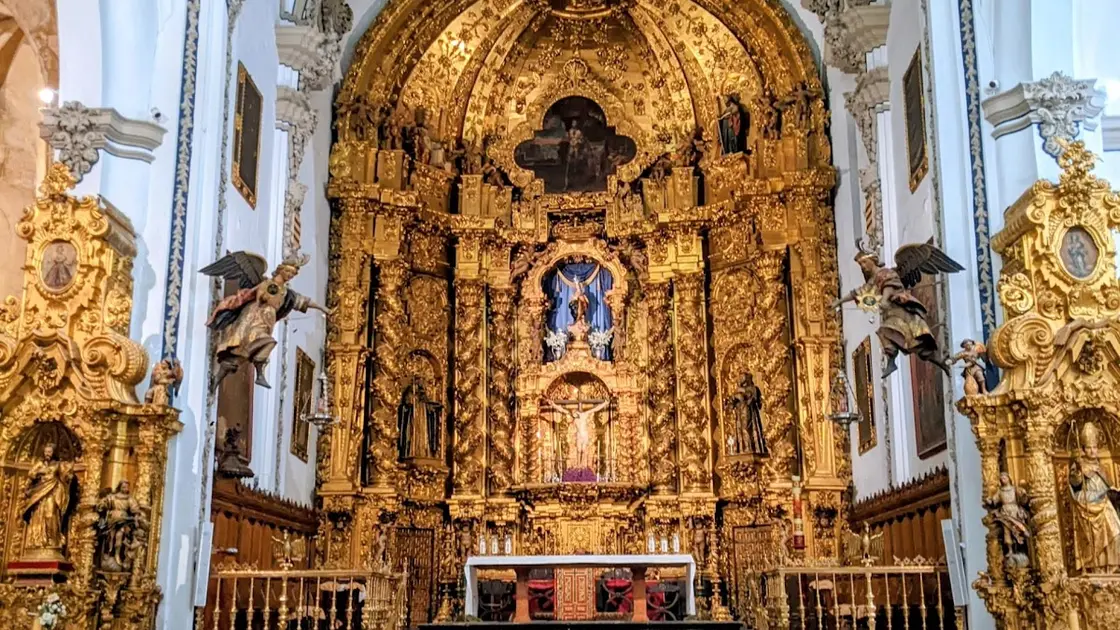
The church is a Latin cross under a barrel vault with lunettes. In the 18th century the walls and vault were plastered and decorated with gilded plasterwork, which is the look you see today. The crossing sits under an oval vault on pendentives, and the high altar is by Teodosio Sánchez de Rueda, dated 1720; its concave shape gives the east end some movement.
Outside, two fronts are worth separate attention:
- Main façade (1731): grey marble, with the statue of Ferdinand III.
- Side portal (1782): on the street side, with a stone figure of St Francis in a niche in the upper storey.
In the Chapel of the Sagrario stands the 16th-century Señor de la Caridad, the titular image of the Hospital de la Caridad brotherhood, whose hospital stands near the Plaza del Potro. The brotherhood was refounded in 1939 and processes on Maundy Thursday. The Junta de Andalucía funded a restoration by the architect Juan Jiménez Povedano, completed on 14 December 2007.