history-buffsarchitecture
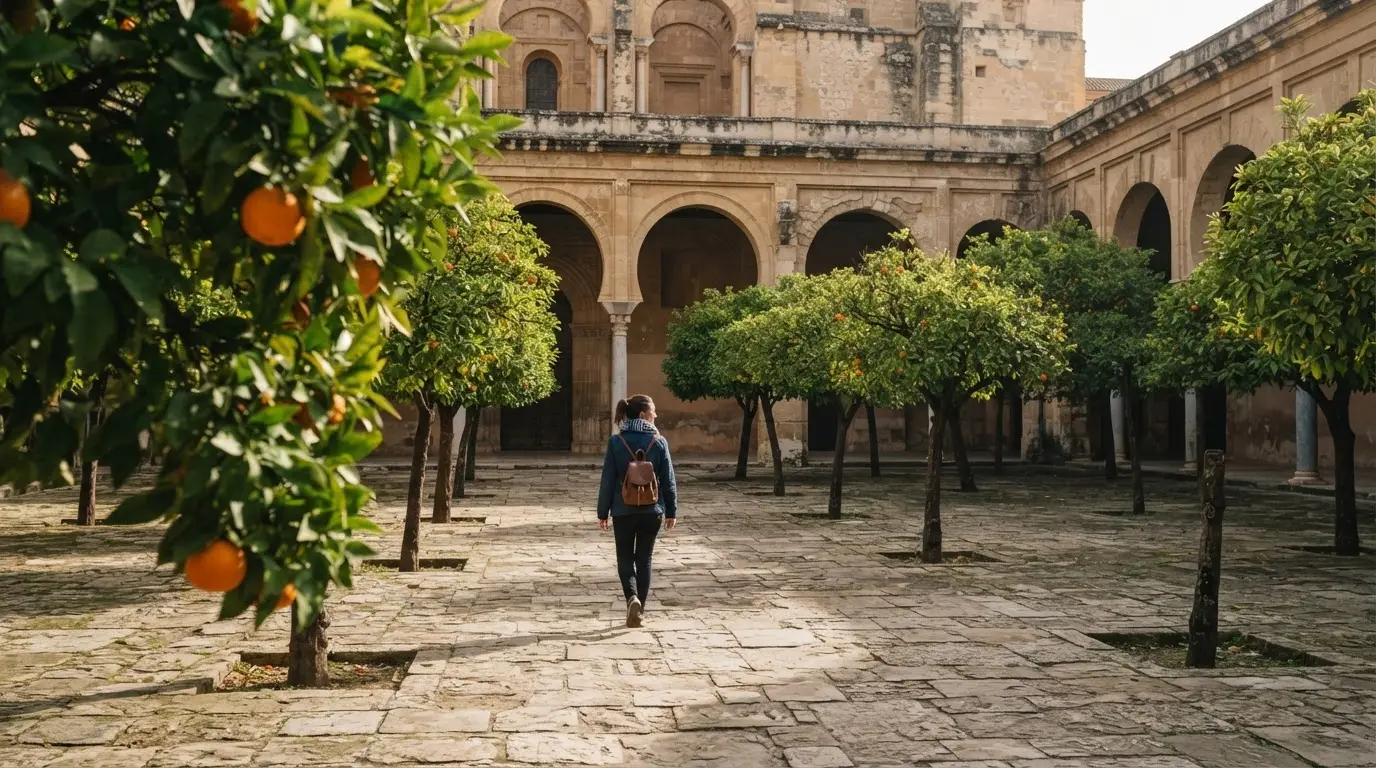
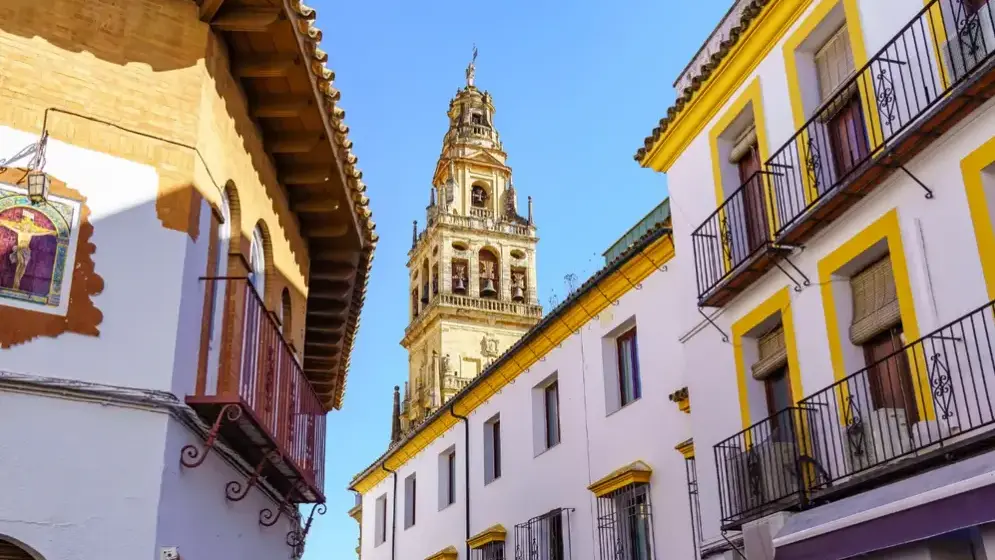
Patio de los Naranjos of the Mezquita-Catedral of Córdoba in morning light, a Roman milestone on a plinth by the arcade, evoking the temple of Janus Cordoba Mezquita myth

Was There a Temple of Janus Under the Mezquita of Córdoba?
The Temple of Janus under the Mezquita traces to a c. 1608 argument and a misread milestone. Here is what the inscriptions and excavations really show.

Portrait of Sophie Marchand
Written by

Art history background with eight years writing interpretive content on Córdoba's Caliphal heritage.

Published
Roman Corduba206 BCE–572
"The Mezquita was built on a Roman temple of Janus" is still repeated as fact, yet it began as a churchman's essay written shortly before Pablo de Céspedes died in 1608[1]. The two Roman milestones it rests on name an arch on the Baetis, not a temple in Córdoba[2], and the dig under the Patio de los Naranjos points to a 5th-century episcopal complex instead[3]. What lies beneath the building is a Christian layer, not a pagan one, and its San Vicente basilica remains, in the basement of the monument, are what a visitor can actually go looking for[4].
Céspedes's Janus essay
1608
Discurso on the cathedral as a temple of Janus, written shortly before he died[1]
What the milestones name
Ianus Augustus
A monumental arch on the Baetis, not a temple in Córdoba[2]
Episcopal complex, 2021 dig
5th century
Patio de los Naranjos dig points to the city's centre before the caliphate[3]

Where the Janus theory comes from

The theory has a paper trail, and it starts with a cathedral prebendary rather than a Roman text. Pablo de Céspedes held his cathedral post for over thirty years, from 1577 until his death in 1608[5], and his essay answered an antiquarian tradition about the building that Ambrosio de Morales had started in the last third of the 16th century[6].
Céspedes closed his argument by identifying Janus with Noah, which carried the temple all the way back to early Christianity[7]. A pagan shrine, a biblical patriarch and a Christian cathedral could then share one foundation story.
As a chain of reasoning it is tidy, and that is part of its appeal: two stones, one god, one patriarch, one cathedral. It is also a chain with a single weak link at the start. Everything depended on two milestones, and on what the inscriptions on them actually say. If the first link breaks, the Noah of the second step has nothing left to hold, however learned the literary sources that surround it.

What the milestones actually say

Two Roman milestones from the road now stand at the entrance of the Mezquita, and reference works on Roman Spain still describe the building as a reused temple[8]. Céspedes had made those stones the foundation of his case, reading them as naming a temple dedicated to Janus Augustus[9]. Both ideas trace back to the same reading of the same inscriptions.
Modern epigraphy dismantles it. Stylow, the epigraphist, called the Janus Augustus temple a phantom born of a misunderstanding of the milestone inscriptions[10]. Read correctly, they describe something else entirely. The temple was a phantom; the arch was real.
The slip is easy to follow. A reader already hunting for classical remains inside a cathedral, and handed a stone that names an Ianus Augustus, will look for a shrine nearby. A monumental arch standing on a highway suggests no such thing, so the error lived on in the reading and not in the stones themselves.

Why the theory lasted three centuries

Counted from the dedication mass held on 29 June 1236[13], the Mezquita had been a cathedral for almost four centuries by Céspedes's day, and its chapter was still praying in an unmistakably Islamic building. His essay landed during the last construction phase of the new cathedral nave, which was then being dressed in classical language[14], and the art historian Antonio Urquízar reads it as an attempt to de-Islamise the Mezquita[15].
Almost nobody pushed back. Pedro Díaz de Ribas was the only early modern writer to contradict Céspedes, pointing to the lack of serious historical argument in his reasoning[16]. In 1744 Tomás Fernández de Mesa went the other way and put a number on the myth: 2,384 years since the temple's foundation, of which only 347 had been Muslim[17]. On that reckoning the caliphs were a short interruption in a very old sacred site.
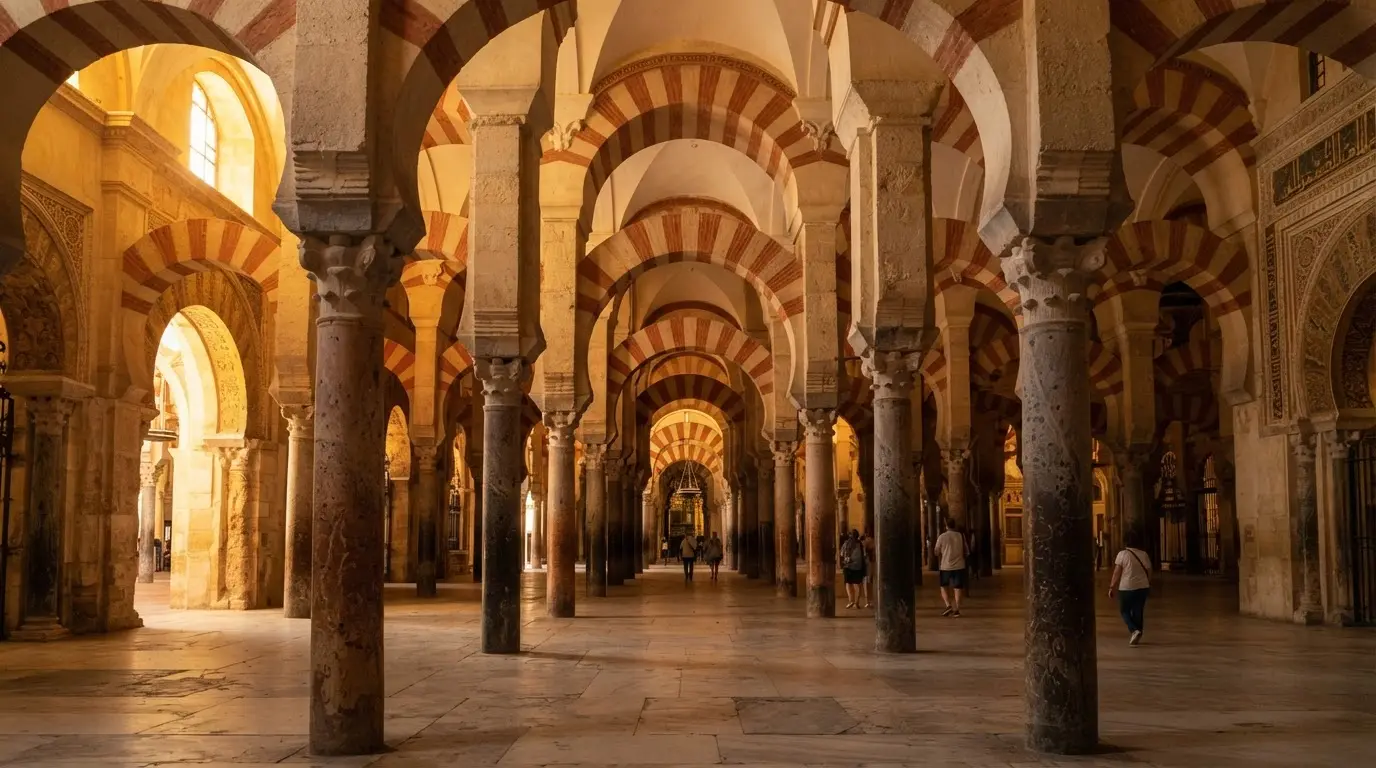
Interior of the Great Mosque of Córdoba at golden hour, red and white striped arches receding into shadow, the mosque that abd al-rahman iii enlarged with a new minaret and courtyard façade

Deep dive · Article

Abd al-Rahman III: The Morning Córdoba Became a Caliphate

Abd al-Rahman III was the first Caliph of Córdoba, declared on January 16, 929, ruling Córdoba for 49 years and starting work on Medina Azahara in 936 CE.

The belief outlived the century. Francisco Ruano Girón (1704-1768), a Jesuit and one of the Córdoba erudites of the 18th century[18], worked in a city where a Janus Augustus temple on the mosque-cathedral's site counted among the firmest beliefs of the learned class[19].

What the ground under the Mezquita does show

Where the theory predicts temple foundations, the excavators found a church. Félix Hernández Giménez dug inside the building between 1930 and 1936[20], and the cathedral's own history says his aim was to learn more about the Visigothic Basilica of San Vicente[21]. He wrote no excavation report, the compulsory bureaucratic ones have not yet been found, and the photographic archive survives in the Museo Arqueológico Provincial[22].

Three points mark where the evidence stands now:

  • The basement room of the basilica carries a brick-and-masonry inscription, EX OFF[ICINA] LEONTI, that names the workshop and dates the construction to the 6th century[23].
  • The 2021 dig in the Patio de los Naranjos, continuing Hernández's 1934 trench, points to a large 5th-century episcopal complex that was the city's nerve centre before the caliphate[3].
  • As of the April 2021 reporting, that dig had not reached Roman levels, and the excavators say that of earlier periods "we know nothing"[24].
Nothing in the documented finds is a temple of Janus, and the Roman layers beneath remain unreached in the Patio, so the question is open at depth but empty of support in everything recorded so far. The official Mezquita site describes the 6th-century remains as the Basilica of San Vicente[4], while the 2021 dig reporting describes a 5th-century episcopal complex in the courtyard[3]; the pre-Islamic archaeology of the site tells the longer story.
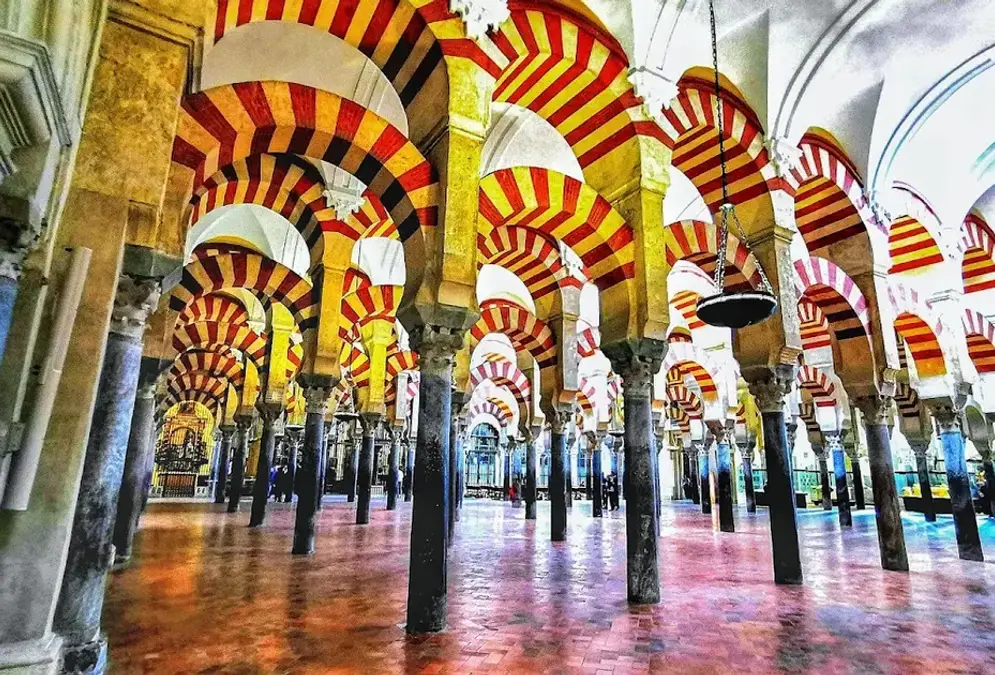
Interior of the Mezquita-Catedral de Córdoba with its iconic red-and-white arches and forest of columns

Explore nearby · Monument

Mezquita-Catedral de Córdoba

856 columns, 1,300 years of Islamic and Christian history. UNESCO monument in Córdoba, Andalusia. Red-and-white arches, Byzantine mosaics, a Renaissance nave.

What a visitor can actually see today

Inside the Mezquita-Catedral the pre-Islamic layer sits in the basement, where the archaeological remains of the Visigothic Basilica of San Vicente are kept[4]. The mosaics from a room of the original basilica continue the Roman and Paleo-Christian tradition across three decorative areas[25], and some of the pieces recovered in the excavations are exhibited in the monument today[26]. It is a church floor, not a shrine to Janus, and that is the honest answer to the question that brings most people here.
The cathedral's own pages on its history and on the basilica tell the San Vicente story and never mention Janus[4]. The Roman and Visigothic material in the prayer hall is reused stone, most visibly in its mismatched columns, not the footprint of a temple.

Recommended tours

Tours are selected for quality, not commission. We earn a small fee if you book — at no extra cost to you.
If you want a Roman temple, the one that has actually been excavated in Córdoba is a separate building, the Roman temple, which stands at the corner of Calle Claudio Marcelo and Calle Capitulares, next to City Hall[27]. It needs no myth to be worth the walk. The Mezquita's real pre-Islamic story is the Christian one in its basement.
So when a plaque, a guide or a website tells you the building is a reused Roman temple, ask which excavation it means. The honest answer today is a late antique Christian sequence under the building, plus Roman stone that was carried in and reused, and none of it is shaped like a Janus shrine.

Frequently asked questions

Was there a temple of Janus under the Mezquita of Córdoba?

No excavation has documented one. The idea comes from an essay by Pablo de Céspedes written shortly before 1608, built on two Roman milestones whose inscriptions name an arch on the Baetis. What the digs have actually recorded under the building is a late antique Christian layer.

Who first claimed the Mezquita stood on a temple of Janus?

The Janus version is tied to Pablo de Céspedes, a cathedral prebendary and painter. He was answering an antiquarian habit of reading classical remains into the building that Ambrosio de Morales had started a generation earlier.

What do the Roman milestones at the Mezquita actually say?

They refer to an Ianus Augustus, a monumental arch on the Via Augusta near the River Baetis that marked the border between the provinces of Baetica and Tarraconensis. Its foundations have been found near Mengíbar, in Jaén, not under Córdoba.

What have archaeologists found beneath the Mezquita-Catedral?

Félix Hernández's excavations of the 1930s recovered late Roman and Visigothic material and the remains of a basilica room dated to the 6th century, which can be seen in the basement. A more recent dig in the Patio de los Naranjos points to an episcopal complex from the 5th century. None of it is a Janus temple.

Is the Roman temple in Córdoba the same as the Janus temple?

No. The Janus temple has never been identified in the ground, while Córdoba's Roman temple is a separate excavated building with its own history, told in the article on the Roman temple discovery.

Sources

27 references Show
  1. muyinteresante.okdiario.com (opens in a new tab)

    “escribió un pequeño ensayo titulado Discurso sobre la antigüedad de la catedral de Córdoba, y cómo antes era templo del Dios Jano.”

  2. dialnet.unirioja.es (opens in a new tab)

    “cuyas referencias epigráficas mencionan en realidad un arco monumental”

  3. elespanol.com (opens in a new tab)

    “apuntan a la existencia de un gran complejo episcopal del siglo V que era el centro neurálgico de la ciudad antes de la época califal.”

  4. mezquita-catedraldecordoba.es — Basilica visigoda de san vicente (opens in a new tab)

    “In the basement of the Mosque-Cathedral Monumental Site of Cordoba are the archaeological remains of the Visigoth Basilica of San Vicente.”

  5. mezquita-catedraldecordoba.es — La historia (opens in a new tab)

    “This humanist and Renaissance painter held the position of prebendary of the Cathedral from the year 1577 to 1608.”

  6. muyinteresante.okdiario.com (opens in a new tab)

    “Céspedes respondía a una tradición anticuaria sobre este edificio, iniciada en el último tercio del XVI por el reverenciado Ambrosio de Morales”

  7. muyinteresante.okdiario.com (opens in a new tab)

    “Céspedes remataba la argumentación con un análisis de fuentes literarias que le llevaba a postular la identificación de Jano con Noé”

  8. livius.org (opens in a new tab)

    “Two milestones that once could be seen along this road are now at the entrance of Córdoba's famous mosque/cathedral, which is a reused temple.”

  9. muyinteresante.okdiario.com (opens in a new tab)

    “El punto de partida de la argumentación de Céspedes eran dos miliarios romanos, que mencionaban la existencia de un templo dedicado a Jano Augusto.”

  10. dialnet.unirioja.es (opens in a new tab)

    “fantasma surgido a base de un mal entendido de las inscripciones de los miliarios allí encontrados”

  11. rujapre.ujaen.es (opens in a new tab)

    “Recent research undertaken as part of the Iliturgi Project has located the remains of an Early Imperial building complex linked to the Via Augusta.”

  12. rujapre.ujaen.es (opens in a new tab)

    “a monumental complex near the River Baetis that marked the limit between the Roman provinces of Baetica and Tarraconensis.”

  13. mezquita-catedraldecordoba.es — La historia (opens in a new tab)

    “on 29 June 1236 it hosted the Cathedral's dedication mass”

  14. muyinteresante.okdiario.com (opens in a new tab)

    “No es casual que esta reclamación coincidiera con la última fase de construcción de la nueva nave de la catedral, que se revestía por entonces de lenguaje clásico.”

  15. muyinteresante.okdiario.com (opens in a new tab)

    “El envite de Céspedes asentó una mirada sobre la Mezquita de Córdoba que buscaba su desislamización”

  16. muyinteresante.okdiario.com (opens in a new tab)

    “Durante la Edad Moderna, sólo Pedro Díaz de Ribas se atrevió a contradecirlo, apuntando a la falta de argumentos históricos serios en su razonamiento.”

  17. muyinteresante.okdiario.com (opens in a new tab)

    “concluía que habían transcurrido 2.384 años desde su fundación. De ellos, solo 347 correspondían a los musulmanes.”

  18. dialnet.unirioja.es (opens in a new tab)

    “El jesuita Francisco Ruano Girón (1704-1768) es un representante de la erudición cordobesa del siglo XVIII.”

  19. dialnet.unirioja.es (opens in a new tab)

    “una de las más firmes creencias de la intelectualidad cordobesa”

  20. editorial.ugr.es (opens in a new tab)

    “llevó a cabo una serie de excavaciones entre 1930 y 1936 que han aclarado mucho la historia arquitectónica del monumento”

  21. mezquita-catedraldecordoba.es — La historia (opens in a new tab)

    “During the 1930s he was responsible for the different archaeological research projects that took place at the site of Abd al-Rahman I in order to extract more information about the Visigoth Basilica of San Vicente.”

  22. editorial.ugr.es (opens in a new tab)

    “No escribió memoria de las mismas y los informes burocráticos preceptivos aún no se han encontrado.”

  23. mezquita-catedraldecordoba.es — Basilica visigoda de san vicente (opens in a new tab)

    “which tells us the workshop where the materials came from and dates the construction to the 6th century.”

  24. elespanol.com (opens in a new tab)

    “De época anterior "no sabemos nada", ya que no se ha llegado tan abajo”

  25. mezquita-catedraldecordoba.es — Basilica visigoda de san vicente (opens in a new tab)

    “They continue the Roman and Paleo-Christian tradition, differentiating between three decorative areas.”

  26. mezquita-catedraldecordoba.es — Basilica visigoda de san vicente (opens in a new tab)

    “Some of the pieces recovered in the excavations are exhibited in the Monumental Site today.”

  27. Wikipedia (opens in a new tab)

    “It is located in the angle formed by the streets Claudio Marcelo and Capitulares.”