
The Iglesia de Santiago is one of the Fernandine churches of the Axerquía, the eastern half of medieval Córdoba, and the one with the most dramatic modern story. The bell tower swallows an Islamic minaret that you can still see from inside, and a 1979 fire nearly destroyed the building. It is a quiet stop on a route most visitors do in a rush, and it rewards a slower look at the stonework.
What the Iglesia de Santiago is
Santiago is listed by the Mezquita-Catedral among the seven Fernandine temples of the Axerquía, all declared of Cultural Interest. The Fernandine churches were founded in the context of Ferdinand III's conquest of Córdoba, in 1236, and served as nuclei of repopulation organised by parish. Santiago stands in the Santiago quarter and is stop number 4 on the route flyer.
The church is said to occupy the site of an older mosque, attributed to the emir Hisham I at the end of the 8th century and Christianised at the conquest. That origin rests on a single secondary source, so treat it as local tradition rather than excavated fact. What is documented is the date of the new church: work began only in 1260, under Alfonso X, and then dragged on for centuries. The result is a Gothic-Mudéjar building that grew in layers rather than to a single plan.
Keep your Mezquita-Catedral ticket
Route access is free with the Mezquita-Catedral entrance, so keep the ticket in your pocket and use it at Santiago and the other Fernandine churches. Without it, the general route ticket is €6.
What to look for
Start outside. The medieval façade is the one on the narrow calle Ronquillo Briceño, where a pointed arch is framed by archivolts and a rose window sits above. The street is tight enough that you cannot step back far, which is part of the pleasure: you read the stone at close range.
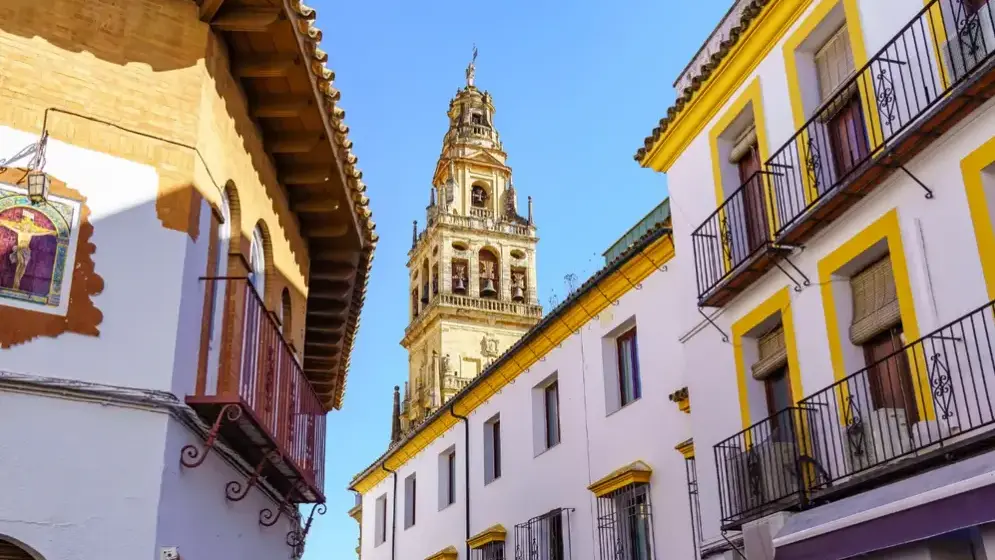
The tower is the real find. In 1555 the architect Hernán Ruiz II built the bell tower around the old minaret, and the minaret can still be seen from inside the church. Few places in the city show the Islamic-to-Christian handover as plainly. The Iglesia de San Lorenzo is another Fernandine church on the route, and the Iglesia de Santa Marina is also on it.
The 1979 fire and the Cristo de las Penas
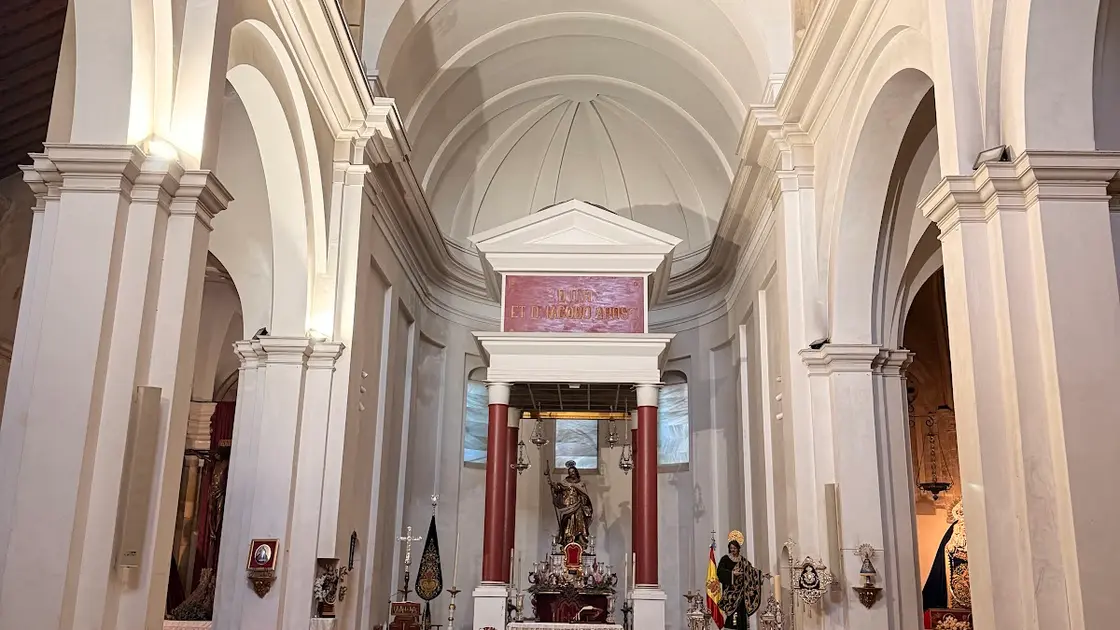
In 1979 a great fire gutted the church, and in 1981 the naves collapsed. A major restoration followed between 1987 and 1990, so the interior you see is a careful reconstruction, not an unbroken medieval room. Two images came through the disaster: the titular figure of Santiago, made in 1770, and the Cristo de las Penas, a late Gothic crucifix of the 15th century that is the oldest crucifix in Córdoba's Holy Week.