
history-buffsarchitecturephotographers
Convento de Santa María de Gracia
Monument

Convento de Santa María de Gracia (Padres de Gracia)

No public visiting hours are published; check with the parish.

Santa María de Gracia, known across Córdoba as the Padres de Gracia, is a Discalced Trinitarian convent and church on the Plaza del Cristo de Gracia, begun after a licence of 16 May 1607 and finished in 1686. It is also the home of the Santísimo Cristo de Gracia, the carving the city calls El Esparraguero. Come for a baroque conventual church that still has a resident community, not for a monument on the main tourist circuit.

What Santa María de Gracia is

The building is a convent and church in one, served by the Trinitarios descalzos, the reformed branch of the Order of the Most Holy Trinity. Its official parish title is Nuestra Señora de Gracia y San Eulogio, but nobody on the street says that; it is the Padres de Gracia, the fathers of Gracia.

It stands in the north-east of the old walled town, beside the wall and next to the Puerta de Plasencia, a gate that no longer exists. The church is directed towards the Plaza de los Olmos, now called Corazón de María. Its Junta de Andalucía heritage record lists it as the Convento Trinitario de los Padres Gracia.

Shoot the façade from the square

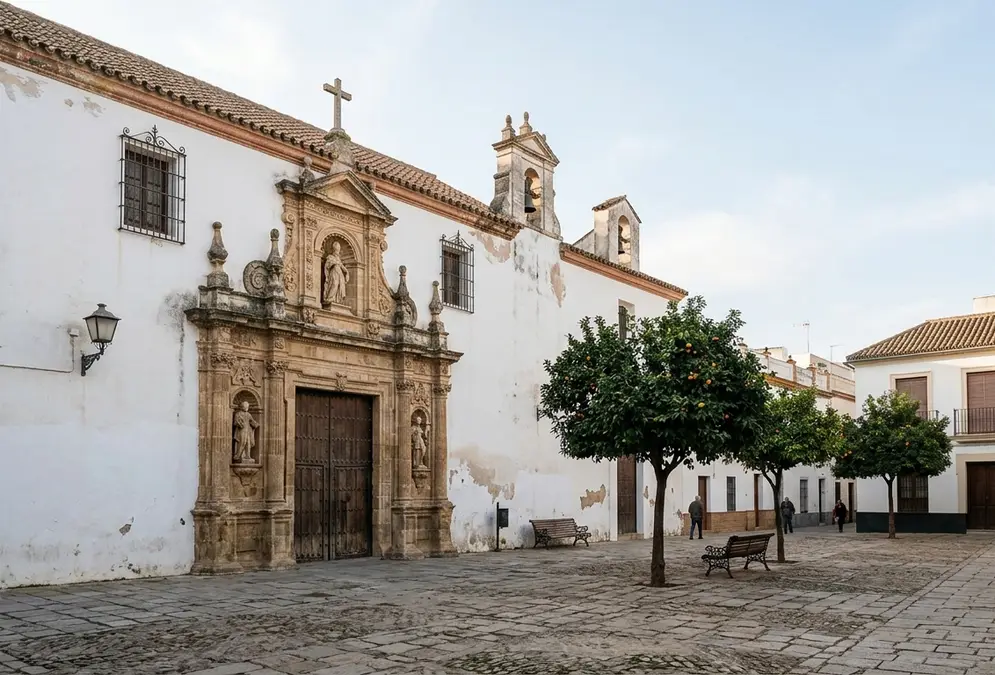
The main façade, attributed to Sebastián Vidal, is the part of the 1686 church you can see without going in. Stand back in the plaza to take it in whole.

From a 1607 licence to a finished church

The chronology is tighter than the vague "early seventeenth century" most listings give. On 16 May 1607 the reformer San Juan Bautista de la Concepción obtained a royal licence and one from the Duke of Lerma; on 7 June the bishop approved, and the friars took over a small, poor house next to the hermitage of Nuestra Señora de Gracia at the Puerta de Plasencia. Some listings put the founding in 1608, but the dated record is 1607.

That hermitage matters: the convent carries the name of the chapel it grew beside.

The church was completed in 1686, and the Blessed Sacrament was moved into it on 21 April of that year. The main façade is attributed to Sebastián Vidal. Inside, the church holds an Inmaculada carved in 1668 by Pedro Roldán.

  • 1607: licence granted and friars take possession
  • 1618: the Christ of Grace arrives
  • 1668: Roldán carves the Inmaculada
  • 1686: church concluded and the Sacrament transferred

A date you may see elsewhere, 1680 for the building, does not match the 1686 completion given by the city's tourism office, so treat 1686 as the finishing year.
Popular tours in Córdoba

Best Seller
Mosque-Cathedral Skip-the-Line Guided Tour

Mosque-Cathedral Skip-the-Line Guided Tour

Skip the queue and explore the Mezquita-Cathedral with a knowledgeable local guide. Discover 13 centuries of layered history in one of Spain's most iconic monuments.

Skip the line
1.5 hours

From €29

4.7 (7,461 reviews)

✓ Verified GetYourGuide reviews

Books up weeks ahead in peak season

Reserve Your Spot
Best Seller
Jewish Quarter, Mosque & Alcázar Tour

Jewish Quarter, Mosque & Alcázar Tour

A comprehensive guided tour covering Córdoba's three UNESCO-listed highlights: the Mezquita, the medieval Jewish Quarter, and the Alcázar de los Reyes Cristianos.

3 hours

From €49

4.6 (5,636 reviews)

✓ Verified GetYourGuide reviews

Books up weeks ahead in peak season

Reserve Your Spot
Best Seller
Mosque-Cathedral E-Ticket with Audio Guide

Mosque-Cathedral E-Ticket with Audio Guide

Explore the Mosque-Cathedral at your own pace with a detailed audio guide that brings every arch, mihrab, and chapel to life. Skip the ticket queue with your e-ticket.

Self-guided

From €18.50

Less than a restaurant lunch

4.2 (3,875 reviews)

✓ Verified GetYourGuide reviews

Books up weeks ahead in peak season

Reserve Your Spot
Best Seller
Caballerizas Reales Equestrian Show

Caballerizas Reales Equestrian Show

70 minutes of Andalusian dressage and live flamenco at Córdoba's historic 1570 Royal Stables. Pure Spanish breed horses perform classical techniques — piaffe, passage, garrocha — in a breathtaking vaulted arena.

70 minutes

From €18.50

Less than a restaurant lunch

4.5 (2,979 reviews)

✓ Verified GetYourGuide reviews

Books up weeks ahead in peak season

Reserve Your Spot
Best Seller
Mosque & Jewish Quarter Tour with Tickets

Mosque & Jewish Quarter Tour with Tickets

Explore two of Córdoba's most iconic sites — the Mezquita and the medieval Jewish Quarter — with skip-the-line tickets and an expert local guide included.

Skip the line
2 hours

From €35.55

4.6 (2,232 reviews)

✓ Verified GetYourGuide reviews

Books up weeks ahead in peak season

Reserve Your Spot
Best Seller
Mosque-Cathedral, Jewish Quarter & Alcázar Tour

Mosque-Cathedral, Jewish Quarter & Alcázar Tour

A comprehensive guided tour of Córdoba's three UNESCO highlights: the Mezquita-Cathedral, the ancient Jewish Quarter, and the magnificent Alcázar gardens.

3.5 hours

From €49.99

4.6 (1,934 reviews)

✓ Verified GetYourGuide reviews

Books up weeks ahead in peak season

Reserve Your Spot
Best Seller
Alcazar Guided Tour and Skip-the-Line

Alcazar Guided Tour and Skip-the-Line

Bypass the queue and explore the Alcázar de los Reyes Cristianos with a guide. Check the listing for what is open on your date.

Skip the line
1.5 hours

From €19

Less than a restaurant lunch

4.2 (1,915 reviews)

✓ Verified GetYourGuide reviews

Books up weeks ahead in peak season

Reserve Your Spot
Best Seller
Mosque-Cathedral Guided Tour with Tickets

Mosque-Cathedral Guided Tour with Tickets

Entry tickets and expert guide included for an in-depth tour of the Mosque-Cathedral. Discover the prayer hall, the gilded mihrab, and the soaring bell tower.

1.5 hours

From €31.10

4.5 (1,708 reviews)

✓ Verified GetYourGuide reviews

Books up weeks ahead in peak season

Reserve Your Spot
Best Seller
Skip-the-Line Mosque-Cathedral History Tour

Skip-the-Line Mosque-Cathedral History Tour

Skip the line and uncover 13 centuries of layered history inside the Mosque-Cathedral with a specialist guide. From Roman columns to Visigoth foundations to Renaissance cathedral.

Skip the line
1.5 hours

From €32

4.7 (1,701 reviews)

✓ Verified GetYourGuide reviews

Books up weeks ahead in peak season

Reserve Your Spot
Best Seller
Flamenco Show Ticket with Drinks

Flamenco Show Ticket with Drinks

Experience the passion and drama of authentic Andalusian flamenco at one of Córdoba's premier tablaos. Ticket includes a drink at the bar.

1 hour

From €25

4.8 (1,189 reviews)

✓ Verified GetYourGuide reviews

Books up weeks ahead in peak season

Reserve Your Spot
Best Seller
Guided Tour of Medina Azahara

Guided Tour of Medina Azahara

Explore the 10th-century Umayyad palace city of Medina Azahara with a specialist guide. Uncover the scale and splendour of Caliph Abd al-Rahman III's once-magnificent capital.

3 hours

From €20

Less than a restaurant lunch

4.6 (1,151 reviews)

✓ Verified GetYourGuide reviews

Books up weeks ahead in peak season

Reserve Your Spot
Best Seller
Authentic Patios: 2-Hour Tour

Authentic Patios: 2-Hour Tour

Discover the famous flower-filled patios of the Judería on a guided walking tour. Learn about the centuries-old tradition that earned Córdoba's patios UNESCO recognition.

2 hours

From €18.83

Less than a restaurant lunch

4.3 (1,119 reviews)

✓ Verified GetYourGuide reviews

Books up weeks ahead in peak season

Reserve Your Spot

Tours are selected for quality, not commission. We earn a small fee if you book — at no extra cost to you.

The Christ of Grace, El Esparraguero

The carving that gives the square its name, the Santísimo Cristo de Gracia, reached the convent on 4 February 1618. Córdoba knows it by the nickname El Esparraguero, and the Christ of Grace brotherhood still takes it through the city's streets each Holy Week.

When a map says Plaza del Cristo de Gracia, this is the Christ it means, and the church that holds it is the one on the square.

Trinitarians back in 1900, parish since 1969

The old convent and church went back to the Order on 11 April 1900, when the bishop ceded them to the Discalced Trinitarians in perpetual usufruct. The community was re-established on 16 August 1903 and is still in residence and still looks after worship in the church.

On 30 December 1969 Bishop Manuel Fernández y García del Rebollar made the conventual church a parish. That is why one building has two names: a convent to the friars, a parish to the neighbourhood.

Finding it and what is nearby

The address is Plaza del Cristo de Gracia, Córdoba. It is a working church with a resident community, so treat it as a place of worship first and check with the parish before you plan a visit around a particular time.

  • Look at: the main façade attributed to Sebastián Vidal, from the plaza.
  • Pair it with: the Church of San Agustín, another church worth adding to the same walk.
  • Then walk on to: the Mezquita-Catedral for the monument everyone else is queuing for.

Reporter notebook

Insider tips

Local custom

Ask for the Padres de Gracia

Locals use the friars' name, not the parish title. Searching or asking for Padres de Gracia or the Cristo de Gracia gets you further than Nuestra Señora de Gracia y San Eulogio.

Booking tip

Treat it as a working church

No public visiting hours are published for the convent church, and a Trinitarian community lives there. Check with the parish before planning a visit around a set time.

Practical information

Opening hours
No public visiting hours are published; check with the parish.
Admission
No admission price is published; check with the parish.
Address
Plaza del Cristo de Gracia, Córdoba, Spain View on Google Maps
Interactive map — loads as you scroll (requires JavaScript)

Frequently asked questions

When was the Trinitarian convent of Santa María de Gracia founded?

The licence is dated 16 May 1607, and the friars took possession of a small house beside the hermitage of Nuestra Señora de Gracia on 7 June 1607. A 1608 date appears in some listings but the dated record says 1607.

Why is Santa María de Gracia called Padres de Gracia?

Padres means the friars, and Gracia comes from the earlier hermitage of Nuestra Señora de Gracia beside the Puerta de Plasencia, where the Trinitarians settled. The church's formal parish title is Nuestra Señora de Gracia y San Eulogio.

What is El Esparraguero in Córdoba?

El Esparraguero is the popular name of the Santísimo Cristo de Gracia, the carving kept in the church since it arrived at the convent on 4 February 1618.

When was the church of Santa María de Gracia finished?

The church was concluded in 1686, and the Blessed Sacrament was moved into it on 21 April that year. The main façade is attributed to Sebastián Vidal.

Is Santa María de Gracia still a Trinitarian convent?

Yes. The bishop returned the old convent to the Discalced Trinitarians in 1900, the community was re-established on 16 August 1903 and remains there. The church became a parish on 30 December 1969.

Where is the Plaza del Cristo de Gracia in Córdoba?

It is in the north-east of the old walled town, beside the wall and the site of the vanished Puerta de Plasencia. The convent church stands on the square.

Sources

15 references Show
  1. Iglesia de Nuestra Señora de Gracia (Córdoba) (opens in a new tab)

    “El 16 de mayo de 1607 San Juan Bautista de la Concepción, reformador de la Orden de la Santísima Trinidad, obtiene licencia real y del Duque de Lerma”

  2. Iglesia de Nuestra Señora de Gracia (Córdoba) (opens in a new tab)

    “el 7 de junio el obispo dio su beneplácito, tomando ese mismo día posesión de una pequeña y pobre morada junto a la ermita de Nuestra Señora de Gracia en la Puerta de Plasencia”

  3. Córdoba Turismo, Convento de los Trinitarios (opens in a new tab)

    “the temple was concluded in 1686, and particular attention should be drawn to the main façade, which was devised by Sebastian Vidal.”

  4. Iglesia de Nuestra Señora de Gracia (Córdoba) (opens in a new tab)

    “El 21 de abril de 1686, terminada la fábrica de la iglesia, se trasladó a ella el Santísimo Sacramento”

  5. Iglesia de Nuestra Señora de Gracia (Córdoba) (opens in a new tab)

    “está situado al nordeste de la ciudad de Córdoba, dentro del antiguo recinto amurallado, junto a la misma muralla y contiguo a la Puerta de Plasencia, hoy desaparecida”

  6. MonumentalNet, Iglesia conventual de los Padres de Gracia (opens in a new tab)

    “La Iglesia y Convento Trinitario de los Padres Gracia se encuentra en la plaza Cristo de Gracia de la ciudad de Córdoba, provincia de Córdoba.”

  7. Córdoba Turismo, Convento de los Trinitarios (opens in a new tab)

    “Directed towards the Plaza de los Olmos, now known as the Corazón de María”

  8. Artehistoria, Convento de los Trinitarios (opens in a new tab)

    “Situado cerca de la Puerta de Plasencia, existió una antigua ermita, la de Nuestra Señora de Gracia”

  9. Iglesia de Nuestra Señora de Gracia (Córdoba) (opens in a new tab)

    “El 11 de abril de 1900 el obispo cedió a los trinitarios descalzos en usufructo perpetuo”

  10. Iglesia de Nuestra Señora de Gracia (Córdoba) (opens in a new tab)

    “El 16 de agosto de 1903 se estableció la comunidad trinitaria, que permanece hasta el día de hoy residiendo en él y atendiendo el culto de la iglesia.”

  11. Iglesia de Nuestra Señora de Gracia (Córdoba) (opens in a new tab)

    “El 30 de diciembre de 1969 el obispo de Córdoba D. Manuel Fernández y García del Rebollar erigió en parroquia la iglesia conventual”

  12. Iglesia de Nuestra Señora de Gracia (Córdoba) (opens in a new tab)

    “La imagen del Santísimo Cristo de Gracia llegó a este convento el 4 de febrero de 1618.”

  13. Iglesia de Nuestra Señora de Gracia (Córdoba) (opens in a new tab)

    “En su interior se conservan, entre otras obras de arte, las tallas de Santísimo Cristo de Gracia, conocido como el Esparraguero”

  14. Córdoba Turismo, Convento de los Trinitarios (opens in a new tab)

    “The church houses a marvellous image of la Inmaculada, sculpted in 1668 by Pedro Roldán.”

  15. IAPH, Convento Trinitario de los Padres Gracia (opens in a new tab)

    “Convento Trinitario de los Padres Gracia (835)”