history-buffs
  • 7 min
  • 46 sources

Where the Alfonsine Tables Got Their Andalusi Astronomy

Alfonso X's astronomers corrected a 200-year-old Andalusi work. Follow the Alfonsine Tables' sources from al-Zarqali's Córdoba years to Toledo, 1263-1272.
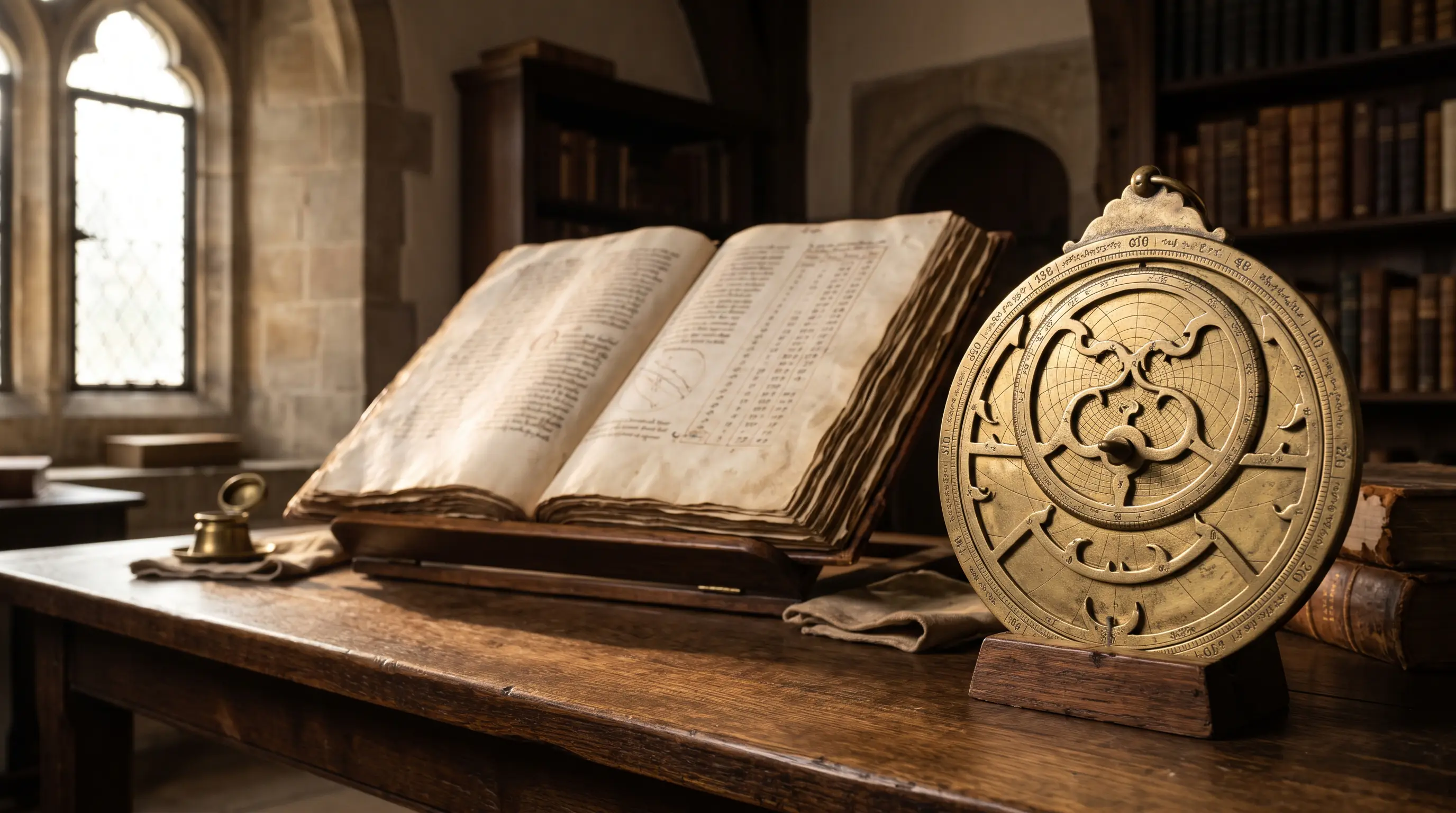
Alfonsine Tables Andalusi sources: an open medieval manuscript page of astronomical tables beside a brass astrolabe on a wooden desk, warm candlelight, photorealistic

The Castilian canons of the Alfonsine Tables survive in one manuscript, BNE MS 3306 in Madrid; the numerical tables are lost.

The numerical tables Alfonso X had compiled in Toledo are lost, and only their instructions survive, the canons, in a single manuscript at the Biblioteca Nacional in Madrid[1]. Those canons take their few stated parameters from the Toledan Tables and from the Maghribi astronomer Ibn Ishaq[2], and the canons of the first version carry al-Zarqali's 24-arcminute correction, a displacement of the centre of the Moon's mean motion in longitude away from Ptolemy's baseline[3][4], so the Andalusi sources of the Alfonsine Tables can still be read in the part that survives. Córdoba enters that chain through two named astronomers, Ibn al-Samh and al-Zarqali.
Toledo observation programme
1263–1272
Span of observations named in the canons' Castilian prologue[5]
Al-Zarqali's death
15 Oct 1100
Recent research favours this date over the older 1087[6]
Alfonsine tropical year
365d 5h 49m
Mean year used in De revolutionibus and the Gregorian reform[7]

Toledo in 1263: an Andalusi work under review

Judah ben Moses ha-Cohen and Isaac ibn Sid began observing in Toledo in 1263 with one stated aim, to improve on and correct the Toledan Tables, a work about two centuries old[8]. The Castilian prologue dates the campaign to 1263–1272[5].
The prologue is plain about whose work was under review. It says the king ordered the team to rectify in Toledo, 'one of the principal cities of Spain', and adds En ella fue el retificar de Azarquiel, meaning that Azarquiel had done his own rectifying there[9].
Azarquiel is al-Zarqali, and the Toledan Tables were a team effort. A group led by the qadi Sa'id al-Andalusi (1029–1070), in which al-Zarqali seems to have been prominent, adapted the best available material, al-Khwarizmi's and al-Battani's, to the coordinates of Toledo[10]. The Castilian canons compute sidereal longitudes, as the Toledan Tables do and the later Latin tables do not, which led Julio Samsó to suggest that the Toledan Tables modelled the first Castilian draft[11].
Ibn Ishaq, the Maghribi astronomer whose tables the canons draw on, was Abu al-'Abbas ibn Ishaq al-Tamimi al-Tunisi, active in Tunis and Marrakech between about 1193 and 1222[12]. The corpus is still called Andalusi because the predominant influence in his materials is clearly Andalusi, even if it is not yet known how much of his work is original, and because the Maghribi zijes that begin with his continued al-Zarqali's school[13]. The Eastern strand, the tables of al-Khwarizmi and al-Battani, had entered al-Andalus before the fall of the Caliphate left its astronomers cut off from Eastern books written after 950[14].

What Alfonso X the Wise commissioned, and from whom

Alfonso X the Wise made recovering Arabic astronomical material, and above all Andalusi material, a priority and had it translated into Spanish, which made him a pioneer of the vernacular as a scientific language[15]. Astronomy served the crown as well as scholarship. His court paired the astrological Libro complido of 1254 and the Libro de las cruzes of 1259 with the instruments and Alfonsine tables needed to compute horoscopes, and the science of the stars counted as a third pillar of his way of governing[16].
The work fell to a small team. Judah ben Moses ha-Cohen had already handled Andalusi astronomy once: between 1225 and 1231 he and the Christian translator Guillelmus Anglicus made a Latin version of Azarquiel's Book of the Azafeha, nearly three decades before the Libro de las Cruzes[17]. Isaac ibn Sid, known as Rabiçag, was the king's most prolific scientific collaborator, with works on astronomical instruments and clocks[18]. A Toledan astronomer, Isaac Israeli, reported in 1310 that Rabiçag observed solar and lunar eclipses in Toledo on the king's orders from 1263 and wrote them down in his own hand[19].
The observing took place in Toledo. Córdoba reaches the programme through the astronomers whose books were translated, while the king's own dealings with the city belong to law and chronicle.

Córdoba's astronomers inside the Alfonsine corpus
Córdoba's earliest contribution is an instrument. Ibn al-Samh (died 1035), a leading member of the Córdoba school of Maslama al-Majriti, wrote the earliest known Andalusi equatorium treatise, which describes a hybrid astrolabe and equatorium and survives in the Alfonsine translation included in the Libros del saber de astronomía; Alfonso X's astronomers also adapted his astrolabe book for the spherical astrolabe[20].
Al-Zarqali's Córdoba years fall well after the caliphal age of Córdoba's eclipse calculations and the Ibn Firnas flight legend. He started in Toledo, in the circle of the qadi Sa'id al-Andalusi (1029–1070) and the emir Yahya al-Ma'mun (r. 1043–1075), and Julio Samsó has him born near Toledo and trained there as a metalsmith[21], while other accounts name Qurtuba, the Arabic name of Córdoba, as his birthplace[22]. Juan Vernet has him driven to Córdoba sometime after 1078, where he fixed the longitude of Regulus in 1080, recorded the culmination of the planets a year later and made his last observations in 1087[23]. The timing of the move is contested: around 1080 for Lutz Richter-Bernburg[24], between 1081 and 1085 for Roser Puig[3], and for Samsó either early in the reign of Yahya II al-Qadir (1075–1085) or at Alfonso VI's conquest of Toledo in 1085[25].
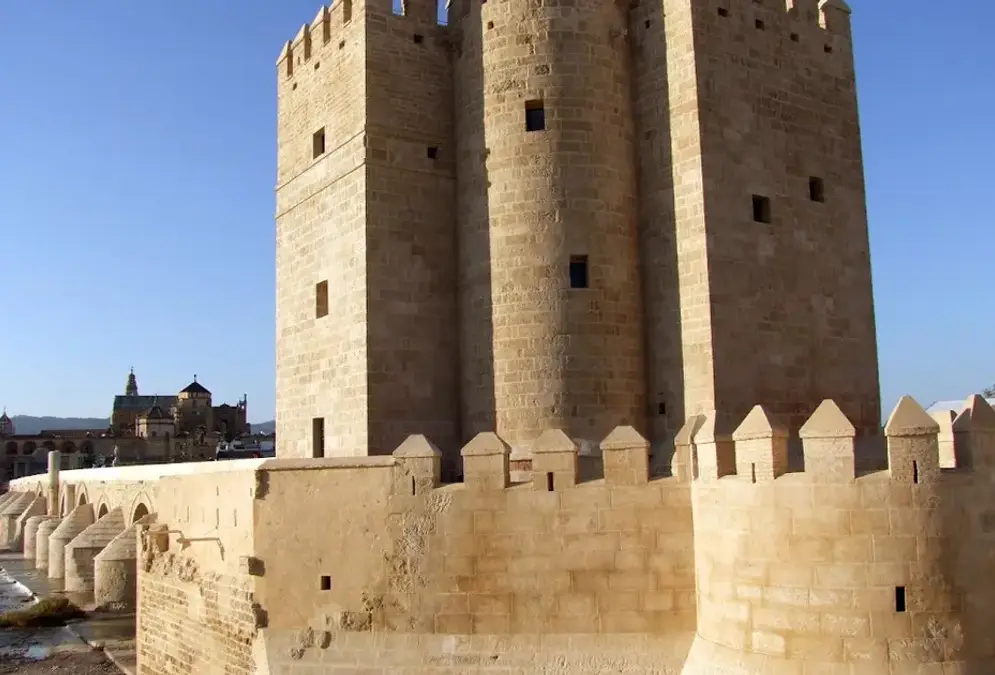
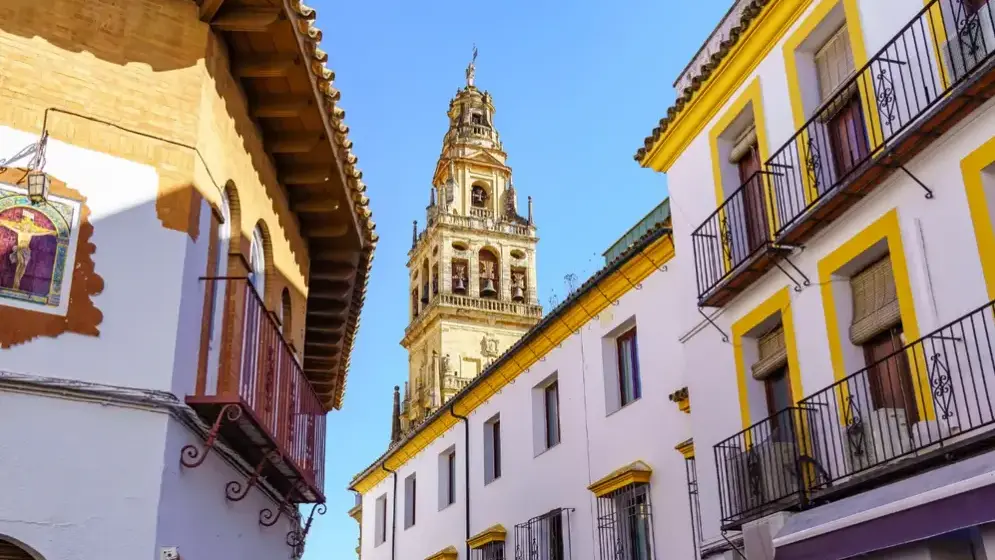
Torre de la Calahorra at the southern end of the Puente Romano de Córdoba

Explore nearby · Monument

Torre de la Calahorra

12th-century Islamic tower at the end of the Roman Bridge. Museum of Al-Andalus with rooftop views of the Mezquita and Guadalquivir. €4.50 adult entry.

In 1081 he wrote an equatorium treatise whose Castilian translation, ordered by Alfonso X, draws the orbit of Mercury as non-circular[26]. His death date is debated as well: Juan Vernet notes that some writers placed it in 1087 because that is the year of his last recorded observations[27], while the 13th-century biographer Ibn al-Abbar records his death in Córdoba on 15 October 1100[6].
The record behind those treatises was long. Ibn al-Ha'im, writing in the early 13th century, credits al-Zarqali with 25 years of solar observations and 37 years of lunar ones[28], and Julio Samsó's 2020 synthesis treats his texts as the explanation for the common astronomical tradition on both sides of the Strait of Gibraltar[29].

What the 24-arcminute correction changes

The correction acts on the mean motion in longitude of the Moon. Ptolemy centred that motion on the Earth, and al-Zarqali displaced the centre to a point on the line from the Earth to the solar apogee, 24 arcminutes from it[3]. His eclipse observations bore out Ptolemy's epicycle, eccentricity and latitude, with the mean motion in longitude the sole exception[30].
Later Andalusi and Maghribi tables, those of Ibn al-Kammad, Ibn Ishaq and Ibn al-Banna', carry the same correction but restrict it to eclipses and the New Moon[31]. The Castilian canons of the first Alfonsine version keep it[4], whereas the Parisian lunar tables keep the Toledan column layout on different parameters and leave it out[32].

Solar apogee, trepidation and the Alfonsine year

From 25 years of solar observations al-Zarqali concluded that the solar apogee moves on its own in addition to precession, at 1° in 279 Julian years[33]. Around 1084 or 1085 he compared three trepidation models in a treatise on the motion of the fixed stars, extant in Hebrew, and settled on the third, in which variable precession is independent of the oscillation of the obliquity of the ecliptic[34].
Little of this passed into the tables unchanged. Neither the Toledan Tables, the Castilian canons nor the Parisian tables adopt the proper motion of the solar apogee, and the Castilian and Parisian sets share a maximum solar equation of 2;10 degrees that matches Ibn al-Kammad's mean eccentricity[35].
The Alfonsine year is where Andalusi parameters and Alfonsine adjustment meet. Samsó showed that the tropical solar mean motion behind it comes from adding about 0;0,0,8 degrees a day of precession and trepidation to the sidereal motion in Ibn Ishaq's tables[36]. The Parisian tables then pair that year with a precession of one revolution in exactly 49,000 years plus a trepidation term[37], which Samsó, to his knowledge, counts as the first tabulation of an Andalusi idea of combined precession and trepidation[11], and John of Murs says in his Expositio of 1321 that he took the fixed tropical year from the Castilian tables[38].
Scholars disagree about where the move from sidereal Castilian canons to tropical Latin tables happened. Emmanuel Poulle denied any Alfonsine link to the Paris tables of the 1320s, Samsó argues that Alfonso X's Toledo team itself began a second, tropical Latin set following al-Battani and Ibn Ishaq, and José Chabás and Bernard Goldstein hold that Parisian astronomers revised authentic Castilian materials in Paris[39].

The Libro de las Cruzes and its Andalusi astrology

The Libro de las Cruzes sits in this story because Judah ben Moses ha-Cohen, one of the two men who ran the Toledo observations, translated it at the same court, which paired its astrological texts with the tables needed to compute horoscopes[16]. He finished it on 26 February 1259, working with Johan Daspa, four years before the observing began[40]. Its prologue claims that Alfonso X himself found the Arabic text and had it translated into Castilian and divided into 75 chapters[41].
The Castilian text preserves an otherwise lost Andalusi version of a late Latin astrological handbook, put into Arabic verse in the first half of the 9th century and revised in the 11th by a certain 'Ubayd Allah[42].

Recommended tours

Tours are selected for quality, not commission. We earn a small fee if you book — at no extra cost to you.
Its judicial astrology differs from the Eastern Islamic kind. The system of crosses pays no attention to the exact degrees and minutes of the planets, reading instead which houses they occupy and how they stand to one another[43]. The Tables, by contrast, exist to supply exactly those degrees and minutes.

From Paris to Venice, and where the evidence sits today
Adapted into Latin in Paris around 1320–1321 by John of Murs, John of Lignères and John of Saxony, the Alfonsine Tables stayed Europe's standard planetary tables for about three centuries, and Erhard Ratdolt first printed them in Venice in 1483, a year after he printed Euclid's Elements[44].
Illustration of the 1808 sack of Córdoba: French Napoleonic infantry looting a Baroque Andalusian palace courtyard at dusk, soldiers carrying silver vessels and church ornaments through an arcaded gallery, dramatic warm torchlight, oil-painting style

Deep dive · Article

1808: The Sack of Córdoba That Broke a French Army at Bailén

In June 1808, French troops sacked Córdoba's churches and palaces on a flimsy pretext — and dragged the plunder into the disaster at Bailén weeks later.

One Alfonsine number outlived the tables' authority: a year of 365 days, 5 hours, 49 minutes and almost 16 seconds, on which Copernicus's De revolutionibus and the Gregorian reform both built[7].
The surviving canons also define the Alfonsine era, which counts from 1252, the year Alfonso X began to reign, for the meridian of Toledo[45]. The epoch therefore predates the observations of 1263–1272 by eleven years, and the Toledo meridian ties the new tables to the city where Azarquiel had already worked.
Timeline
  1. 1252

    Alfonsine era begins

    Alfonso X's accession year, the epoch of the tables for Toledo's meridian[45]

  2. 1263–1272

    Toledo observation programme

    Dates given in the Castilian prologue[5]

  3. c. 1320–1321

    Latin adaptation in Paris

    The version that spread across Europe[44]

  4. 1483

    First printed in Venice

    Erhard Ratdolt's edition[44]

The Andalusi layer can be checked in a handful of collections, one of them in Córdoba:
  • Biblioteca Nacional de España, Madrid, MS 3306: the Castilian canons, the only manuscript of the original Alfonsine Tables[1]
  • Biblioteca Nacional de España, MS 9294: the 1259 royal scriptorium codex of the Libro de las Cruzes[41]
  • Biblioteca Medicea Laurenziana, Florence, MS Or. 152: two Arabic treatises whose colophons place their copying in Toledo in 1265 and 1266, with a note by Isaac ibn Sid on the copying[46]
  • Torre de la Calahorra, Córdoba: the city's Museum of Al-Andalus, for the wider Andalusi setting of this science

Frequently asked questions

Who compiled the Alfonsine Tables, and when?

They were produced in Toledo under Alfonso X by Judah ben Moses ha-Cohen and Isaac ibn Sid (Rabiçag), whose observation programme the Castilian prologue dates to 1263–1272. The original Castilian numerical tables are lost; the canons survive.

What were the Andalusi sources of the Alfonsine Tables?

The surviving Castilian canons take their parameters from the Toledan Tables, compiled in the 11th century by a team under the qadi Sa'id al-Andalusi that included al-Zarqali, and from the Maghribi astronomer Ibn Ishaq, alongside al-Battani's zij. Al-Zarqali's 24-arcminute lunar correction also appears in the canons of the first version.

How do the Alfonsine Tables relate to the Toledan Tables?

Alfonso X had new observations made in Toledo to correct the Toledan Tables, and the Castilian prologue names Azarquiel's earlier rectification in the same city. Because the canons compute sidereal longitudes, as the Toledan Tables do, Julio Samsó suggests the Toledan Tables modelled the first Castilian draft.

What is Córdoba's connection to the Alfonsine Tables?

Ibn al-Samh (died 1035), of Maslama al-Majriti's Córdoba school, wrote the earliest known Andalusi equatorium treatise, preserved in Alfonso X's Castilian Libros del saber de astronomía. Al-Zarqali spent his later career in Córdoba, to which scholars date his move from sometime after 1078 to the conquest of Toledo in 1085, and made his last observations there in 1087.

What is the Libro de las Cruzes?

It is a judicial-astrology text that Judah ben Moses ha-Cohen and Johan Daspa completed in Castilian on 26 February 1259, in 75 chapters. It preserves an otherwise lost Andalusi version, revised in the 11th century by 'Ubayd Allah, of a late Latin astrological handbook.

Did the original Alfonsine Tables survive?

Only the canons did, in BNE MS 3306 in Madrid. The numerical tables circulated in Latin versions made in Paris around 1320–1321 and were first printed in Venice in 1483.

Who was al-Zarqali?

Al-Zarqali (Azarquiel) was an 11th-century astronomer and instrument maker who worked in Toledo and, after leaving it, in Córdoba. Scholars disagree on his birthplace, near Toledo or Qurtuba (Córdoba), and on his death, given as about 1087 or 15 October 1100. Ibn al-Ha'im credits him with 25 years of solar and 37 years of lunar observations.

What is al-Zarqali's 24-arcminute lunar correction?

It shifts the centre of the Moon's mean motion in longitude from the Earth, where Ptolemy put it, to a point on the line from the Earth to the solar apogee, 24 arcminutes away. Later Andalusi and Maghribi tables restricted it to eclipses and the New Moon, and the Castilian canons of the first Alfonsine version keep it.

Why are the Alfonsine Tables called Andalusi when they use Maghribi tables?

The Maghribi tables they draw on, beginning with those of Ibn Ishaq al-Tunisi (fl. 1193–1222), continue al-Zarqali's school, and the predominant influence in Ibn Ishaq's materials is clearly Andalusi. The Eastern tables of al-Khwarizmi and al-Battani had already been absorbed in al-Andalus.

Sources

46 references Show
  1. revistas.ucm.es (opens in a new tab)

    “Las Tablas Alfonsíes originales no se han conservado, y tan sólo contamos con un manuscrito de la Biblioteca Nacional de Madrid, Ms. 3306”

  2. islamsci.mcgill.ca — Alfonso X BEA (opens in a new tab)

    “The few numerical parameters mentioned in the canons or in the rest of the Alfonsine works extant in Spanish derive from the Toledan Tables or from the work of the Maghribī astronomer Ibn Isḥāq”

  3. islamsci.mcgill.ca — Zarqali BEA (opens in a new tab)

    “the displacement of the center of the lunar mean motion in longitude to a point on a straight line linking the center of the Earth with the solar apogee, and at a distance of 24'.”

  4. islamsci.mcgill.ca — Zarqali BEA (opens in a new tab)

    “It appears also in the Spanish canons of the first version of the Alfonsine Tables”

  5. docta.ucm.es — Download (opens in a new tab)

    “The prologue of the canons of the Alfonsine Tables specifies that the observations were made between 1263 and 1272”

  6. mathshistory.st-andrews.ac.uk — Al Zarqali (opens in a new tab)

    “Recent research, however, has determined that he died on 15 October 1100.”

  7. islamsci.mcgill.ca — Alfonso X BEA (opens in a new tab)

    “the Alfonsine tropical year of 365 days, 5 hours, 49 minutes, and almost 16 seconds was the mean tropical year used in the De revolutionibus and became the basis for the Gregorian reform.”

  8. docta.ucm.es — Download (opens in a new tab)

    “Judah ben Moses ha-Cohen and Isaac ben Sid began observations in the city of Toledo with the aim of improving on and correcting a precedent work, the Toledan Tables.”

  9. revistas.ucm.es (opens in a new tab)

    “E mandonos retificar en la çibdad de Toledo ques una de las çibdades prinçipales de España. guardela Dios. En ella fue el retificar de Azarquiel.”

  10. islamsci.mcgill.ca — Zarqali BEA (opens in a new tab)

    “an adaptation of the best available astronomical material (i. e., Khwārizmī and Battānī) to the coordinates of Toledo that was made by a team led by Ṣāʿid and in which Zarqālī seems to have been a prominent member.”

  11. resolve.cambridge.org (opens in a new tab)

    “The Toledan Tables could have been the model for the first draft of the Alphonsine zij, of which we know only the Spanish canons (Rico IV, 119-183), for in this latter text it is clearly established that the tables were used to compute sidereal longitudes.”

  12. arrabita.ma (opens in a new tab)

    “astronomical tables ( zījes) belonging to the tradition of Ibn Is ḥāq al-Tunis ī (fl. 1193–1222) were available to the astronomers in the service of King Alfonso X”

  13. islamsci.mcgill.ca — Ibn Ishaq BEA (opens in a new tab)

    “The whole constitutes an impressive collection of materials in which the predominant influence is clearly Andalusian, but we do not know yet to what extent Ibn Isḥāq's contributions are original.”

  14. inference-review.com (opens in a new tab)

    “The Ṭabaqāt gives no indication that Ṣāʽid knew of any Eastern Islamic books published after 950, confirming that Andalusian culture was isolated after the fall of the Córdoban Caliphate.”

  15. islamsci.mcgill.ca — Alfonso X BEA (opens in a new tab)

    “made a great effort to recover Arabic and, very especially, Andalusian astronomical materials by translating them into Spanish, thus becoming a pioneer in the use of the vernacular as a scientific language.”

  16. bne.es (opens in a new tab)

    “el tercer pilar que sostuvo el modo de gobierno alfonsí fuera la ciencia de las estrellas, a la que los reyes musulmanes o cristianos recurrían para averiguar el futuro o, incluso, para modificarlo.”

  17. docta.ucm.es — Download (opens in a new tab)

    “The first news we have of him is his participation in the Latin translation of Azarquiel’s Book of the Azafeha , together with the Christian translator, Guillelmus Anglicus, between 1225 and 1231.”

  18. institucional.us.es (opens in a new tab)

    “Isaac ben Sid was the most prolific scientific collaborator of the wise king, with numerous works, mostly his own but also translated, on the construction of astronomical instruments and clocks.”

  19. docta.ucm.es — Download (opens in a new tab)

    “Rabiçag, whom he quotes as Rabbi Isaac ha-hazzan b. Sîd, made the observations of the eclipses in the city of Toledo under the orders of King Alfonso, observations he recorded in his own handwriting.”

  20. islamsci.mcgill.ca — Ibn al Samh BEA (opens in a new tab)

    “The instrument described by Ibn al‐Samḥ is a hybrid astrolabe/equatorium, and his treatise is preserved in the Alfonsine translation included in the Libros del Saber de Astronomia.”

  21. inference-review.com (opens in a new tab)

    “his full name was Abū Is ḥāq Ibrāhīm ibn Ya ḥyā al-Naqqāsh al-Tujībī. 9 He had been born near Toledo and trained as a metalsmith”

  22. mathshistory.st-andrews.ac.uk — Al Zarqali (opens in a new tab)

    “He was born in Qurtuba, the Arabic name for the city of Córdoba in Spain.”

  23. mathshistory.st-andrews.ac.uk — Al zarqali.pdf (opens in a new tab)

    “obliged him to move to Córdoba sometime after 1078. There he determined the longitude of Calbalazada (Regulus) in 1080 and the culmination of the planets a year later; in 1087 he carried out his last observations.”

  24. islamsci.mcgill.ca — Said al Andalusi BEA (opens in a new tab)

    “Azarquiel's less than voluntary move to Cordova circa 1080 because of unsettled conditions under al‐Maʾmūn's dissolute grandson Yaḥyā al‐Qādir.”

  25. inference-review.com (opens in a new tab)

    “he left Toledo either at the beginning of the reign of al-Ma’mūn’s successor, Yaḥyā II al-Qādir (1075–1085), or as a result of the conquest of Toledo by Alfonso VI, king of Castile, in 1085.”

  26. mathshistory.st-andrews.ac.uk — Al zarqali.pdf (opens in a new tab)

    “in the graphic representation included in the Castilian translation ordered by Alfonso X (The Wise) the orbit of Mercury is not circular”

  27. mathshistory.st-andrews.ac.uk — Al zarqali.pdf (opens in a new tab)

    “in 1087 he carried out his last observations. This fact has led some writers to establish 1087 as the year of his death.”

  28. islamsci.mcgill.ca — Zarqali BEA (opens in a new tab)

    “attributes to Zarqālī 25 years of solar observations and 37 years of observations of the Moon.”

  29. sehepunkte.de (opens in a new tab)

    “Samsó highlights Ibn al-Zarqālluh's profile and considers that his texts and their further influence explain the common astronomical tradition at both sides of the Strait of Gibraltar.”

  30. inference-review.com (opens in a new tab)

    “[He reached results] which did not disagree at all with [what] the Ancients said on this topic, with the only exception of the mean [lunar] motion in longitude.”

  31. islamsci.mcgill.ca — Zarqali BEA (opens in a new tab)

    “we find the same correction in later Andalusian (Ibn al‐Kammād) and Maghribī (Ibn Isḥāq, Ibn al‐Bannāʾ) zījes, although restricted to the calculation of eclipses and the New Moon.”

  32. webspace.science.uu.nl (opens in a new tab)

    “the presentation of the parisian alfonsine tables agrees exactly with that of the toledan tables although the underlying parameters are different.”

  33. webspace.science.uu.nl (opens in a new tab)

    “Later, in the 11th century, azarquiel realized that the solar apogee had a proper motion in addition to precession, and fixed its amount as 1° in 279 Julian years or about 0;0,0,2°/d”

  34. islamsci.mcgill.ca — Zarqali BEA (opens in a new tab)

    “It contains a study of three different trepidation models, in the third of which variable precession becomes independent of the oscillation of the obliquity of the ecliptic.”

  35. ircps.org (opens in a new tab)

    “a value of 2;10 ◦ as maximum solar correction; and no proper movements for the apogees of the Sun and the planets.”

  36. arrabita.ma (opens in a new tab)

    “The fact that most Alfonsine mean motions derive clearly from Ibn Is ḥāq’s parameters shows the Toledan origin of the Parisian Alfonsine mean motion tables.”

  37. webspace.science.uu.nl (opens in a new tab)

    “based on a mean motion of 0;0,0,4,20,41,17,12°/d, corresponding to one revolution in exactly 49,000 years.”

  38. webspace.science.uu.nl (opens in a new tab)

    “a fixed tropical year of 365d 5;49,15,59,34,3h [= 365;14,33,9,59,20,7,30d], a value that first appeared in the Expositio by John of Murs, who explicitly says that he took it from the castilian alfonsine tables”

  39. islamsci.mcgill.ca — Alfonso X BEA (opens in a new tab)

    “they believe that the revision was made in Paris, on the basis of the Alfonsine materials mainly represented by the Castilian canons.”

  40. docta.ucm.es — Download (opens in a new tab)

    “On 26 February 1259, he completed the Libro de las cruzes ,working again with Johan Daspa”

  41. docta.ucm.es — Download (opens in a new tab)

    “El prólogo afirma que el texto fue hallado por Alfonso X y ordenó su traducción al castellano y su separación en 75 capítulos.”

  42. islamsci.mcgill.ca — Alfonso X BEA (opens in a new tab)

    “a late Latin astrological handbook based on a versified Arabic version that had been written in the first half of the 9th century and subsequently revised by a certain ʿUbayd Allāh in the 11th century.”

  43. docta.ucm.es — Download (opens in a new tab)

    “se diferencia del sistema astrológico oriental en que no presta atención a la indicación exacta del lugar de los planetas (grados y minutos) sino en qué casa se encuentran y su posición entre sí.”

  44. institucional.us.es (opens in a new tab)

    “They were first printed in Venice in 1483; the printer, Erhard Ratdolt, had printed Euclid’s Elements the previous year.”

  45. revistas.ucm.es (opens in a new tab)

    “por último se define la “ la hera alfonsí ” que comienza con el año en el que empezó a reinar Alfonso X, 1252”

  46. docta.ucm.es — Download (opens in a new tab)

    “According to the colophons, two of its treatises were copied in Toledo, in 1265 and 1266, and on page 75 there is an interesting note written in Arabic with Hebrew script where Isaac ben Sid talks about the process of copying”