history-buffs
Fernández de Córdoba family Gran Capitán dukes of Sessa: three heraldic shields joined by a branching family tree on aged parchment, warm candlelight, Renaissance Andalusian style

The Fernández de Córdoba Family and the Great Captain's Duchy
Cabra counts, Aguilar lords and the dukes of Sessa: how the Fernández de Córdoba branches feuded, then married to keep the Great Captain's name in the family.

Portrait of Sophie Marchand
Written by

Art history background with eight years writing interpretive content on Córdoba's Caliphal heritage.

Published
Early modern1492–1808
The Great Captain (Gonzalo Fernández de Córdoba, 1453–1515[20], who led Spanish forces in the Catholic Monarchs' Italian campaigns[21]) left his dukedom of Sessa not to his Aguilar kin but to his daughter Elvira, second Duchess of Sessa[1], whose husband Luis belonged to the Cabra branch[2]. One surname therefore runs through three houses: the lords of Aguilar, later marquesses of Priego, the counts of Cabra, and the dukes of Sessa, with Cabra, long Aguilar's rival, ending up holding the Sessa title as well.
Cabra becomes a county
1455
Enrique IV rewards Granada-campaign service with the title[4]
Luis, Duke of Sessa
2nd duke
Duke by marrying Elvira, and also fourth Count of Cabra[2]
Grandson named Gonzalo
1520
Named Gonzalo for his maternal grandfather, the Great Captain[5]

One surname, three sets of titles

Three sets of titles carry this story:
  • The lords of Aguilar, later the marquesses of Priego, who kept the family's Subbética lordships. The historian Gonzalo Oliva Manso calls Aguilar the senior branch of the lineage[17].
  • The counts of Cabra, a branch that Oliva Manso dates from the death of Alfonso II Fernández de Córdoba in 1424[17].
  • The dukes of Sessa, a title that began with the Great Captain and, through his daughter, ended up in the Cabra line[1][2].
All three descend from a lineage that came from Castile and settled in the Subbética in the time of Ferdinand III[6]. Its senior line had gathered lordships including Priego and Montilla under Pedro Fernández, the Great Captain's father, who also held the posts of alcalde mayor and alguacil of Córdoba[7].
Pedro's eldest son, Alfonso de Aguilar, was heir to the family property[8]. That left his younger brother Gonzalo without the estates, and the lordships and the famous name would travel by different routes.

How Cabra and Aguilar fell out

The Cabra branch owes its rank to a reward for frontier service. In 1439 Diego Fernández de Córdoba won the lordship of the town of Cabra from Juan II for his military effort on the frontier[9], and in 1455 Enrique IV raised him to Count of Cabra for his part in that year's Granada campaign[4]. The Royal Academy of History's biography of Diego records the "deep rivalry" between the counts of Cabra and the lords of Aguilar, and passes on the view of unnamed authors that it began when Diego lost the office of chief bailiff of Córdoba, which Pedro Fernández de Córdoba, lord of Aguilar, briefly held[3].
The historian Gonzalo Oliva Manso describes the dispute as a general conflict that set the two houses against each other for control of the Córdoba area[16]. In his account, Alonso de Aguilar headed the senior branch, while the branch led by the Count of Cabra was only forty-six years old, counted from 1424[17]. Seniority sat on one side and a newer comital title on the other, which gave the rivalry a precedence question as well as a territorial one.
The feud did not stay inside the family archive. The Academy's biography of Pedro Fernández de Córdoba has him and his kinsman, the lord of Cabra, heading opposing noble factions in the city of Córdoba itself[10]. A quarrel between two branches of one house had become a map of who stood with whom among the city's nobility, and both camps carried the same surname and claimed the same ancestors.

How Sessa passed to the Cabra line

Sessa passed into the Cabra line through a woman and a marriage. Elvira Fernández de Córdoba, the Great Captain's daughter and heir, was the second Duchess of Sessa[1], and her husband Luis Fernández de Córdoba became second Duke by marriage, and was also fourth Count of Cabra[2]. Her full name, Elvira Fernández de Córdoba y Manrique, joins her father's surname to her mother's, and the Academy's description of her as the Great Captain's daughter and heir[2] is what made her marriage the route by which his dukedom changed hands. Luis held the dukedom through the marriage while he had no title of his own, and became Count of Cabra only after his father's death[19], so a duchy from one branch and a county from another ended up with one man.
The dukedom therefore left the Aguilar orbit by way of a daughter: Elvira, not a male cousin of the Aguilar house, carried the Sessa title into the Cabra family[1][2]. Luis came from the Cabra branch[18] and Elvira's father from the Aguilar house[6], so the match put a Cabra heir at the head of the Great Captain's line. Delaigue places the wedding in early 1519 and notes that the exact date is unknown[22].
Delaigue reports that the Great Captain, before his death, had made plain his wish to marry his only heir to Diego's eldest son, as the best way of increasing cohesion between the lineages[18]. It records an aim, not a settled peace.
Timeline
  1. 1439

    Diego Fernández de Córdoba gains the lordship of Cabra

    Granted by Juan II for frontier service.

  2. 1455

    Cabra becomes a county

    Enrique IV rewards service in the Granada campaign.

  3. Early 1519

    Elvira marries Luis

    Date per Delaigue; the exact day is unknown.

  4. 1520

    Gonzalo born

    Named for his maternal grandfather, the Great Captain.

  5. 1555

    Montilla Jesuit college decided

    Catalina Fernández de Córdoba backs the foundation.

  6. Early 1558

    Montilla Jesuit college established

    The Jesuits enter Montilla and the college opens.

Grandson Gonzalo and the titles the Sessa line combined
Within a generation the Sessa household had turned the Great Captain's memory into a family task. Elvira and Luis's son was born on 27 July 1520 and named Gonzalo, after his maternal grandfather Gonzalo Fernández de Córdoba, the Gran Capitán[5].
The same historian separately describes Luis as sharing with his wife the duty of remembering the Great Captain's deeds[11]. Dynastic memory was a shared task between husband and wife.
The titles followed the name. The grandson Gonzalo held the duchies of Sessa and Terranova and the countship of Cabra, and was lord of the house of Baena[12], so one man carried the dukedoms tied to his grandfather, the Cabra county and a surname shared with the rival Aguilar branch.
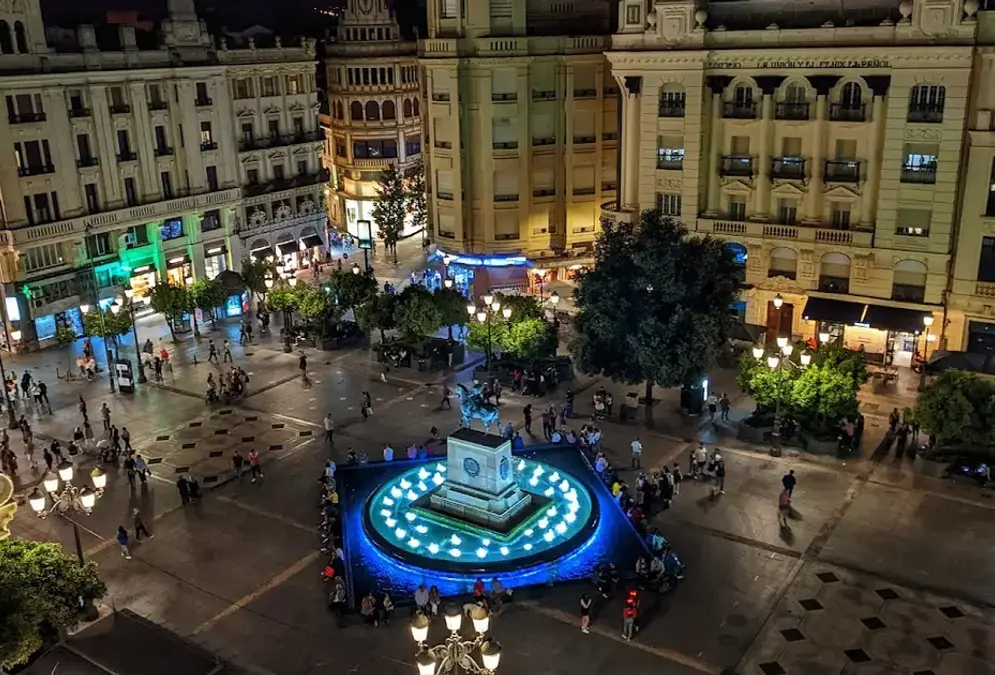
Plaza de las Tendillas in Córdoba with the equestrian statue of El Gran Capitán and the flamenco clock

Explore nearby · Monument

Plaza de las Tendillas

Córdoba's central square, with a clock that chimes guitar chords on the hour. Equestrian statue of El Gran Capitán, terrace cafés and the main shopping streets.

His grandfather's own career, from the War of Granada onward, made the name worth keeping; what the Sessa line added was a custodian. Córdoba's civic memorial to him, the work of the sculptor Mateo Inurria, is the public counterpart of that private care.

The Priego side: Catalina and the Aguilar lordships
The Aguilar side passed through a daughter as well. Catalina Fernández de Córdoba inherited the marquessate of Priego from her father and became its second marchioness[13].
Illustration of the 1808 sack of Córdoba: French Napoleonic infantry looting a Baroque Andalusian palace courtyard at dusk, soldiers carrying silver vessels and church ornaments through an arcaded gallery, dramatic warm torchlight, oil-painting style

Deep dive · Article

1808: The Sack of Córdoba That Broke a French Army at Bailén

In June 1808, French troops sacked Córdoba's churches and palaces on a flimsy pretext — and dragged the plunder into the disaster at Bailén weeks later.

Her inheritance covered the lordships of Aguilar, Priego and Montilla together with Santa Cruz, Puente de Don Gonzalo, Duernas, Castillo-Anzur, Carcabuey and Monturque, and she was countess consort of Feria[14]. Montilla was among the lordships Pedro Fernández had gathered[7].
Her use of the inheritance was local and institutional. In Montilla she backed a Jesuit college, decided on in 1555 with the support of Saint John of Ávila[15] but not established until early 1558[23], in a town already tied to the family's senior line.

Recommended tours

Tours are selected for quality, not commission. We earn a small fee if you book — at no extra cost to you.
Frequently asked questions

How are the Fernández de Córdoba family, the Gran Capitán and the dukes of Sessa connected?

The Great Captain was born into the Aguilar and Fernández de Córdoba lineage[6]. His daughter Elvira became second Duchess of Sessa[1], and her husband Luis, of the Cabra branch, became second Duke by marriage[2], so the Sessa title passed into the Cabra branch.

Who were the counts of Cabra?

They were a branch of the same lineage. Diego Fernández de Córdoba won the lordship of Cabra from Juan II in 1439[9], and Enrique IV granted him the title of count in 1455 for his service in the Granada campaign[4].

Were the Cabra and Aguilar branches really rivals?

The Royal Academy of History's biography of Diego Fernández de Córdoba records a deep rivalry between the counts of Cabra and the lords of Aguilar, and relays the view of unnamed authors that it began with Diego's loss of the office of chief bailiff of Córdoba[3]. The historian Gonzalo Oliva Manso describes a wider family conflict over control of the Córdoba area[16], and the Academy's biography of Pedro Fernández de Córdoba has him and the lord of Cabra heading opposing noble factions in the city[10].

Why was the Great Captain's grandson called Gonzalo?

Elvira and Luis's son, born in 1520, was named Gonzalo after his maternal grandfather, the Great Captain[5].

Who was Catalina Fernández de Córdoba?

She was the second Marchioness of Priego, heir to the marquessate of Priego, which she inherited from her father[13] and holder of the lordships of Aguilar, Priego and Montilla[14]. She backed the founding of a Jesuit college in Montilla, decided on in 1555[15] and established in early 1558[23].

Which titles did the Great Captain's grandson Gonzalo hold?

Elvira's son Gonzalo later held the duchies of Sessa and Terranova together with the countship of Cabra, and was lord of the house of Baena[12].

Sources

23 references Show
  1. ehumanista.ucsb.edu (opens in a new tab)

    “Elvira Fernández de Córdoba [Manrique], II duquesa de Sessa, hija del Gran Capitán.”

  2. historia-hispanica.rah.es — 15460 luis fernandez de cordoba (opens in a new tab)

    “Segundo duque de Sessa por su matrimonio con la hija y heredera del Gran Capitán, Elvira, Luis Fernández de Córdoba, que fue además IV conde de Cabra”

  3. historia-hispanica.rah.es — 15440 diego fernandez de cordoba (opens in a new tab)

    “sobre todo del cargo de alguacil mayor de Córdoba, que cayó en poder, aunque temporalmente, de Pedro Fernández de Córdoba, señor de Aguilar. De aquí procede, según algunos autores, el origen de la enemistad”

  4. historia-hispanica.rah.es — 15440 diego fernandez de cordoba (opens in a new tab)

    “ya en el reinado de Enrique IV, el nuevo Monarca le premió sus servicios militares en la campaña granadina de 1455 con la concesión del título condal de Cabra.”

  5. ehumanista.ucsb.edu (opens in a new tab)

    “el 27 de julio de 1520 nació su hijo Gonzalo, que llamaron como su abuelo materno, el Gran Capitán, en conformidad con lo que estipulaban las capitulaciones matrimoniales.”

  6. historia-hispanica.rah.es — 15450 gonzalo fernandez de cordoba (opens in a new tab)

    “Nació en el seno de una familia de la alta aristocracia andaluza, los Aguilar y Fernández de Córdoba, originarios de Castilla, pero afincados en la subbética desde tiempos de la reconquista de Fernando III el Santo.”

  7. historia-hispanica.rah.es — 15450 gonzalo fernandez de cordoba (opens in a new tab)

    “El padre, Pedro Fernández, reunió en torno a él diversos señoríos como VIII señor de la casa de Córdoba, VII señor de la Cañete de la Frontera, Priego, Montilla, y en sus funciones de alcalde mayor y alguacil de Córdoba”

  8. historia-hispanica.rah.es — 15450 gonzalo fernandez de cordoba (opens in a new tab)

    “su hermano mayor, Alfonso de Aguilar, el primogénito y, por tanto, el heredero de los bienes familiares”

  9. historia-hispanica.rah.es — 15440 diego fernandez de cordoba (opens in a new tab)

    “En 1439, Diego Fernández de Córdoba consiguió de Juan II el señorío sobre la villa de Cabra, como recompensa a sus esfuerzos militares en la frontera.”

  10. historia-hispanica.rah.es — 15471 pedro fernandez de cordoba (opens in a new tab)

    “su pariente, el señor de Cabra, cabeza de otra de las ramas del tronco central de Córdoba, encabezaba el bando opuesto”

  11. ehumanista.ucsb.edu (opens in a new tab)

    “compartía el deber de memoria de las hazañas del Gran Capitán con su mujer”

  12. journals.uco.es (opens in a new tab)

    “Gonzalo Fernández de Córdoba, duque de Sesa y Terranova, conde de Cabra y señor de la Casa de Baena”

  13. montilla.es (opens in a new tab)

    “Heredó el marquesado en 1517 tras la muerte de su padre”

  14. historia-hispanica.rah.es — 15818 catalina fernandez de cordoba (opens in a new tab)

    “Heredó los títulos de señora de la villa de Aguilar, Priego, Montilla, Santa Cruz, Puente de Don Gonzalo, Duernas, Castillo-Anzur, Carcabuey, Monturque (VIII), señora de Montalbán (II), condesa consorte de Feria.”

  15. montilla.es (opens in a new tab)

    “Se encargó personalmente de apoyar e introducir en Andalucía a la Compañía de Jesús, fundando su colegio en Montilla en 1555, con el apoyo de San Juan de Ávila y San Francisco de Borja.”

  16. revistas.uned.es (opens in a new tab)

    “un conflicto general que enfrenta a ambos personajes y a sus familias por el control de la zona cordobesa.”

  17. revistas.uned.es (opens in a new tab)

    “Don Alonso de Aguilar representa la rama primogénita del linaje mientras que la comandada por el conde de Cabra apenas tenía cuarenta y seis años de anligüedad, desde la muerte en 1424 de don Al-fonso II Fernández de Córdoba.”

  18. ehumanista.ucsb.edu (opens in a new tab)

    “el Gran Capitán, antes de su muerte, había dejado clara su voluntad de casar a su única heredera con el hijo mayor de Diego, como mejor forma de acrecentar la cohesión entre los linajes”

  19. ehumanista.ucsb.edu (opens in a new tab)

    “el primogénito, que carecía de título hasta la muerte de su padre, obtuvo así, de inmediato, el título de duque de Sessa”

  20. ejercito.defensa.gob.es (opens in a new tab)

    “The period in which he lived (1453-1515) was one of the most complex and decisive in the history of Spain, dedicating his life to the service of the Catholic Monarchs, at that time with absolute loyalty and honesty.”

  21. digibug.ugr.es (opens in a new tab)

    “En este artículo se analiza el papel desempeñado por Gonzalo Fernández de Córdoba en las dos grandes campañas sostenidas por Francia y los Reyes Católicos por el control de Italia entre 1495 y 1504.”

  22. ehumanista.ucsb.edu (opens in a new tab)

    “No conocemos la fecha exacta del matrimonio entre Luis y Elvira pero tuvo lugar a principios de 1519, antes del 4 de abril de 1519, cuando el embajador de Venecia informó de la realización del mismo (Hernando Sánchez, 221).”

  23. revistas.uloyola.es (opens in a new tab)

    “En este viaje ya se decidió la fundación pero no se pudo efectuar hasta principios de 1558”