history-buffs
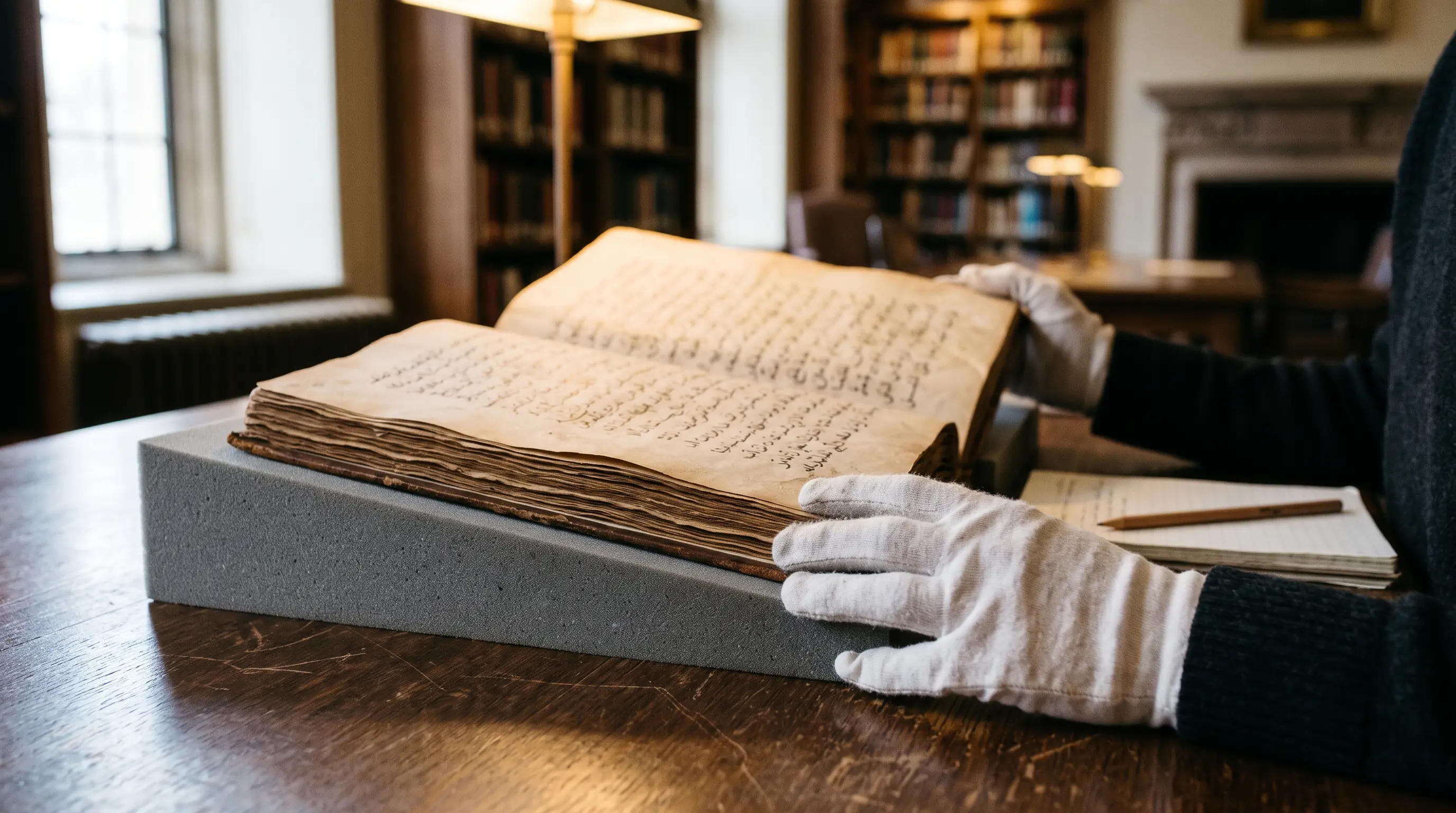
Open Arabic chronicle manuscript with loose folia and a reed pen on a carved wooden desk in a lamplit scriptorium, a scene for historians of al-Andalus, Córdoba chronicles and the Muqtabis

How Historians Reconstruct Caliphal Córdoba from the Muqtabis

Ahmad al-Razi's chronicle is lost, Ibn al-Qutiyya survives in a single manuscript, and Ibn Hayyan's Muqtabis carries the rest. How Córdoba's story reached us.

Portrait of Sophie Marchand
Written by

Art history background with eight years writing interpretive content on Córdoba's Caliphal heritage.

Published
Caliphate of Córdoba929–1031
Ahmad al-Razi wrote the first narrative history of Islamic rule in Spain,[1] and no Arabic copy of it has reached us.[2] A detailed record of al-Hakam II's court survives for the opposite reason: the historian Ibn Hayyan folded the court's annals into one volume of his Muqtabis (a compilation of earlier chroniclers' works), and more than 135 folia of them remain.[3] Historians of al-Andalus who work on Córdoba's chronicles therefore read the caliphate at second hand, and the useful test for any sentence is which route it travelled: quotation, translation, compilation or a single manuscript.
Surviving annals fragment
135+ folia
Isa al-Razi's court record, June 971 to July 975[3]
Al-Hakam II volume compiled
Summer 1009
Ibn Hayyan assembled the seventh volume of his Muqtabis[4]
Ibn al-Qutiyya's history
1 copy
Survives in one manuscript, edited by Gayangos in 1868[5]

Ahmad al-Razi: the first history, lost in Arabic

The Akhbar muluk al-Andalus of Ahmad al-Razi (born around 888, died 955)[6][7] is a lost work, and so is its continuation. Ahmad's work is known only from quotations by other historians and from a late medieval translation of part of the text,[2] while Isa's continuation survives only in quotations.[15] For a book credited with being the first narrative history of Islamic rule in Spain, that is a harsh fate: nobody can now open the Arabic and check what a quotation left out.
Two routes carry what is left. One passes through translation into Portuguese and then Castilian, ending in the Castilian Crónica del moro Rasis, which stops well short of the Umayyad story; the other runs through quotation by later authors, Ibn Hayyan among them. Neither returns the original.
A book that survives in quotation behaves differently from one that survives in manuscript. Each quoting author kept what suited his own page and dropped the rest, so a reader meets Ahmad al-Razi through other people's selections, never through his own order of argument. The gaps between the quotations are invisible, and that invisibility is the first hazard of working on caliphal Córdoba from its chronicles.

The Rasis chronicle: a Portuguese and Castilian detour

A translation carried part of Ahmad al-Razi's work out of the Arabic world, but the route was partial at every step. The Portuguese version, the Crónica do mouro Rasis, is lost today, and can be reached only through passages in later chronicles and through a Castilian translation made in the fifteenth century.[8] One of those chronicles, the Crónica Geral de Espanha de 1344, was drafted by Pedro, Count of Barcelos.[9]
The Castilian text, the Crónica del moro Rasis, is limited to the first and second parts of the original, the geography of Spain and its history before Islam.[10] The Umayyad story is not in it. A reader who opens "Rasis" hoping for the emirate or the caliphate finds none of it, and the title gives no warning.
So the Rasis text answers a question few visitors to Córdoba ask, what a medieval Andalusi author knew of Spain before the Muslim conquest, and it is silent on Umayyad Córdoba itself.
Only the Castilian Crónica del moro Rasis stops at those two parts. The Castilian version of the Crónica Geral de 1344 preserves more of the original, including an abridged account of the 711 conquest and the Islamic period,[11] and Ibn Hayyan is one of several later authors, among them al-Zubaydi, Ibn al-Faradi, al-Humaydi, al-Dabbi and Yaqut, who quote al-Razi's Akhbar muluk al-Andalus.

Isa al-Razi: the son whose annals Ibn Hayyan used

A detailed record of al-Hakam II's reign was written by a court insider, and it reaches us inside someone else's book. Isa ibn Ahmad al-Razi (died in the 980s)[12][13][14] continued the chronicle of his father, Ahmad al-Razi, and all that survives of his part are quotations in other Arabic histories.[15] One such quotation is a fragment of more than 135 folia, covering June 971 to July 975, which Ibn Hayyan used to compose one volume of his Muqtabis.[3]
The fragment, known as the annals of al-Hakam II's court, logs everything that happened around the caliph. Its entries run from administration to ceremony and from good news to bad:[16]
  • appointments and dismissals of officials
  • embassies
  • famines
  • parades
  • victories and defeats
  • illnesses
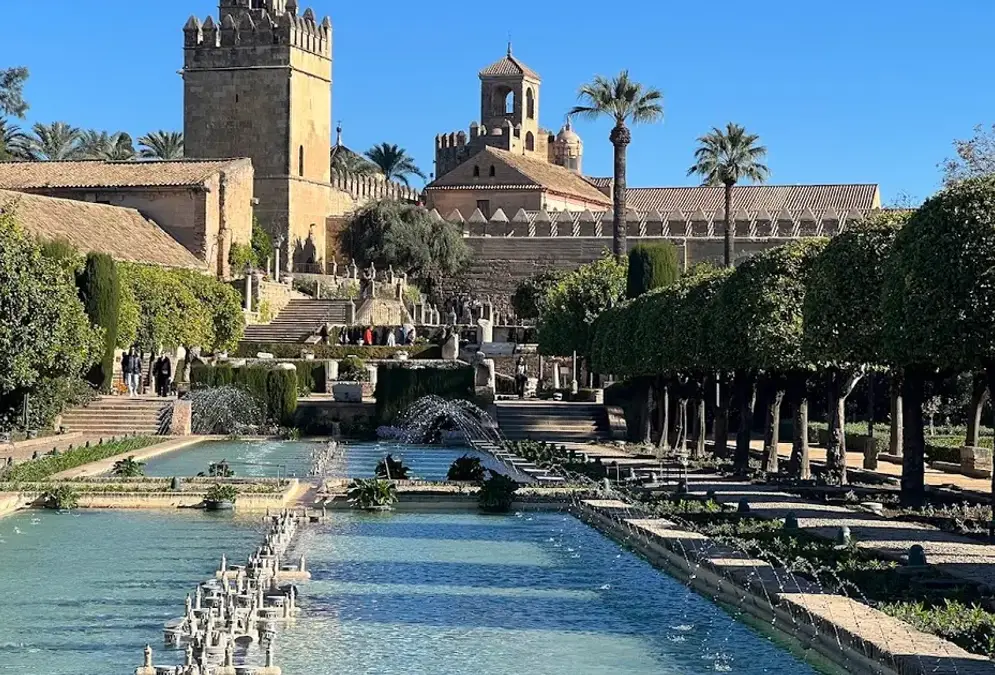
Gardens of the Alcázar de los Reyes Cristianos with pools, fountains, and sculpted cypress trees

Explore nearby · Monument

Alcázar de los Reyes Cristianos

Alcázar de los Reyes Cristianos, Córdoba: free entry on Tuesdays. A 14th-century fortress-palace with terraced Moorish-inspired gardens and Roman mosaics.

As of 1967, Emilio García Gómez wrote that a fair number of fragments (bastantes trozos) of the Muqtabis were now known, whereas a few decades earlier only two had been: one on the emirate of Abd Allah, kept at Oxford, and one on the caliphate of al-Hakam II.[17] Credit for the text has wandered: researchers who use it have often named Ibn Hayyan, an eleventh-century writer from a family close to the Umayyad court, as its author, while Eduardo Manzano Moreno argues that the text is Isa's own record, preserved by a later compiler.[18]

Ibn al-Qutiyya: a history that survives in one copy

The Ta'rikh iftitah al-Andalus, the history of the conquest of al-Andalus by Ibn al-Qutiyya, survives in a single manuscript, which Pascual de Gayangos edited in 1868.[5] Every reading of it rests on one copy, with no second witness against which to check a doubtful word.
That puts it in a different category from the work of Ahmad al-Razi and his son Isa. Their books are lost and reach us through intermediaries; this one survives without an intermediary, but singly, so there is no variant reading to compare.

Ibn Hayyan and the Muqtabis: a compiler at work in 1009

Ibn Hayyan (born around 987, died 1076)[19][20] was a compiler, and his Muqtabis gathered the works of earlier chroniclers rather than replacing them.[21] He assembled the seventh volume, the one on al-Hakam II, in the summer of 1009, just as the civil war that ended the caliphate, the fitna, broke out.[4]
The distance is worth stating plainly. Isa's annals stop in 975, and the volume built from them was assembled in 1009, more than three decades later, by a writer working in the middle of a civil war.[3][4] The annals were an older record by then, and Ibn Hayyan was handling them as a historian handles an archive.
He did not hide his debts: Isa's text served him beyond al-Hakam's reign, and in volume II he cites Isa for a revolt in the province of Rayyo at the end of 265 AH (878 to 879), under Emir Muhammad I.[22]
Belalcázar Castle's granite torre del homenaje, the tallest castle keep in Spain by official listing, rising above the fortress walls in soft morning light

Deep dive · Article

47 Metres Tall and Almost Unknown: Spain's Tallest Keep

Belalcázar Castle's 47 m keep is listed by the Junta de Andalucía as Spain's tallest. How it grew, what to see inside and how to book the free guided visit.

That method explains both the value of the Muqtabis and its limits. A compiler who quotes his predecessors gives us texts we would otherwise lose; he also stands between us and them, so every passage has to be read as his selection from a longer original.

What survives of the Muqtabis, and how far to trust it

Only part of Ibn Hayyan's ten volumes has come down.[23] Even volume II, which reaches into the reign of Emir Muhammad I, survives in a headless manuscript.[24]
The al-Hakam II volume became the property of the Real Academia de la Historia in Madrid, thanks to the scholar Francisco Codera.[25]
Medieval readers already weighed these books with care. Al-Faradi, a later biographer, warned that Ibn al-Qutiyya's histories were tales (akhbar) and not serious history (ta'rikh).[27]

Recommended tours

Tours are selected for quality, not commission. We earn a small fee if you book — at no extra cost to you.

The chain of transmission is rarely shown on the page, but it decides how much weight a sentence can bear. Each route costs something different: quotation drops context, translation can drop whole parts, as the Rasis text dropped the Umayyad story, compilation adds the compiler's choices, and a unique manuscript removes any chance of comparison.

Frequently asked questions

Who were the historians of al-Andalus behind Córdoba's chronicles and the Muqtabis?

The main names are Ahmad al-Razi, his son Isa al-Razi, Ibn al-Qutiyya and, as compiler, Ibn Hayyan. Ibn Hayyan's Muqtabis used Isa's annals for the years 971 to 975, while Ahmad al-Razi's own chronicle and Ibn al-Qutiyya's history reached us by other routes.

What is the Muqtabis and who was Ibn Hayyan?

Ibn Hayyan was an eleventh-century writer from a family close to the Umayyad court, and the Muqtabis was his ten-volume compilation of earlier chroniclers' works. Only part of the ten volumes survives.

Did Ahmad al-Razi's chronicle survive?

Not in Arabic. His Akhbar muluk al-Andalus is known from quotations by later authors and from a late medieval translation. The Castilian Crónica del moro Rasis preserves only the geography and pre-Islamic history, so the Rasis text itself omits the Umayyad story, although the Crónica Geral de 1344 keeps an abridged account of the Islamic period.

Who wrote the annals of al-Hakam II's court?

Isa ibn Ahmad al-Razi, the son of Ahmad al-Razi. Ibn Hayyan used his annals for the Muqtabis volume covering June 971 to July 975, and the Arabic text survives as a substantial fragment inside that volume.

How many manuscripts of Ibn al-Qutiyya's history survive?

Only one. It is the only known copy, which Pascual de Gayangos edited in 1868.

Why do historians rely on chroniclers who wrote after the events?

For caliphal Córdoba they often have no alternative: Ahmad al-Razi's chronicle and Isa's annals survive only through later authors who quoted or compiled them. Even medieval readers were wary, and a later biographer, al-Faradi, called Ibn al-Qutiyya's histories tales rather than serious history.

Sources

27 references Show
  1. Wikipedia — Ahmad ibn Muhammad ibn Musa al Razi (opens in a new tab)

    “was a Muslim historian of Persian origin who wrote the first narrative history of Islamic rule in Spain.”

  2. Wikipedia — Ahmad ibn Muhammad ibn Musa al Razi (opens in a new tab)

    “The Akhbār mulūk, including its continuation, is a lost work. It is known only from quotations by other historians and a late medieval translation of a part of it.”

  3. degruyterbrill.com (opens in a new tab)

    “Used by Ibn Ḥayyān to compose one of the volumes of his celebrated Muqtabis, these ‘annals’ have come to us in a substantial fragment of more than 135 folia that cover the period from June 971 to July 975 CE.”

  4. e-revistas.uc3m.es (opens in a new tab)

    “en el verano de 1009 para componer el volumen séptimo de su Muqtabis”

  5. routledge.com (opens in a new tab)

    “the only serious examination of the unique manuscript since Pascual de Gayangos’ edition in 1868.”

  6. Wikipedia — Ahmad ibn Muhammad ibn Musa al Razi (opens in a new tab)

    “Aḥmad al-Rāzī was born in April 888 in Córdoba, then the capital of the al-Andalus.”

  7. infopedia.pt — $cronica do mouro rasis (opens in a new tab)

    “A crónica, atualmente perdida, traduzida para castelhano ainda no século XV, é apenas acessível em alguns trechos da”

  8. infopedia.pt — $cronica geral de espanha de 1344 (opens in a new tab)

    “Redigida em 1344 por D. Pedro, conde de Barcelos”

  9. Wikipedia — Ahmad ibn Muhammad ibn Musa al Razi (opens in a new tab)

    “It is limited to the first and second parts of the original work.”

  10. Wikipedia — Ahmad ibn Muhammad ibn Musa al Razi (opens in a new tab)

    “It preserves more of the original, including an abridged version of the conquest of 711 and the Islamic period.”

  11. Wikipedia — Isa al Razi (opens in a new tab)

    “ʿĪsā ibn Aḥmad al-Rāzī (died 980) was a Muslim historian”

  12. e-revistas.uc3m.es (opens in a new tab)

    “unos anales que escribió ʻĪsà b. A ḥmad al-Rāzī (m. 985)”

  13. europenowjournal.org (opens in a new tab)

    “Based on ‘Īsa al-Rāzī’s (d. 989 CE;”

  14. Wikipedia — ʿĪsā al Rāzī (opens in a new tab)

    “All that survives of ʿĪsā's part are quotations in other Arabic histories.”

  15. e-revistas.uc3m.es (opens in a new tab)

    “En él se da cuenta de todo lo que sucede en la corte del califa al-Ḥakam II: nombramientos o destituciones de funcionarios, embajadas, hambrunas, desfiles, victorias, derrotas y enfermedades.”

  16. revistas.ucm.es — 4753 (opens in a new tab)

    “hace unas décadas, de toda la obra no se sabía más que de dos fragmentos: uno, sobre el emirato de ‘Abd Alláh, conservado en Oxford, y éste, sobre le califato de al-Hakam II”

  17. europenowjournal.org (opens in a new tab)

    “those employing it often attribute it to Ibn Ḥayyān, an eleventh-century writer whose family had close ties to the Umayyad court.”

  18. revistas.ucm.es — 3780 (opens in a new tab)

    “nació en Córdoba hacia el año 987 de nuestra era.”

  19. revistas.ucm.es — 3780 (opens in a new tab)

    “Murió en octubre de 1076.”

  20. es.hispanopedia.com (opens in a new tab)

    “hace referencia a su carácter de compilación de obras previas de cronistas árabes”

  21. revistas.ucm.es — 4564456615376 (opens in a new tab)

    “Dijo ´Īsà b. Aḥmad al-Rāzī: A finales de ese año [265/878-879] surgió la sedición en la provincia de Rayyo”

  22. es.hispanopedia.com (opens in a new tab)

    “La obra está compuesta por diez volúmenes”

  23. revistas.ucm.es — 4564456615376 (opens in a new tab)

    “mientras que M2c designaría al texto correspondiente a la continuación del reinado de ʽAbd al-Raḥmān II y al gobierno de Muḥammad I”

  24. revistas.ucm.es — 4753 (opens in a new tab)

    “vino a ser propiedad exclusiva de la Real Academia de la Historia en Madrid, gracias a Codera”

  25. Wikipedia — ʿĪsā al Rāzī (opens in a new tab)

    “Other scholars, such as García Gómez and Picard, treat only the court history of al-Ḥakam as the work of ʿĪsā and assign that of ʿAbd al-Raḥmān (died 961) to his father (died 955).”

  26. Wikipedia — Ibn al Qutiyya (opens in a new tab)

    “Al-Faraḍī cautions that Qūṭiyya's histories were tales(akhbār), and not serious history(ta'rīkh).”