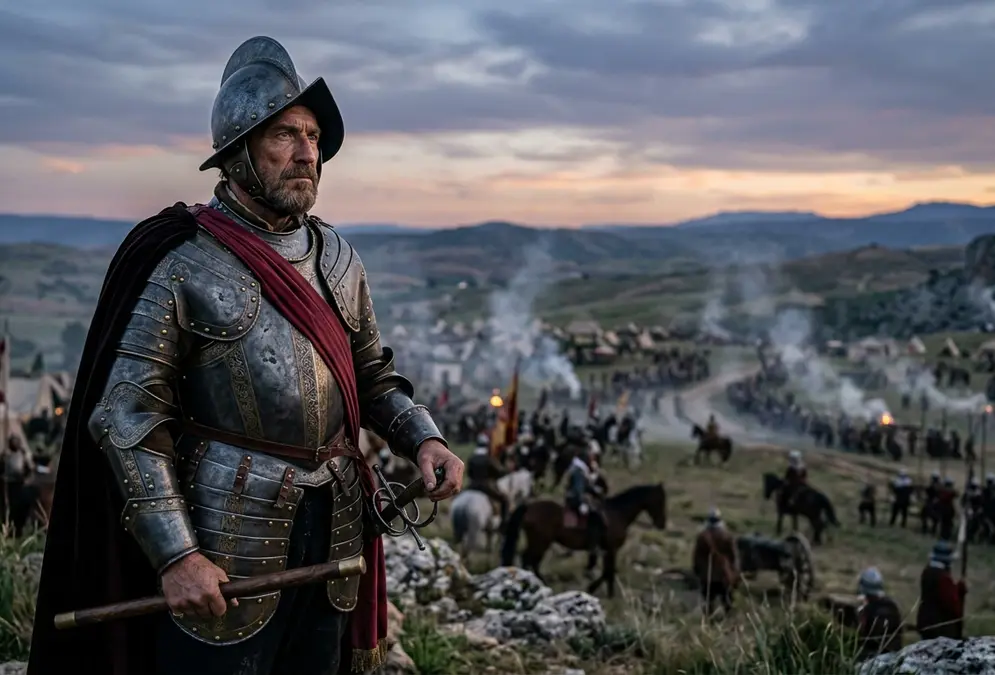

From Montilla to the walls of Granada
Gonzalo Fernández de Córdoba was born on September 1, 1453, in Montilla, in the province of Córdoba, the second son of a mid-ranking Castilian noble household[1]. The family seat stood in Córdoba province, and while the future general grew up in the orbit of the provincial nobility, his real education came from the Reconquista campaigns that consumed the final decade of Moorish Iberia.
By the early 1480s, he had fought alongside Ferdinand II of Aragon in the grinding siege warfare of southern Spain. He spoke Arabic with sufficient fluency to negotiate, which made him unusual among the Christian commanders. When Ferdinand and Isabella needed someone to conclude the fall of Granada in January 1492, they chose Gonzalo for the task. He met with Muhammad XII (Boabdil), the last Nasrid sultan, and brokered terms that included safe passage, property guarantees, and religious protections for the remaining Muslim population.
The consequence of that negotiation is still standing. Had Granada fallen by storm rather than surrender, the Alhambra would almost certainly have been looted and demolished, as most Moorish structures in reconquered Andalucía eventually were. Gonzalo's diplomatic instinct preserved the palace complex for the Castilian crown. He received no particular credit for this in the official record.
The year 1492 was dense. Columbus departed Palos de la Frontera in August on Ferdinand and Isabella's commission, and the monarchs received his return the following spring not in Córdoba but in Barcelona, where he presented his discoveries at court in 1493. That reception was a separate episode from Columbus's earlier lobbying visits to the Córdoba court between 1486 and 1492, when he spent six years in and around the Alcázar de los Reyes Cristianos awaiting the monarchs' decision. That Córdoba court is one of the hinges of Córdoba's history: Gonzalo was present there for the planning that closed out Moorish Spain, in the same years Columbus was pressing his own case down the same corridors. He had just helped end one chapter at Granada; a different kind of expansion was already beginning.
Italy and the problem with medieval cavalry
The Italian Wars began in 1494 when Charles VIII of France marched an army through the peninsula and demonstrated that the mounted knight, the backbone of 15th-century European warfare, had a serious structural problem: well-organized infantry with pikes could stop him.
Spain sent Gonzalo to southern Italy in 1495 as commander of the relief force in Calabria[2]. His first campaigns were difficult. The Spanish army was smaller, under-equipped, and fighting French forces with a numerical advantage. What Gonzalo learned during those early reverses was more useful than a victory: the old Castilian infantry formations, built for the short engagements of the Reconquista, were too rigid for sustained Italian-style campaign warfare. He needed something that combined the stopping power of the Swiss pikemen (then the most feared infantry in Europe) with a new weapon the Swiss did not yet respect: the arquebus.
The arquebus was slow to reload. A single shot took a trained soldier thirty seconds under battlefield conditions. Swiss infantry exploited that gap, closing at the run before a second volley was possible. The solution Gonzalo developed over several campaigns was positional: dig a defensive trench, position the arquebusiers in a protected line, and mix them with pikemen in close formation so that any cavalry or infantry charge that survived the musket fire ran onto pikes at close range. Neither element alone was decisive. Together, they were.
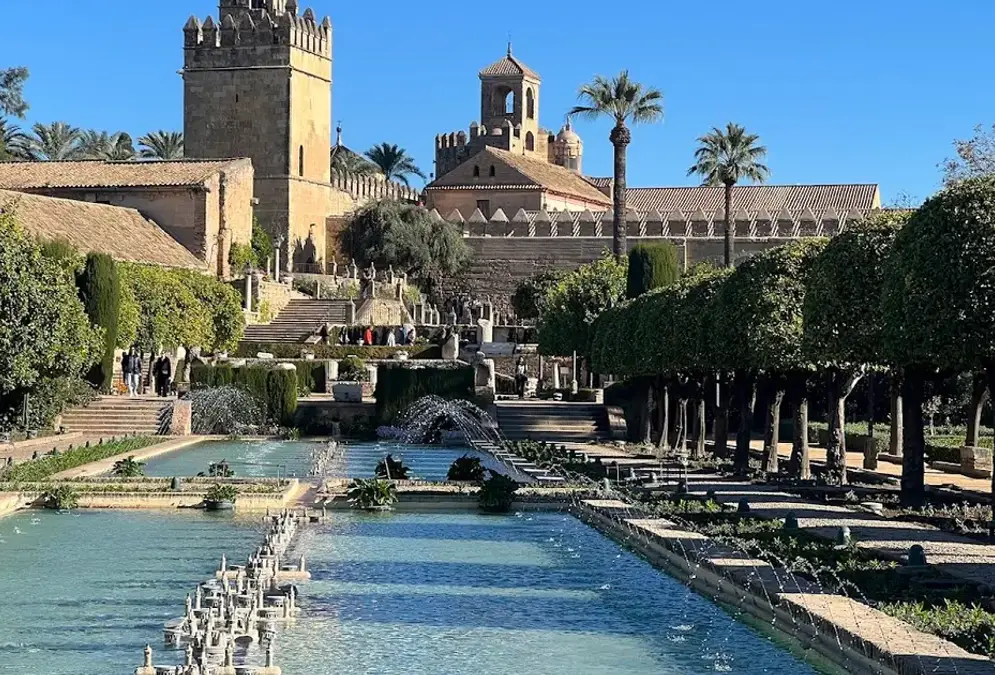
Explore nearby · Monument
Alcázar de los Reyes Cristianos
Alcázar de los Reyes Cristianos, Córdoba: free entry on Tuesdays. A 14th-century fortress-palace with terraced Moorish-inspired gardens and Roman mosaics.
He also reorganized the basic unit of Spanish infantry into the coronelía: roughly 1,000 men[4] combining all weapon types under a unified command structure. This was new. Earlier armies assigned different weapon categories to different units, which meant coordination depended on commanders transmitting orders in real time across a chaotic battlefield. The coronelía gave a local commander a self-contained tactical package. From the coronelía came the tercio, the formation that would dominate European land warfare for 150 years.
Cerignola, April 28, 1503: the first modern battle
The Battle of Cerignola was fought on April 28, 1503, near the town of Cerignola in Apulia, southern Italy[3]. The French army under the Duc de Nemours outnumbered the Spanish force. What Gonzalo had, on a ridge above the town, was a prepared position: a ditch dug along the defensive line, arquebusiers positioned behind it, pikemen ready to engage anything that crossed.
The French cavalry charged. The horses could not clear the ditch cleanly. The arquebusiers fired in rotation, one line reloading while another fired, a technique that closed the 30-second reload gap that had made the arquebus tactically marginal until then. The French Swiss mercenary pikemen who followed the cavalry charge ran into the Spanish pike formation at the ditch line. The Duc de Nemours was killed in the first exchange. The French army broke.
Recommended tours
Tours are selected for quality, not commission. We earn a small fee if you book — at no extra cost to you.
Historians classify Cerignola as the first battle in history decided by firearms. The French did not lose because they ran out of soldiers or because Spanish cavalry outflanked them. They lost because the tactical combination of prepared position, arquebus rotation, and integrated pike made a frontal assault more expensive than any 15th-century army could absorb. The lesson took a generation to fully penetrate the courts of Europe, but from 1503 forward, gunpowder infantry was the decisive arm of land warfare.
Within two months of Cerignola, Gonzalo had taken Naples. He followed the Cerignola victory with the Battle of Garigliano on December 29, 1503: a winter flanking maneuver across a flooded river estuary at night, which no military convention of the time considered a viable option. The French army on the far bank, expecting a conventional siege, was taken completely by surprise. Spain now controlled the Kingdom of Naples, a position it would hold for two centuries.
140
The tactical architecture Gonzalo proved at Cerignola and Garigliano is not a technical footnote. It is the intellectual equivalent, in military terms, of a philosophical breakthrough: a new way of organizing human force that rendered the previous system obsolete. Averroes systematized Aristotle for medieval Europe from a study in Córdoba. Gonzalo systematized firearms and pike from a ditch outside an Apulian market town. Both men changed what came after.
The tercio and 140 years of European dominance
The tercio that emerged from Gonzalo's campaigns was not a single invention with a fixed date. It crystallized over the decade from 1495 to 1507, formalized in subsequent Spanish military regulations, and refined by commanders who understood what he had done at Cerignola[4]. A tercio at full strength numbered around 3,000 men[4] organized into companies of mixed arms: arquebusiers (later musketeers), pikemen in a dense central square, and sword-and-buckler infantry for close-quarters work.
The formation's strength was that it could defend itself from cavalry without external support, absorb arquebusier fire, and still advance with the pike square. It was genuinely combined arms, not just adjacent weapon types marching together.
- Battle of Pavia (1525): Francis I of France, commanding personally, was captured and his army destroyed by Spanish tercios under Charles V.
- Battle of Mühlberg (1547): The tercio formation helped Charles V defeat the Schmalkaldic League in a single engagement.
- Battle of Nördlingen (1634): Spanish-Imperial forces crushed a Swedish-Bernhardine army, killing 9,000 and capturing 4,000[4] in an afternoon.
- Battle of Rocroi (1643): French cavalry under Condé finally broke the tercio formation for the last time, ending 140 years of Spanish infantry supremacy.
The intellectual lineage is traceable. Niccolò Machiavelli wrote about the new infantry in Arte della Guerra (1521), drawing on what he had observed in Italy. Maurice of Nassau and Gustavus Adolphus of Sweden, who eventually developed the tactics that defeated the tercio, were consciously responding to its strengths. You cannot describe the evolution of European warfare without naming what Gonzalo built.
The standard narrative of Córdoba's intellectual heritage runs: Seneca to the Jewish philosopher Maimonides to Averroes, the Roman Stoic, the Jewish philosopher, the Islamic polymath, all within a compact radius of the old city. Gonzalo does not fit that narrative. He was not a philosopher. He built no library. He left no text. What he left was a system of organized force that shaped the political map of Europe for six generations. The omission from Córdoba's self-image is partly geography (born in Montilla, buried in Granada) and partly a city choosing which achievements it wants to commemorate.
The cuentas: when the king asked for the receipts
After Isabella I died in November 1504, the political landscape shifted. Gonzalo controlled Naples, commanded the loyalty of a battle-proven army, and was the most famous military commander in Castile. Ferdinand II, now ruling as regent rather than joint monarch, grew uneasy with a general who had outgrown the role of instrument.
In 1507, Ferdinand summoned Gonzalo to Spain and demanded an accounting of the military expenditures in Naples: years of campaign costs, troop payments, fortification expenses, logistics. The implication was misappropriation. The demand was, by most contemporary assessments, politically motivated rather than financially grounded. Ferdinand wanted to remove a powerful subject from command and needed a legal pretext.
Gonzalo's response became a legend. The story, preserved in chronicles and almost certainly improved in the retelling, describes him presenting an itemized counter-ledger[1]. The figures included:
- Several hundred thousand ducats for friars who prayed for the souls of Spanish soldiers
- Millions for bells, candles, and sacred objects to invoke divine assistance
- A substantial sum for the king's own ingratitude as a line item
- And a final figure, in one version stated as one hundred million gold ducats, for his patience in being asked to account for the kingdom he delivered
Gonzalo presented his counter-ledger to the king: millions for candles, millions for prayers, and a final line for his patience in being asked to account for the kingdom he had delivered.
The story may be apocryphal. No original document survives. What is not contested is the outcome: Gonzalo was removed from command of Naples in 1507 and given the titles of Duke of Sessa, Andría, and Montalto (honors that carried prestige and no power)[6]. The Duque de Terranova title had already been conferred in 1502 — a reward for the Naples victory — five years before the recall[6]. Ferdinand also promised him the position of Master of the Order of Santiago (the most senior military-religious honor in Castile). The promise was never honored. He spent the last eight years of his life in honorable retirement in Granada, politically neutered by the king whose kingdom he had expanded by a third.
Ferdinand's conduct toward Gonzalo fits a pattern visible in how Spanish monarchs handled successful commanders throughout the 16th century: tolerated while needed, contained once the campaign was won. The Duke of Alba, a later generation, would experience a version of the same treatment after his Netherlands campaign.
Montilla, Granada, and Córdoba's selective memory
Gonzalo Fernández de Córdoba died on December 2, 1515, in Granada, where he had lived since his removal from Naples command. He was 62. He is buried in the Real Monasterio de San Jerónimo in Granada, where his tomb was reportedly surrounded by 700 captured enemy battle standards at the time of interment[1]. Napoleonic forces sacked the monastery in 1810[5], burning the captured banners and desecrating the tomb. What survives of the original monument is a fraction of its 16th-century form.
The tourist who wants to trace his presence faces a geographical problem. He was born in Montilla, 45 kilometres south of Córdoba on the road toward Málaga, in the wine country that produces Montilla-Moriles. His tomb is in Granada, 160 kilometres east. Córdoba itself has no monument to him, no statue, no named street of any prominence in the historic centre.
This contrasts with the treatment of the city's other famous figures. Averroes and Maimonides both have bronze statues near the Judería walls. A statue of Seneca stands beside the Puerta de Almodóvar. The Roman temple on Calle Capitulares is partially reconstructed and signposted, and the Roman Córdoba past is actively curated, with the temple, the Roman bridge, and the Alcázar folded into a coherent historical narrative.
Gonzalo falls outside that narrative for several reasons: he was not born in the city itself, his greatest achievements happened in Italy rather than Córdoba, and his contribution is military rather than intellectual or religious. A city that identifies its heritage as the convergence of three cultures and the life of the mind has less obvious use for a man who invented new ways to kill cavalry horses. The city's Reconquista-era history gets its fuller sweep in this guide to Christian Córdoba.

Deep dive · Article
1808: The Sack of Córdoba That Broke a French Army at Bailén
In June 1808, French troops sacked Córdoba's churches and palaces on a flimsy pretext — and dragged the plunder into the disaster at Bailén weeks later.
There is something honest in this. Not every city needs to claim every famous person born within administrative reach. But the scale of the oversight is worth noting. Averroes changed how medieval Europe read Aristotle, a real and significant contribution. Gonzalo changed the physical map of Europe and the mechanics of every war fought on the continent for six generations. Pavia (1525), Mühlberg (1547), Nördlingen (1634): these were tercio battles, and the tercio was his system.
If you want to find him, go to Montilla: the Castillo de Montilla has exhibits on his life, and the town identifies itself with his name prominently. The monastery in Granada is open to visitors; the tomb is in the church, restored after the Napoleonic damage, marked with a plaque that gives the dates and the title. It is a quieter memorial than Averroes receives in Córdoba, for a man whose impact was considerably louder.