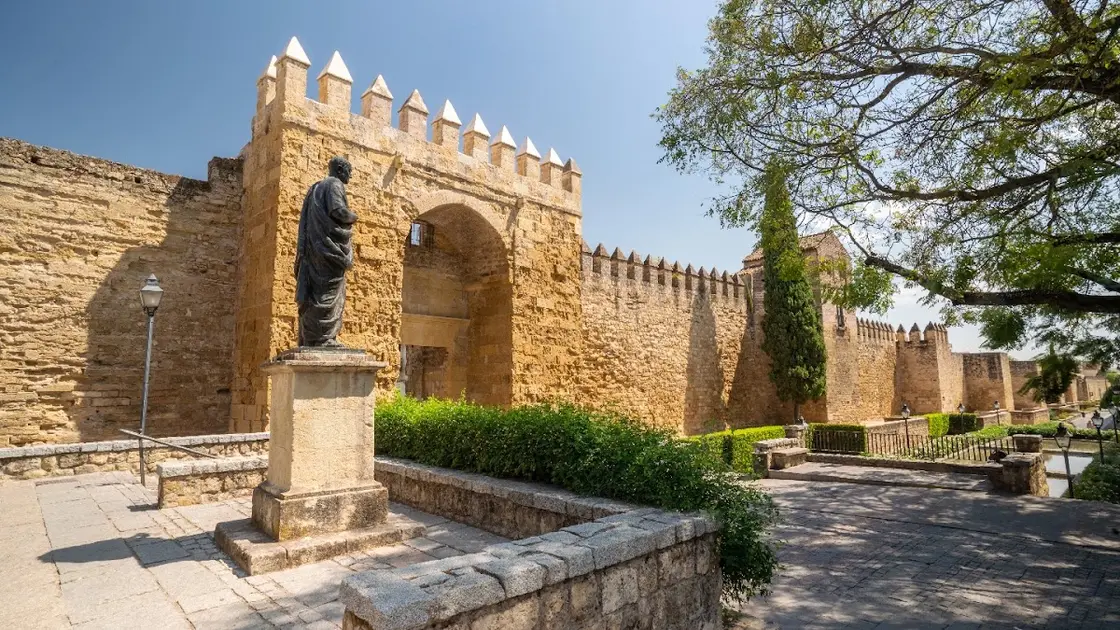
The Puerta de Almodóvar is one of only three gates of Córdoba's medieval wall still standing, on Calle Cairuán. It is built of sandstone ashlar, keeps its full crenellation, and has a bronze of the philosopher Seneca standing near it. Treat it as a short wall-reading stop beside the Judería rather than a full visit.
What you are looking at
The IAPH heritage guide describes a gate built in the 10th century and reformed in the 14th and 19th centuries. It stands where a Roman and caliphal gate once opened, which the Arabs called the Puerta del Nogal, the Walnut Gate. Spanish Wikipedia counts it among the three surviving medieval gates, alongside the Puerta del Puente and the Puerta de Sevilla.
The present structure is Mudéjar work in sandstone ashlar. Its arch, set in a slightly projecting frame, was walled up early in the 19th century and a lintelled doorway opened in the infill. Look up: the full crenellation and the wall-walk survive at the top.
Do not expect a pristine caliphal gate. The heritage guide itself warns that later restorations have distorted its original look. It also records that the gate once had an albarrana tower, a detached defensive tower, destroyed in the 19th century, as at the Puerta de Sevilla.
Why Almodóvar
After the 1236 reconquest the gate took its name from the road that began here and led to Almodóvar. The town in question is Almodóvar del Río, about 23 km from Córdoba. The Arabic Puerta del Nogal name belongs to the earlier gate on the spot.
Pair the gate with the Seneca bronze
The statue stands near the gate, so you can take in both on one short stop. Look up for the surviving battlements and wall-walk.
Seneca and the street outside
Standing near the gate since 1965 is a bronze of Córdoba-born philosopher Seneca, by Amadeo Ruiz Olmos. Spanish Wikipedia adds that it was unveiled by members of an international philosophy congress. The Averroes monument followed two years later, lower down the promenade. The result is a short open-air walk past two philosophers and a wall.
The street is Calle Cairuán, renamed on 27 May 1968 after Córdoba's twinning with Kairouan in Tunisia. For the story of that street and its walls, read the Calle Cairuán and Almodóvar Gate article rather than expecting it here. For the philosopher himself, see Seneca.
The ground just outside the wall, beside the Judería, is thought to have held an old Jewish cemetery. The Synagogue is the related stop if you want to follow that thread.