
The Hospital de Jesús Nazareno is the church of an old charitable institution in Córdoba, and it is a quiet one: no published schedule or admission price, and a building the 19th century rewrote almost entirely. What survives is a nave under a neo-Mudéjar artesonado and two paintings of the mid-1600s. Come for those, and treat it as one more stop on a walk through the city's churches rather than a destination on its own.
What the Hospital de Jesús Nazareno is
The Junta de Andalucía's heritage institute (IAPH) describes the hospital as a charitable institution whose origins go back to the Middle Ages. Its great promoter was Padre Cristóbal de Santa Catalina, who drove the institution forward in the 17th century. Nineteenth-century works then remodelled the building so completely that little of the older fabric is readable from the outside.
The name is worth a note. Here "hospital" means a charity house for the poor and sick, in the old sense, not a modern clinic. The church is what remains for a visitor to look at.
Check access before you walk over
No opening hours or entry price are published, so confirm that the church is open on the day. If it is closed, other churches on the same IAPH walk (check a map for distances) are a possible fallback.
What to look for inside
IAPH's guide singles out three things, all of them worth looking up for.
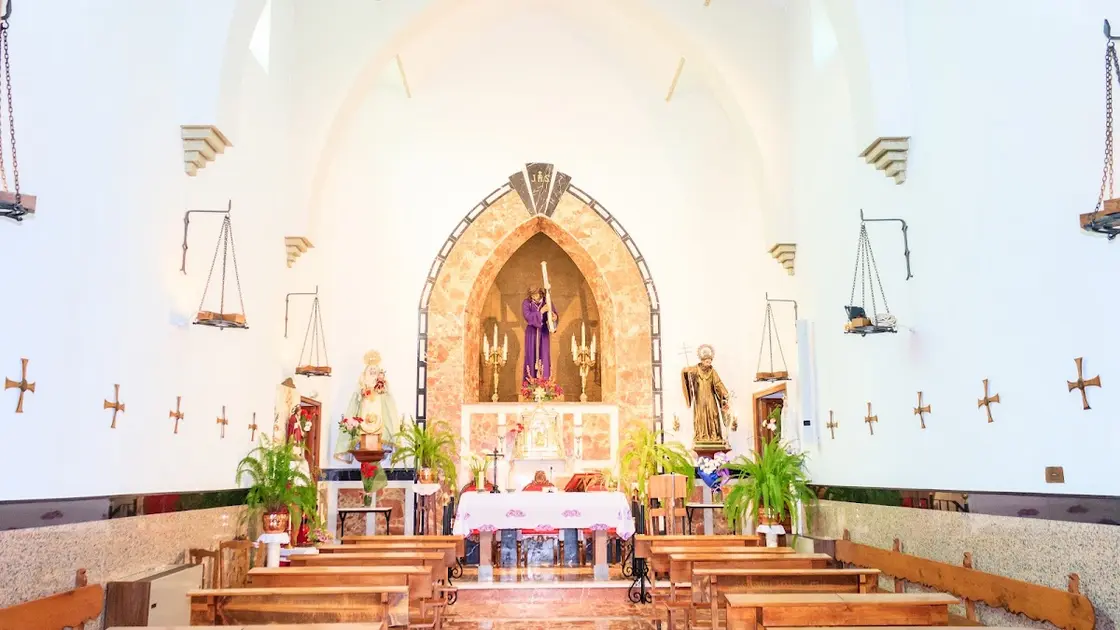
- The nave and its ceiling. Of the old church fabric only the nave survives, covered by a neo-Mudéjar artesonado, the carved timber ceiling style Córdoba's Christian builders borrowed from Islamic craft.
- Santa Elena and San Dimas. At the west end, each housed in a neo-Gothic structure, hang two paintings attributed to the workshop of Antonio Castillo and dated to the middle of the 17th century.
- The crossing dome. In the modern part of the church, the dome over the crossing carries a glory scene in which angels hold the monogram of Christ.
The contrast is the point. The paintings date from the era of Padre Cristóbal's work, while the neo-Mudéjar and neo-Gothic styles are revivals that sit on top of them. A single visit lets you read several periods of taste in one room.