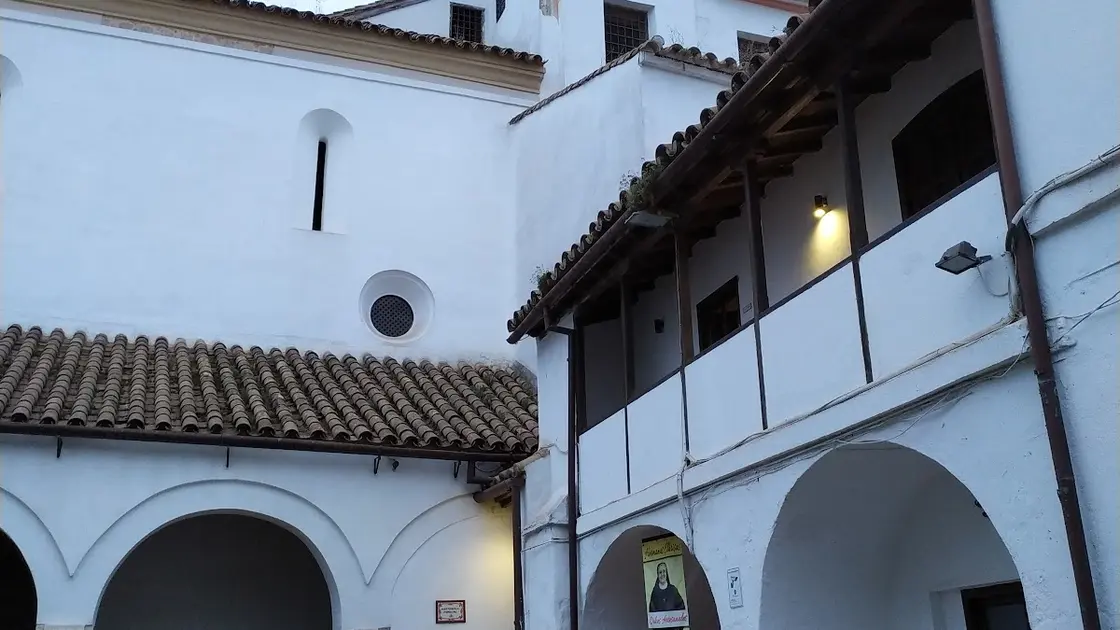
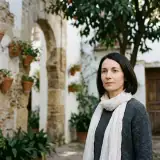
The Convento de Santa Cruz is a walled convent in the barrio de San Pedro, in the historic centre of Córdoba. It was founded around the 15th century by Pedro de los Ríos, Lord of Fernán Núñez, and his wife Teresa Zurita. It is a Bien de Interés Cultural with the legal category of Monument, and the Junta de Andalucía measures the protected plot at 4,896 m². Come for the quarter and the street front. Do not plan your day around getting inside.
A noble foundation in the San Pedro quarter
The heritage guide of the Junta's IAPH institute says the widow Teresa Zurita carried out her late husband's wishes and founded the convent in 1464, for Poor Clare nuns of the Franciscan order. Other sources give 1435, so treat any single year with care; the decree itself says only that it was founded around the 15th century.
The Ríos family never let go of the place. They kept adding houses around courtyards, which is why the complex grew into an irregular plan centred on the main cloister and the church, with a large orchard behind. When the older Santa Clara monastery closed for good in 1868, its nuns joined the Santa Cruz community.
Treat it as a street-front stop
No opening hours or ticket are published, so do not build a plan around going inside. Enjoy the doorway on calle Agustín Moreno and the quarter around it.
What the heritage record describes inside
The IAPH guide is the detailed description used here, and it describes interiors that visitors should not expect to enter. It lists:
- The church: a single nave of three bays, with an 18th-century blue-and-white tile dado of plant motifs running round the interior.
- The cloister: two storeys, some columns reusing Roman and Mudéjar elements, and painted 15th-century alfarje ceilings over the galleries.
- The casa mudéjar: a clear example of the domestic architecture of its period.
- The casa de novicias: an 18th-century Baroque building put up around 1726 as a retreat for Petronila and María José Gutiérrez de los Ríos. Its painted trompe-l'oeil decoration is one of the few surviving examples of paint applied to architecture in Córdoba.
The IAPH sums the complex up as a mix of Roman, Islamic, Mudéjar and Baroque elements, with retablos, tilework and paintings, though some parts are deteriorated.