Architecture
Córdoba for architecture lovers
Nowhere in Spain are this many architectural vocabularies this legible in a single walkable district. Roman, Umayyad, Mudéjar, Renaissance — each era built over the last rather than erasing it.

Written by
María Fernanda González Ten years covering Córdoba's UNESCO heritage sites, sourcing from Junta de Andalucía documentation.
Published
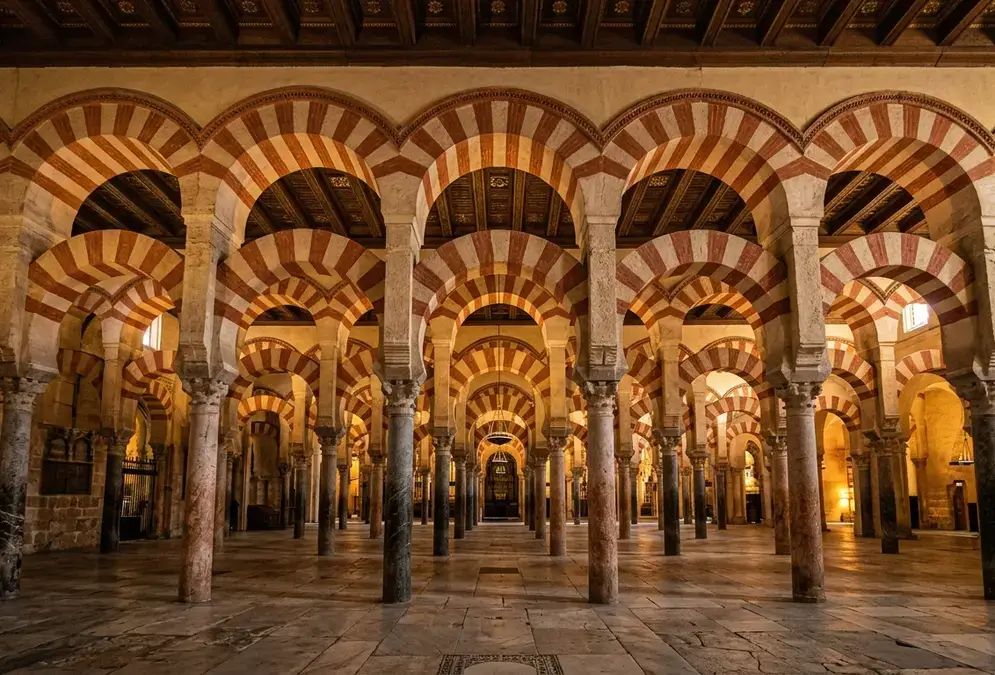
The Mezquita-Cathedral contains a 16th-century cathedral inserted without demolishing a single column. The Roman Temple's granite column drums are a different stone from the limestone of the Moorish arches — visible if you look at the colour. In the Judería, Capilla de San Bartolomé holds Christian iconography in the upper registers and Islamic geometric tilework on the lower walls, with no attempt to resolve the visual argument between the two systems. Córdoba is a city you read as much as visit.
The compression is unusual. Roman, Umayyad, Mudéjar, Renaissance, and contemporary architecture coexist within a district you can walk end to end in twenty minutes. More unusually, these styles frequently occupy the same building rather than separate ones. Medina Azahara, buried for a thousand years, is still only 10% excavated. The C3A, designed with a strict 15-metre height limit to protect the Mezquita's skyline dominance, opened in 2016. The city's architectural argument is still being made.
This page collects Córdoba's architecture-focused monuments, museums, and tours. For the full interpretive guide — six periods explained, five photography locations, and the vocabulary that changes what you see — go to the Córdoba Architecture Guide.
At a glance
- Construction span
- 45 BC to 2016 AD — 2,000 years
- Defining monument
- Mezquita-Cathedral — 4 expansion phases
- Mudéjar churches
- 12 built after the 1236 Reconquista
- UNESCO inscription
- 1984 (Mezquita), 1994 (historic centre), 2012 (patios)
- Medina Azahara
- 8 km west — only 10% excavated
- Architecture walk
- Moorish Architecture Tour — self-guided
In this guide
Architecture by style
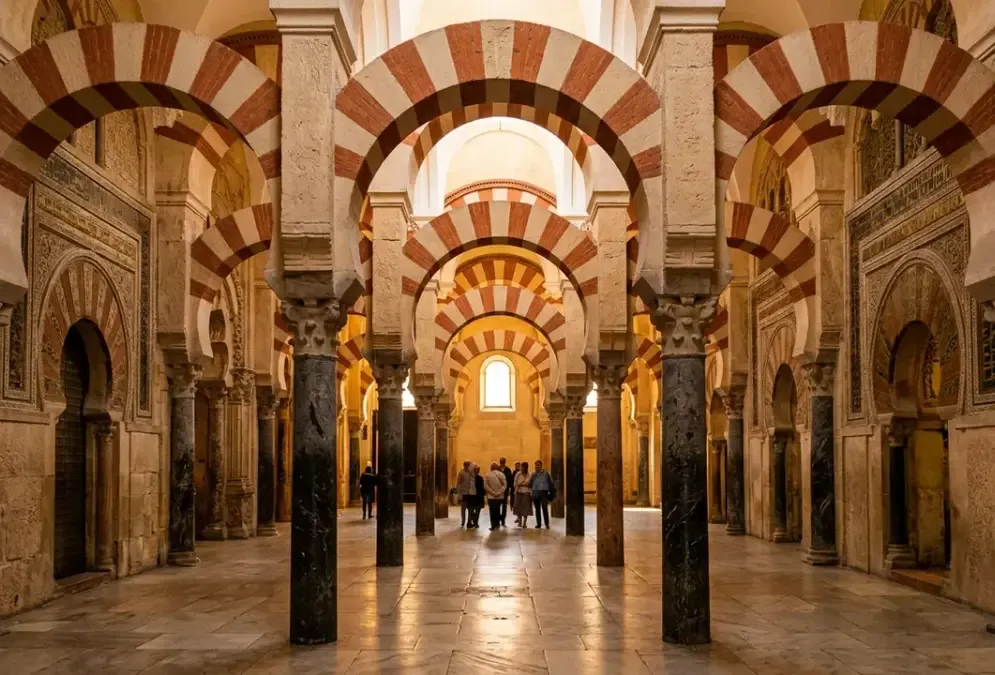
Five periods, each leaving visible evidence. The unusual thing about Córdoba is that the periods coexist within single buildings rather than occupying distinct districts.
45 BC – 8th century
Roman
Granite columns, bridge foundations, forum infrastructure. Colonia Patricia was the capital of Hispania Baetica. The Roman Bridge still carries pedestrian traffic.
786 – 1031Umayyad
Horseshoe arches, double-tiered naves, Byzantine mosaic work. The Mezquita's red-and-white voussoir pattern is a pure Umayyad invention, nowhere in architecture before this.
936 – 1009Medina Azahara
Abd al-Rahman III's palace city. The Salon Rico is a political argument in carved marble — three decorative registers across every wall surface, designed to project Caliphate authority.
1236 – 16th c.Mudéjar
Islamic craftsmen under Christian patronage. Twelve churches built rapidly after the Reconquista, combining Romanesque bones, Gothic tracery, and Islamic surface ornament.
Roman → presentPatio tradition
The spatial logic — central fountain, azulejo dado, enclosing walls — has not changed in 2,000 years. UNESCO inscribed it as intangible cultural heritage in 2012. Over 4,000 homes still live by it.
2016Contemporary
C3A by Nieto Sobejano — constrained to 15 metres height, horizontal, hexagonal skin referencing Islamic geometry. Free admission. The city's skyline argument is still being made.
Essential reading
Córdoba Architecture Guide
Six architectural terms that change what you see. Six periods of construction — who built what, when, and why. Five photography locations where the geometry pays off. The definitive interpretive guide to 2,000 years of Córdoba's built environment.
Read the architecture guideFrequently Asked Questions
What architectural styles will I see in Córdoba?
Córdoba compresses five distinct architectural vocabularies into a single walkable city. Roman — granite columns, bridge foundations, forum infrastructure (1st century BC–AD). Umayyad — horseshoe arches, double-tiered naves, Byzantine mosaic work (786–1031). Mudéjar — Islamic craftsmen under Christian patronage, hybrid vocabulary in 12 neighbourhood churches (1236–15th century). Renaissance and Baroque — palaces, convents, civic buildings (16th–18th century). Contemporary — C3A by Nieto Sobejano (2016), constrained to 15 metres so it doesn't compete with the Mezquita's campanario. Most unusually, these styles coexist within single buildings rather than in separate districts.
How much time do I need to appreciate Córdoba's architecture seriously?
Two full days covers the essentials without rushing: day one for the Mezquita-Cathedral (allow 2–3 hours minimum), the Roman Temple, and the historic centre; day two for Medina Azahara (half day, book transport in advance) and the Judería's Mudéjar churches and synagogue. A third day adds Palacio de Viana's twelve patios, the C3A, and the lesser-known Mudéjar churches in the Axerquía. Architecture enthusiasts often extend to four nights and find each revisit reveals new detail. The Mezquita repays multiple visits at different times of day — the light through the nave changes entirely between morning and afternoon.
Is a guided architecture tour worth taking?
For the Mezquita, a specialist guide makes a significant difference: the building's four expansion phases, the seams where each caliph's work meets the next, and the logic of the 16th-century cathedral insertion are all but invisible without context. For Medina Azahara, the on-site guided tour is close to essential — the ruins are legible with explanation and genuinely difficult to read without it. For the rest of the city, a self-guided walk using the architecture guide and the Moorish architecture walk covers the major sites efficiently. Private architecture-focused tours (GetYourGuide, Civitatis) offer full-day programmes covering all periods.
What is the best order to visit Córdoba's architectural sites?
Start with the Mezquita-Cathedral — it is the centre of the city's architectural argument and everything else relates back to it. Then the Roman Temple (free, 5 minutes' walk), which gives you the pre-Islamic baseline in stone colour and material. Medina Azahara (8 km west) is best as a half-day excursion on day two, when you already have enough context to read the Salon Rico as a political statement rather than decoration. The Judería's Mudéjar churches (Capilla de San Bartolomé, Synagogue) and Palacio de Viana work well on a third morning. The C3A, on the riverbank south of the Mezquita, is open with free general admission and closes the narrative: 2,000 years of construction compressed into a 15-minute walk.
Can I visit most sites on foot?
Yes. The historic centre — Roman Temple, Mezquita, Judería, synagogue, Capilla de San Bartolomé, Palacio de Viana, Alcázar, Roman Bridge, Calahorra Tower, C3A — is compact enough to cover on foot in a day. The notable exception is Medina Azahara, 8 kilometres west along the Sierra Morena foothills. The site has a dedicated bus service from central Córdoba (check the Junta de Andalucía website for current schedules). Taxis and tour minibuses are the other options. Do not try to walk it — the approach road has no pedestrian infrastructure.