music-loversart-lovers
Written by Sophie Marchand
Modern Córdoba · 1808–today
  • 5 min
  • 35 sources

Joaquín Cortés Took Flamenco Dance From Córdoba to the World

Joaquín Cortés was born in Córdoba in 1969, trained in Madrid and took Pasión Gitana on tour. His flamenco dance career, from the Ballet Nacional to Seville.
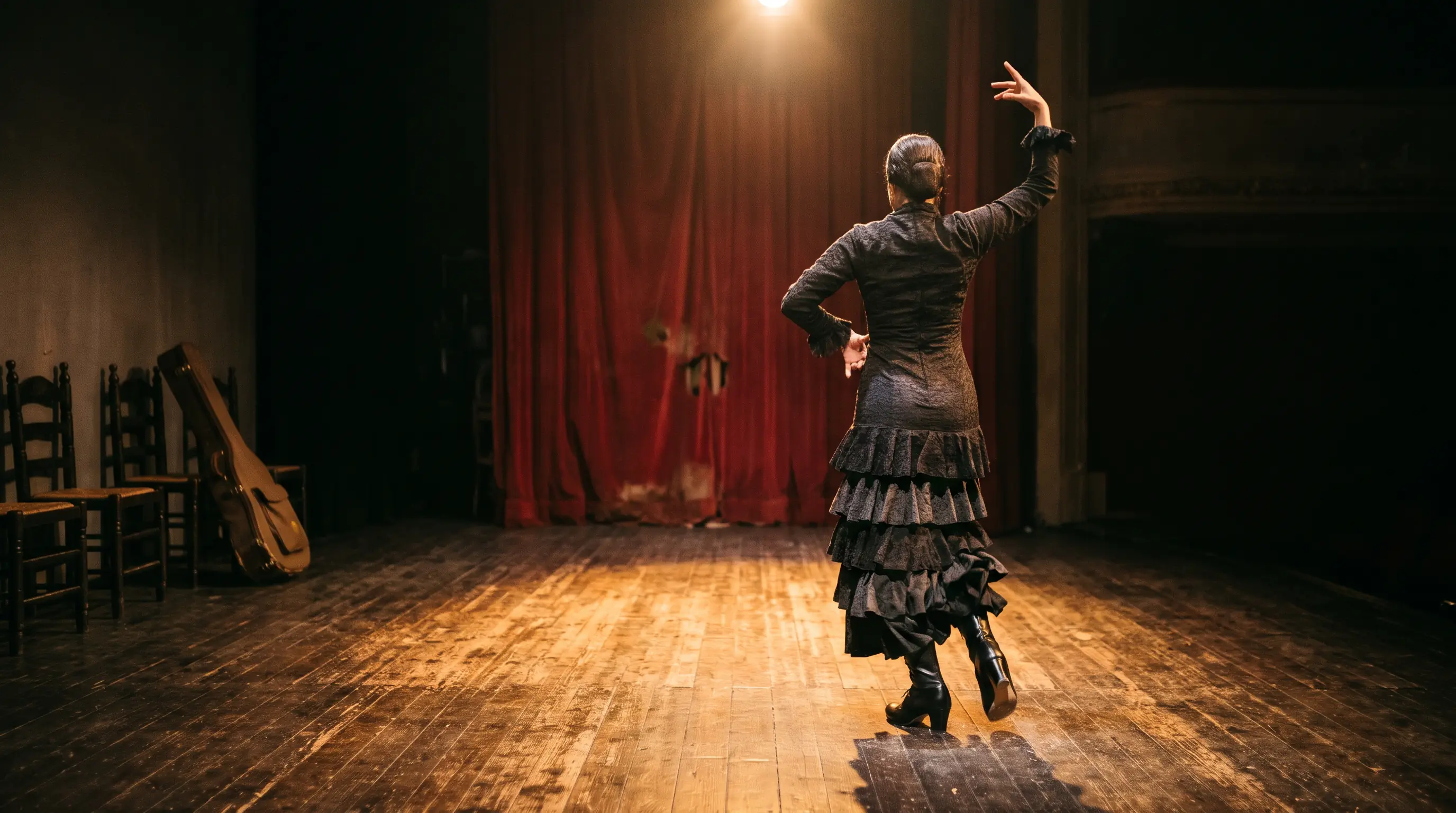
Joaquín Cortés flamenco dance theme: an anonymous bailaor in a fitted dark costume mid-turn on a darkened stage, a single warm spotlight, arms raised, heels striking the boards, red theatre curtain behind

Pasión Gitana premiered at Madrid's Teatro Albéniz in 1995 and toured for four years, by DeFlamenco's account.

Joaquín Cortés was born in Córdoba on 22 February 1969[1] but trained in Madrid, and the stages that made him known were mostly far from the Guadalquivir: DeFlamenco's biography counts more than a million people at Pasión Gitana, premiered in 1995,[2] while Cortés's own press material says 1.5 million.[28] The Gitano bailaor Joaquín Fajardo told La Jornada in 1998 that the show was not flamenco, and that argument is part of the story.[30]
Born in Córdoba
22 Feb 1969
Gitano dancer born in the city, aged 57 in 2026[1]
Pasión Gitana premiere
1995
Teatro Albéniz, Madrid; DeFlamenco counts over a million viewers[2]
Seville opening ceremony
20 Aug 1999
Opening of the 7th IAAF World Championships[3]

A Gitano family, Lavapiés and the Ballet Nacional

Cortés was born in Córdoba but made as a dancer in Madrid. Born into a Gitano family, he moved to the capital and began dance studies at twelve,[5] spending much of his childhood in the Lavapiés district.[6] At that age he wanted to be a bailaor to imitate his uncle and hero, Cristóbal Reyes.[7]
Córdoba's flamenco reputation rests mainly on cante, the tradition laid out in the history of flamenco in Córdoba and carried by singers such as Fosforito. The city's Concurso Nacional de Arte Flamenco began in 1956 as a cante jondo contest,[34] and dance only joined, together with guitar, in 1965.[35] Cortés belongs to the city by birth, not by schooling.
That makes him an unusual Córdoba name: a dancer who grew up in Madrid and came back as a touring artist. It is also why his career is worth telling here.
In his mid-teens he joined the Ballet Nacional de España and rose to soloist,[8] touring theatres as grand as New York's Metropolitan Opera House and the Kremlin Palace of Congresses in Moscow.[9] The state company supplied the training; in 1992 he built his own. A teenage soloist in a national ballet is a long way from a crowd of thousands, and the road between the two is the rest of this story.

1992 to 1995: Cibayí, then Pasión Gitana

In 1992, after a performance at the Théâtre des Champs-Élysées in Paris, Cortés founded his own company, Joaquín Cortés Ballet Flamenco.[10] His first work, Cibayí, debuted at the same Paris theatre[11] and later toured venues that included the Festival de la Guitarra de Córdoba.[12]
Pasión Gitana, his second show, premiered at Madrid's Teatro Albéniz in 1995 and, by DeFlamenco's count, was seen by more than a million people over a four-year tour,[2][29] though Cortés's own press material puts the figure at 1.5 million.[28] The tour went well beyond the theatre circuit, and three stops show how far:[13]
  • London's Royal Albert Hall, a Victorian concert hall
  • Ipanema beach, open sand in Rio de Janeiro
  • Barcelona's Palau Sant Jordi, an indoor arena
Halls, arenas and a beach: that range is what taking flamenco to stadium-scale crowds amounts to in practice. Costume design for the show is credited to his friend Giorgio Armani.[14]
Cibayí and Pasión Gitana are three years apart, and journalists reached for pop comparisons early. Miami New Times, writing when he was 24, called him "the first flamenco dancer to achieve the popular status of a rock star",[32] and Hot Press compared his stature and status to those of Bono or Prince.[33]
The staging borrowed technology once reserved for rock and pop concerts, and Biografías y Vidas calls him highly controversial among the most orthodox flamenco circles.[4] The Gitano bailaor Joaquín Fajardo told La Jornada in December 1998 that Pasión Gitana was not flamenco, though he added that Cortés did not dance it badly.[30] The same Biografías y Vidas entry, by Tomás Fernández and Elena Tamaro, credits Cortés and Antonio Canales with decisively renewing baile flamenco.[15]

Screen work, an Oscars stage and a Seville gala

Cortés's film career began in 1995, when he appeared in Pedro Almodóvar's La flor de mi secreto and Carlos Saura's Flamenco.[16] In January 1999 he moved to New York and began working with the choreographer Debbie Allen, with whom he took part in the 71st Academy Awards ceremony.[17]
That same year, on 20 August 1999, he danced the adult Hercules at the opening ceremony of the 7th IAAF World Championships in Seville.[3][31] An athletics championship is a long way from a theatre tour, and the ceremony gave flamenco a place in a sporting spectacle.
Two film credits in one year set a pattern. Cortés did not wait for theatre audiences to find him; he went where the crowds already were, into cinema and the Seville ceremony.
His next theatre show, Soul, opened at Barcelona's Teatro Tívoli on 14 October 1999.[18] In 2000 he began shooting Gitano, his first leading film role, from a script by the novelist Arturo Pérez-Reverte.[19] By 2000 his work spanned theatre, cinema and large-scale ceremony.

Roma pride on stage: Calé, Caracas and Esencia
In 1999 Cortés set up the Fundación Gitana Joaquín Cortés to promote Gitano culture and art.[20] His Roma heritage has stayed at the centre of his stagecraft: at Mexico City's Auditorio Nacional in June 2009 he shouted "¡Soy gitano!" to the hall during Calé.[21]
Three years later, in Caracas, a free open-air performance filled a populous downtown square with thousands of people,[23] and he called himself "the universal Gitano", proud of his roots.[24]
In 2017 he returned to Spanish stages with Esencia, which ran at Madrid's Teatro Rialto with a cast of 40 artists.[25] In a 2017 interview he claimed the title of pioneer of fusion, the mixing of flamenco with other dance traditions,[26] and said that artists like him fill venues of 10,000 seats.[27] The 10,000 is his own claim, not a box-office record, and it is as close as any source comes to the stadium label he is given.
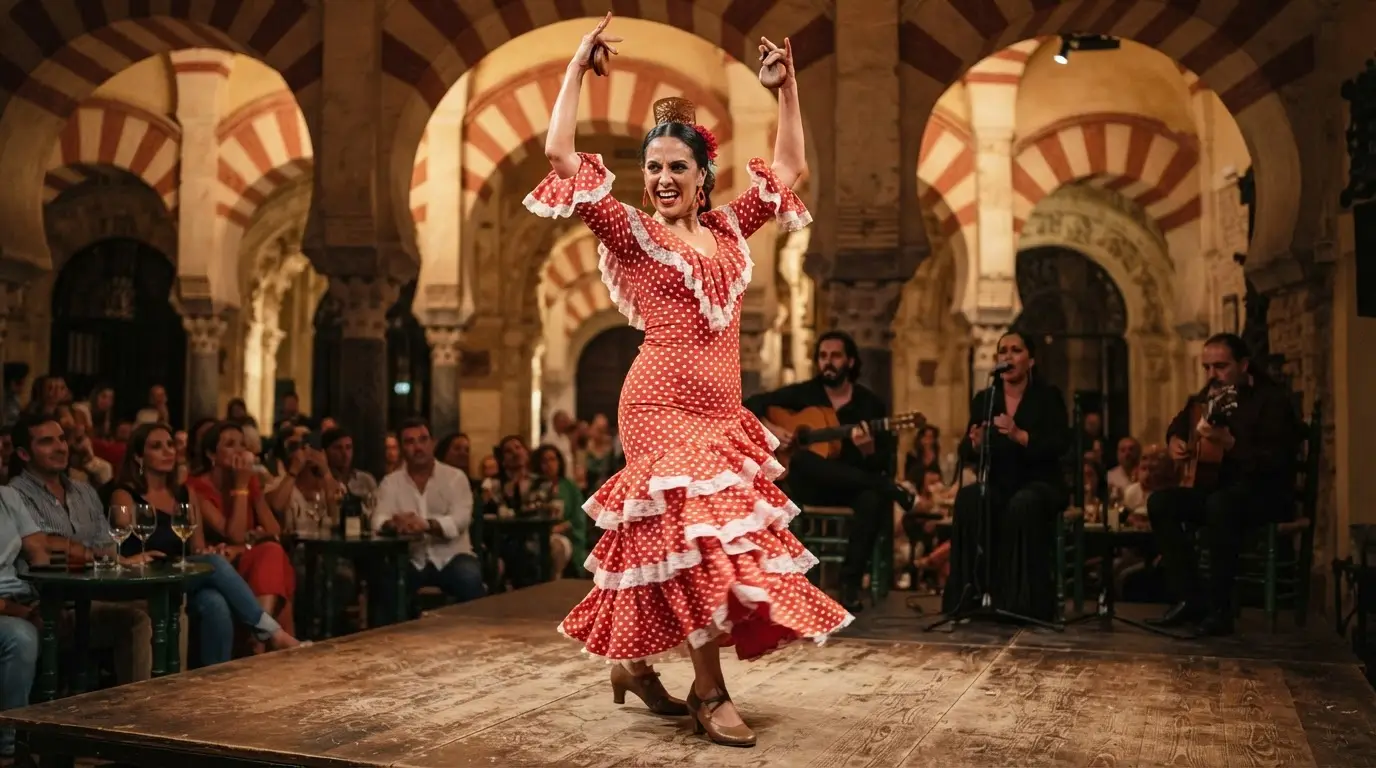
Sevillanas vs flamenco: dancer in traje de flamenca performing in a Córdoba tablao, red-and-white striped arches in the background, castanets raised

Deep dive · Article

Sevillanas vs Flamenco: What Tourists Always Confuse

Sevillanas is a four-copla folk dance anyone can learn in an afternoon. Flamenco takes years and depends on duende. Here's the real difference, explained.

The pattern repeats across the decades: a form the dancer was born into, performed for crowds far larger than it was made for. His critics hear a loss in that. His supporters hear a rescue. Both are describing the same career, and both can point to the same Caracas square.

Seeing flamenco dance in Córdoba today
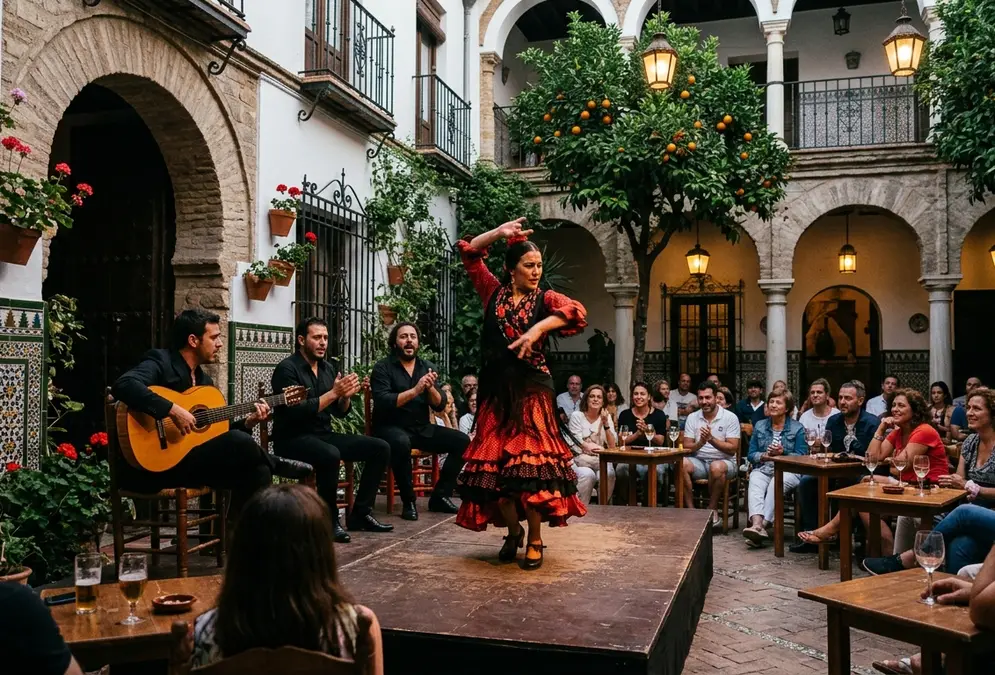
Flamenco dance in Córdoba is easiest to see in its tablaos and at the city's festivals. Cortés worked in halls, arenas and open squares; a tablao is the opposite scale, close enough to hear the footwork and the breath before a phrase.
Flamenco dancer performing at Tablao El Cardenal in a historic palace in Córdoba

Things to do · Activity

Tablao Flamenco El Cardenal

Córdoba flamenco since 1987, now in a historic palace. Directors Antonio Alcázar and Victoria Palacios lead seven performers. Shows Mon–Sat. €25 with drink.

  • Tablao El Cardenal and Tablao El Jaleo: two evening shows to compare, so check which night puts a bailaor on the bill alongside cante and guitar
  • Noche Blanca del Flamenco: the city's night-long flamenco festival in June, with dance among the programmes
  • Book the earlier sitting and sit near the front, then watch the dancer's back and arms as well as the feet

Recommended tours

Tours are selected for quality, not commission. We earn a small fee if you book — at no extra cost to you.
The best bailaores keep the argument between tradition and spectacle that Cortés made so loud inside a single movement, and a small room is where you can see it.
Go with a question in mind. Does the dancer answer the singer, or lead the singer? Does the guitar follow the feet, or the other way round? Cortés built his name by changing the answers to those questions at scale. A tablao lets you hear them asked at close range, with no big screen and very little between you and the floorboards.

Frequently asked questions

Who is Joaquín Cortés?

Joaquín Cortés is a flamenco dancer, choreographer and producer born in Córdoba on 22 February 1969 into a Gitano family. He trained in Madrid, joined the Ballet Nacional de España in his mid-teens and founded his own company in 1992. Pasión Gitana, premiered in 1995, made him an international name.

How old is Joaquín Cortés?

Joaquín Cortés turned 57 on 22 February 2026, having been born in Córdoba on 22 February 1969.

Where was Joaquín Cortés born?

Joaquín Cortés was born in Córdoba, Spain, then moved to Madrid and spent much of his childhood in the Lavapiés district. He began dance studies there at twelve.

What is Pasión Gitana?

Pasión Gitana is Joaquín Cortés's second show, premiered in 1995 at Madrid's Teatro Albéniz. DeFlamenco's biography counts more than a million people over a four-year tour, a figure Cortés's own press material raises to 1.5 million. The tour reached the Royal Albert Hall in London, Ipanema beach in Rio de Janeiro and Barcelona's Palau Sant Jordi.

Did Joaquín Cortés dance with the Ballet Nacional de España?

Joaquín Cortés joined the Ballet Nacional de España in his mid-teens and rose to soloist. With the company he performed at the Metropolitan Opera House in New York and the Kremlin Palace of Congresses in Moscow.

What films has Joaquín Cortés appeared in?

Joaquín Cortés appeared in Pedro Almodóvar's La flor de mi secreto and Carlos Saura's Flamenco, both in 1995. In 2000 he began shooting Gitano, his first leading role, from a script by Arturo Pérez-Reverte.

Why is Joaquín Cortés controversial in flamenco?

Biografías y Vidas calls Joaquín Cortés highly controversial among the most orthodox flamenco circles because his shows use technology once reserved for rock and pop concerts. The Gitano bailaor Joaquín Fajardo told La Jornada in 1998 that Pasión Gitana was not flamenco. The same entry credits Cortés, alongside Antonio Canales, with decisively renewing flamenco dance.

Where can you see flamenco dance in Córdoba?

Flamenco dance in Córdoba is staged in tablaos such as Tablao El Cardenal and Tablao El Jaleo, and at the Noche Blanca del Flamenco festival in June.

Sources

35 references Show
  1. jornada.com.mx — A09n1esp (opens in a new tab)

    “bailaor Joaquín Cortés (Córdoba, 22 de febrero de 1969)”

  2. deflamenco.com (opens in a new tab)

    “Su segundo espectáculo Pasión Gitana, estrenado en 1995 en el Teatro Albéniz de Madrid, fue visto por más de un millón de personas.”

  3. worldathletics.org (opens in a new tab)

    “20 August 1999 – Seville, Spain – The Opening Ceremony of the 7th IAAF World Championships”

  4. biografiasyvidas.com (opens in a new tab)

    “Figura muy controvertida dentro de los círculos más ortodoxos del flamenco, sus espectáculos aprovechan recursos tecnológicos antes exclusivos de la música rock y pop”

  5. deflamenco.com (opens in a new tab)

    “JOAQUÍN CORTÉS, nacido en Córdoba de familia gitana en 1969, se trasladó a vivir a Madrid y a los doce años empezó sus estudios de danza.”

  6. gitanos.org (opens in a new tab)

    “pasó gran parte de su infancia en el barrio madrileño de Lavapiés y fue en la capital del país donde empezó a estudiar danza a los 12 años”

  7. gitanos.org (opens in a new tab)

    “un niño de 12 años que quería ser bailaor para imitar a su tío y héroe”

  8. deflamenco.com (opens in a new tab)

    “Ingresó en el Ballet Nacional de España con quince años y ascendió a la categoría de solista.”

  9. deflamenco.com (opens in a new tab)

    “actuó en teatros como el Metropolitan, Opera House de Nueva York o el Palacio de Congresos del Kremlin de Moscú”

  10. deflamenco.com (opens in a new tab)

    “En 1992, tras una actuación en el Teatro Champs Elysées de París, creó su propia compañía, Joaquín Cortés Ballet Flamenco.”

  11. Wikipedia (opens in a new tab)

    “En 1992 crea su primera obra Cibayí y con ella debuta en el Teatro de los Campos Elíseos de París.”

  12. Wikipedia (opens in a new tab)

    “Luego, estuvo en diversos lugares como: el Festival de la Guitarra de Córdoba, el Teatro de la Zarzuela”

  13. deflamenco.com (opens in a new tab)

    “el Royal Albert Hall de Londres, el Festival de Sydney, el Luna Park de Buenos Aires, la playa de Ipanema en Rio de Janeiro, el Palau Sant Jordi en Barcelona”

  14. Wikipedia (opens in a new tab)

    “El diseño de vestuario de dicha obra se debió a su amigo el diseñador Giorgio Armani.”

  15. biografiasyvidas.com (opens in a new tab)

    “junto a Antonio Canales y otros artistas jóvenes, contribuyó decisivamente a la renovación del baile flamenco”

  16. biografiasyvidas.com (opens in a new tab)

    “Como actor cinematográfico ha intervenido en La flor de mi secreto (1995, Pedro Almodóvar) y Flamenco (1995, Carlos Saura).”

  17. deflamenco.com (opens in a new tab)

    “Allí inicia su colaboración con la reconocida coreógrafa Debbie Allen con quien participará en la ceremonia 71 Annual Academy Awards”

  18. deflamenco.com (opens in a new tab)

    “El 14 de octubre de 1999 estrena en el Teatro Tívoli de Barcelona, su espectáculo Soul.”

  19. deflamenco.com (opens in a new tab)

    “inicia el rodaje de la película Gitano, su primer papel como protagonista, escrita por uno de los más prestigiosos escritores españoles, Arturo Pérez Reverte”

  20. Wikipedia (opens in a new tab)

    “crea en España la Fundación Gitana Joaquín Cortés para la difusión, divulgación, promoción y desarrollo de la cultura y el arte gitanos”

  21. jornada.com.mx — A09n1esp (opens in a new tab)

    ““¡Soy gitano!”, gritó orgulloso el bailaor Joaquín Cortés”

  22. jornada.com.mx — A09n1esp (opens in a new tab)

    “que en romaní significa gitano”

  23. eluniverso.com (opens in a new tab)

    “a miles de personas que asistieron a un espectáculo gratuito que colmó una populosa plaza del centro caraqueño”

  24. eluniverso.com (opens in a new tab)

    “Yo soy el gitano universal y me siento muy orgulloso de mis raíces, muy orgulloso de ser gitano”

  25. gitanos.org (opens in a new tab)

    “actúa desde hoy y hasta el día 25 en el Teatro Rialto de Madrid con un elenco de 40 artistas”

  26. gitanos.org (opens in a new tab)

    “Joaquín Cortés se reivindica en Madrid como “pionero de la fusión””

  27. gitanos.org (opens in a new tab)

    “que llenamos sitios de 10.000 asientos”

  28. joaquincortes.es (opens in a new tab)

    “Pasión Gitana (1995, vestuario Giorgio Armani) recorrió treinta países y superó el millón y medio de espectadores.”

  29. deflamenco.com (opens in a new tab)

    “En sus cuatro años de gira recorrió más de treinta países en los cinco continentes”

  30. jornada.com.mx — Cul bailaor (opens in a new tab)

    “No es que lo haga mal, pero no es flamenco.”

  31. worldathletics.org (opens in a new tab)

    “Hercules, the boy, was represented by the 7 year-old Antonio Moreno while the renowned dancer Joaquin Cortes, became the adult Hercules with a routine demonstrating all his mastery of ballet and flamenco techniques.”

  32. miaminewtimes.com (opens in a new tab)

    “Joaquin Cortes, 24 years old and a dangerously handsome Gypsy trained in classical ballet, is the first flamenco dancer to achieve the popular status of a rock star.”

  33. hotpress.com (opens in a new tab)

    “With the stature and status of a Bono or Prince”

  34. teatrocordoba.es (opens in a new tab)

    “Ricardo Molina queda prendido en ella y concibe un concurso de Cante Jondo a la manera de 1922 en Granada.”

  35. teatrocordoba.es (opens in a new tab)

    “En el año 1965 el baile junto con la guitarra pasan a formar parte de este concurso que va creciendo en complejidad y en magnitud.”