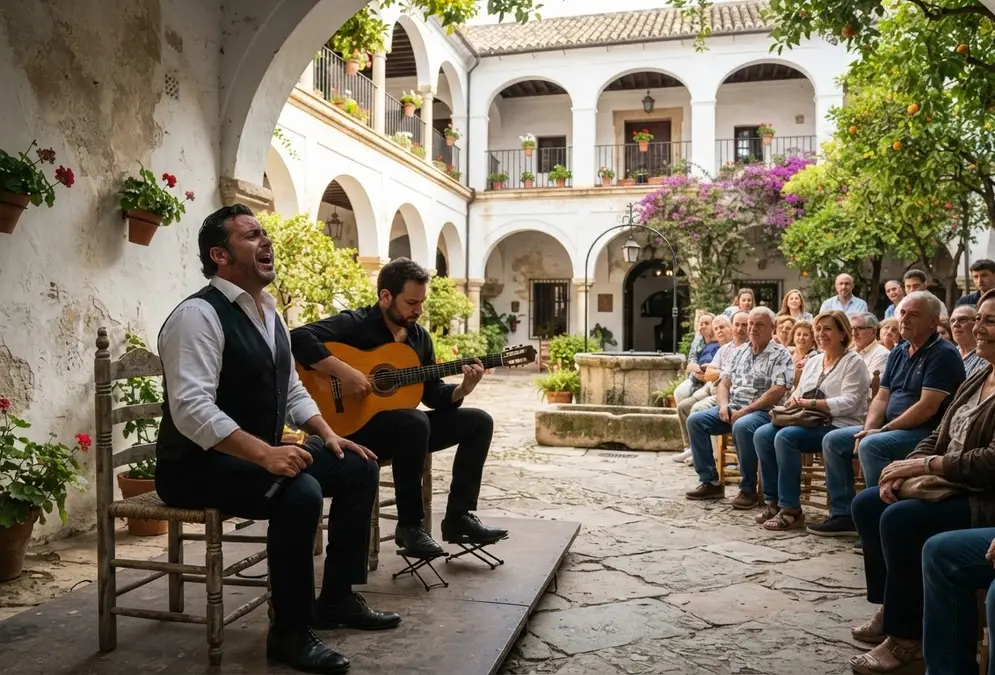

A working stage, not just a museum
Most visitors come to Centro Flamenco Fosforito to look — at the guitars, the touch-screen exhibits, the Golden Key that once belonged to the singer the building is named after. Fewer come for what the courtyard was actually built to hold: a live audience for cante, toque, and baile. Turismo de Córdoba describes this as the only centre in Andalusia dedicated to these characteristics of flamenco, functioning both as a venue for performances and as a museum. That double role is the whole point of a recital visit — you are sitting in the same 15th-century inn courtyard the exhibits describe, except now someone is singing in it.
The Posada del Potro operated as a working inn until 1972, and its stone troughs and timber gallery were built for travelers and pack animals, not audiences. A recital here has none of the polish of a purpose-built theatre. What it has instead is the sense that the room predates the performance by six centuries, and the compás carries differently off worn stone than it does off a stage floor.
What the programme actually looks like
Centro Flamenco Fosforito does not run one fixed weekly show. Its own programme is organized into named recurring strands, each with a different format and focus:
- Matinales Flamencas — free Sunday-noon recitals, admission free until capacity is reached, but run as seasonal editions (the 2026 season ran 15 February–8 March) rather than a standing weekly show
- Café Cantante — a format that borrows its name from the 19th-century café cantante circuit, where flamenco moved from private gatherings into public rooms with paying audiences
- Trasteando con la guitarra — sessions built around toque, the guitar side of the tradition, rather than cante or baile
- Latidos Flamencos and Cantarillo Flamenco — recurring cycles that rotate through different cantaores and cantaoras
- Semana del Patrimonio Flamenco — an annual week dedicated specifically to flamenco heritage
Each strand runs on its own calendar, and none of them follows a standing weekly slot. The practical result: you cannot assume a recital happens on any given night just by showing up. Check the current listing on the centre's own programme page before you plan an evening around it.
How this differs from a tablao show
Córdoba's commercial tablaos — El Cardenal, Los Arcos, and others in the Judería — sell a fixed nightly show built for visitors: one set time, one ticket price, a curated 60–80 minute programme moving through the major palos. Centro Flamenco Fosforito is not that. It is a municipal cultural institution attached to a museum, and its recitals function closer to a peña flamenca — a members'-club format built around the art form itself rather than a tourist schedule. Expect a smaller, more local room, programming tied to specific themes or artists rather than a greatest-hits set, and a recital that can as easily be a masterclass on toque as a full cante jondo performance.
Neither format is better; they answer different questions. If you want a guaranteed show at a fixed hour, book a tablao — the flamenco shows guide covers Córdoba's nightly options and the best flamenco in Córdoba guide ranks them. If you want to hear flamenco performed inside the building that documents its history, and you don't mind checking a rotating calendar first, this is the one venue in the city built for exactly that.
One name, two organisations
Córdoba also has a Peña Flamenca Fosforito, a members' club within the city's peña federation. It shares its name with the singer this centre honors, but it is a separate organisation with its own premises and its own programme — not a branch of the museum-and-recital centre on Plaza del Potro. If you're trying to track down a specific listing, confirm which of the two you're looking at before you go.
Planning around a recital
Centro Flamenco Fosforito sits on Plaza del Potro, next to the Museo de Bellas Artes and across from the square itself, one of the oldest in the old city. Pair a recital with the museum visit on the same trip — the exhibits explain the history and the Fosforito biography that a recital only performs. General admission to the centre is free, and Matinales Flamencas is confirmed free too, starting at 12:00 on Sundays during its own season — but the exact recital days for the other rotating strands and a booking channel for any of them are not published in a form we could confirm here — treat the centre's own programme page as the only reliable source before you build an evening around any of them.