
music-loversart-loverssolobudget
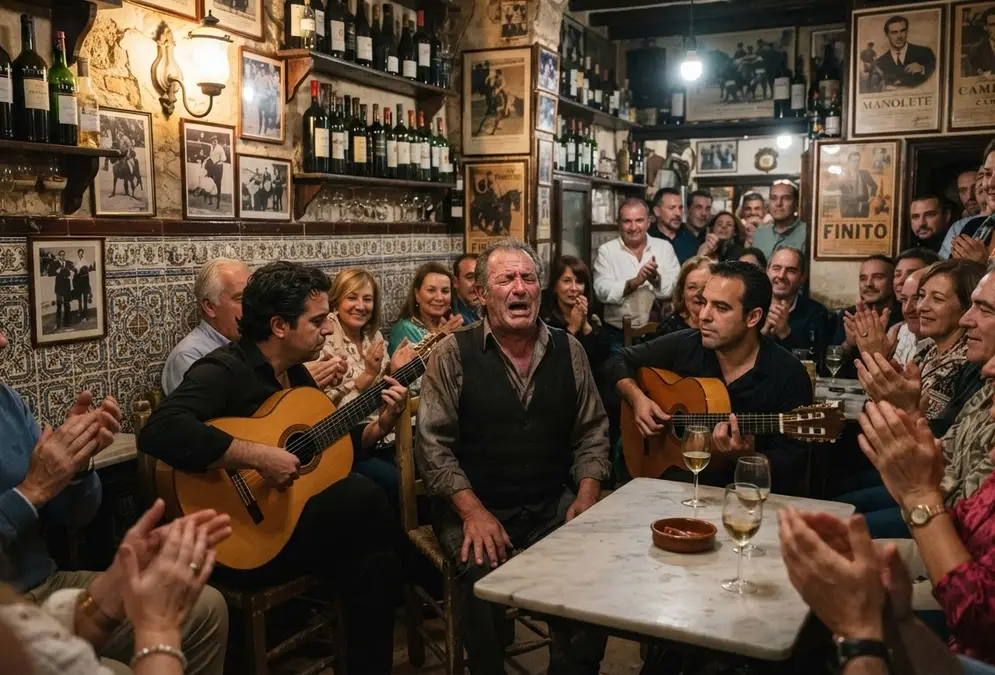
Guitarist and singer performing spontaneous flamenco inside a crowded historic taberna in Córdoba
Experience

Chasing Flamenco Peña Culture at Taberna La Fuenseca

Varies
No fixed schedule — performances are spontaneous; ask at the bar whether anything is happening
Taberna entrance on Calle Juan Rufo — no booking, walk in directly

At a glance

Duration
Varies
Price
Drinks only
Schedule
No fixed schedule — performances are spontaneous; ask at the bar whether anything is happening
Meeting point
Taberna entrance on Calle Juan Rufo — no booking, walk in directly
Languages
Universal — no spoken dialogue needed to follow the music
Group size
Individuals and small groups — the room seats around forty comfortably
Availability
Year-round, but only on nights when local musicians happen to be there
Accessibility
Historic taberna interior — step-free access is not confirmed; contact the venue ahead of a visit
Interactive map — loads as you scroll (requires JavaScript)
Jump to a section

What a peña flamenca actually is

A peña flamenca is not a bar that happens to play flamenco. It's a members' association built around keeping the art alive as a practice, not a product — a gathering point for aficionados who show up because they care about the form, not because a tour bus dropped them off. Córdoba's Federación Provincial de Peñas Flamencas de Córdoba lists close to twenty of these federated groups, among them Peña Flamenca Fosforito and Peña Flamenca El Yunque, each with its own clubhouse, its own membership, and often its own modest programme of sessions.

La Fuenseca isn't on that list

Search "flamenco peña cordoba" and Taberna La Fuenseca comes up constantly. Worth correcting before you go: La Fuenseca does not appear on the federation's official roster. It's a taberna — a working neighbourhood bar on Calle Juan Rufo that has been pouring Montilla-Moriles wine for close to two centuries — and one of Córdoba's federated peñas, the one that honours the singer Merengue de Córdoba, happens to hold its meetings inside it. That's not a technicality. A federated peña answers to its members and its calendar. La Fuenseca answers to whoever walks in and orders a fino, whether or not a peña meeting is underway.

For the venue's own history, wines and tapas, see the taberna's own page — this page is about what happens when the guitar comes out, not what's on the menu.

No published schedule, and no way around that

The single thing worth knowing: nobody can promise you flamenco on a given night. There is no printed programme, no stage, no ticket. A guitarist who happens to be a regular picks up an instrument. A cantaor or cantaora answers with a verse. If the compás locks and the room leans in, that's the performance — and it can last twenty minutes or run well past midnight. It can also not happen at all. That unpredictability is not a flaw in the experience; it is the experience. A venue that could schedule duende wouldn't have any.

What you can do is stack the odds. Ask at the bar whether anyone is expected to play — regulars usually know before it's announced anywhere else. If music has already started as you walk past the door, that is the only schedule that matters, and it means go in now.

Reading the room: etiquette for a first-timer

A peña-style gathering runs on unwritten rules that a tablao doesn't need, because a tablao is built for an audience and this isn't. A few things to know before you sit down:

  • Don't ask when the show starts. There isn't one. Ask quietly whether anything is happening tonight, and accept the answer.
  • Silence during a cante jondo verse is not awkwardness, it's attention. Talking over a singer mid-verse is the fastest way to mark yourself as a tourist.
  • An olé at the right moment — when a phrase lands, not on a fixed beat — is welcome. Filming the whole thing on a phone is not; ask first, or better, don't.
  • Order something. This is still a working bar, and the regulars who make the music happen are also the ones keeping the place open on the nights nothing happens at all.

If you want the real, federated peña experience

If what you actually want is a scheduled evening with a genuine federated peña — a members' programme, an announced date, a proper stage inside a clubhouse — the Federación Provincial de Peñas Flamencas de Córdoba is the route in, not a taberna's Instagram. Groups like Peña Flamenca Fosforito run their own calendars and welcome visitors to organised sessions. For a guaranteed evening on a fixed schedule and a ticket, Córdoba's flamenco tablaos are the honest alternative — professional shows, booked in advance, no gamble involved.

La Fuenseca sits in the historic centre, a few minutes from Plaza de las Tendillas, which makes it an easy stop to check on the way past even on a night when nothing is happening. Some nights you'll find an empty bar and a good glass of wine. Occasionally you'll find both, plus a room full of people who forgot to check their phones for an hour.

Highlights

  • Not a federated peña — a taberna where a federated peña happens to meet
  • Spontaneous, unticketed flamenco with no fixed schedule
  • Nearly two centuries as a meeting point for local musicians
  • Etiquette and expectations for a first-time outsider

Not included

  • Guaranteed performance on any given night
  • Reserved seating or booking
  • Food and drinks (paid separately at the bar)

When to Visit

Visit duration

A session lasts as long as it lasts — sometimes twenty minutes, sometimes past midnight

Reporter notebook

Insider tips

Local custom

Never ask when the show starts

That question marks you as a tourist immediately, because there is no show to start. Ask quietly at the bar whether anything is happening tonight, order a drink, and let the room's rhythm decide when to talk, clap, or go quiet. Whether a cover charge applies on a night with music is unconfirmed, so don't assume your drink alone covers it.

Best time

Thursday and Friday nights carry better odds, unofficially

Nothing is scheduled or promised, but regulars say Thursday and Friday evenings, roughly after 9:30pm, produce more spontaneous sessions than a random Tuesday. Treat it as folklore worth weighing, never as a guarantee to plan a trip around.

Crowd tip

If you hear music from outside, go in immediately

The room holds around forty people comfortably, and word of a real session travels fast among locals. Ten minutes of hesitation on the street can be the difference between a seat near the singer and standing at the back.

Good to know before booking

  • No booking — walk in and ask at the bar whether anything is happening

Prices & Booking

Drinks only

Frequently asked questions

Is La Fuenseca a peña flamenca?

Not in the formal sense. La Fuenseca does not appear on the Federación Provincial de Peñas Flamencas de Córdoba's official list of federated peñas. It is a taberna where one of Córdoba's federated groups, the peña honouring Merengue de Córdoba, happens to hold its meetings — and where flamenco also breaks out spontaneously outside those meetings.

What's the difference between a peña flamenca and a tablao?

A tablao is a commercial venue with a scheduled show, a stage, and a ticket price — built for an audience. A peña flamenca is a members' association built around practising and preserving flamenco, usually with an informal, unticketed programme for members and welcomed guests. La Fuenseca is neither exactly: it's an independent taberna where spontaneous flamenco happens alongside a federated peña's meetings.

When does the flamenco happen at La Fuenseca?

There is no published schedule. Performances are spontaneous, depending on which local musicians happen to be at the bar on a given night. Ask at the bar when you arrive — regulars usually know before anything is announced anywhere else.

Can tourists visit La Fuenseca?

Yes — it's a public taberna, not a private members' club. There's no fee to walk in, and no one will turn a visitor away. The atmosphere is unpolished rather than staged, so go with the expectation that you might see nothing, or might see something a tablao can't replicate.

How much does it cost to see flamenco at La Fuenseca?

There's no admission fee published for the music itself; you pay only for what you order at the bar. Whether a cover charge or minimum consumption applies on nights with a performance is not confirmed, so ask before assuming it's entirely free.

What is cante jondo?

Cante jondo, or "deep song," is the most intense, unadorned register of flamenco singing — raw voice, minimal ornament, built around forms like the siguiriya and the soleá. It's the register most likely to surface in an unscripted setting like La Fuenseca, where nobody is performing for an audience's comfort.

What does duende mean in flamenco?

Duende describes the moment a flamenco performance stops being technique and becomes something felt in the room — a quality that can't be rehearsed or guaranteed. It's the reason spontaneous flamenco has a different draw than a scheduled show: duende either shows up on a given night, or it doesn't.

How do I know if there's a real federated peña flamenca to visit in Córdoba?

Check the Federación Provincial de Peñas Flamencas de Córdoba's own list of member peñas, such as Peña Flamenca Fosforito or Peña Flamenca El Yunque. These run their own calendars and clubhouses, which is the more reliable route to an organised peña evening than an independent taberna.

Further reading

Sources

3 references Show