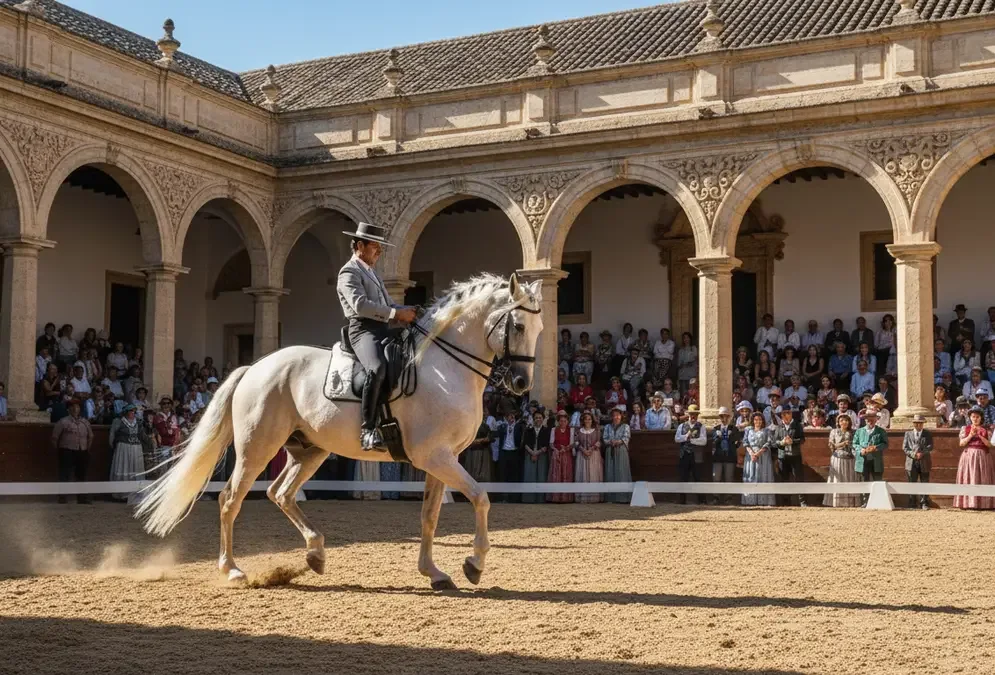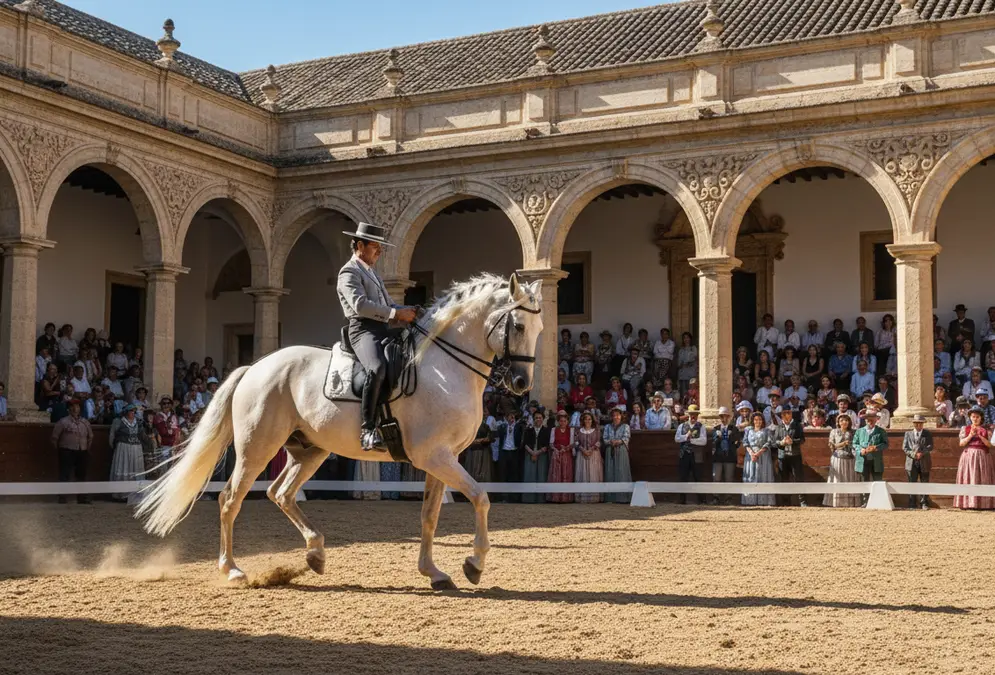

At the 16th-century equestrian complex founded by Philip II, 70 minutes of Andalusian dressage performed to live flamenco music. Pure Spanish breed horses (PRE) work through several techniques: classical dressage, working equitation, side-saddle riding and garrocha (traditional lance play). Live musicians accompany each sequence. If you only spend one evening watching something in Córdoba, make it this.
The building is worth the visit on its own
The stables stand inside the historic monumental zone, adjacent to the Alcázar de los Reyes Cristianos and less than two minutes on foot from the Roman Bridge. Philip II built them to breed horses for the royal cavalry, and the complex has barely changed since. Three vaulted brick naves run the full length of the building, each supported by stone columns at regular intervals. The arches overhead absorb sound in a way that modern arenas never do. Hoofbeats arrive as something heavier, more resonant.
At night, when the spotlights come up on the sand floor and the walls recede into shadow, the 16th-century setting stops being historical backdrop and starts being atmosphere. The stable smell is still there: hay, leather, horse. National Historic Monument since 1929. García Lorca apparently called it the "cathedral of horses." Walk in and you'll understand why he reached for that word.
These horses have a story
The Pura Raza Española (PRE) was selectively bred here over generations for the Spanish royal cavalry, prized for its collection: the ability to carry weight on the hindquarters and lift the front end, which makes it naturally suited to the elevated movements of classical dressage. It is a compact breed, typically grey or bay, with a short-coupled back and a crest that arches under pressure rather than collapsing.
The show demonstrates what that breeding produces. Riders take horses through the piaffe (trotting on the spot, suspended), the passage (a slow-motion elevated trot with distinct suspension), and the Spanish walk (front legs extended horizontally at each stride). Each movement requires years of training and near-total communication between horse and rider through pressure, weight and leg rather than visible aids. The garrocha sequences are different in character: faster, more agricultural in origin, the rider using a long lance to work cattle. The horse turns tight around the lance at a canter, haunches dropping, front end light. Technically demanding, and visually unlike anything else in the programme.
Side-saddle riding appears in the middle section, demonstrating the feminine equestrian tradition that survives in Andalusian feria culture. The riders in flamenco dress work at the same level of technical difficulty as the rest.
What to expect during the show
The 70 minutes are structured as a sequence of short acts, each framed by a change in lighting and a new piece of music from the live band. The musicians sit to one side of the arena: guitar, singing, sometimes percussion. Between the major dressage sequences, the music fills the space and the mood shifts. Spanish flamenco guitar in a stone vaulted stable at night carries differently than a recording. The acoustics add something a concert hall can't replicate.
The crowd is mixed: local families, couples, international visitors. Spanish commentary runs through most shows, but the performance is visual. You do not need Spanish to follow what is happening, and the audioguide (available in English, French and Spanish) fills in context during the quieter moments.
The sand floor is lit well enough that you can read the horses' footfall patterns from your seat. From the first three rows, you can see the rider's hands, the contact on the reins, the small half-halts that prepare each movement. From further back the overall picture is clear, but some of the technical detail goes.
Planning your evening
The premium ticket admits you 30 minutes before the show starts, when the horses are still being groomed and tacked up in the stable corridor. Watching a rider go through the warm-up (walking, stretching, asking for lateral work before the lights come on) makes the performance more legible once it begins. The surcharge is small.
Children under 3 enter free. The 70-minute format with live music and continuous horse movement holds the attention of children old enough to sit still for it, roughly five or six and above.
Book ahead for Friday and Saturday shows; they sell out. Wednesday and Thursday shows run with the same horses and riders but smaller audiences, and the sight lines from any seat are better. For ticket options, prices, and what to expect at each tier, the Caballerizas Reales ticket guide covers everything you need before you buy. Parking: the Mezquita car park on Calle Caballerizas Reales is the closest option for drivers.
Afterwards, the Judería is right there: a flamenco show at a tablao makes a natural follow-up if you want to stay with that musical thread into the night. The Mezquita night tour is the alternative if you'd rather end the evening in silence than in more performance. The equestrian show is a centrepiece of Córdoba after dark; the full guide covers the rest of the city's evening options.
Worth knowing if you're building a longer visit around this address: the nightly show isn't the only thing that happens at the Caballerizas Reales. Each autumn the Cabalcor Horse Fair turns the same Main Courtyard over to competitive judging of the Pure Spanish Horse, and each spring QuesArte Córdoba fills it with artisan cheese stalls instead. Neither replaces the evening performance; they're daytime, dated fairs with their own tickets and calendars.
The Caballerizas Reales horse show features in our Top 10 Activities & Experiences in Córdoba and the Top 15 Highlights of Córdoba guide, which covers the essential experiences spread across two to three days in the city.