History of Flamenco in Córdoba: From Santa Marina to UNESCO
From Santa Marina's gitano quarter to the 1956 Concurso Nacional (won outright by Fosforito) to UNESCO in 2010: how Córdoba built its own flamenco tradition.
Art history background with eight years writing interpretive content on Córdoba's Caliphal heritage.
Published
Córdoba does not enter most flamenco histories until the middle of the 20th century, when the city council decided to put on a competition and a young singer from Puente Genil turned up and won everything. But the history of flamenco in Cordoba Spain begins a century earlier, in the narrow streets of Santa Marina, where Gitano families had been mixing Andalusian folk melody with Roma rhythmic sensibility since at least the 1830s. What follows is not a venues guide. It is the story of how a working-class neighbourhood, a demanding community of aficionados, a single competition in 1956, and one singer's career shaped a flamenco tradition distinct enough that UNESCO inscribed it on the Representative List of the Intangible Cultural Heritage of Humanity.
In this article
Santa Marina: the Gitano cradle of Córdoba's flamenco
Santa Marina is one of Córdoba's oldest parishes, its church consecrated in the mid-13th century soon after Fernando III took the city from the Almohads in 1236. By the 19th century, the neighbourhood had become the principal Gitano settlement in Córdoba, a working-class district of narrow streets and communal patios where extended Roma families lived, worked as blacksmiths and street vendors, and passed songs from one generation to the next.[1]
The Roma had arrived in Andalusia in the 15th century, crossing from northern India through Persia, the Caucasus, and the Balkans over the course of several hundred years. They brought with them a musical tradition based on modal scales, complex rhythmic cycles, and an oral transmission model that depended on family lineages rather than written notation.[2] When that tradition encountered the folk music of Andalusia — the seguidilla, the fandango, the Moorish-inflected melodic structures that had survived the Reconquista. The fusion produced the earliest recognisable forms of what would become flamenco.
In Córdoba, Santa Marina and the adjacent San Lorenzo neighbourhood became the geographic centre of this fusion. Unlike Seville, where flamenco developed in Triana with a more extroverted, performative character, Córdoba's flamenco emerged from a smaller, more concentrated Gitano community whose isolation produced a different musical temperament: more introspective, less ornamental, oriented toward the weight of a single held note rather than the flourish that follows it.
The first written record of what scholars now recognise as flamenco music appears in José Cadalso's Las Cartas Marruecas in 1774.[3] But the documented presence of flamenco in Córdoba specifically comes later: references to Gitano gatherings in Santa Marina patios where cante (song), toque (guitar playing), and baile (dance) merged without a stage, without an audience, and without a ticket price. This was not performance. It was community.
The peña flamenca: how Córdoba built its afición
The peña flamenca is a members' club dedicated to flamenco: a place where aficionados gather to listen, discuss, and sometimes perform, always outside the commercial circuit. The peña movement emerged across Andalusia in the mid-20th century, but in Córdoba it acquired a particular intensity. The city's peñas were more than social clubs: they were the institutional mechanism through which Córdoba asserted its own flamenco identity at a moment when the art form was being repackaged for mass tourism.
To understand why this mattered, you need to know what flamenco looked like in Spain during the 1940s and early 1950s. The ópera flamenca format, which had begun in the 1920s, packaged flamenco into variety shows with orchestral backing, lightened palos (forms), and a visual aesthetic designed for foreign audiences. The Franco regime later adopted this commercialised version of flamenco as a tool of national branding.[4] Purist singers and guitarists who worked in cante jondo (the deep, serious forms like the soleá and the seguiriya, which sit at the opposite end of the spectrum from the folk dance sevillanas) found themselves increasingly marginal. The peñas, by contrast, offered a space where those forms could survive without compromise. No amplified guitars, no dinner service, no obligation to make the tourists clap.
The earliest peñas in Córdoba formed in the 1950s and early 1960s, concentrated in Santa Marina and San Lorenzo, the same neighbourhoods where flamenco had first taken root. Membership was not casual. A prospective member was expected to demonstrate genuine afición: a knowledge of the palos, their rhythmic cycles, and their emotional registers, as well as the ability to distinguish a mediocre zapateado (footwork sequence) from an authoritative one. This was the audience that the Concurso Nacional de Arte Flamenco would later depend on. When a singer performed a soleá de Córdoba on a competition stage, there were people in the room who could name his teacher and his teacher's teacher.
Timeline
Late 18th century
Gitano flamenco emerges in Andalusia
Roma communities in lower Andalusia fuse their musical traditions with local folk forms. First written mention: 1774.
Mid-19th century
Santa Marina becomes Córdoba's flamenco quarter
Gitano families settle in the parish of Santa Marina. Flamenco reuniones (gatherings) in patios establish oral transmission lines.
1880s–1910s
Café cantante era
Flamenco professionalises in Seville, Cádiz, and Jerez. Córdoba, with a smaller Gitano population, remains on the periphery, but its style is already taking shape outside commercial venues.
1920s–1940s
Ópera flamenca and commercialisation
Franco-era tourism policy repackages flamenco as national spectacle. Purist forms retreat to private spaces.
1950s–1960s
Peña flamenca movement
Flamenco clubs form in Córdoba's Santa Marina and San Lorenzo, creating a demanding, knowledgeable audience that sustains cante jondo outside the commercial circuit.
1956
First Concurso Nacional de Arte Flamenco
Córdoba City Council organises a national competition. Fosforito wins. Córdoba enters the flamenco map.
2010
UNESCO recognition
Flamenco inscribed on the Representative List of the Intangible Cultural Heritage of Humanity. Three years later, the Centro Flamenco Fosforito opens in the Posada del Potro.
The peña model also changed how flamenco was transmitted. In the commercial circuit, transmission was vertical: from professional to professional, in dressing rooms and on tour. In the peña, it was horizontal: older aficionados taught younger ones as a matter of community duty. The distinction between professional flamenco and aficionado flamenco blurred. Some of Córdoba's most influential flamenco figures (singers, guitarists, critics) spent years in the peñas before they ever stepped onto a stage. The result was an artistic ecosystem where knowledge circulated without being priced.
1956: the Concurso Nacional and the singer from Puente Genil
In 1956, the Córdoba City Council organised the first Concurso Nacional de Arte Flamenco de Córdoba.[5] This was not a spontaneous cultural gesture. It belonged to a broader movement of flamenco rehabilitation that had begun with the 1922 Concurso de Cante Jondo in Granada, organised by the poet Federico García Lorca and the composer Manuel de Falla.[6] That earlier competition had been an attempt to rescue flamenco's deepest forms from the commercial flattening of the ópera flamenca era. It failed commercially but succeeded intellectually: it gave flamenco's purist wing a vocabulary and a cause. The Córdoba competition, three decades later, was the same cause picked up by municipal government rather than poets.
Antonio Fernández Díaz, known as Fosforito, was born in Puente Genil, a town in the province of Córdoba, in 1932.[7] He was 23 when he walked onto the stage of the first Concurso Nacional and walked off having taken every available prize. The competition had been designed to identify the best flamenco talent in Spain across multiple categories. Fosforito swept them: the definitive moment in a career that would span more than six decades and fundamentally reshape the relationship between Córdoba and flamenco. His archive and the collection built around his career now form the core of the Centro Flamenco Fosforito, the city's museum dedicated to the art form he helped define.
What Fosforito did was not win a single competition. He gave Córdoba a flamenco identity it had not previously possessed in the national conversation. Before 1956, flamenco history meant Seville, Jerez, Cádiz. Granada had its own zambra tradition. Córdoba was absent. After Fosforito, Córdoba became a centre of flamenco authority, and his victory, a local boy from the province winning on home soil, gave the city a narrative it has been building on ever since.
The Concurso Nacional continues today, held every three years and still attracting the most serious flamenco performers in the country. It is among the most important flamenco competitions in Spain, occupying a position roughly equivalent to what the Concurso de Cante de las Minas in La Unión holds for the Levante region. The difference is that Córdoba's competition was built by and for the kind of audience that had already been trained in the peñas. This was not a competition for tourists. It was, and remains, a competition for aficionados who can hear the difference between a competent bulerías and a definitive one.
The soleá de Córdoba: what makes it distinct
Córdoba's specific contribution to the flamenco taxonomy is the soleá de Córdoba, a variant of the soleá (the 12-beat cycle that is the foundation of cante jondo) that is slower, more extended, and more reflective than any other version of the form.[8]
The soleá itself is the gravitational centre of flamenco's serious repertoire. In its classic form, it follows a 12-beat compás (rhythmic cycle) with accents on beats 3, 6, 8, 10, and 12. The singer works within that architecture to build a long arc of tension and release, and the guitar answers with falsetas (melodic phrases) that work in the spaces between the vocal lines. A competent soleá performance feels inevitable: the compás pulls toward its resolution like a sentence you can feel coming before you hear it. A great one leaves you unsure of where the next phrase is going and then makes the arrival feel retrospectively obvious.
12 beats
The soleá is built on a 12-beat compás with accents on 3, 6, 8, 10, and 12 — the same rhythmic architecture underlies the seguiriya, the alegrías, and a dozen other flamenco forms. The Cordoban variant uses the same structure but extends the singer's phrases, trading momentum for reflection.
The Cordoban version derives from the soleá de Triana, the variant associated with Seville's Gitano quarter. The transmission line is documented, if not always in the detail scholars would like. In the 19th century, the Sevillian singer Ramón El Ollero brought the Triana soleá to Córdoba. Juanero El Feo, a Cordoban Gitano singer, absorbed it and transmitted it to the next generation of the city's performers.[9] What they passed on was a soleá more deliberate and longer than the Sevillian model, with a recitative quality that allowed for extended moral reflection. The verses in a soleá de Córdoba tend not to narrate. They observe.
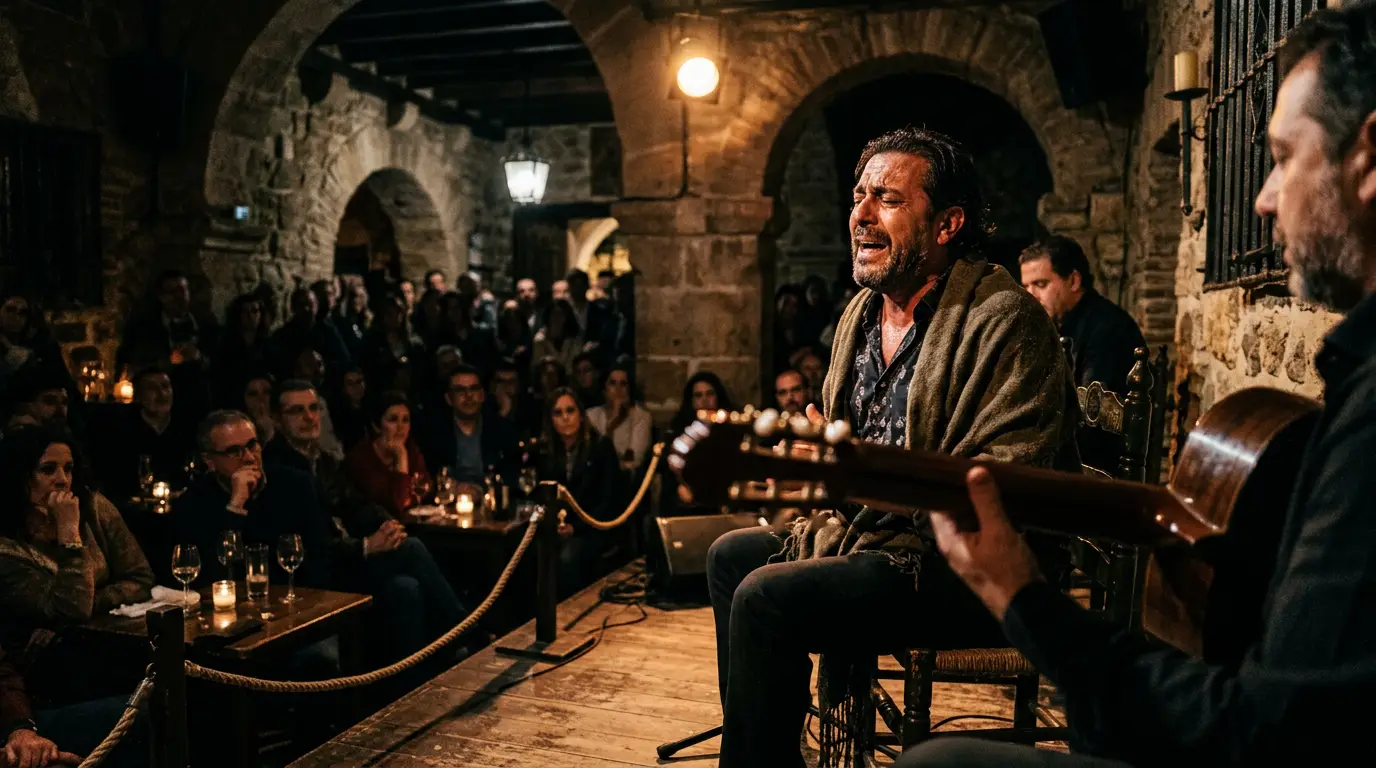
A flamenco singer in Córdoba performing cante jondo. The soleá — 12 beats, deliberate pacing — is the form Córdoba made its own, stretching the Sevillian model into something longer, slower, and more reflective.
This style acquired a name among flamenco specialists: cante cordobés. The term does not refer to a catalogue of new palos. It describes a temperament: deliberate, measured, suspicious of virtuosity, oriented toward what critics called a cante de sentencias, song built around verses expressing lived wisdom rather than emotional discharge. If the Sevillian flamenco performer communicates through the force of feeling, the Cordoban communicates through the discipline of withholding it.
Fosforito became the defining exponent of this tradition. His recordings from the 1960s and 1970s show a singer working without ornament, using the long Cordoban phrase to let a single note sustain beyond what most performers would risk. The risk is the point. In flamenco, holding a note long enough creates the structural tension the form's emotional language depends on. Fosforito held it longer than anyone.
El Pele (Manuel Moreno Maya, born 1954 in Córdoba's San Pedro neighbourhood) carries the same tradition into the present. His voice has a range that allows him to move across palos, but his soleares work in exactly the lineage described above: the same deliberate pacing, the same moral seriousness, the same refusal to court the audience by accelerating into the crowd-pleasing bulerías before the form has resolved.[10] When El Pele performs in Córdoba, the aficionados who fill the room are the direct descendants, culturally and sometimes literally, of the peña audiences who trained Fosforito's generation.
From the Posada del Potro to UNESCO: the institutional era
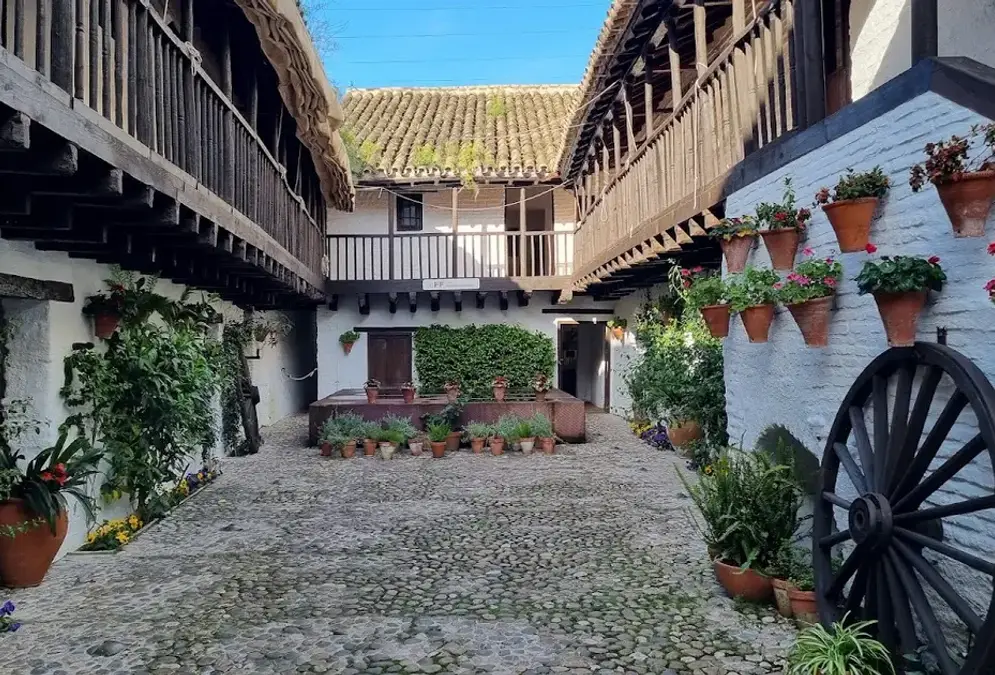
In 2013, three years after UNESCO inscribed flamenco on its Representative List of the Intangible Cultural Heritage of Humanity, the Centro Flamenco Fosforito opened in the Posada del Potro, a 16th-century inn on one of Córdoba's oldest squares.[11] Cervantes mentioned this building in Don Quijote. The decision to house Córdoba's flamenco museum in a structure that already carried literary and architectural weight was deliberate. The museum was not going to be a collection of artefacts in a white box. It was going to root flamenco in the built fabric of the city.
The museum traces flamenco from its Andalusian origins (distinct from the medieval court music that Ziryab established in 9th-century Córdoba, though the two are sometimes conflated in tourist narratives) through its many palos: touch-screen exhibits let visitors hear the difference between a soleá and a seguiriya, between the festive bulerías and the solemn martinete. A rhythm station invites visitors to practise compás patterns with their hands, an exercise that makes the intellectual understanding of a 12-beat cycle immediately, physically frustrating, which is exactly the point. Bilingual displays in English and Spanish make the content accessible without making it superficial. And the building itself, with its original courtyard and its stone walls, provides a reminder that flamenco has always lived in domestic architecture: patios, not auditoriums.
The UNESCO inscription itself happened on 16 November 2010, at the 5th session of the Intergovernmental Committee for the Safeguarding of the Intangible Cultural Heritage, held in Nairobi.[12] The nomination was driven by the Andalusian regional government, with Córdoba's institutions playing a supporting role, but one rooted in the specific history this article traces. The city that had been absent from the flamenco map in 1900 had, by 2010, produced an institutional infrastructure dense enough to contribute meaningfully to a UNESCO dossier. The peñas, the Concurso Nacional, the Fosforito archive, the academic studies produced by Córdoba-based flamencologists: none of these alone would have been decisive, but together they gave the city a seat at the table.
The relationship between the museum and the tradition it documents is uneasy in the way all museum-tradition relationships are. Putting flamenco in a museum building risks suggesting that the art form belongs to the past. The museum's response to that risk is its Sunday programme: free live flamenco performances at noon in the Posada del Potro courtyard.[11] The building is not a tomb. It is a venue, and the programme insists on it. On the Sunday mornings when a local singer or guitarist performs, the distinction between museum and peña blurs, briefly and genuinely, in a way that both the performers and the audience recognise.
Flamenco in Córdoba today: between the stage and the patio
A visitor to Córdoba in 2026 encounters flamenco through channels that did not exist when Fosforito won the Concurso Nacional: professional tablaos with online booking systems, a tourist-facing marketing apparatus, a UNESCO designation that appears on promotional material. The distance between a Santa Marina patio in 1850 and a tablao show at 9 pm in the Judería is real, and it is worth acknowledging rather than pretending away.
The two professional tablaos in the historic centre — Tablao El Jaleo, 20 metres from the Mezquita, and Tablao El Cardenal, in a 16th-century palace on Calle Buen Pastor, operate at the high end of the commercial spectrum. Both employ professional artists, some of whom hold national awards. Shows run 60 to 90 minutes, with tickets priced between €25 and €55 including a drink.[13] These are not the peña experience. They are theatre, and they work as theatre: designed sightlines, professional sound, a clear separation between performer and audience. The best of them (El Cardenal's permanent company, for instance, which has worked together for decades) achieve an ensemble tightness that a peña performance, by its nature, cannot.
What the tablaos cannot replicate is what the peñas still offer: proximity without staging, music without a start time, an audience that listens differently. The peña circuit in Córdoba continues, though it is harder for visitors to access. Membership is required at most clubs. A few (Taberna La Fuenseca being the most accessible) open their doors more broadly, but the general rule holds: the most authentic flamenco experience in Córdoba is the one that requires you to know someone.
The Festival de la Guitarra de Córdoba, held each July, occupies the middle ground. It brings internationally significant flamenco guitarists (Paco Peña, Vicente Amigo, Tomatito) to outdoor venues including the Alcázar gardens and the Gran Teatro. Tickets sell weeks in advance. The festival format is concert, not tablao, and the focus on guitar reflects something specific about Córdoba: the city has always been more guitar-centric than Seville. The instrument carries emotional freight here that the voice, in the Cordoban tradition, deliberately withholds.
What survives from the history traced in this article is best understood as a tension. The art form that was born in the Gitano patios of Santa Marina, that was preserved by the peñas when the commercial circuit abandoned cante jondo, that was legitimised by the Concurso Nacional and carried to UNESCO by Fosforito's career — that art form now lives partly in a museum, partly on a tabulao stage, partly in private gatherings that most visitors will never see. This is not a decline narrative. It is a description of what happens when a tradition that was never meant to be public becomes globally visible. The transmission lines — Ramón El Ollero to Juanero El Feo to Fosforito to El Pele — are still intact. The afición that made the peñas possible still exists, listenable in the silence between phrases at a Sunday recital in the Posada del Potro. The history of flamenco in Cordoba Spain is not finished. It is still being played, one 12-beat cycle at a time.
The transmission lines — Ramón El Ollero to Juanero El Feo to Fosforito to El Pele — are still intact.
FAQ about history of flamenco in Cordoba Spain
Where did flamenco in Córdoba start?
Flamenco in Córdoba started in the Santa Marina neighbourhood, which became the city's main Gitano (Roma) settlement during the 19th century. Extended Roma families lived in the parish's narrow streets and communal patios, where they fused their own musical traditions — modal scales, complex rhythmic cycles — with Andalusian folk forms including the seguidilla and the fandango. This fusion produced the earliest recognisable flamenco performed in Córdoba, with a character more introspective and measured than the more extroverted style that developed across Seville's Triana quarter.
Who was Fosforito and why does he matter to Córdoba?
Fosforito, born Antonio Fernández Díaz in Puente Genil (Córdoba province) in 1932, was the singer who won every available prize at the first Concurso Nacional de Arte Flamenco de Córdoba in 1956. His victory gave Córdoba a flamenco identity it had not previously possessed on the national stage. Before 1956, flamenco history was dominated by Seville, Jerez, and Cádiz. After Fosforito, Córdoba became a recognised centre of flamenco authority. He spent his career defining cante cordobés — a deliberate, measured vocal style oriented toward moral reflection rather than virtuosic display — and the city's flamenco museum, the Centro Flamenco Fosforito, bears his name.
What is the Concurso Nacional de Arte Flamenco de Córdoba?
The Concurso Nacional de Arte Flamenco de Córdoba is a national flamenco competition first held in 1956 by the Córdoba City Council. It was part of a broader movement to rehabilitate flamenco's deepest forms — cante jondo — after decades of commercial simplification during the ópera flamenca era. Fosforito won the inaugural edition, and the competition has been held every three years since, remaining one of the most important flamenco competitions in Spain. It draws serious performers and a knowledgeable audience shaped by Córdoba's peña flamenca culture.
What is the soleá de Córdoba?
The soleá de Córdoba is Córdoba's distinctive variant of the soleá, one of flamenco's foundational forms built on a 12-beat compás. It derives from the soleá de Triana (Seville), brought to Córdoba in the 19th century by the Sevillian singer Ramón El Ollero and transmitted through the Gitano singer Juanero El Feo to subsequent generations. What distinguishes it is a slower tempo, more extended vocal phrases, and a recitative quality that allows for cante de sentencias — verses expressing moral observations drawn from lived experience rather than pure emotional display. Fosforito and El Pele are its most recognised exponents.
What is a peña flamenca?
A peña flamenca is a members' club dedicated to flamenco, where aficionados gather to listen, discuss, and sometimes perform outside the commercial circuit. The peña movement emerged across Andalusia in the mid-20th century, but Córdoba's peñas — concentrated in Santa Marina and San Lorenzo — acquired a particular reputation for knowledgeable, demanding audiences. During the Franco era, when flamenco was being repackaged as mass entertainment, the peñas preserved cante jondo in its purest forms. Membership typically required demonstrated afición (knowledge of palos, compás, and performance quality).
When did UNESCO recognise flamenco?
UNESCO inscribed flamenco on the Representative List of the Intangible Cultural Heritage of Humanity on 16 November 2010, at the 5th session of the Intergovernmental Committee for the Safeguarding of the Intangible Cultural Heritage in Nairobi. The nomination was driven by the Andalusian regional government, with Córdoba's institutions — the peñas, the Concurso Nacional, the Fosforito archive — contributing to the dossier. Three years later, the Centro Flamenco Fosforito opened in the Posada del Potro, giving the city a physical space to house its flamenco memory.
What is cante jondo?
Cante jondo (literally 'deep song') is the term for flamenco's most serious and emotionally demanding vocal forms: soleá, seguiriya, martinete, and toná. The word jondo is an Andalusian pronunciation of hondo (deep). These styles are distinguished by their rhythmic complexity, the range and weight of the vocalist's expression, and their historical association with Gitano culture. Cante jondo is what the peña flamenca movement preserved during the Franco era when commercial flamenco favoured lighter, more accessible forms. The soleá de Córdoba belongs to the cante jondo tradition.
Is cante cordobés a distinct flamenco style?
Cante cordobés is not a catalogue of new palos but the term for a temperament specific to Córdoba's flamenco tradition: deliberate pacing, measured delivery, an orientation toward moral reflection rather than emotional display. It is most evident in the soleá de Córdoba, where singers extend phrases beyond the Sevillian norm and use the longer structure for verses that observe rather than narrate. The style runs through the transmission line from Ramón El Ollero and Juanero El Feo in the 19th century through Fosforito in the 20th to El Pele in the contemporary period.
Where can I experience the history of flamenco in Cordoba Spain as a visitor?
The Centro Flamenco Fosforito in the Posada del Potro traces flamenco's history through interactive exhibits and bilingual displays. It hosts free live performances on Sunday mornings. For live performance, Tablao El Jaleo (near the Mezquita) and Tablao El Cardenal (in a 16th-century palace) offer professional tablao shows. The Festival de la Guitarra de Córdoba in July brings major flamenco guitarists to the city. Accessing the peña circuit — the most authentic flamenco experience — typically requires a local connection, though Taberna La Fuenseca is the most visitor-accessible option.