Was Capa's Falling Soldier Taken at Cerro Muriano or Espejo?
Capa's Falling Soldier is captioned Cerro Muriano, but a landscape case since 2009 points to hills near Espejo. Who claims what, and what stays unproven.
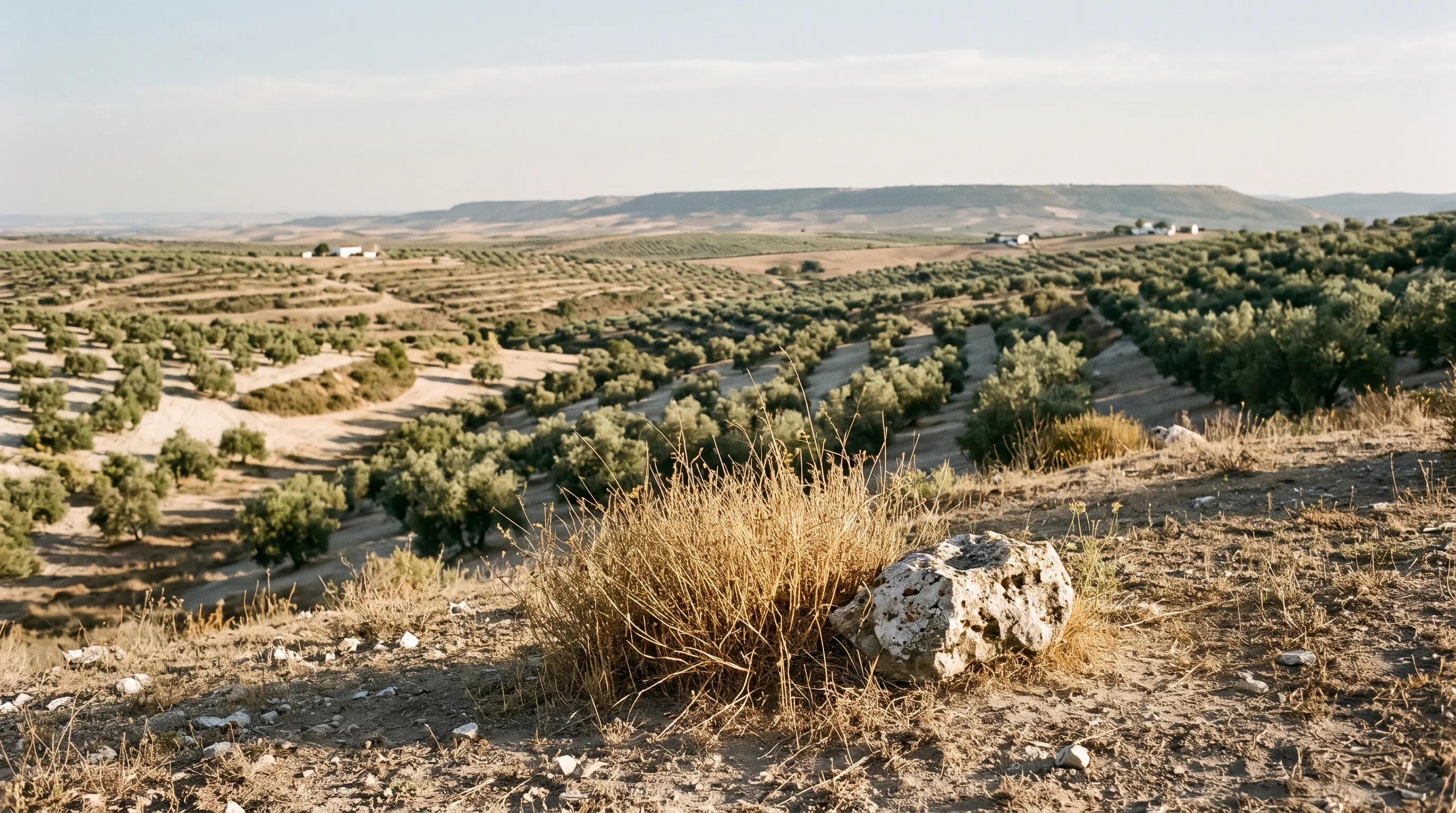
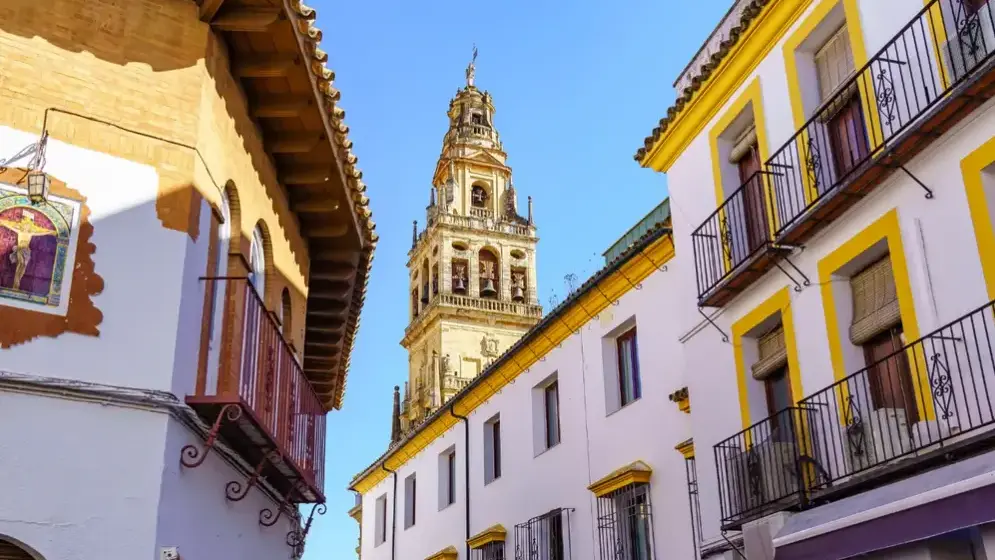
AI-generated view of olive hills in southern Córdoba province. Penco Valenzuela puts Espejo about 52 km from Cerro Muriano.
In this article
Jump to a section
The claim: Cerro Muriano on 5 September 1936
Explore nearby · Monument
Alcázar de los Reyes Cristianos
Alcázar de los Reyes Cristianos, Córdoba: only the gardens are open, Tuesday to Sunday (€7, buy ahead). Fortress interior closed, no published reopening date.
How it first appeared in print
Doubts before 2009
What the landscape evidence puts near Espejo
What stays contested: the shutter, the staging, the sitter
Who pressed the shutter
Posed, genuine or in between
- Posed, in Penco Valenzuela's reading: Espejo was a countryside village with no war activity in early September 1936,[33] and its battle ran from 23 to 25 September, so he calls the picture "casi con plena seguridad" a posado (staged).[34] Spanish historians likewise record intense combat at Espejo only in late September.[35]
- Genuine, in Whelan's reconstruction, which he wrote in 2002 and which is therefore not a reply to Penco Valenzuela: the militiamen played up for the camera, then a hidden enemy machine gun opened fire just as Capa was about to press the shutter.[36]
- In between, in the ICP's: director Willis Hartshorn found plausible a picture taken "not during the heat of battle" but during manoeuvres.[37]
Who the man was
How to caption the Falling Soldier without overclaiming
Deep dive · Article
47 Metres Tall and Almost Unknown: Spain's Tallest Keep
Belalcázar Castle's 47 m keep is listed by the Junta de Andalucía as Spain's tallest. How it grew, what to see inside and how to book the free guided visit.
- Distance: the gap between the two sites depends on who measures it, so attribute any figure to its author rather than treating it as the record.
- Sitter: the name rests on Brotóns Jordá's identification as reported by Whelan,[38] and Domenech and Susperregui question it.[40]
- Staging: the posed, genuine and in-between readings all argue from inference, because no negative survives.[22]
- Weight: Faber notes that a photographer's whole career "does not stand or fall by a single image".[41]
Recommended tours
Tours are selected for quality, not commission. We earn a small fee if you book — at no extra cost to you.
Frequently asked questions
What is the location of Capa's Falling Soldier photograph?
How far apart are Cerro Muriano and Espejo?
Was Capa's Falling Soldier staged?
Who is the man in the Falling Soldier?
Sources
41 references Show Hide
- Wikipedia (opens in a new tab)
“The Falling Soldier (full title: Loyalist Militiaman at the Moment of Death, Cerro Muriano, September 5, 1936) is a black-and-white photograph by Robert Capa”
- revistas.ucm.es — 4564456629699 (opens in a new tab)
“localidad situada a unos 52 kilómetros al sureste de Cerro Muriano”
- historynewsnetwork.org (opens in a new tab)
“Cynthia Young, curator of the Robert Capa Archive at the I.C.P., said the new evidence suggesting that “Falling Soldier” was photographed in Espejo was “compelling, even persuasive.””
- spartacus-educational.com (opens in a new tab)
“Franz Borkenau, the son of a civil servant, was born in Vienna, Austria, on 15th December, 1900.”
- pbs.org (opens in a new tab)
“Swiss journalist Franz Borkenau tells that he witnessed a battle around the village of Cerro Muriano, eight miles north of Córdoba, on the afternoon of September 5, 1936.”
- revistas.ucm.es — 4564456629699 (opens in a new tab)
“quien no pudo alcanzar la línea de frente al impedírselo un intenso fuego de ametralladora”
- historynewsnetwork.org (opens in a new tab)
“the current skyline seems an almost perfect match with what is seen in the background of Capa’s photographs, taken in September 1936, less than two months after the Spanish Civil War began.”
- pbs.org (opens in a new tab)
“the numbers of the sequence to which The Falling Soldier belongs immediately precede those of the Cerro Muriano refugee series.”
- www2.oberlin.edu (opens in a new tab)
“He sent it to Paris to be developed and later gave several mutually contradictory accounts of its creation.”
- historynewsnetwork.org (opens in a new tab)
“The confusion over the site may have arisen, she added, because Capa “captioned so few of his pictures” during the trip”
- pbs.org (opens in a new tab)
“The Falling Soldier was first published in the September 23, 1936, issue of the French magazine Vu (below), where it was reproduced with another, similar picture on the same page.”
- pbs.org (opens in a new tab)
“The sub-head on the top of the page reads, “How they fell,” but there is no mention of where or under what circumstances the pictures had been shot.”
- pbs.org (opens in a new tab)
“When The Falling Soldier was published in the July 12, 1937, issue of Life magazine, the caption stated, “Robert Capa’s camera catches a Spanish soldier the instant he is dropped by a bullet through the head in front of Córdoba.””
- pbs.org (opens in a new tab)
“The allegation that Capa had posed his photograph was first made by O.D. Gallagher, a South African-born journalist”
- pbs.org (opens in a new tab)
“The allegation had first surfaced in 1975, in a book by Phillip Knightley, a British journalist and historian”
- pbs.org (opens in a new tab)
““The famous photograph is almost certainly a fake — Capa posed it.””
- historynewsnetwork.org (opens in a new tab)
“He then e-mailed the clearest of those images to librarians and historians in towns around Córdoba, asking if they recognized the landscape, and eventually got a positive response from a community called Espejo.”
- historynewsnetwork.org (opens in a new tab)
“concludes that Capa’s picture was taken not at Cerro Muriano, just north of Córdoba, but near another town, about 35 miles away.”
- nzherald.co.nz (opens in a new tab)
“was photographed in Llano de Banda, an area of countryside close to the small village of Espejo, southern Spain, 40km from Cerro Muriano.”
- www2.oberlin.edu (opens in a new tab)
“not taken at Cerro Muriano near Córdoba, as had long been assumed, but some 50 kilometers south, near the town of Espejo”
- nzherald.co.nz (opens in a new tab)
“Although the land itself, which was arable when Capa was there, has had olive trees growing on it for the past three decades, the skyline created by a nearby set of hills closely matches that of the celebrated war photographer's own pictures.”
- historynewsnetwork.org (opens in a new tab)
“No negative of “Falling Soldier” is known to exist.”
- revistas.ucm.es — 4564456629699 (opens in a new tab)
“the definitive location of this and the photographic series, some 40 snapshots according to the ICP (International Center of Photography)”
- nzherald.co.nz (opens in a new tab)
“She pointed out a new location did not rule out the theory that The Falling Soldier might have been shot by a sniper - who could have been active on a dormant front.”
- revistas.ucm.es — 4564456629699 (opens in a new tab)
“unos 300 metros más abajo del lugar que propusimos en 2009, en la Haza del Reloj y en su límite con el cerro del Alcaparral”
- revistas.ucm.es — 4564456629699 (opens in a new tab)
“In July 2020, the Forum for Historical and Democratic Memory of Espejo Comandante Pérez Salas, through the Córdoba Provincial Council, commissioned us to carry out a research project”
- revistas.ucm.es — 4564456629699 (opens in a new tab)
“which were taken in Castro del Río, eight kilometers east of Espejo”
- revistas.ucm.es — 4564456629699 (opens in a new tab)
“Durante nuestros trabajos pudimos identificar a Rafael Medina como el oficial que acompañó a Robert Capa y Gerda Taro y que fue fotografiado por ambos.”
- Wikipedia (opens in a new tab)
“I just kind of put my camera above my head and even [sic] didn't look and clicked the picture, when they moved over the trench.”
- albavolunteer.org (opens in a new tab)
“The changed aspect ratio suggests that the photo may have been taken with Gerda Taro’s Rolleiflex (which produces square negatives) rather than with Capa’s Leica (whose negatives have a 3:2 ratio).”
- revistas.ucm.es — 4564456680059 (opens in a new tab)
“Al principio se relacionaba este formato con la cámara Rolleiflex pero Irme Schaber (Schaber, 2013: 96) demostró que la cámara era una Reflex Korell de formato 120.”
- revistas.ucm.es — 4564456680059 (opens in a new tab)
“esta característica resuelve la discusión sobre la autoría de la fotografía del miliciano que algunos asignan a Gerda Taro”
- revistas.ucm.es — 4564456629699 (opens in a new tab)
“un pueblo de la campiña cordobesa donde a comienzos de septiembre de 1936 no había actividad bélica”
- revistas.ucm.es — 4564456629699 (opens in a new tab)
“La batalla de Espejo se libró entre los días 23 al 25 de septiembre de 1936 por lo que Muerte de un miliciano , casi con plena seguridad, es un posado.”
- historynewsnetwork.org (opens in a new tab)
“Spanish historians say that though there was intense combat in Espejo in late September, no fighting occurred there early in the month”
- pbs.org (opens in a new tab)
“Just as Capa was about to press his shutter release, a hidden enemy machinegun opened fire.”
- historynewsnetwork.org (opens in a new tab)
“one which the photography center finds plausible, is that Capa’s photograph, was taken “not during the heat of battle,” as Mr. Hartshorn put it, but during maneuvers”
- pbs.org (opens in a new tab)
“Mario Brotóns Jordá, who had identified the Falling Soldier as Federico Borrell García”
- pbs.org (opens in a new tab)
“Borrell, a 24-year-old millworker from Alcoy, was one of about fifty militiamen who had arrived at Cerro Muriano on the morning of September 5”
- nzherald.co.nz (opens in a new tab)
“describes him dying in Cerro Muriano behind a tree he used as cover.”
- www2.oberlin.edu (opens in a new tab)
“A whole photographic career, however, does not stand or fall by a single image.”