Córdoba and the Spanish Civil War: 1936 and Its Scars
On 18 July 1936, a coup plunged Córdoba into the Spanish Civil War: Plaza de las Tendillas seized, thousands executed, and a failed August counter-offensive.
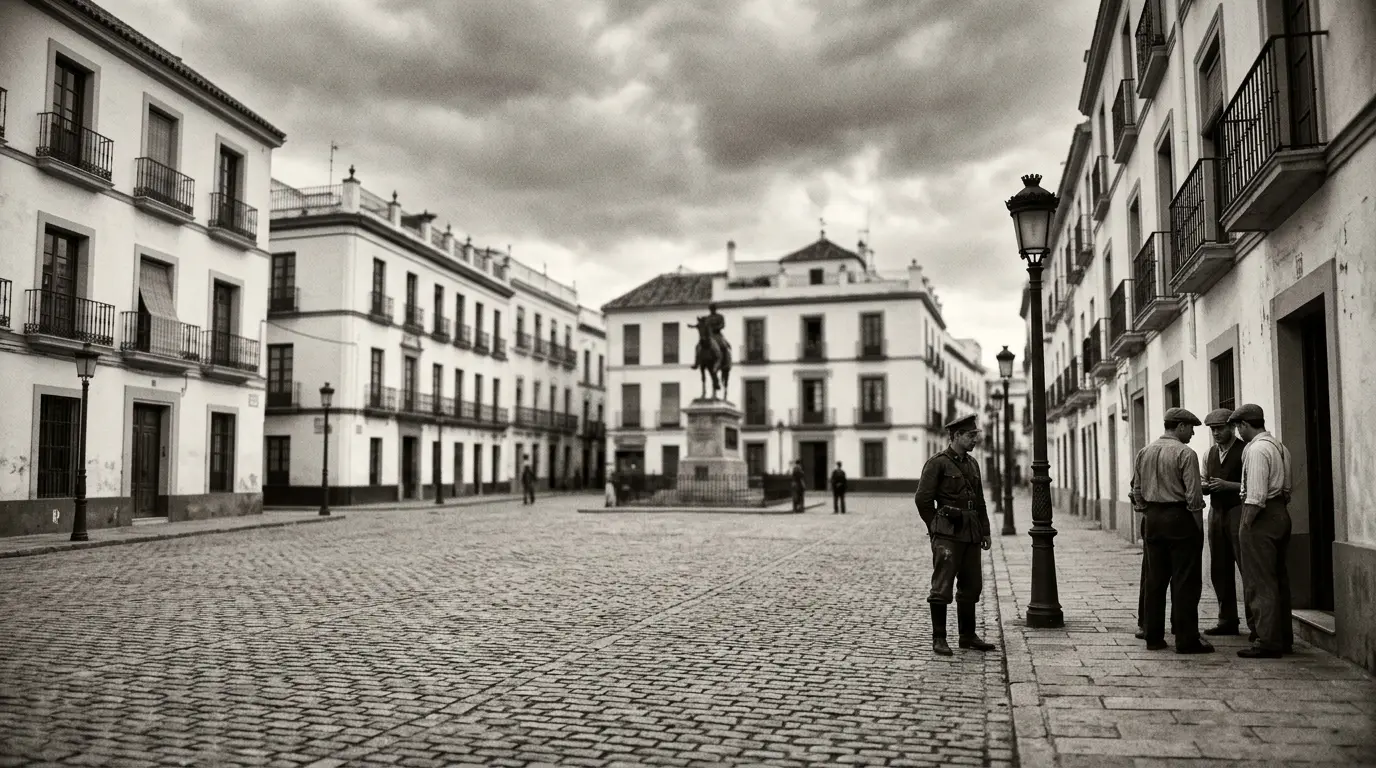
Córdoba's Spanish Civil War began at 2:30 PM on 18 July 1936, with a phone call from Seville, an entirely different conflict from the medieval fitna that some guides also call "Córdoba's civil war," fought nine centuries earlier over the Caliphate's collapse. Colonel Ciriaco Cascajo declared martial law that afternoon, and by before midnight Nationalist militants controlled Plaza de las Tendillas and the Ayuntamiento; the repression that followed killed a larger share of the city's population than almost anywhere else in Spain. This is the account of that week, the failed Republican attempt to retake the city a month later, and the scars the war left on Córdoba.
In this article
Jump to a section
⌄
18 July 1936: the coup that split an afternoon
Córdoba in the spring of 1936 was a province split down agrarian lines: large estates and landless day labourers, a Popular Front government in Madrid that much of the landowning class despised, and a military that had been plotting against the Republic for months. None of that tension stayed abstract for long.
At 2:30 PM on 18 July 1936, the telephone rang at the Regiment of Heavy Artillery No. 1 in Córdoba. General Gonzalo Queipo de Llano, calling from Seville, was on the line to Colonel Ciriaco Cascajo, the artillery commander who was acting as the city's de facto military governor. The order was simple: declare martial law and join the uprising against the Second Republic.[1] The Guardia de Asalto, still answering to the Republic that morning, intercepted the call and warned the Civil Governor's office. It changed nothing.
By 3:00 PM, Cascajo had phoned the Civil Government offices directly, and Córdoba's unions, hearing of the mobilisation within the hour, called a general strike in response. Right-wing militants gathered at the Círculo Mercantil, the businessmen's club a few streets from Tendillas, while the Republican mayor, Manuel Sánchez Badajoz, barricaded himself inside the Ayuntamiento. At 4:00 PM, Cascajo signed the bando de guerra, the decree declaring a state of war across the whole province.[2] No shots had been fired, and the city's institutions were already changing hands.
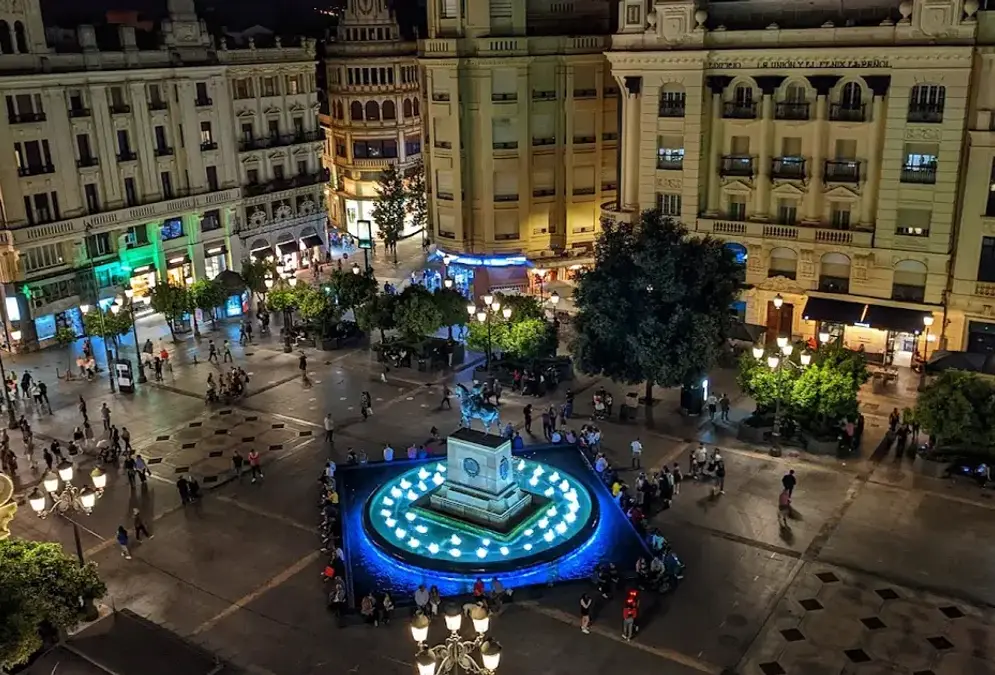
By before midnight, rebel forces controlled the city's three symbolic centres: the Correos (post office), the square known simply as Tendillas, Córdoba's central meeting square, and the Ayuntamiento itself.[3] That same night, Cascajo, invoking orders from Queipo de Llano at every turn, installed a new civilian administration:
Salvador Muñoz Pérez as mayor
Eduardo Quero as president of the Diputación, the provincial council
José Marín Alcázar as civil governor
The Republican government of Córdoba was gone before sunrise, replaced not through negotiation but through an afternoon's chain of telephone calls.
Bruno Ibáñez and the machinery of repression
Queipo de Llano's reach extended past the initial coup, though the repression machinery he built took months, not days, to reach full strength. He appointed Bruno Ibáñez, a Civil Guard officer known to contemporaries as Don Bruno, as Córdoba's chief of public order on 22 September 1936, replacing Luis Zurdo more than two months after the July coup.[15] The directives Ibáñez inherited left no room for ambiguity: purge the city of its political enemies. Within his first days in the post, Ibáñez had 109 people arrested and executed, working from lists supplied by local landowners and clergy who had scores of their own to settle.[4]
Historians attribute more than 2,000 extrajudicial killings in Córdoba to Ibáñez's tenure as public order chief, a separate tally from the roughly 2,000 executions carried out during the coup's first weeks under Cascajo's initial purge.[5] The Córdoba-born psychiatrist Carlos Castilla del Pino, who lived through the period as a child, later described in his memoirs how executions became a daily occurrence at the city's cemeteries and along its roadsides, the cunetas where bodies were simply left. Killing became routine faster than the city could process what routine now meant.
The machinery behind this was not improvised. Denunciation lists, drawn up by people who knew their neighbours' politics, fed directly into military courts that offered no meaningful defence. The pattern Ibáñez established in his first days repeated itself across the province for years, run by different officers in different towns but following the same basic method: arrest on a list, summary process, execution.
Killing became routine faster than the city could process what routine now meant.
The scale of repression: a city, and a province, counting its dead
In the first weeks after the coup, roughly 2,000 people were executed in Córdoba, according to the standard historical account of the offensive.[6] The killing did not stop when the initial purge lists ran out; it became the ordinary business of the new administration for years.
Historians now estimate that more than 4,000 people were killed in Córdoba city alone in the years following 18 July 1936.[7] Across the whole province, the figure rises to about 11,000 killed, making the repression in Córdoba one of the most severe carried out anywhere in Nationalist Spain.[8]
More than 4,000 of the province's victims remain unrecovered today, buried in mass graves at municipal cemeteries or left along roadside cunetas.[9] San Rafael cemetery, on Córdoba's northern edge, is one of the documented sites where exhumations continue. The scale of the killing outpaced the paperwork; many victims were never formally registered as dead, only as disappeared.
~11,000
Estimated killed across the province of Córdoba during the Francoist repression that followed 18 July 1936, more than 4,000 of them in the city alone.
The figures did not come from official record-keeping. Francoist administrations kept execution registries inconsistently, when they kept them at all, so most of what is known today comes from decades of archival cross-referencing, cemetery record searches, and testimony gathered long after the fact, work that continues in Córdoba under Spain's historical memory law.
Recommended tours
Tours are selected for quality, not commission. We earn a small fee if you book — at no extra cost to you.
The Córdoba offensive: the Republic's failed August counterattack
Córdoba sat at a strategic junction between Nationalist-held Seville and the rest of Andalusia, which made recapturing it a priority for the Republican high command once the initial shock of the coup had passed. Five weeks after the coup, Republican forces attempted to retake the city in what military histories call the Córdoba offensive. The advance began on 5 August 1936; the main assault on the city opened on 20 August and continued until Nationalist forces repelled it on 22 August, a Nationalist victory that stabilised the province for the rest of the war.[10]
Command on both sides was experienced. Leading the Republican advance:
Gen. José Miaja
Lt. Col. Juan Bernal Segura
Col. Joaquín Pérez Salas
Timeline
5 August 1936
Republican advance begins
Forces move toward Córdoba, taking small towns along the way.
20 August 1936
Main assault opens
Republican troops reach the city's gates, about 5 km out.
22 August 1936
Nationalists repel the attack
The offensive is turned back; Córdoba remains in Nationalist hands.
23 August 1936
Desertion cripples the retreat
A Nationalist officer embedded in Republican ranks defects with 200 Civil Guards.
September 1936
The front stabilises
Córdoba remains behind Nationalist lines for the rest of the war.
Defending Córdoba for the Nationalists were Col. Ciriaco Cascajo, the same officer who had declared martial law a month earlier, and Col. José Enrique Varela, who arrived with reinforcements of regular colonial troops.[11]
The Republican advance was slow. Troops took a string of small towns on the approach before the main assault on the city began on 20 August; they came within sight of the Roman Bridge and Córdoba's southern approaches, about 5 kilometres from the gates, before Nationalist defenders repelled them by 22 August.[12]
Nationalist officers embedded within the Republican ranks did real damage to the offensive from the inside. On 23 August, one captain deserted to the Nationalists, taking 200 Civil Guards with him.[13] The attack that had looked, for a few days, like it might succeed collapsed within its final week.
Palma del Río and the front that held
The failed offensive did not end the violence around Córdoba; it relocated it. In towns that had briefly fallen under Republican control during the advance, the reprisals that followed the Nationalist recovery were severe. In Palma del Río, a local landowner is reported to have killed 300 Republican supporters in the aftermath alone.[14]
The front around Córdoba held for the rest of the war. Whatever the city's later reputation as a monumental centre of Roman, Umayyad, and Renaissance building, the summer of 1936 left it on the Nationalist side of a line that would not move again until the war ended in 1939. What moved instead was the population: those who had survived the purges, those who had fled, and those who spent the following decades saying nothing about either.
Two civil wars, one name: why Córdoba's story splits at 1009 and 1936
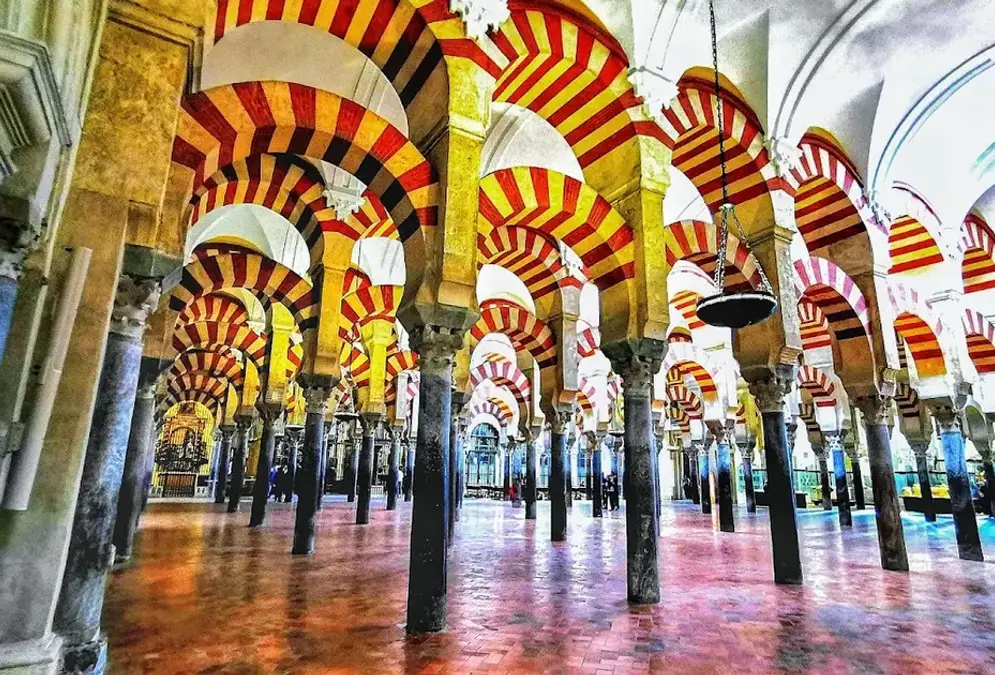
Anyone searching for Córdoba's civil war will find two completely different conflicts sharing a city and almost nothing else. The great mosque turned cathedral had already stood for two and a half centuries when the fitna, the Umayyad Caliphate's own civil war, fought between rival claimants and mercenary armies from roughly 1009 to 1031, tore the caliphate apart. That medieval collapse is a separate story: Córdoba's Golden Age civil war covers palace intrigue and Berber sackings nine centuries before Cascajo picked up a telephone. The 1936 war was not a rerun of anything. It was Spain's twentieth century arriving in a city that had assumed its worst wars were behind it.
They were not. Walk from Plaza de las Tendillas to the old town's riverside walls today, and nothing in the stonework marks the events of that July afternoon or the August offensive that followed. Córdoba's monuments commemorate the Caliphate, the Reconquista, and the cathedral's Renaissance additions. The twentieth-century war survives mostly in family stories, in the unopened ground of cemeteries like San Rafael, and in academic studies of a repression whose scale still surprises visitors who know the city only for its columns and courtyards. Those visitors are part of a record wave: Spain drew 96.8 million international arrivals in 2025 (see Spain travel statistics 2026), and most of them come for the Caliphate and the courtyards, not the mass graves still being located a few kilometres away. The city's public memory has been slow to turn toward 1936, mostly because the mass graves are still being found.
On 18 July 1936, General Gonzalo Queipo de Llano telephoned Colonel Ciriaco Cascajo in Córdoba from Seville, ordering him to declare martial law and join the military coup against the Second Republic. Cascajo signed the bando de guerra at 4:00 PM, and by before midnight Nationalist forces controlled the Correos, Plaza de las Tendillas, and the Ayuntamiento. The Republican mayor, Manuel Sánchez Badajoz, had barricaded himself inside City Hall, but the old administration was replaced overnight.
Who was Ciriaco Cascajo?
Ciriaco Cascajo commanded the Regiment of Heavy Artillery No. 1 in Córdoba and acted as the city's de facto military governor when the 1936 coup began. He declared martial law on Queipo de Llano's orders, installed a new civilian administration overnight, and later commanded the Nationalist defence of Córdoba during the Republican counter-offensive in August 1936.
What was Queipo de Llano's role in the fall of Córdoba?
Gonzalo Queipo de Llano, the general who had seized Seville for the Nationalists, telephoned Cascajo in Córdoba on the afternoon of 18 July 1936 with direct orders to declare martial law. He later appointed Bruno Ibáñez as Córdoba's chief of public order, and historians consider him the principal instigator of the repression that followed across the province.
How many people were killed in the repression in Córdoba during the Spanish Civil War?
Historians estimate that more than 4,000 people were killed in Córdoba city alone in the years following the 18 July 1936 coup, and about 11,000 across the whole province, making it one of the most severe repression campaigns of the Spanish Civil War. In the first weeks alone, roughly 2,000 people were executed in the city. More than 4,000 victims from the province remain unrecovered, buried in mass graves and roadside cunetas.
Did Republican forces try to retake Córdoba during the Civil War?
Yes. Republican troops launched what is recorded as the Córdoba offensive, advancing from 5 August 1936 and mounting a main assault on the city from 20 to 22 August. Forces under Gen. José Miaja reached the city's gates, about 5 kilometres out, before Nationalist defenders under Col. Ciriaco Cascajo and Col. José Enrique Varela repelled them. The failure was compounded when a Nationalist officer embedded in Republican ranks deserted with 200 Civil Guards on 23 August.
What happened at Plaza de las Tendillas in 1936?
Plaza de las Tendillas, Córdoba's central square, was one of the first strategic points seized by rebel forces on the night of 18 July 1936, alongside the Correos building and the Ayuntamiento. Its capture, along with City Hall, marked the effective end of Republican control in the city within hours of the coup being declared.
Is the 1936 Spanish Civil War the same as Córdoba's medieval civil war (the fitna)?
No. The 1936 Spanish Civil War is a completely separate conflict from the fitna, the Umayyad Caliphate's own civil war fought between rival claimants and Berber mercenaries from roughly 1009 to 1031, which is covered in Córdoba's Golden Age civil war. The two wars share only a city and a loose English translation; they are separated by nine centuries and involve entirely different causes, factions, and outcomes.
Where are Córdoba's Spanish Civil War mass graves today?
More than 4,000 victims of the repression across Córdoba province remain unrecovered, buried in municipal cemeteries and roadside cunetas. San Rafael cemetery, on Córdoba's northern edge, is one of the documented sites where mass graves from this period have been identified, and exhumation efforts continue as part of Spain's broader historical memory movement.
“Antes de las doce de la noche los sublevados se hicieron con el control de las zonas más importantes de la ciudad, como la sede de Correos, la plaza de las Tendillas y el Ayuntamiento.”
“The article attributes over 2,000 extrajudicial killings to Ibáñez during his tenure, citing Carlos Castilla del Pino's memoir describing executions occurring daily at cemeteries and roadsides.”