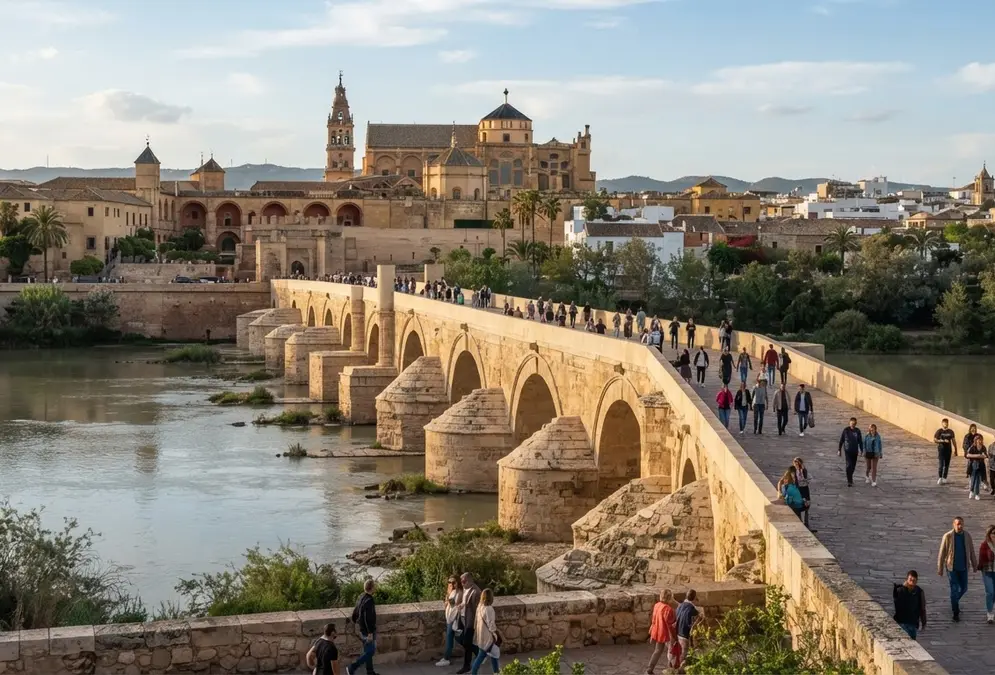
history-buffsmusic-lovers
Written by Sophie Marchand
Modern Córdoba · 1808–today
  • 5 min
  • 27 sources

Mérimée's Carmen in Córdoba: What Bizet's Opera Cut

Mérimée's 1845 Carmen is framed in Córdoba: a Dominican library, the Guadalquivir quay, the condemned chapel. Here is how Bizet moved it all to Seville.
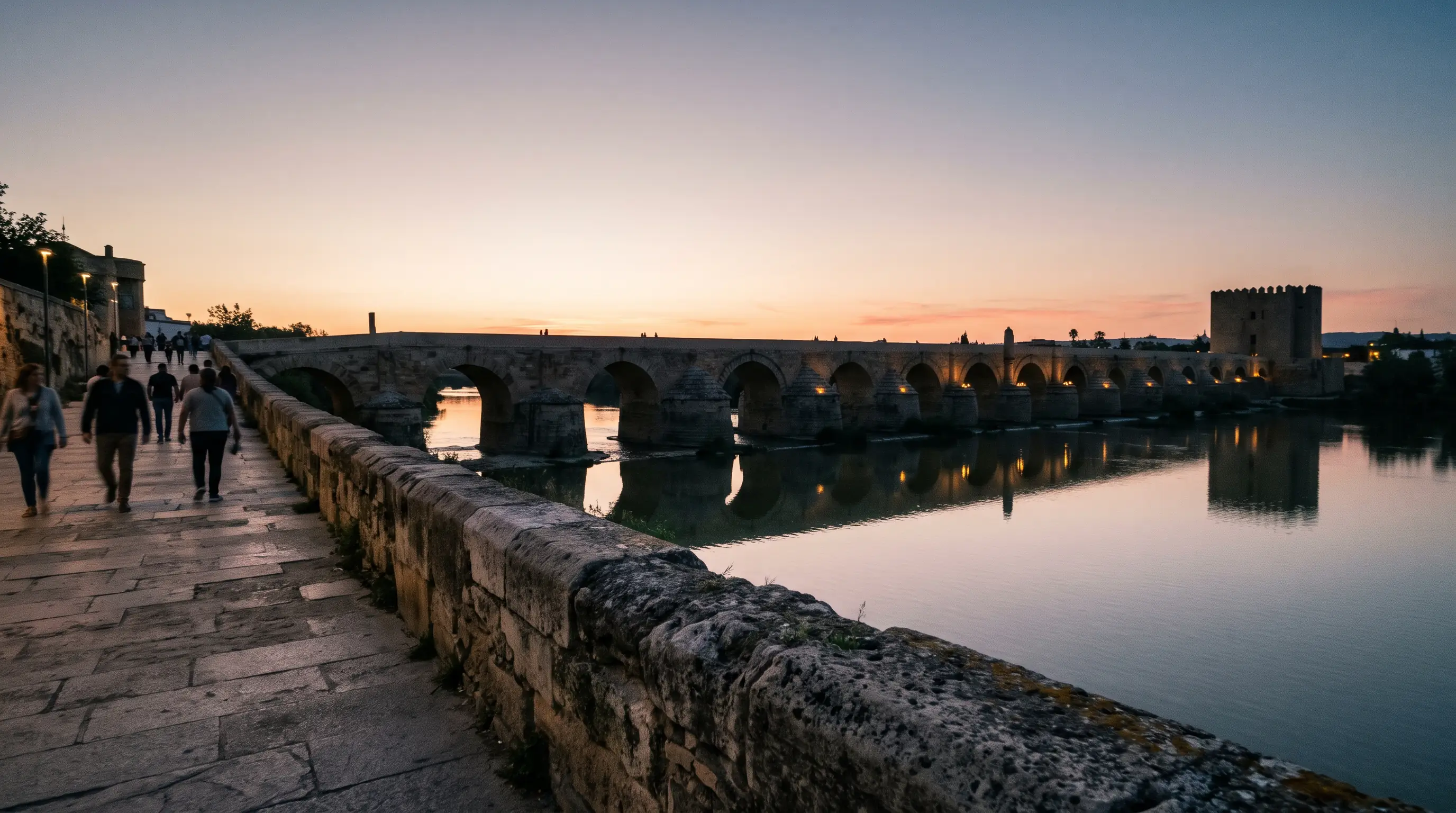
Scene from Mérimée's Carmen in Córdoba: men leaning on the high stone quay of the Guadalquivir at sunset, women bathing at the water's edge below, the Roman bridge arches dark against an orange sky

Mérimée's novella first ran in the Revue des Deux Mondes on 1 October 1845, with Córdoba as the frame of the story.

The first time Carmen gives her name in Mérimée's novella she is on the Guadalquivir quay in Córdoba, asking a Frenchman whether he has heard of the Carmencita and answering her own question: it is me.[1] The story ran in the Revue des Deux Mondes on 1 October 1845[2], and Córdoba is its frame, the city where the narrator visits the condemned chapel and hears Don José's confession before the garrotte. Bizet's librettists removed the narrator and with him that frame[3], so the opera that premiered in Paris on 3 March 1875[4] never reaches the city, and setting the opera beside the novella shows what that cut takes out of the story.
Mérimée leaves for Spain
27 Jun 1830
Departure date of the journey the novella claims as its source[5]
First printed in the Revue
1 Oct 1845
Carmen appears in the Revue des Deux Mondes[2]
Opéra-Comique premiere
3 Mar 1875
Bizet's opera first performed in Paris[4]

A novella that claims to be a travel memory

Mérimée wrote Carmen in 1845 as a memory of the Spain he had crossed fifteen years earlier, and the novella insists on that claim.[6] He left for Spain on 27 June 1830[5], and the narrator he invents is a French antiquarian in that same Spain, riding out from Córdoba with a hired guide and two horses to find the battlefield of Munda, with Caesar's Commentaries and a few shirts for luggage.[7]
That pretext is why a tale of smugglers and jealousy opens among Roman ruins. In the first part the antiquarian falls in with an outlaw on the plain of Cachena and shelters him at a roadside inn; Córdoba comes only in the second. The four parts run like this:
  • Part I: the ravine, the inn and the stranger who is Don José.
  • Part II: the narrator in Córdoba, twice, months apart.
  • Part III: Don José's confession, told in the condemned chapel.
  • Part IV: an essay on the Romani that the magazine run left out.
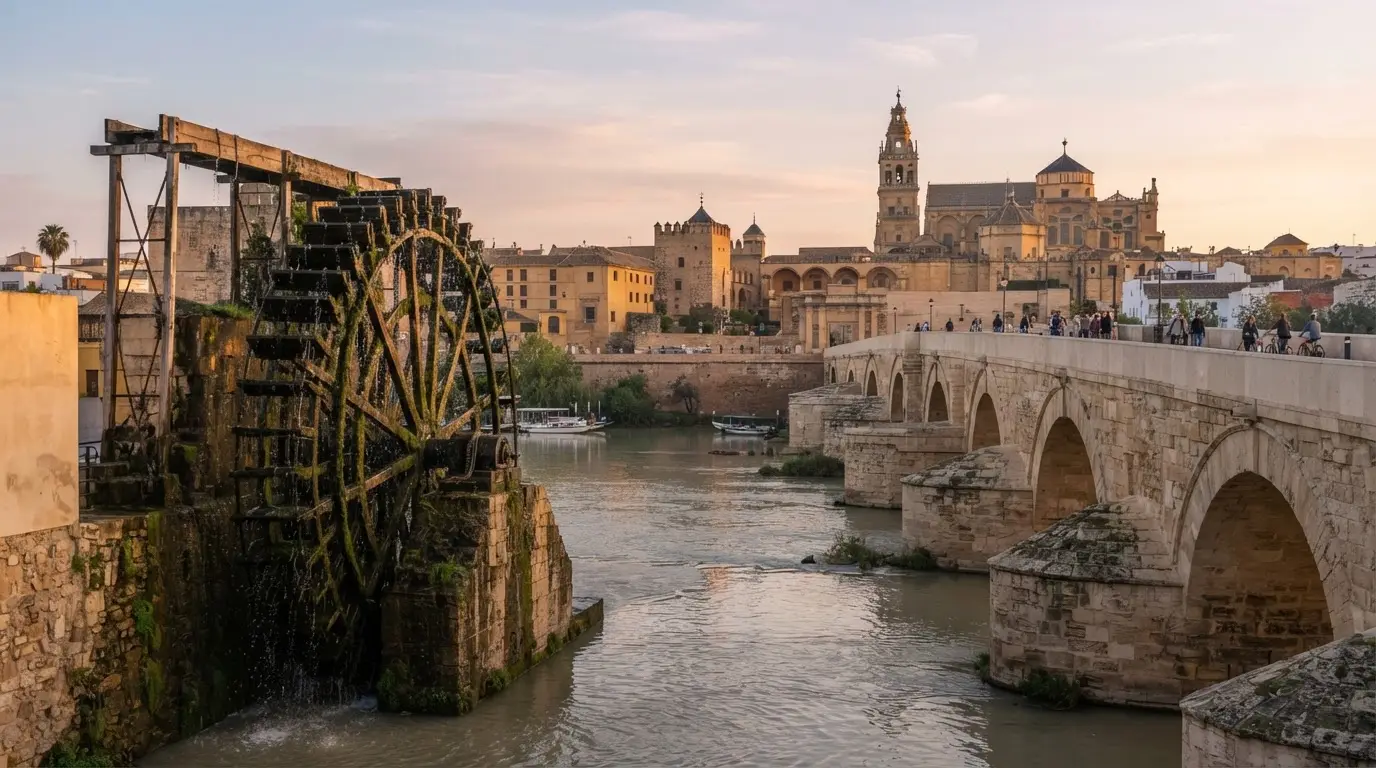
The Albolafia waterwheel turning on the Guadalquivir River at dawn, Córdoba Spain, Roman Bridge stone arches to the right, the Mezquita-Catedral tower visible beyond, warm golden light on the river surface and medieval stonework

Deep dive · Article

Albolafia waterwheel history: Abd al-Rahman II's Córdoba

The Albolafia waterwheel first appeared on Córdoba's coat of arms in the 1300s, vanished for centuries, and returned in 1983 — not Abd al-Rahman II's work.

The frame does the work of a witness statement, since the man who hunts for Roman evidence in a library is also the man who writes down a killer's story. Other Romantic travellers published their Spanish journeys as travel books: Théophile Gautier's Voyage en Espagne appeared in 1843[8] and Richard Ford's A Handbook for Travellers in Spain in 1845[9], the year of Carmen. Mérimée put his inside fiction.

The Dominicans' library and the Guadalquivir quay

Córdoba enters Carmen as a place to work: the narrator spends his days on a manuscript in the Dominicans' library, hunting for evidence about ancient Munda. His evenings belong to the river.
At sunset the idlers of the town gather on the quay along the right bank of the Guadalquivir[10], and Mérimée gives the scene its smells and its voyeurism. The air carries the fumes of a tannery that keeps up the country's old reputation for preparing leather[11], and just before the angelus women come down to bathe below the high quay while the men watch from above. The narrator is one of the watchers, and the novella never pretends otherwise.
Carmen comes out of that crowd with a question that is half introduction and half challenge. By the end of the evening the two have shared cigarette papers and eaten ices at a neveria, and she has proposed a fortune-telling at her house.
The novella never names the Dominican house, so any identification is inference. The nearest verifiable Dominican site is the church of San Pablo, in front of Córdoba Town Hall on calle Capitulares, built between the 13th and 14th centuries and heavily reformed in the 18th.[12]

Across the bridge to Carmen's house

From the quay Carmen leads the narrator across the Guadalquivir bridge to a house at the far end of the suburb that looks nothing like a palace.[13] The novella names no span and gives the house no address; the Roman bridge is simply the crossing a modern reader will picture, and the house belongs to fiction.
The fortune-telling is cut short when Don José bursts in, recognises the narrator and escorts him out. Carmen's gestures mime a throat being cut, and the narrator, unsure whose, suspects his own. Only when undressing that night does he find that his repeating watch is gone.
Puente Romano de Córdoba spanning the Guadalquivir with the Mezquita in the background

Explore nearby · Monument

Puente Romano de Córdoba

Puente Romano de Córdoba: 16 arches over the Guadalquivir since the 1st century BC. Best viewpoint for the Mezquita at sunset. Game of Thrones location. Free.

Everything the confession later explains is already visible from the quay: Carmen's tricks, Don José's jealousy, and a narrator who is robbed rather than hurt because he is only an observer.

The condemned chapel and the garrotte

Don José tells his story in the condemned chapel, and Mérimée places that chapel in Córdoba. Months after the theft the narrator passes through the city again, and a Dominican father tells him that the thief is a prisoner who will be garrotted the day after tomorrow, with Father Martinez ready to take him to the cell.
The Dominican explains that a hidalgo is garrotted rather than hanged, and Mérimée footnotes the point himself: in 1830 the nobility still held the privilege of the garrotte.[14] The distinction had a legal footing: a Royal Order of 24 April 1832 replaced hanging with the garrote vil and kept a separate garrote noble for hijosdalgo.[15][16]
The narrator, curious, visits the prisoner with a packet of cigars to excuse the intrusion. Don José asks for a mass for his soul, another for the person who offended him, and a favour for a woman in Pamplona: a medal to carry to her, with the message that he is dead, but not how.
The narrator returns the next day and spends part of it with the prisoner, and what he hears is Part III: Elizondo in the Baztan valley, the Seville tobacco factory, the smugglers' trails and Carmen's death in open country. Almost none of it happens in Córdoba. The city is where the story is told, not where it happens.

Why Bizet's Carmen never reaches Córdoba

Bizet's librettists, Henri Meilhac and Ludovic Halévy, a successful team in vaudeville and operetta[17], eliminated the narrator, and with him Mérimée's framing device.[3] The opera that opened at the Opéra-Comique on 3 March 1875[4] therefore has no library, no quay and no listener in a condemned chapel. What survives is chiefly the story Don José tells, minus much that surrounds it, Carmen's husband included.[18]
The libretto also changes when the audience learns things: the novella introduces Don José only after he has joined the outlaws, whereas the opera lets the audience witness his downfall.[19] With the narrator gone, the story also stops passing through a listener who has been robbed by its heroine.

Recommended tours

Tours are selected for quality, not commission. We earn a small fee if you book — at no extra cost to you.
Meilhac and Halévy took their cue from Mérimée but drew on many other sources, as he had himself borrowed freely.[20] What they had no use for was Córdoba: in the novella it is the room where the story is told, and the opera has no such room.
The opera is set in Seville and the hills around it[21], and its first scene is a square with the tobacco factory door on the right.[22] That keeps the city where the novella's love story begins and loses the city of the frame. Inside the confession Córdoba survives only as a passing comparison, Don José likening Carmen's rolling walk to a filly from the Córdoba stud[23]; nothing in it requires the city on stage.

Following the novella through Córdoba today

No plaque in Córdoba marks a Carmen route and the text supplies no street addresses, so a visit means standing at the kinds of place the novella uses. Three are worth the stop:
  • The church of San Pablo, in front of Córdoba Town Hall on calle Capitulares, the nearest verifiable Dominican site to the library scene, offered as inference rather than identification.[12]
  • The right bank of the Guadalquivir, the side the novella gives to the idlers' quay at sunset.[10]
  • The Roman bridge, the crossing a modern reader will picture for Carmen's walk, whose own story is told in the Roman bridge's history.

Carmen's house is fiction

The text offers a bridge and the end of a suburb, nothing more, so there is no address to look for. Treat any claim to the exact spot of Carmen's house or the condemned chapel as a guess.
That is the honest extent of the trail: a church, a bank and a bridge. The Córdoba of the novella was always a frame around somebody else's story, and standing at those three places is the closest a visitor gets to the narrator's evenings.

Frequently asked questions

Is Mérimée's Carmen set in Córdoba or Seville?

Both. In the novella the love story starts at the Seville tobacco factory, where Don José is posted on guard[24], and Córdoba supplies the frame, from the quay to the condemned chapel. The opera, by contrast, is set in Seville and its surrounding hills.[21]

Is Carmen based on a true story?

In a letter to the Countess of Montijo, Mérimée said the story came from her account of a ruffian from Málaga who killed his mistress.[25] The novella itself passes the tale off as the narrator's own experience on a journey through Spain.

When was Mérimée's Carmen published?

On 1 October 1845 in the Revue des Deux Mondes[2], where only the first three parts appeared in that issue.[26]

Does Carmen die in Córdoba?

No. Part III ends with her death in open country, and Córdoba appears in the confession only in passing, as the city the pair rode out of on the night Carmen recalls a hare running across the road.[27]

Does the narrator appear in Bizet's opera?

No. The librettists eliminated him, and with him Mérimée's framing device.[3] That is why the library, the quay and the condemned chapel have no counterpart on stage.

Who is the narrator of Mérimée's Carmen?

An unnamed French antiquarian who hires a guide and two horses at Córdoba to look for the site of Munda.[7] He meets Don José before he meets Carmen, and later hears the confession in the condemned chapel.

Can you visit the places in Mérimée's Carmen in Córdoba?

Not as such: the novella gives a quay on the right bank, a bridge and the end of a suburb, but no addresses. The church of San Pablo on calle Capitulares is the nearest verifiable Dominican site, as inference.[12]

Sources

27 references Show
  1. fr.wikisource.org (opens in a new tab)

    “Avez-vous entendu parler de la Carmencita ? C’est moi.”

  2. merimee.byu.edu (opens in a new tab)

    “October 1: Carmen appears in the Revue des Deux Mondes.”

  3. columbia.edu (opens in a new tab)

    “Furthermore, the narrator of the novella is eliminated, thus removing Mérimée's framing device.”

  4. Wikipedia — Carmen (opens in a new tab)

    “The opera was first performed by the Opéra-Comique in Paris on 3 March 1875”

  5. merimee.byu.edu (opens in a new tab)

    “June 27: Mérimée leaves for Spain.”

  6. Wikipedia — Carmen (novella) (opens in a new tab)

    “Mérimée tells the story as if it had really happened to him on his trip to Spain in 1830.”

  7. fr.wikisource.org (opens in a new tab)

    “J’avais loué à Cordoue un guide et deux chevaux, et m’étais mis en campagne avec les Commentaires de César et quelques chemises pour tout bagage.”

  8. gutenberg.org (opens in a new tab)

    “is a travel book first published in 1843. The work recounts the author's journey through the Iberian Peninsula in 1840, accompanied by art collector Eugène Piot.”

  9. Wikipedia — A Handbook for Travellers in Spain (opens in a new tab)

    “A Handbook for Travellers in Spain is an 1845 work of travel literature by English writer Richard Ford.”

  10. fr.wikisource.org (opens in a new tab)

    “À Cordoue, vers le coucher du soleil, il y a quantité d’oisifs sur le quai qui borde la rive droite du Guadalquivir.”

  11. fr.wikisource.org (opens in a new tab)

    “Là, on respire les émanations d’une tannerie qui conserve encore l’antique renommée du pays pour la préparation des cuirs”

  12. Turismo de Córdoba (opens in a new tab)

    “In front of Cordoba Town Hall stands the impressive church of San Pablo. It was built between the 13th and 14th centuries, but was heavily reformed in the 18th.”

  13. fr.wikisource.org (opens in a new tab)

    “Nous passâmes le pont du Guadalquivir, et à l’extrémité du faubourg nous nous arrêtâmes devant une maison qui n’avait nullement l’apparence d’un palais.”

  14. fr.wikisource.org (opens in a new tab)

    “En 1830, la noblesse jouissait encore de ce privilége. Aujourd’hui, sous le régime constitutionnel, les vilains ont conquis le droit au garrote.”

  15. economistjurist.es (opens in a new tab)

    “El 24 de abril de 1832 el rey Fernando VII, el Deseado, firmó en Aranjuez una Real Orden que abolía la pena de muerte por horca, conmutándola por la de garrote vil.”

  16. economistjurist.es (opens in a new tab)

    “quede abolida la muerte por horca y se sustituya por el garrote vil y para los hijosdalgo se mantiene el garrote noble donde el reo llegaba ensillado en un caballo.”

  17. columbia.edu (opens in a new tab)

    “The librettists, Halévy and Meilhac, were a successful team, writing for vaudeville and operettas”

  18. Wikipedia — Carmen (novella) (opens in a new tab)

    “The opera is based on Part III of the story and omits many elements, such as Carmen's husband.”

  19. columbia.edu (opens in a new tab)

    “In the novella, we are introduced to Don José after he has joined the outlaws, whereas in the opera we are witness to his downfall.”

  20. cambridge.org (opens in a new tab)

    “In the formation of their libretto the two writers had plundered many sources, taking their cue from Mérimée, who had also borrowed freely.”

  21. Wikipedia — Carmen (opens in a new tab)

    “Place: Seville, Spain, and surrounding hills”

  22. Wikipedia — Carmen (opens in a new tab)

    “A square, in Seville. On the right, a door to the tobacco factory.”

  23. fr.wikisource.org (opens in a new tab)

    “elle s’avançait en se balançant sur ses hanches comme une pouliche du haras de Cordoue.”

  24. fr.wikisource.org (opens in a new tab)

    “on me mit de garde à la manufacture de tabacs à Séville.”

  25. Wikipedia — Carmen (novella) (opens in a new tab)

    “It was about that ruffian from Málaga who had killed his mistress, who consecrated herself exclusively to the public.”

  26. Wikipedia — Carmen (novella) (opens in a new tab)

    “Only the first three appeared in the original publication in the October 1, 1845, issue of the Revue des deux Mondes”

  27. fr.wikisource.org (opens in a new tab)

    “Et cette nuit, en sortant de Cordoue, n’as-tu rien vu ? Un lièvre a traversé le chemin entre les pieds de ton cheval.”