outdoorphotographers
Written by Sophie Marchand
  • 5 min
  • 26 sources

Why Córdoba's Orange Trees Fill the Streets but Feed Nobody

Córdoba lines about 27,000 bitter orange trees along its streets, then pays crews to strip the fruit. Why nobody eats it and where 1,379 tonnes ended up.
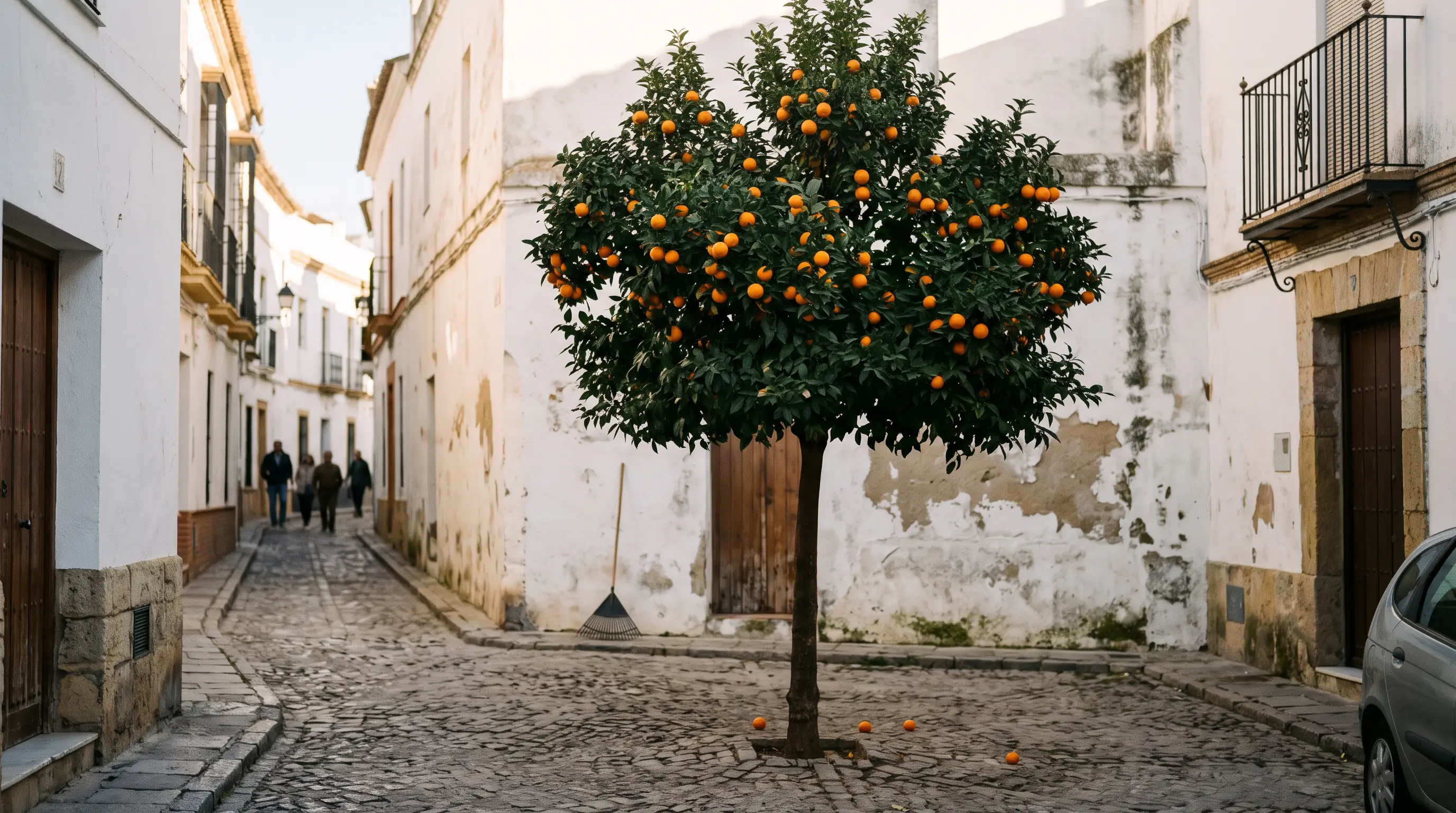
Bitter orange trees heavy with ripe fruit lining a narrow whitewashed Córdoba street in January, low winter light, parked cars beneath the branches (cordoba orange trees)

In 2026 Sadeco collected 1,379,000 kg of street oranges, fruit that ends up as compost rather than marmalade.

Córdoba keeps about 27,000 bitter orange trees along some 700 streets,[4] and nobody is meant to eat the fruit. Each winter the municipal sanitation company, Sadeco, knocks it down before it can litter the pavement,[5] carts it away and composts it: 1,379 tonnes of oranges in 2026.[3] Come roughly between January and March for fruit on the branch and crews in the street, or in April and May for the blossom.
Street orange trees
27,000
Sadeco's estimate, spread across more than 700 streets[1]
2026 harvest start
16 Jan
Sadeco's street-orange campaign began on this date in 2026[2]
Fruit collected in 2026
1,379 t
Final balance of Sadeco's 2026 street-orange campaign[3]

Why bitter oranges suit a narrow street

Bitter orange earns its place on a Córdoba street by staying small. The naranjo amargo, Citrus aurantium, is planted as an avenue tree on narrow pavements because its crown is compact and trims easily,[6] a useful trait in lanes where a plane tree would block the way. In spring it covers itself in white azahar blossom, and the scent can fill whole neighbourhoods.[7]
Orange trees have grown in the Mezquita's courtyard since at least the 15th century,[8] so the species is hardly a recent arrival. The catch is where the fruit lands. An orange in a Córdoba patio drops its fruit on private tiles; a street tree drops it on public pavement, parked cars and passers-by.
In January the evidence is overhead: heavy fruit above doorways, and a scatter of split oranges along the kerb where gravity got there first. That scatter is what the winter harvest exists to prevent. Walk under the trees in January and the contrast is plain: an ornamental doing its job overhead, and a municipal chore stacked up underneath.

Why nobody eats the street oranges

Street oranges go uneaten because the fruit is sour and because the city has settled what happens to it instead. Bitter oranges are acidic fruit whose traditional use is marmalade and other sweets, not eating from the hand.[9] Córdoba's street fruit no longer even goes to the preserving pan: Sadeco's president said at the launch of the 2026 campaign that, for legal and food-safety reasons, oranges collected from public streets can no longer be used to make marmalade or other products for consumption.[10]
Not everyone believes the rule is observed. A bitter-orange defence association, ADNA, has denounced the sale of street-picked oranges for marmalade in municipalities across the provinces of Cádiz, Sevilla and Córdoba.[11] It is an advocacy group's allegation, not a finding, and it is aimed at three provinces rather than at Córdoba alone.
For a visitor the rule of thumb needs no legal reading. The fruit hangs over public pavement, it is bitter, and the city is about to sweep it up anyway. Photograph it, smell it, leave it. The restraint costs nothing: the blossom in spring is the part worth the trip, and the street oranges will still be there next January for anyone who wants to watch the shakers work.

How the winter harvest works

Sadeco harvests street by street through the winter, and a visitor in January or February is more likely to meet the operation than the fruit. Three details explain most of what you will see:
  • The 2026 campaign began on 16 January and was scheduled to end on 25 March in the outlying districts of Alcolea, Santa Cruz and Cerro Muriano.[12]
  • Notices go up on affected streets well in advance, naming the day the oranges on that street will be picked.[13]
  • Three trunk shakers bring the fruit down, eleven sweepers gather it and eight auxiliary vehicles support the operation.[14]

Read the sign before you park

Between mid-January and late March, check for Sadeco's notice before you leave a car overnight on an orange-lined street. The pick day is fixed in advance and named on the sign.[13]
The sequence keeps the pavement usable: the shakers drop the fruit and the sweepers clear it behind them, so each street has one named pick day and is walkable again once the crew has passed. Residents with cars are the people who feel the schedule most, which is why the notices matter more than the machinery. If you want pictures of the harvest, stay clear of the shakers; the quieter shot is the empty street afterwards, kerbs swept and branches stripped.

How many trees, and how much fruit

No single number settles how many orange trees Córdoba has. The three lots of Sadeco's 2023 harvesting tender cover 7,704, 8,766 and 9,127 bitter orange trees on municipal land,[15] 25,597 in all, a little under the roughly 27,000 the company quotes for the street campaign.[1] Treat both as working estimates: the tender counts only council-owned bitter oranges, a narrower question than how many orange trees stand along Córdoba's streets.
Weight is better documented. Sadeco's forecast for the 2026 campaign was about 1,500 tonnes, with close to 1,000 tonnes already harvested by early March.[16] The campaign closed at 1,379 tonnes,[3] about 8 percent short of forecast and an average of about 50 kg of fruit for each of those 27,000 trees.
Fifty kilograms is a serious crop from a species planted for its blossom and its manageable crown, and it lands in the one place a city cannot leave it: public pavement. The printed notices, the shakers, the lorries and the weighing at the plant all follow from that single fact.

Recommended tours

Tours are selected for quality, not commission. We earn a small fee if you book — at no extra cost to you.


The same small crowns do other work once the fruit is gone. A compact tree on a narrow lane gives shade without blocking the street, one more piece of the courtyard-and-alley logic behind how Córdoba survives extreme heat. In January the shade is beside the point and the fruit is the story; by June the trees are doing the job a street tree is there for.

Where the fruit goes, and when to see the trees

The oranges end up as compost. Lorries take them to the Juan Revilla Environmental Complex, where each load is weighed,[17] and there the fruit is mixed with other organic waste to make compost that can be used as a soil amendment.[18] It is the least romantic fate available to an orange, and a fitting one for fruit nobody is supposed to eat.
The Mezquita-Catedral's courtyard runs on its own schedule. The Cabildo's maintenance team harvests the Patio de los Naranjos oranges itself every year,[19] and the Cabildo has agreed with a Córdoba winery to remove and make use of them.[20] That courtyard, now lent to flower artists for FLORA's living-flower installations, is the better-known orange grove, and the Mezquita-Catedral is where to see it.
Interior of the Mezquita-Catedral de Córdoba with its iconic red-and-white arches and forest of columns

Explore nearby · Monument

Mezquita-Catedral de Córdoba

856 columns, 1,300 years of Islamic and Christian history. UNESCO monument in Córdoba, Andalusia. Red-and-white arches, Byzantine mosaics, a Renaissance nave.
So the calendar for a visitor runs in two halves. January to late March belongs to fruit and crews. Bitter orange generally flowers between April and May, and earlier in warm weather,[21] a window that overlaps the season of the Patios Festival, when the courtyards themselves smell of azahar. Either way, leave the oranges where they hang.
The harvest is an annual fixture, not a one-off. Sadeco lists harvesting the street orange trees as part of its standing cleaning service,[22] and the launch of the 2026 campaign anticipated about 1,500 tonnes, similar to previous years.[23]
Crews do not work the whole city at once. The 2026 campaign began in Cercadilla-Medina Azahara, Campo de la Verdad, Miraflores, Fray Albino and Sector Sur,[24] and finished in Alcolea, Santa Cruz and Cerro Muriano.[12] Treat them as places where the winter work begins and ends, good starting points for a January walk rather than a ranking of the most orange-lined streets.
Cordoba cultural landscapes route illustrated as a wide Guadalquivir vega at golden hour, olive rows and vineyards in the foreground, a castle on a distant rise and reservoir water glinting beyond

Deep dive · Article

Andalusia Maps a New Route Through Eight Córdoba Landscapes

Andalusia's heritage institute has published a GPX and KML route linking eight Córdoba landscapes, from Medina Azahara to Santa Eufemia. Here is each stop.

For the Patio de los Naranjos, the Mezquita-Catedral's official site lists monument hours of 08:30 to 11:30 and 15:00 to 19:00,[25] plus a free visit from Monday to Saturday between 08:30 and 09:30, except on days of extraordinary celebration.[26] Hours change for special events, so check the site before you go.

Frequently asked questions

How many orange trees does Córdoba have?

About 27,000 along some 700 streets, according to Sadeco's figures for its harvest campaign.[1] The three lots of its 2023 harvesting tender add up to 25,597 bitter orange trees on municipal land,[15] so treat the true number as approximate and the street total as at least 25,000.

Can you eat the oranges from Córdoba's street trees?

Not sensibly. They are bitter oranges (Citrus aurantium), whose acidic fruit is traditionally cooked into marmalade and sweets.[9] Sadeco's president said at the 2026 campaign launch that street-collected fruit can no longer be used for marmalade or other food products, for legal and food-safety reasons.[10]

What happens to the oranges collected from Córdoba's streets?

Trunk shakers bring the fruit down and sweepers gather it,[14] then lorries take it to the Juan Revilla Environmental Complex, where it is weighed[17] and processed with other organic waste into compost.[18]

When are the oranges picked in Córdoba?

In 2026 the campaign began on 16 January and was scheduled to end on 25 March in the outlying districts of Alcolea, Santa Cruz and Cerro Muriano.[12] Sadeco puts up notices on each street naming its pick day.[13] The campaign repeats every year, as the company counts the street harvest among its standing cleaning services.[22]

When do Córdoba's orange trees flower?

Bitter orange generally flowers between April and May and can start in March when the weather is warm.[21] If the scent is your reason for coming, plan for spring rather than winter.

Why are bitter orange trees used as street trees in Córdoba?

Their crown is compact and easy to trim, which suits narrow pavements,[6] and their blossom is strongly scented in spring.[7] The price is a winter crop that falls on public ground, which is why the city runs a harvest.

Do I need to move my car on streets with orange trees?

Check for Sadeco's notices between mid-January and late March. The company puts signs on affected streets well in advance, naming the day the oranges on that street will be picked,[13] so move the car for that day.

Sources

26 references Show
  1. El Debate (La Voz de Córdoba), 18 April 2026 (opens in a new tab)

    “Esta actuación se ha desarrollado sobre aproximadamente 27.000 naranjos distribuidos en más de 700 calles del término municipal”

  2. El Debate (La Voz de Córdoba), 18 April 2026 (opens in a new tab)

    “No obstante, la campaña se ha desarrollado sin incidencias destacables desde su inicio el pasado 16 de enero”

  3. El Debate (La Voz de Córdoba), 18 April 2026 (opens in a new tab)

    “La Empresa Municipal de Saneamientos de Córdoba (Sadeco) ha concluido la campaña anual de recogida de naranja agria en la ciudad con un balance total de 1.379.000 kilogramos de fruto recolectado.”

  4. El Debate (La Voz de Córdoba), 8 March 2026 (opens in a new tab)

    “se ha retirado ya el fruto en más de 17.100 naranjos de los más de 27.000 ejemplares distribuidos por unas 700 calles de la capital”

  5. Jardinería On, Sadeco launches the bitter orange collection campaign (opens in a new tab)

    “The abundance of orange trees in the Andalusian capital creates a highly recognizable landscape, but it also requires meticulous planning to prevent slips, litter, and other problems when the fruit falls to the ground.”

  6. Diputación de Cádiz, Guía virtual de especies vegetales: Naranjo amargo (opens in a new tab)

    “En jardinería se utilizada como arbolito de alineación en aceras estrechas por su copa reducida que puede recortarse con facilidad.”

  7. Ayuntamiento de Sevilla, estudio técnico del naranjo amargo (opens in a new tab)

    “Aparecen en primavera su flor de azahar olorosa, invadiendo con sus aroma barrios enteros creando un ambiente único e incomparable.”

  8. Turismo de Córdoba, The Orange Tree Courtyard (opens in a new tab)

    “The first mention of palm trees being planted here goes back to the 13th century, and there were orange trees in the 15th century, with olive trees and cypresses being added in the 18th.”

  9. Diputación de Cádiz, Guía virtual de especies vegetales: Naranjo amargo (opens in a new tab)

    “Actualmente se sigue cultivando en algunos lugares por la esencia de sus flores y por sus frutos ácidos que son utilizados en la fabricación de mermeladas y otros dulces.”

  10. Jardinería On, Sadeco launches the bitter orange collection campaign (opens in a new tab)

    “Albás clarified that, for legal and food safety reasons, it is no longer permitted to use bitter oranges collected from public streets for making marmalade or other products for consumption.”

  11. Consumer, denuncian la venta de naranjas recogidas en la calle (opens in a new tab)

    “La Asociación para la Defensa de la Naranja Amarga (ADNA) ha denunciado la venta de naranjas recogidas en la calle en municipios de las provincias de Cádiz, Sevilla y Córdoba para la elaboración de mermeladas”

  12. El Debate (La Voz de Córdoba), 8 March 2026 (opens in a new tab)

    “La campaña comenzó el pasado 16 de enero y se desarrollará hasta el 25 de marzo, cuando concluyan los trabajos en las barriadas periféricas de Alcolea, Santa Cruz y Cerro Muriano.”

  13. Jardinería On, Sadeco launches the bitter orange collection campaign (opens in a new tab)

    “The municipal company has already begun installing signs on the affected streets , indicating well in advance the specific day the oranges are scheduled to be picked.”

  14. El Debate (La Voz de Córdoba), 18 April 2026 (opens in a new tab)

    “A este dispositivo humano se han sumado once barredoras, tres vibradores de tronco y ocho vehículos auxiliares”

  15. TED, contract notice 558513-2023 (opens in a new tab)

    “Lote 3: Recolección de las naranjas de los 9.127 naranjos amargos.”

  16. El Debate (La Voz de Córdoba), 8 March 2026 (opens in a new tab)

    “La previsión global para este ejercicio se sitúa en torno a las 1.500 toneladas de naranja amarga, de las que ya se ha cosechado cerca de un millar de toneladas.”

  17. El Debate (La Voz de Córdoba), 18 April 2026 (opens in a new tab)

    “La naranja recogida ha sido transportada al Complejo Medioambiental de Córdoba (CMC) Juan Revilla, donde se han realizado los pesajes correspondientes a cada porte.”

  18. Jardinería On, Sadeco launches the bitter orange collection campaign (opens in a new tab)

    “At the Juan Revilla complex, oranges are mixed and processed with other organic waste to produce compost that can be used as an organic soil amendment”

  19. Mezquita-Catedral de Córdoba, orange collection campaign 2025 (opens in a new tab)

    “Como cada año, el equipo de mantenimiento del Cabildo Catedral de Córdoba, realiza la recogida de las naranjas en el patio.”

  20. Esdiario, 23 February 2026 (opens in a new tab)

    “para que se encargue de la retirada y el aprovechamiento de las naranjas amargas que se producen en el Patio de los Naranjos durante su campaña anual de recolección”

  21. Diputación de Cádiz, Guía virtual de especies vegetales: Naranjo amargo (opens in a new tab)

    “florece entre abril y mayo (si el clima es cálido puede comenzar en marzo).”

  22. Sadeco, limpieza (opens in a new tab)

    “Además de recolectar los naranjos de nuestras calles para mantenerlas saneadas.”

  23. Jardinería On, Sadeco launches the bitter orange collection campaign (opens in a new tab)

    “The municipal company anticipates collecting around 1.500 tons of bitter oranges , as in previous years”

  24. Jardinería On, Sadeco launches the bitter orange collection campaign (opens in a new tab)

    “The collection operation will begin on January 16th and will start in the neighborhoods of Cercadilla-Medina Azahara, Campo de la Verdad, Miraflores, Fray Albino, and Sector Sur”

  25. Mezquita-Catedral de Córdoba, tickets and opening hours (opens in a new tab)

    “Monday to Saturday: 8:30 to 9:30 hrs free visit. Except on day of extraordinary celebration.”