history-buffs
Written by Sophie Marchand
Caliphate of Córdoba · 929–1031
  • 6 min
  • 44 sources

Sancho the Fat Went to Córdoba to Slim Down and Win Back León

Deposed King Sancho I of León travelled to Córdoba in 958 for Hasdai's cure and a caliph's army. Here is what the sources record and what legend added.
Sancho the Fat, a heavyset 10th-century Leonese king in a dark tunic, leaning on a staff beside a physician in a long robe at the arched entrance of a caliphal palace, warm lamplight on carved stucco, photorealistic composition

Ordoño IV entered León on 1 August 958; Sancho's road to Córdoba began the same year, with his grandmother Toda engineering the trip.

When Ordoño IV entered León on 1 August 958[1], the king he had displaced, Sancho the Fat, had one card left: a grandmother with a line to the caliph of Córdoba. That card bought him a journey to the court of Abd al-Rahman III, a promised price of ten fortresses[2] and, in Dozy's account, forty days of infusions under the physician Hasdai[3]. The 240 kg and the sewn lips that fill popular retellings come from modern medical writing[4], not from the medieval chronicles.
Ordoño IV enters León
1 Aug 958
The rival king takes the Leonese capital[1]
Price of the restoration
10 fortresses
Promised by Sancho once back on the throne[2]
Infusion-only regimen
40 days
Hasdai's treatment in Dozy's account[3]

A king who could not ride

Sancho I lost León because a king who could not ride a horse[5] was an easy man to abandon. Without church backing and deserted by Count Fernán González, he was overthrown and replaced by Ordoño IV[6], the count's own son-in-law, whom the Leonese nobility chose at Fernán's urging[7]. Ordoño IV was also Sancho's first cousin, a son of Alfonso IV the Monk and Ónega of Navarre[8], and a nephew of Ramiro II of León and of García Sánchez I of Pamplona[9].
Accounts differ on whether the fall came in 957 or 958. What is firm is the day Ordoño IV entered León as king, 1 August 958[1]. Obesity is the usual explanation for the deposition[10], and whether it was the cause or a convenient pretext, it left Sancho holding a crown he could not defend from the saddle.
The problem was practical, not cosmetic. A tenth-century Leonese king was expected to lead his own campaigns and to ride between his magnates to keep them loyal, and a man who could not mount a horse could do neither[5]. Every noble who doubted him had a ready argument.
Sancho was born around 933 to Ramiro II and the Navarrese infanta Urraca Sánchez[11]. His predecessor Ordoño III was his half-brother, Ramiro II's son by his first wife, the Galician noblewoman Adosinda Gutiérrez[12][13], and Sancho came to the crown when Ordoño III died at Zamora[14]. His Navarrese kin in Pamplona were where the road to Córdoba began.

Toda's bargain with the caliph

The journey to Córdoba was Toda's doing. In 958, during the reign of Abd al-Rahman III, Sancho's grandmother, one of Pamplona's most formidable figures, engineered the trip[15].
Hasdai ibn Shaprut, the caliph's Jewish physician, went first to Pamplona, to the court of Toda's son García Sánchez I, sent at the outset only to cure Sancho, and ended by persuading Sancho and Toda to come south and conclude a treaty[16]. Once there he won Sancho's confidence and began treating him, promising a quick cure[17].
The order of events matters. The physician went north before the king went south, which suggests the cure was part of the diplomacy from the start rather than a favour granted at the end of it[16].
García Sánchez, king of Pamplona, went south with his mother[18], Hasdai's brief having been to bring Toda, her son the king and her exiled grandson to Córdoba[19]. The caliph in turn backed García Sánchez's reign and defended him from his enemies[20], and García later helped Sancho plan his return with the Cordoban generals[21].
The price was ten fortresses. In the reading of the historian Reinhart Dozy, the caliph demanded their cession and Sancho promised to hand them over as soon as he was restored to the throne[2]. A deposed king was pledging fortresses he did not yet control. None of the ten is named in the sources and no handover is recorded: once restored, Sancho was slow to honour the clauses agreed in 958[22], and he agreed to them again only in 962, when al-Hakam II backed Ordoño IV[23].

Received at Madinat al-Zahra

Sancho set out for Córdoba still unwell, walking leaning on Hasdai in Dozy's telling[24]. In 958 Abd al-Rahman III is said to have received Toda's party with ceremony at the palace-city of Madinat al-Zahra[25], where the caliph and the organs of state had sat since the move of 945[26]. Ibn Khaldun, in the passage Carriedo Tejedo quotes, has Toda going to see an-Nasir, as he calls the caliph, and prostrating herself to ask peace for herself and for King Sancho, son of Ramiro[27].
The sight of two Christian rulers in Muslim Córdoba was widely hailed, and rightly counted as an important diplomatic achievement[28]. A Hebrew poem by Dunash ben Labrat in praise of Hasdai draws the king less kindly: a lord, knight and king brought like a pawn, staff in hand, to a people hostile to him[29]. Both readings fit the facts, a triumph for Córdoba's diplomacy and a humiliation for León's king.
That a Christian king should walk into the caliph's court leaning on a Jewish physician says something about how Córdoba wanted the episode remembered: as a visit by supplicants, with the caliph's own doctor as the author of the arrangement[28].
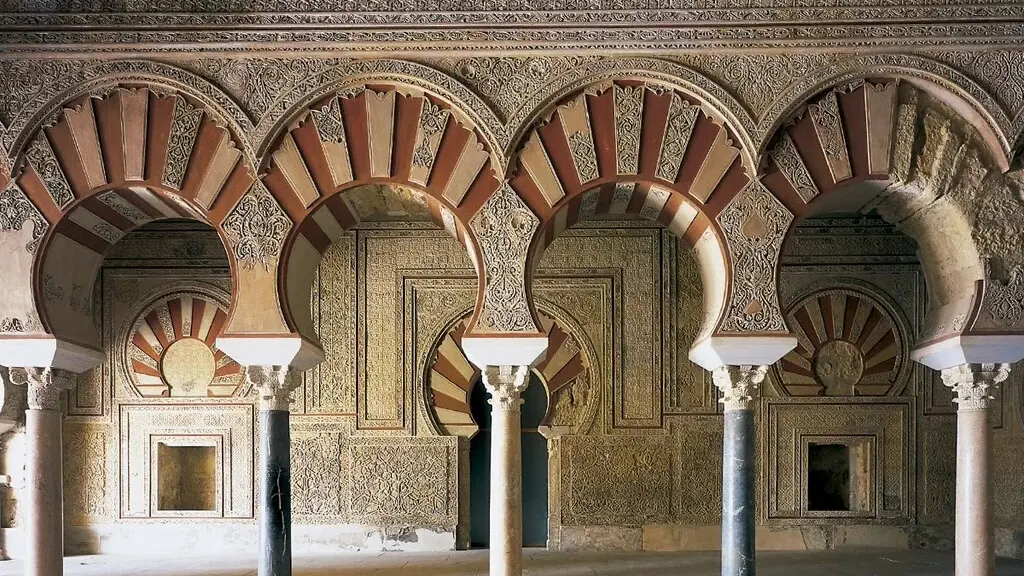
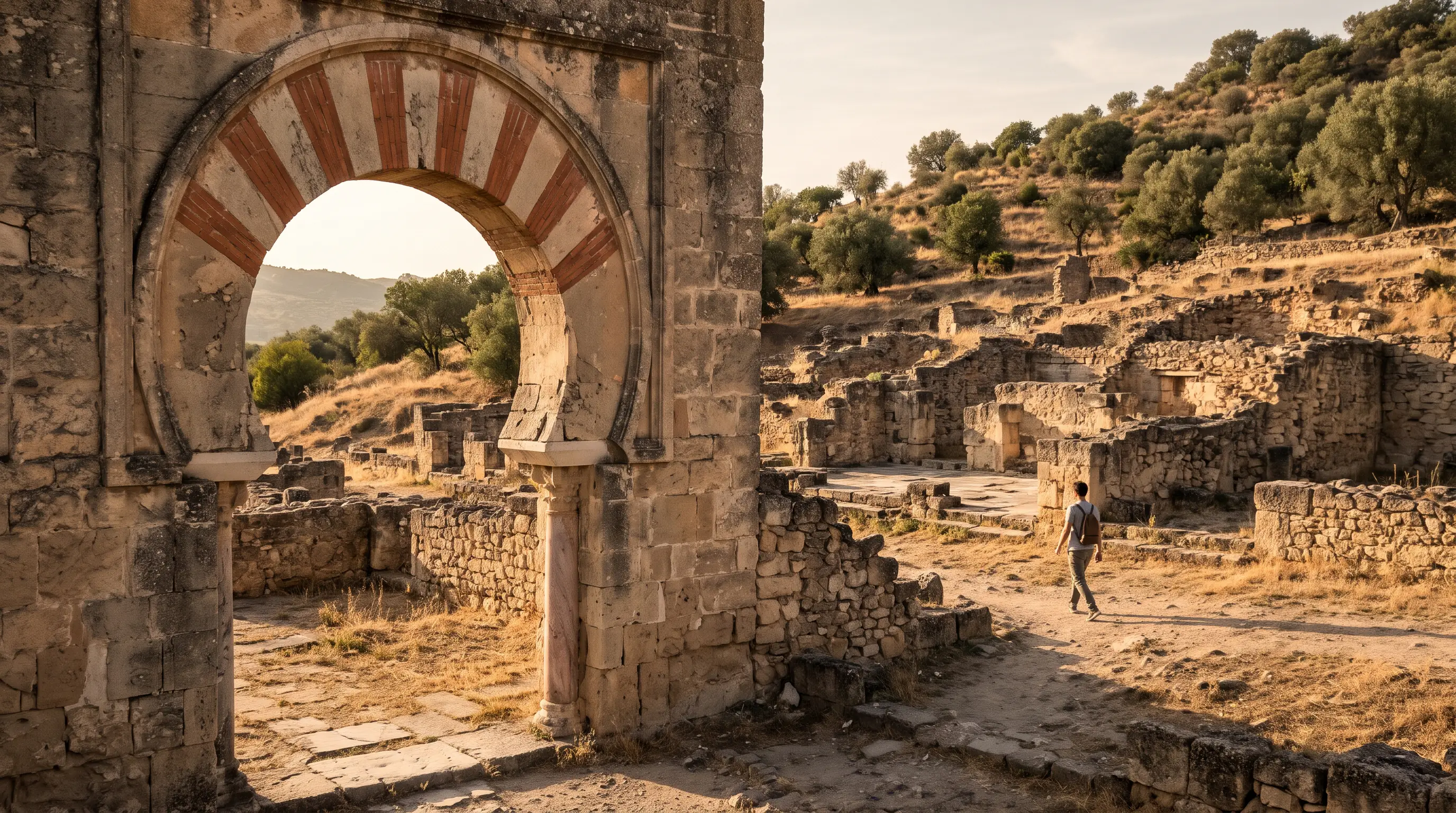
Ruins of Medina Azahara with arches and columns of the Salon Rico

Explore nearby · Monument

Medina Azahara

Medina Azahara is Córdoba's UNESCO listed Caliphate City: a 10th century palace 8 km from town, with the Salón Rico and award-winning museum. Plan your visit.

Forty days of infusions, and the legend that grew

The cure itself was a diet. In Dozy's account Hasdai kept Sancho to infusions alone for forty days[3], while a Christian chronicle line puts it differently: because he was too fat, the Agarenes, its word for Muslims, gave him a herb and took the fat from his belly[30].
How well it worked is thinly recorded. Once in Córdoba, the caliph is said to have entrusted him to Hasdai, who after some months had him slim enough to lead the army the caliph put at his disposal[31]; a more cautious version allows only that he came back, if not thin, then able to ride again, with Hasdai getting the credit in some tellings[32].

Later retellings fill the gap with striking detail:

  • A peak weight of about 240 kg, "supposedly", with seven meals a day[4]
  • Hasdai ordering the king's mouth sewn shut, with a small opening left for a straw[33]
  • A fall to 120 kg after forty days on that regimen[34]
Treat all three as later tradition, not record. A chronicle line about a herb is a long way from a mouth sewn shut, and the regimen Dozy describes is a restricted diet, not an operation. The numbers also sit badly together: a king who started near 240 kg[4] and reached 120 kg in forty days[34] would have lost about three kilos a day, a rate hard to square with a diet of infusions.

Back on the throne, and the bill that never came
Sancho went back to León with a caliphal army behind him. The date depends on who is counting: early 959, when he displaced his cousin Ordoño[35], or the second half of 960, after a Muslim and Pamplonese army had taken Zamora[36]. The gap is not trivial: it separates a campaign that followed the cure within months from one that took the best part of two years.
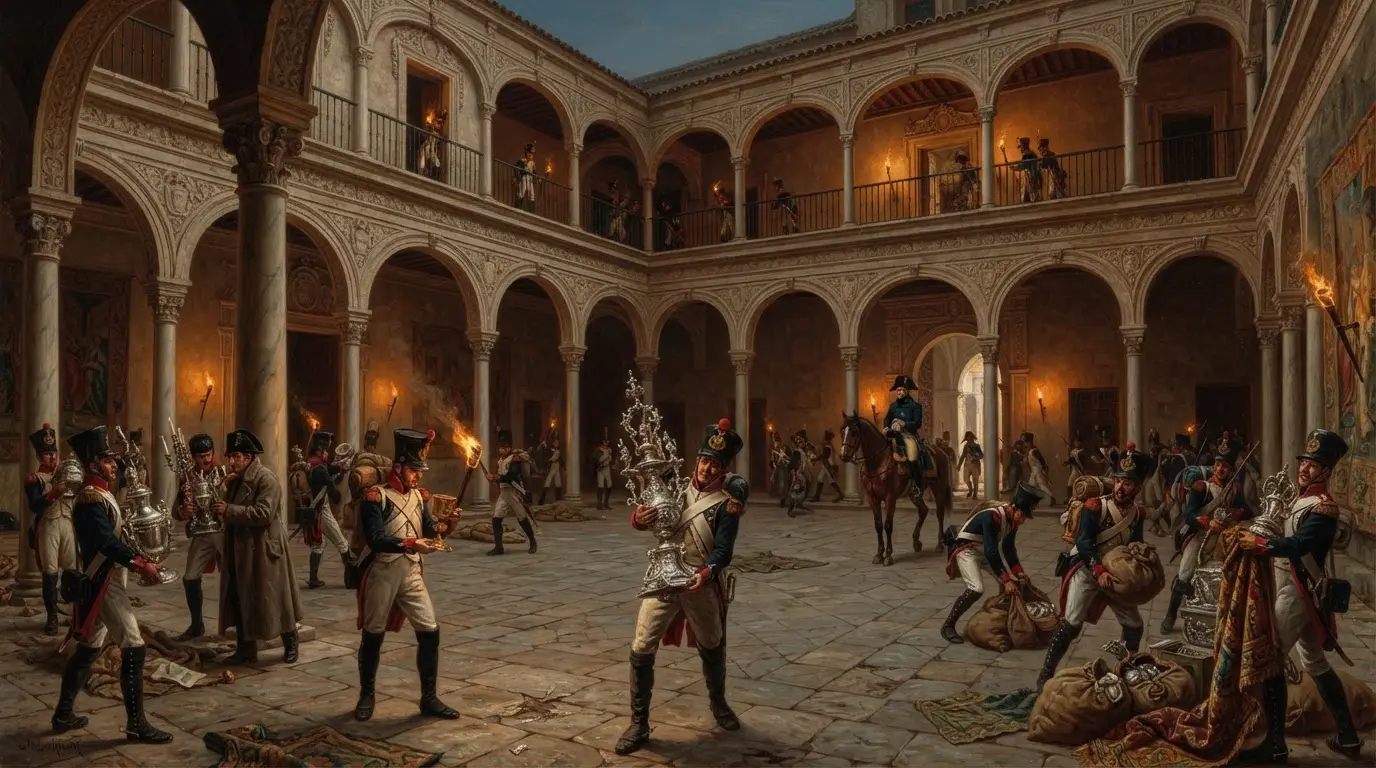
Illustration of the 1808 sack of Córdoba: French Napoleonic infantry looting a Baroque Andalusian palace courtyard at dusk, soldiers carrying silver vessels and church ornaments through an arcaded gallery, dramatic warm torchlight, oil-painting style

Deep dive · Article

1808: The Sack of Córdoba That Broke a French Army at Bailén

In June 1808, French troops sacked Córdoba's churches and palaces on a flimsy pretext — and dragged the plunder into the disaster at Bailén weeks later.

The chronicler Sampiro compressed the whole affair into a few words: Ordoño lost the kingdom, Sancho received it[37]. Whether or not the diet worked, the visit paid off in contacts, and the Cordoban leadership became the lever that put him back on the throne[38].
The bill was another matter. When Abd al-Rahman III died in 961, Sancho took the death as an excuse not to keep his side of the agreement[39].

Medina Azahara today

Medina Azahara is where the caliph is said to have received Sancho, and the court that received him had been sitting there for thirteen years[26]. Walk the site with that date in mind: the king in this story arrived at a seat of government that was still new.

Practical details, which change by season:

  • Winter hours: Tuesday to Saturday 09:00 to 18:00, Sunday and holidays 09:00 to 15:00[42]
  • Admission: free for accredited EU citizens, €1.50 for other visitors[43]
  • Tickets and transport: the Medina Azahara tickets and transport guide has the booking details

Recommended tours

Tours are selected for quality, not commission. We earn a small fee if you book — at no extra cost to you.
Among the visitors that court received, Sancho is the one whose business was his own body: a deposed king who needed a physician before he could use an army. The dates to carry through the ruins are 945 for the court's move[26], 958 for the embassy and 961 for the caliph's death[39].

Frequently asked questions

How did Sancho the Fat lose weight?

The best-attested account has Hasdai ibn Shaprut keeping Sancho to infusions alone for forty days[3], and a Christian chronicle line speaks of a herb that took the fat from his belly[30]. The sewn lips and the 120 kg finish belong to later retellings[33][34].

How fat was Sancho the Fat?

Fat enough that he could not ride a horse[5], and fat enough that his deposition is usually blamed on it[10]. No contemporary measurement is known, so every precise figure is a later estimate.

How much did Sancho the Fat weigh?

No medieval source gives a weight. Modern retellings put his peak at 21 arrobas, a little over 240 kg[44], and say he was down to 120 kg after forty days[34]; treat both as tradition rather than record.

Who deposed Sancho the Fat, and when?

The Leonese nobility replaced him with Ordoño IV, chosen at the urging of Count Fernán González[7]. Ordoño entered León on 1 August 958[1], and the fall itself is dated to 957 or 958 depending on the telling.

Why did Sancho the Fat go to Córdoba?

His grandmother Toda of Pamplona engineered the 958 trip[15], Hasdai having been sent first to treat him[16]. The price was ten fortresses, promised once Sancho was back on his throne[2].

Where was Sancho the Fat received in Córdoba?

The caliph is said to have received him at the palace of Madinat al-Zahra[25], the caliph's seat since 945[26]. The site is now Medina Azahara and can be visited.

How did Sancho the Fat die?

In December 966, poisoned by the Portuguese magnate Gonzalo Menéndez[40]. Sampiro's chronicle says the poison came in an apple at the monastery of Castrelo de Miño[41].

Sources

44 references Show
  1. revistas.unileon.es (opens in a new tab)

    “el cual hizo su entrada en la capital del reino el 1 de agosto de 958”

  2. revistas.unileon.es (opens in a new tab)

    “Le dijo que... el califa... exigía la cesión de diez fortalezas, y Sancho prometió entregárselas en cuanto estuviera restablecido en el trono.”

  3. Wikipedia — Sancho I of León (opens in a new tab)

    “by not allowing him to take more than infusions for forty days.”

  4. hekint.org (opens in a new tab)

    “Supposedly he weighed up to 240 kilograms and ate seven meals a day, chiefly composed of rich meat dishes.”

  5. neh.gov (opens in a new tab)

    “Toda had both personal and political interest in finding a cure for her heir’s obesity, which, among other things, prevented him from riding a horse”

  6. historia-hispanica.rah.es — 33849 ordono iv (opens in a new tab)

    “Desprovisto de apoyos eclesiales y con el abandono del conde Fernán González, Sancho I es derrocado y sustituído en el trono por Ordoño IV”

  7. uv.es (opens in a new tab)

    “En 958 la nobleza leonesa derrocó a Sancho I el Craso y, a instancias del conde Fernán González, eligió como rey a su yerno”

  8. historia-hispanica.rah.es — 33849 ordono iv (opens in a new tab)

    “El príncipe Ordoño nació del matrimonio de Alfonso IV, apodado el Monje, rey de León, y su esposa Ónega de Navarra.”

  9. Wikipedia — Ordoño IV of León (opens in a new tab)

    “and nephew of Ramiro II of León and of García Sánchez I of Pamplona.”

  10. Wikipedia — Sancho I of León (opens in a new tab)

    “he was deposed by the nobles led by Fernán González of Castile because of his extreme obesity”

  11. historia-hispanica.rah.es — 41186 sancho i (opens in a new tab)

    “Sancho I, hijo de Ramiro II y de su segunda esposa la infanta navarra Urraca Sánchez, nació hacia el 933.”

  12. historia-hispanica.rah.es — 33848 ordono iii (opens in a new tab)

    “Ordoño III nació de la unión del leonés Ramiro II y la dama gallega Adosinda Gutiérrez”

  13. uv.es (opens in a new tab)

    “El rey Ordoño III de León era hijo de la primera esposa de Ramiro II, y tenía un hermanastro conocido como Sancho el Craso”

  14. historia-hispanica.rah.es — 41186 sancho i (opens in a new tab)

    “Fallece en Zamora de muerte natural el rey Ordoño III de León. Le sucede su hermano Sancho I”

  15. neh.gov (opens in a new tab)

    “Sancho’s journey to the great metropolis of Cordoba took place in 958—during the reign of Abd al-Rahman III—and was engineered by one of Pamplona’s most formidable figures: his grandmother, Toda”

  16. encyclopedia.com (opens in a new tab)

    “He was at first sent there in order to cure Sancho”

  17. revistas.unileon.es (opens in a new tab)

    “en cuanto hubo llegado a Pamplona, el judío se ganó la confianza de Sancho, encargándose de medicinarle y prometiéndole una pronta curación”

  18. uv.es (opens in a new tab)

    “la enérgica reina Toda de Navarra marchó a Córdoba con su hijo el rey García II Sánchez”

  19. revistas.unileon.es (opens in a new tab)

    “tanto su anciana hermana vascona, como su hijo el rey García Sánchez de Pamplona, y su nieto, el desterrado Sancho Ramírez leonés, viajaran a Córdoba”

  20. revistas.unileon.es (opens in a new tab)

    “(Lo mismo) con... García, hijo de Sancho... para sostenerlo en su reinado, defendiéndolo de sus enemigos”

  21. revistas.unileon.es (opens in a new tab)

    “una vez trazado su plan con los generales cordobeses, con su tío García de Pamplona y con sus propios partidarios leoneses”

  22. revistas.unileon.es (opens in a new tab)

    “el rey Craso no hubo de mostrarse muy activo en el cumplimiento de todas las cláusulas pactadas con el califa en 958 a través de Hasday”

  23. uv.es (opens in a new tab)

    “Rápidamente, Sancho I se avino a cumplir el acuerdo, con lo que Ordoño IV perdió todos los apoyos”

  24. revistas.unileon.es (opens in a new tab)

    “con García y con el desdichado Sancho, cuya salud no estaba aún bastante mejorada y marchaba apoyándose en Hasdai”

  25. uv.es (opens in a new tab)

    “El califa los recibió solemnemente en el palacio de Madinat al-Zahra”

  26. Junta de Andalucía (opens in a new tab)

    “En el año 941 se inaugura la mezquita aljama, mientras que el traslado del califa y los distintos órganos del Estado se produjo en el 945.”

  27. revistas.unileon.es (opens in a new tab)

    “fue a entrevistar a an-Nasir... prosternándose ante él para pedirle el otorgamiento de la paz en favor de ella y de ... el rey Sancho hijo de Ramiro”

  28. encyclopedia.com (opens in a new tab)

    “The appearance of the two Christian rulers in Muslim Cordoba was widely hailed, and justly considered as an important diplomatic achievement.”

  29. revistas.unileon.es (opens in a new tab)

    “A un señor, caballero y rey, / lo trajo como un peón, / bastón en mano, / a un pueblo enemigo suyo”

  30. revistas.unileon.es (opens in a new tab)

    “ciertamente, como estuviese demasiado gordo, los mismos agarenos le dieron una yerba y quitaron de su vientre la gordura”

  31. uv.es (opens in a new tab)

    “Abd al-Rahmán III encomendó el enfermo a Hasday ibn Saprut, que al cabo de unos meses lo dejó lo suficientemente delgado como para que encabezara el ejército que el califa puso a su disposición.”

  32. neh.gov (opens in a new tab)

    “Sancho was apparently transformed, rendered if not thin at least more able-bodied, and able to ride again, and in some accounts this was thanks to Hasdai ibn Shaprut”

  33. elsevier.es (opens in a new tab)

    “To prevent food intake, Hasday ordered that Sancho’s mouth be sewn up, with only a small opening being left so that with the aid of a straw he could sip liquids”

  34. elsevier.es (opens in a new tab)

    “After 40 long days on this strict and noxious diet, Sancho’s weight had been reduced to 120 kg”

  35. revistas.unileon.es (opens in a new tab)

    “consiguió entrar en León a comienzos de 959 y desplazar a su primo Ordoño”

  36. Wikipedia — Sancho I of León (opens in a new tab)

    “a Muslim-Pamplonian army took Zamora in the spring of 959 and León in the second half of 960 and restored Sancho I as king.”

  37. revistas.unileon.es (opens in a new tab)

    “Él lo perdió, Sancho lo recibió. Entrando en León, sometió todo el reino de sus padres”

  38. neh.gov (opens in a new tab)

    “Sancho came away with useful political ties to the Cordoban leadership, and they helped restore him to the throne”

  39. uv.es (opens in a new tab)

    “Sin embargo, la muerte de Abd al-Rahmán III sirvió de excusa al rey para incumplir su parte del acuerdo.”

  40. historia-hispanica.rah.es — 41186 sancho i (opens in a new tab)

    “Muere Sancho I como consecuencia del envenenamiento de que es objeto por parte del dux portugués Gonzalo Menéndez.”

  41. hekint.org (opens in a new tab)

    “He was poisoned, according to Sampiro’s chronicle, in the Galician monastery of Castrelo de Miño, when the rebel Count Gonzalo Menéndez gave him a poisoned apple.”

  42. Junta de Andalucía (opens in a new tab)

    “Martes a sábado de 09:00 a 18:00. Domingos, festivos y lunes víspera de festivos, de 9:00 a 15:00 horas.”

  43. Junta de Andalucía (opens in a new tab)

    “Ciudadanos de la Unión Europea acreditados: gratuita. Otros países: 1, 50 euros.”

  44. elsevier.es (opens in a new tab)

    “the king’s weight eventually reached 21 arrobas (a Castilian weight unit)”