The Triunfos de San Rafael are the devotional monuments to Archangel Raphael that stand in squares, on towers and beside the river across Córdoba. Many visitors are surprised to find a commemorative statue of the archangel in a small square or on top of a tower. The one to see first is the most elaborate, beside the Puerta del Puente. The oldest is on the Roman Bridge and dates from 1651. No opening hours or admission fee are published for them, so this is a walk, not a visit.
What a triumph is
A triumph is a column or pillar raised on a pedestal and crowned with the archangel, who carries his attributes, the fish and the gourd. Spanish Wikipedia calls the type typically Cordoban and traces it to the 17th century. It places the origin in Baroque art itself, with its promotion of devotion through images.
The city's own tourism office gives the civic reason. In years of great suffering or plagues, the people of Córdoba showed their veneration of their Guardian Angel by building these statues all over the city. The story that Raphael appeared in a dream to Father Andrés de las Roelas and promised to save Córdoba from the epidemic is tradition, not documented fact. Nearly every neighbourhood has one.
Frame the grotto, the tower and the column together
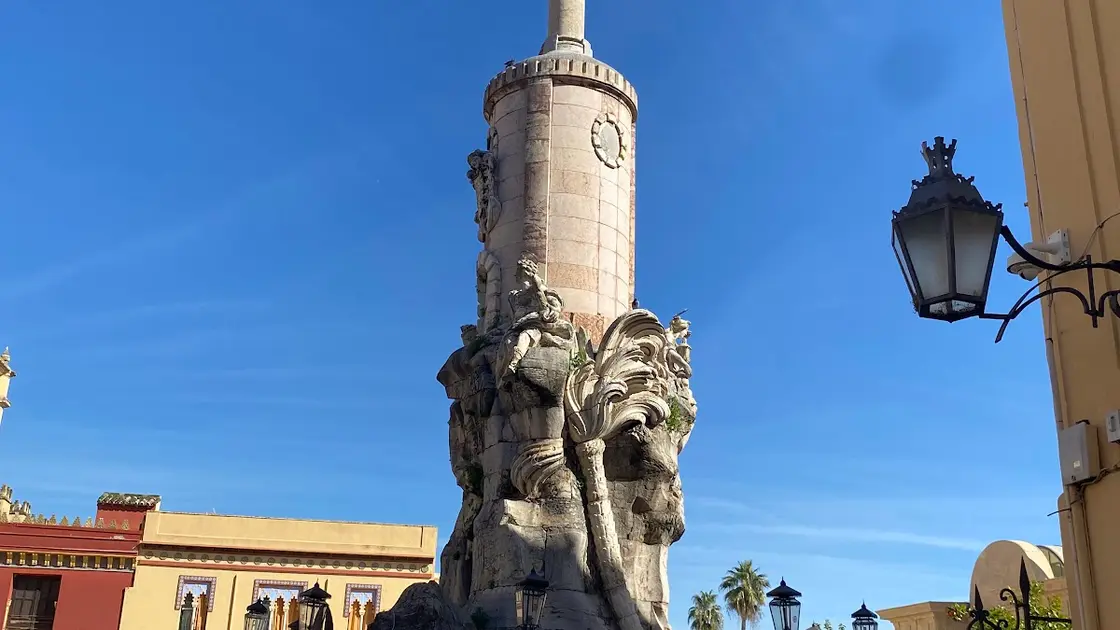
At the Puerta del Puente the statue crowns a column on a tower that rises from a grotto. Step back far enough to take in all three levels, with the Roman Bridge and the Mezquita-Catedral nearby.
Which triumphs to look for
There is no official count to quote, and the sources list different sites. These are the ones the sources date or place:
- Roman Bridge, 1651: the oldest, by the sculptor Bernabé Gómez del Río, set into a parapet of the Roman Bridge.
- Puerta del Puente: the grandest, beside the gate described on its own page, Puerta del Puente.
- Plaza de la Compañía, 1736: built with alms donated by the parishioners.
- Conde de Guadalhorce Roundabout, 1743: next to the former train station, originally set in front of the Alcázar de los Reyes Cristianos.
- Calle Sebastián Cuevas, 2014: a modern one, unveiled on 17 December 2014 and made by teachers and students of the Mateo Inurria School of Arts and Crafts.
- Further squares: Plaza de San Hipólito, Puerta Nueva, Plaza de San Basilio and Plaza del Potro.
The Plaza del Potro example is a short walk from the river, so it fits the same loop as the Plaza del Potro itself.
The Puerta del Puente triumph
This is the one the guidebooks mean. Andalucia.org gives the sculptor as Michel de Verdiguier, dates it to 1781 and calls it the most impressive and magnificent in Córdoba. Spanish Wikipedia lists the same work as 1765-1781 by Miguel Verdiguier, so treat the exact year with care. The statue crowns a column on a tower that rises from a grotto, symbolising three worlds: the underworld, the earth and heaven.
It stands in a privileged spot beside the Roman Bridge, the Guadalquivir and the Mezquita-Catedral, so it combines easily with the Mezquita-Catedral. The gate behind it has its own story, told in Puerta del Puente Córdoba: The Gate and What It Replaced.