
The soldier the crucifix supposedly saved
Local tradition tells a specific story about the Cristo de los Faroles, and it has nothing to do with the friar who commissioned it or the sculptor who carved it. According to popular legend, a royal soldier was ambushed one night near the Plaza de los Capuchinos and left for dead in the street. He woke disoriented in front of the crucifix, the story goes, and found himself alive with no memory of how he had survived the attack.
From that night on, according to the tale, the soldier returned to the same spot at the same hour: midnight, every night, without explanation. Neighbours grew used to seeing him there, a solitary figure standing before the wooden Christ in the dark. He never spoke of what had happened to him, and no one asked. This went on, the legend says, for years.
Then, one night, the soldier finally broke his silence. He told the small crowd that had gathered around him the story of the ambush, the crucifix, and the survival he could not explain. And then, according to every version of the tale that ends this way, he walked away into the darkness of the Plaza de los Capuchinos and was never seen in Córdoba again.
It is a good story precisely because it resists verification. No parish register records a soldier's nightly vigil. No 18th-century chronicle mentions a midnight confession outside the Cristo de los Faroles. What survives is the shape of the tale (miracle, ritual, disappearance), passed down as oral tradition rather than documented fact. Córdoba has other night-time legends attached to its lantern-lit corners, but few are told with this much specific detail: the exact hour, the exact number of years, the exact ending. That specificity is part of what has kept the story alive through two centuries of retelling.
Even the legend has more than one ending
The soldier's midnight vigil is the version most often repeated in Córdoba, but it is not the only one. At least two other legends circulate around the same crucifix, and neither agrees with the ambush story.
One variant, recorded on local folklore sites, follows a soldier returning from war who stops to help a freezing beggar on the road before encountering a miraculous crucifix, a different kind of test with the same crucifix at the centre. Another names a heartbroken tailor called Juan Navarro who is said to walk the streets nightly carrying a lantern and an image of Christ.
That last detail is worth pausing on. The real sculptor of the Cristo de los Faroles was named Juan Navarro León, a documented historical figure who has nothing to do with any legendary tailor[1]. It is a good example of how oral tradition absorbs real names into invented narratives: a craftsman's signature becomes, two centuries later, the name of a fictional character in someone else's ghost story.
None of these variants can be traced to a single origin. They read less like competing eyewitness accounts and more like a living folklore tradition: a story a city keeps retelling, adjusting the details each time, because the crucifix itself and the atmosphere of the square invite exactly this kind of story.
The friar, the sculptor, and the year 1794
Strip away the legend and the documented history is almost austere by comparison. The crucifix now known as the Cristo de los Faroles, officially the Cristo de los Desagravios y Misericordias, was carved in 1794 by Juan Navarro León[1]. It was commissioned by Fray Diego José de Cádiz, a Capuchin friar attached to the nearby monastery, as a public devotional image rather than a private commission for a wealthy patron[2].
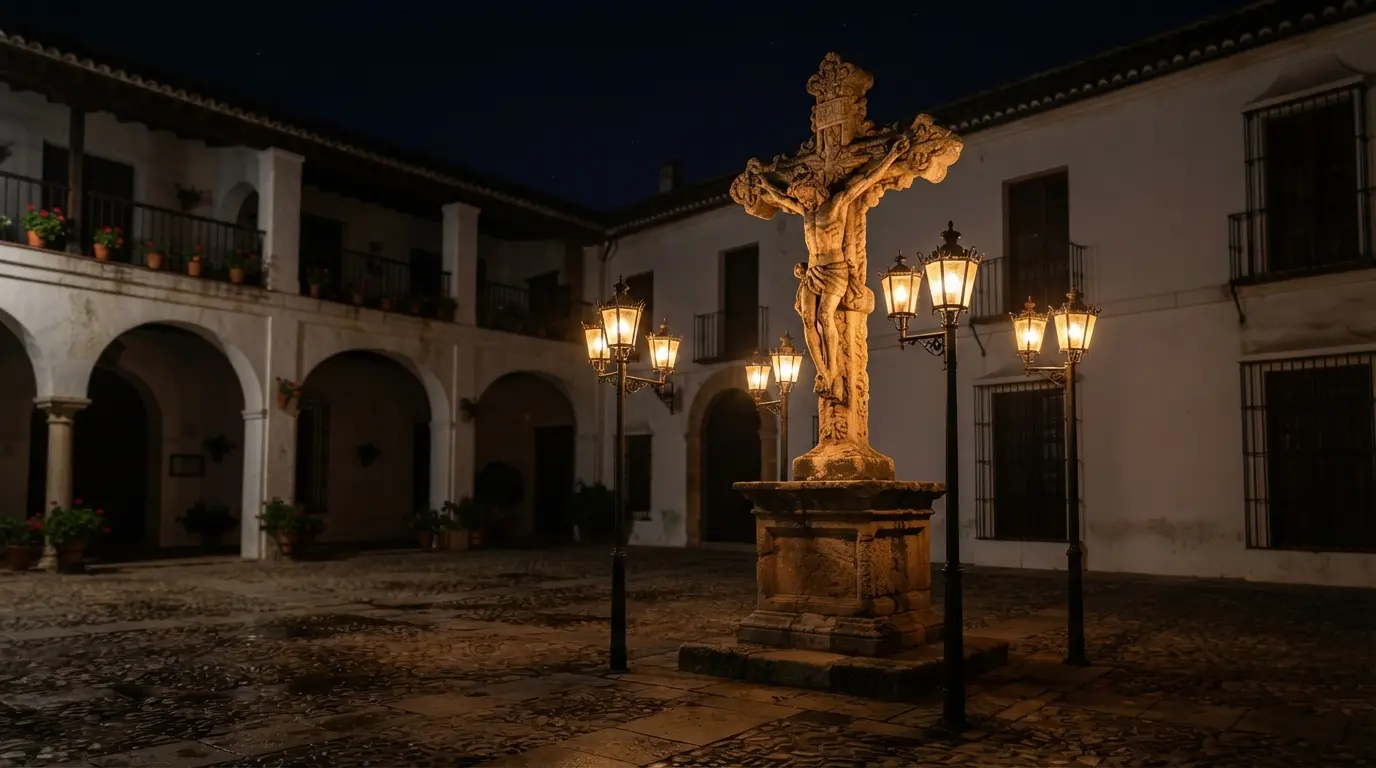
That distinction matters. Devotional crosses of this kind were meant to be seen by whoever passed through the square, at any hour, without needing to enter a church or pay for access. The Cristo de los Faroles still stands exactly where it was placed, on Plaza de los Capuchinos, in front of plain white facades left deliberately unornamented so nothing competed with the figure itself.
Fray Diego José de Cádiz was, by most accounts, a significant itinerant preacher in his own right, the kind of Capuchin friar whose missions drew crowds across Andalusia through the 1780s and 1790s. Outdoor crucifixes like this one served a broader Capuchin strategy: public catechesis conducted in squares and street corners rather than confined to a chapel interior, aimed at reaching people who might never set foot inside a formal church. That he chose this particular square for a permanent devotional monument says something about how central street-corner Christianity was to Córdoba's religious life at the time, independent of any later legend about soldiers or midnight vigils.
Explore nearby · Monument
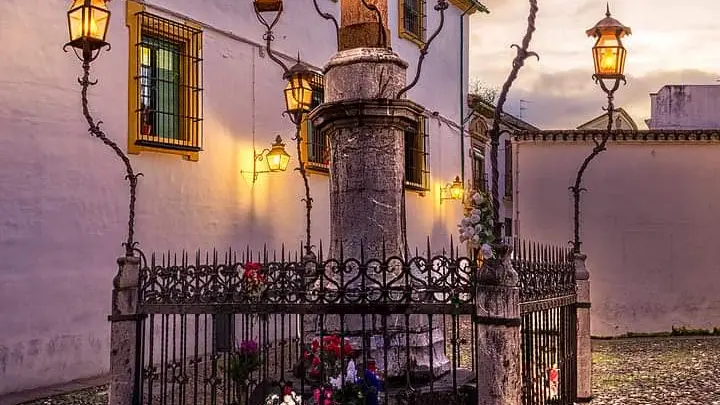
Cristo de los Faroles
1794 Christ sculpture on Plaza de Capuchinos, encircled by eight wrought-iron lanterns. Most affecting at dusk when they are lit. Free, open 24 hours.
None of this explains why the legend attached itself specifically to this crucifix and not to any of Córdoba's other outdoor devotional images, several of which are just as old. The likeliest answer has nothing to do with theology: Plaza de los Capuchinos is small, enclosed, and dark once the lanterns are the only light source, exactly the kind of setting where a solitary figure at midnight becomes a story worth repeating. The friar built a place for prayer. The atmosphere he built it in did the rest.
Eight lanterns, an indulgence, and a neighbourhood's devotion
The crucifix is ringed by eight wrought-iron lanterns mounted on iron stands, which give the monument both its nickname and its nighttime silhouette[3]. Local guides often repeat that the eight lanterns represent the eight provinces of Andalusia, a tidy piece of symbolism that shows up in almost every tourist description of the square. No documented source confirms that reading; it survives as popular interpretation rather than an established fact, alongside the lanterns themselves, which are real and countable regardless of what they are said to symbolise.
What is documented is the crucifix's continuing role as an active site of devotion, not just a photogenic monument. An inscription carved directly into the stone base, not a modern plaque, grants an indulgence to anyone who prays a Creed devoutly in front of the image[4], a detail that only makes sense if the crucifix has functioned, since the 18th century, as a working object of neighbourhood worship rather than a static piece of street furniture. During Holy Week, the square becomes one of the emotionally charged stops on the Madrugada processions, when candlelit brotherhoods pass through in the small hours of Good Friday.
The San Lorenzo neighbourhood around the plaza sees a fraction of the visitors that the Mezquita or the Judería attract, which is part of why the legend has had room to survive here relatively undisturbed. There is no ticket booth competing with the ghost story, no audio guide offering an official version. The quiet of the square outside festival dates is exactly the kind of atmosphere in which a story about midnight visitations keeps its power.
From oral tradition to the silver screen
By the mid-20th century, the legend of the Cristo de los Faroles had become well-known enough to reach Spanish cinema. El Cristo de los Faroles, released in 1958, took the crucifix and its square as the backdrop for a musical drama directed by Gonzalo Delgrás[5], built around a copla singer trying to win over a woman named Soledad. The film did not need to invent atmosphere; it simply pointed a camera at a plaza that already had a reputation. Its soundtrack, built around Antonio Molina's copla numbers, likely did more to spread the crucifix's name nationally than any devotional pamphlet could have: audiences who had never set foot in Córdoba learned the plaza's name from a cinema screen.
Coplas referencing the Cristo de los Faroles circulated well before and after the film, part of the same oral culture that carried the soldier's legend from one generation to the next. No specific ballad text has survived clearly enough to quote here, but the general association between this crucifix and Andalusian folk song is well established in how Córdoba talks about the square.
The monument itself has kept changing quietly in the background of all this storytelling. In 1984, the original lanterns were swapped for darker replacements[6], a practical maintenance decision with no legend attached to it at all and itself a useful reminder that not everything about the Cristo de los Faroles needs a story. Sometimes a lantern is just a lantern that wore out.
Deep dive · Article
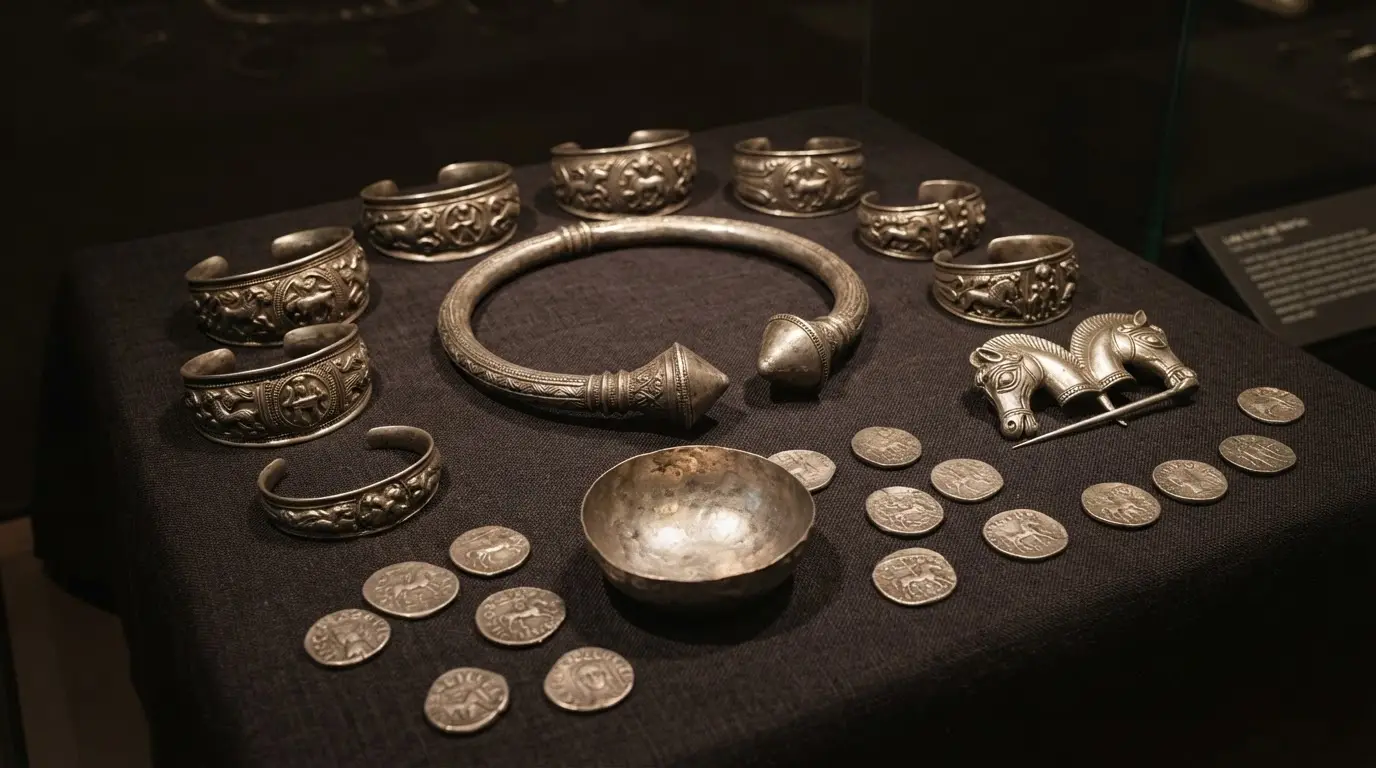
An Andalusian Treasure Has Sat in the British Museum Since 1932
A silver hoard dug up in Córdoba in 1915 left Spain against the law and has been in the British Museum since 1932. Here is how, and what a 2026 study found.
Visit today and you get both layers at once: a working devotional crucifix with a documented 18th-century date, and a ghost story that has outlived everyone who might once have verified it.
Recommended tours
Tours are selected for quality, not commission. We earn a small fee if you book — at no extra cost to you.