
A feast born in Liège, weaponised in Córdoba
The Corpus Christi feast originated in the visions of Juliana of Liège (1191–1258), an Augustinian canoness who reported receiving instructions from Christ to establish a Eucharistic solemnity separate from Maundy Thursday.[1] Her confessor relayed the proposal to the bishop of Liège, who ordered the feast observed in his diocese from 1246. When one of the Liège canons, Jacques Pantaléon, became Pope Urban IV in 1261, he extended the feast to the entire Latin Church by the bull Transiturus de hoc mundo on 11 August 1264.[2]
The feast's chief intellectual advocate was Thomas Aquinas, who composed the office for Corpus Christi during his residency at Orvieto (1259–1265), including the hymns Pange Lingua, Lauda Sion, and Tantum Ergo, texts that still accompany the Córdoba procession today.[1] The first formal Corpus Christi procession was instituted by Pope John XXII in 1316, and the feast spread rapidly through the Iberian kingdoms during the 14th and early 15th centuries.
By the early 1500s, the feast had acquired a political dimension in Spain. The Catholic Monarchs and their successors funded increasingly elaborate processional monstrances, recognising that a public display of the consecrated host — the literal body of Christ carried through the streets under a canopy — was an assertion of doctrinal orthodoxy against both Islam and, increasingly, the Protestant reformers north of the Pyrenees. Córdoba's bishopric acted on this logic decisively: in 1512, Bishop Martín Fernández de Angulo commissioned a processional custodia of unprecedented scale for the Mezquita-Catedral.[4] He did not live to see it completed, leaving 500 ducats in his will for its finishing.
The Custodia of Arfe: 200 kilos of Gothic silver
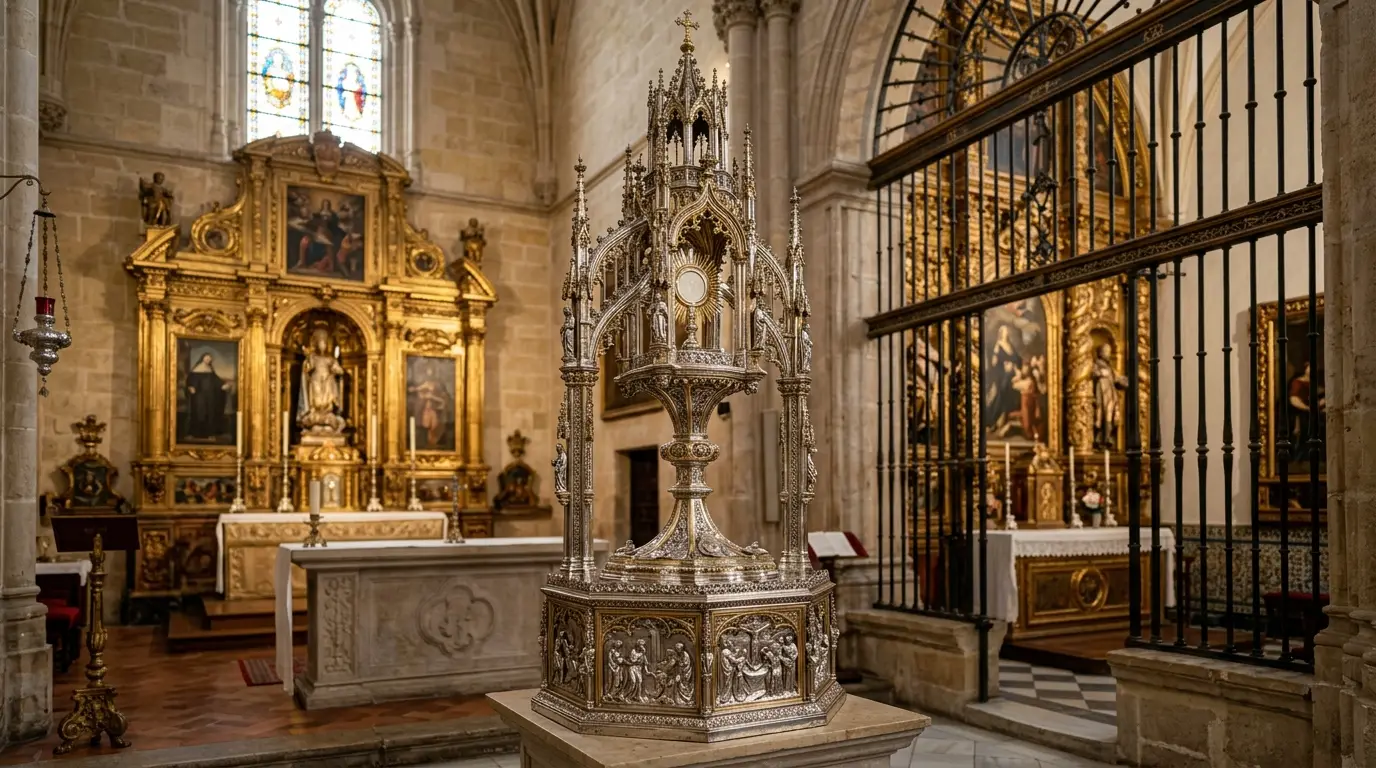
The silver monstrance that defines Córdoba's Corpus Christi was created by Enrique de Arfe (1475–1545), a German-born silversmith from Erkelenz, near the modern Dutch-German border, who had settled in León around 1500.[3] Arfe (whose surname may derive from the German Arff or Arfft) was already the leading custodia-maker in Castile, having completed one for León Cathedral and begun another for Toledo.
The Córdoba commission began in 1514 and took four years. Arfe worked with local silversmiths including Juan Ruiz el Vandalino, training them in the northern Gothic techniques (repoussé, chasing, and lost-wax casting) that characterised his work.[4] The finished piece stood 2.63 metres tall and weighed more than 200 kilograms, making it one of the largest processional monstrances in Spain. Its architectural form (a two-tiered Gothic tower with flying buttresses, pinnacles, and a dodecagonal plan) echoed the contemporary cathedral-building impulse: a miniature church in silver, designed to house the consecrated host.
Explore nearby · Monument
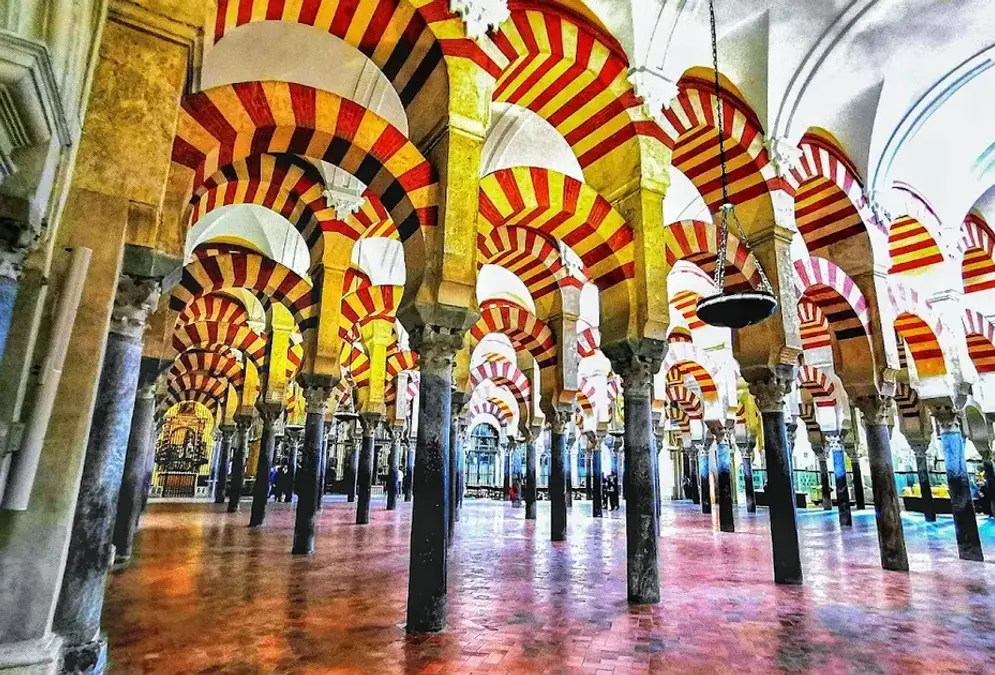
Mezquita-Catedral de Córdoba
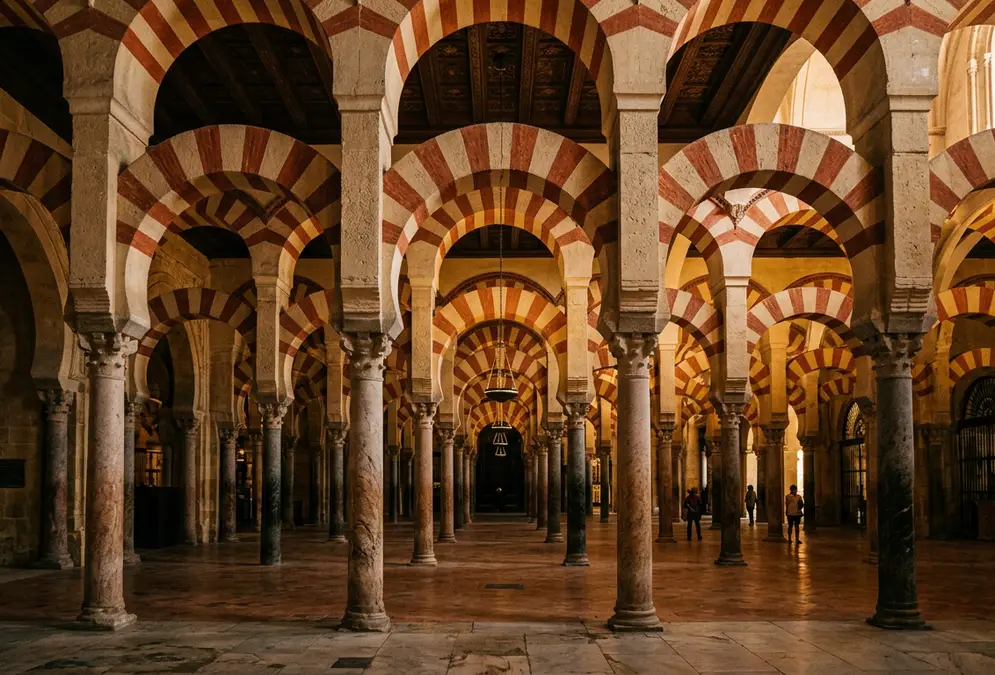
856 columns, 1,300 years of Islamic and Christian history. UNESCO monument in Córdoba, Andalusia. Red-and-white arches, Byzantine mosaics, a Renaissance nave.
The original base contained eighteen scenes from the life of Christ, from the Annunciation to the appearance before Thomas, each panel carved to a height of just 55 millimetres. Above this, the viril (the glass receptacle holding the host) sat within a hexagonal tempietto ringed by scenes of the Adoration of the Magi. The second tier originally held a figure of the Risen Christ; this was replaced in the 18th century with a silver Virgin of the Assumption, made in Milan and donated by the canon Bernardo Blázquez.[6]
The custodia first processed on 3 June 1518, during the episcopate of Cardinal Alonso Manrique. It has done so, with interruptions during the Napoleonic occupation and the Civil War, every Corpus Christi since.
Counter-Reformation theatre: why Córdoba invested in spectacle
It is impossible to understand the scale of Córdoba's Corpus Christi without the Counter-Reformation. When Martin Luther denounced Eucharistic processions as «vain idolatry» and the Council of Trent (1545–1563) responded by reaffirming the doctrine of transubstantiation, the public display of the host became a frontline in the doctrinal war.[1] A Corpus Christi procession was not merely pious; it was a visible refutation of Protestant Eucharistic theology.
The Spanish monarchy recognised this early. Philip II, who reigned from 1556 to 1598, made Corpus Christi the most heavily funded religious festival in the Spanish world, commissioning custodias, underwriting processional decorations, and requiring civic participation by decree. Cities competed: Toledo's custodia used the first gold brought from the Americas. Seville's procession stretched for hours. In this environment, Córdoba's decision to commission Arfe, and later to fund the Baroque additions by Bernabé García de los Reyes (completed 1735), was both devotional and competitive.
The Baroque base García de los Reyes added is instructive. It depicts King David dancing before the Ark of the Covenant, surrounded by children, angels, and musicians, an Old Testament scene explicitly linked to Eucharistic procession in Counter-Reformation typology. The Ark, which carried the tablets of the Law, prefigured the monstrance carrying the body of Christ. The dancing (which had been common in Spanish Corpus processions until banned by the Tridentine reforms) was frozen into silver relief, preserved in the very object that had suppressed it.
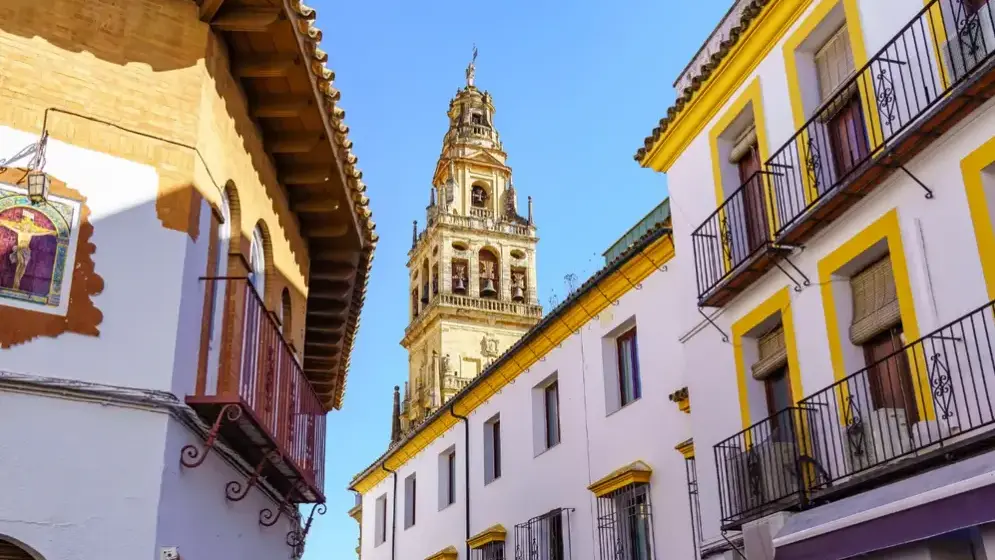
For a city that had been a Muslim capital for five centuries and a Jewish intellectual centre for much of that same period, Corpus Christi carried a particular charge. The Semana Santa processions expressed grief and penance; Corpus Christi expressed theological certainty and institutional power. The host processed through streets that had once heard the call to prayer from the minaret that became the bell tower. The message was doctrinal, but its setting was territorial.
The host processed through streets that had once heard the call to prayer from the minaret that became the bell tower. The message was doctrinal, but its setting was territorial.
Where Corpus Christi sits in Córdoba's spring
Corpus Christi is the most formally ecclesiastical of Córdoba's spring festivals, and understanding where it sits in the sequence clarifies why.[6] The city's spring cycle runs roughly: Semana Santa (March or April), Cruces de Mayo (early May), the Festival de los Patios (mid-May), Corpus Christi (late May or June, 60 days after Easter), and the Feria de Córdoba (late May, often overlapping or immediately following Corpus).
The differences in religious register are instructive. Semana Santa is penitential and confraternal: the cofradías process their pasos in mourning, and the dominant emotion is sorrow. The Cruces de Mayo are folk-Catholic, layering Christian imagery onto spring fertility traditions that predate the Church. The Patios are secular-religious hybrid: private courtyards opened to public judging, abundance expressed through flowers rather than doctrine.
Corpus Christi is none of these things. It is institutional, episcopal, and doctrinal. The bishop presides. The cathedral chapter organises. The host (not a statue, not a relic, not a flower arrangement) is the sole focus. In a city whose religious calendar has absorbed Roman, Islamic, Jewish, and folk traditions, Corpus Christi is the most unapologetically Tridentine event on the calendar. It declined to syncretise. That is its distinctiveness.
The Feria, by contrast, which often falls on the same week, is almost entirely secular, a fairground, a casetas circuit, a social release after a month of religious observance. The juxtaposition, whether intentional or not, enacts the modern Spanish compromise: the Church claims Thursday, the city claims Saturday night.
Corpus Christi today: a city still processing
Corpus Christi keeps its traditional date, the Thursday after Trinity Sunday, even though Spain no longer observes it as a national public holiday; in 2027, that falls on May 27. In Córdoba, the day remains a local holiday, though the crowd that fills the streets is thinner than it was a generation ago.[10]
The procession unchanged in its essentials: the custodia leaves the Mezquita-Catedral, the streets are still strewn with herbs, the bishop still elevates the host at the altars. What has changed is the audience. The kneeling faithful now share pavement space with tourists holding phones. The municipal band plays the same hymns, but fewer people in the crowd know the words. The First Communion children still walk behind the host, but they are fewer than in the 1960s, when entire school classes processed together.
Sociologists of Spanish religion describe this as the shift from religious observance to cultural heritage. Corpus Christi is increasingly framed by the Ayuntamiento and the regional tourism authority as patrimonio, something Córdoba has and displays, rather than as a living obligation. The vocabulary of promotional materials has shifted accordingly: «una tradición centenaria» (a centuries-old tradition) replaces «el misterio de la fe» (the mystery of faith).
Deep dive · Article
Abd al-Rahman III: The Morning Córdoba Became a Caliphate
Abd al-Rahman III was the first Caliph of Córdoba, declared on January 16, 929, ruling a city of up to 500,000 people and building Medina Azahara in 936.
Whether this reframing constitutes preservation or hollowing-out is a live question. The custodia still processes. The arches are still built. The rosemary still smells the same when crushed. But a tradition that was designed to be a doctrinal weapon is now described as a tourist attraction, and it is not obvious that the two functions can coexist indefinitely. The custodians of the tradition (the cathedral chapter, the Ayuntamiento, the diminishing congregations) are not in agreement about what they are keeping alive, or why.