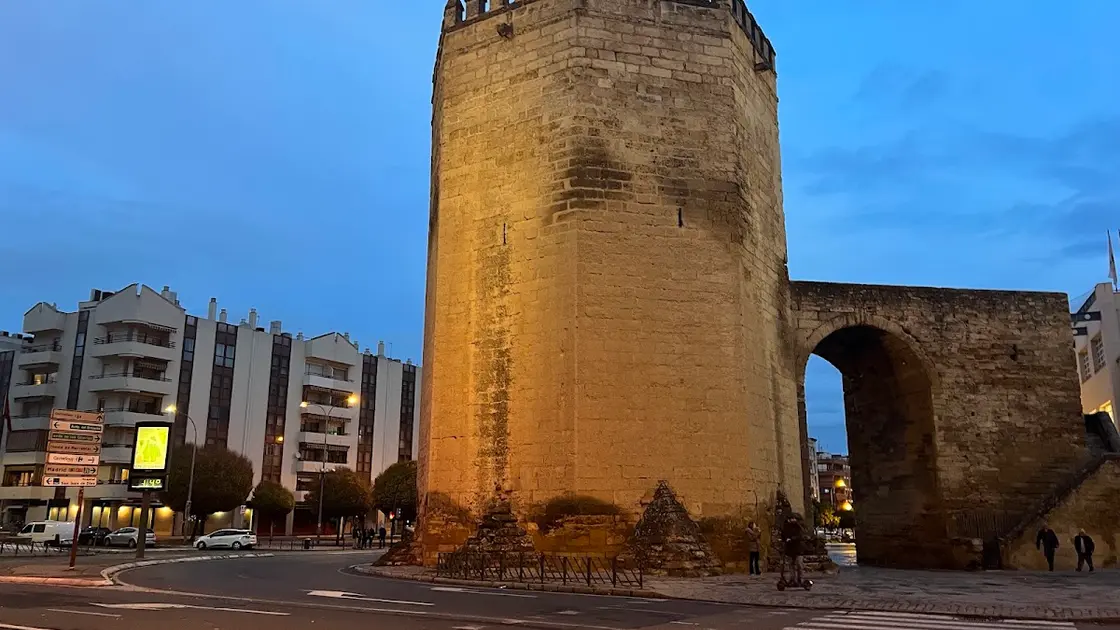

The Torre de la Malmuerta is an octagonal tower standing apart from the Axerquía wall and tied to it by a single surviving arch. It was built between 1406 and 1408 for Henry III of Castile,. You can see all of it from the pavement in a few minutes. What keeps people lingering is the name, which means "Tower of the Wrongly Dead Woman", and the argument over whether the story behind it has any basis.
What the tower is
An albarrana tower is built independently of the wall but forms part of the fortification, and it is usually joined to the wall by a small arch that defenders could destroy if an enemy captured the tower. The Malmuerta follows that pattern. The tower has an octagonal plan, an annexed arch and decorative crenellations along the top. It was raised over a pre-existing Almohad structure to defend the Rincón and Colodro gates.
Up close, the details are the point. The masonry is ashlar, each side of the octagon has a spur at its base, and the loopholes are cut to rest crossbows. Below the crenellations the tower is solid up to the height of the arch and hollow above it, with rooms and a stair to the platform. The arch carries the royal arms and tablets with inscriptions that record the building date.
Who built it, and when
Henry III commissioned the work from Córdoba's first corregidor, Penedro Sánchez. The inscription under the arch gives 1406 as the start and 1408 as the finish, and that is the range used here. Spanish Wikipedia gives 1404 as the start, so you will meet both dates in print. A royal decree held in the Municipal Archive is cited for the claim that the tower was paid for with fines collected from gamblers and gaming dens.
Look under the arch for the royal arms
The arch joining the tower to the wall carries the royal arms and tablets recording the building date. The main inscription is almost worn away, so look closely rather than expecting a clear plaque.
The legend of the wrongly dead woman
According to popular legend, the name comes from a vengeful husband who killed his wife because he believed her unfaithful, when in fact she was innocent. The story is usually tied to the murders of the comendadores of Córdoba in 1448, which Lope de Vega dramatised in 1609.
The dates do not work. The tower was finished some 40 years before the 1448 crimes, and historians treat the link as unfounded. A second, separate legend says that a horseman who could read the whole inscription while riding at a gallop under the arch would bring the tower down and release a treasure. The inscription is now almost worn away, which does nothing to stop people retelling it.