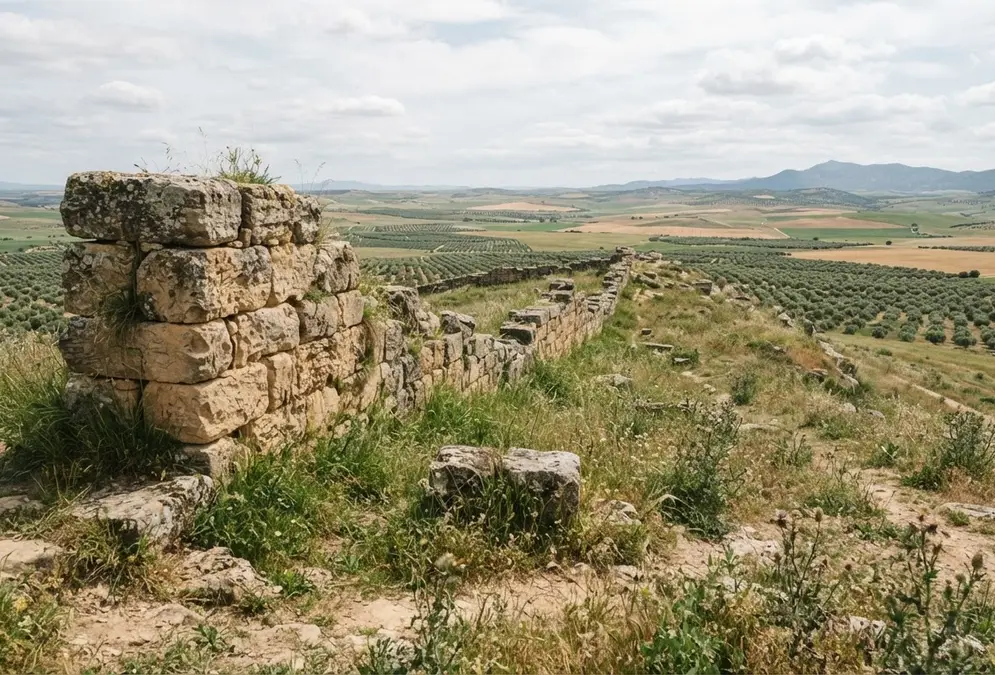

The Ategua oppidum is a Bronze Age cremation necropolis, a Tartessian walled city and a large Iberian town inside a great wall, layered on one site in the low campiña of Córdoba. The Junta de Andalucía counts more than 3,000 years of archaeological stratigraphy here. It is not a polished attraction. Go if you want an Iron Age site with the grass still growing through it, and if you are happy to phone ahead first.
What Ategua is
An oppidum is a fortified town, and Ategua's layers are listed by the Junta in order: a Bronze Age necropolis, a Tartessian walled city, and a large Iberian city ringed by a wall. The IAPH heritage sheet dates the cremation necropolis to the late or final Bronze Age, around the 9th century BCE. It places the formation of the oppidum in the Iron Age, at the end of the 8th or start of the 7th century BCE, with a wall of Phoenician colonial influence.
That wall is why the site matters. Ategua gives you pre-Roman defences in open country, with no cathedral or ring road on top of them; the pre-Roman wall found inside the city itself is told in the discovery of Córdoba's pre-Roman walls.
Why archaeologists call it Iberian-Turdetanian
The IAPH treats Ategua as an example of the Iberian-Turdetanian political and socio-economic structure of the Baetic campiñas. For a sister site of the same period and a very different setting, see Torreparedones.
Contact the enclave before you drive out
The Junta de Andalucía asks visitors to contact the enclave directly for up-to-date information, and no permanent hours are published. Confirm access first rather than arriving at a closed gate.
The siege of 45 BCE
Ategua is also a battlefield. It fell to Caesar after a long siege during the Caesarian campaign in Baetica, and its capture led to the fall of Colonia Patricia Corduba in 45 BCE. That date is the reason the monument's timeline closes at 45 BCE: the Iberian town ends in the same war that decided who would hold the provincial capital.
For the Roman city that followed, the Roman Temple in central Córdoba is a standing remnant.