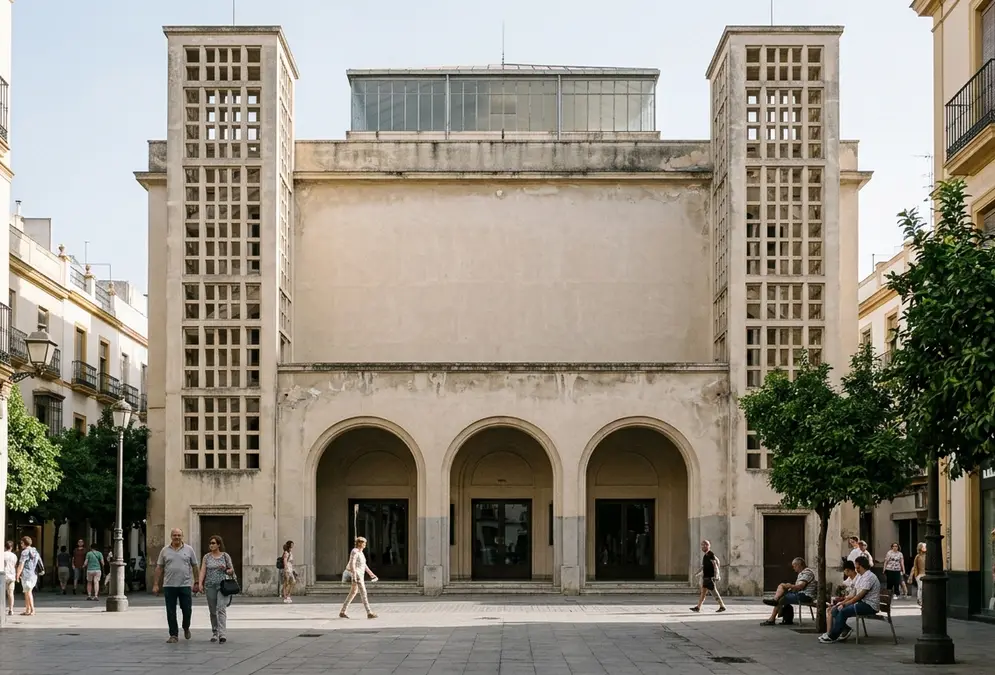

The Teatro Góngora is a cine-teatro built between 1929 and 1932 to designs by the Madrid architect Luis Gutiérrez Soto, one of the few Rationalist buildings in Córdoba. It started life as the Cine Góngora and now works as a municipal theatre close to Plaza de las Tendillas. You come for an evening show or, failing that, for a long look at a 1930s facade that looks more like the Mediterranean than the Mezquita.
What makes the Góngora different
Most of Córdoba's famous buildings are Roman, Islamic or Baroque. The Góngora is a rare Rationalist work, joining a Mediterranean-looking facade of pergolas and round arches to a sober interior. Gutiérrez Soto mixed the Andalusian regionalist language outside with Rationalist and Art Deco forms inside, which is why the front looks warm and the hall looks modern.
Two tall towers decorated with lattices (celosías) flank the facade and hold the staircases to every floor. Between them the entrance opens in three arches on columns. The original structure was reinforced concrete with brick walls, chosen so the building would not burn.
- Architect: Luis Gutiérrez Soto, from Madrid
- Built: 1929 to 1932
- Style: Rationalism with Art Deco interiors and a regionalist facade
- Site: the former Convento de Jesús María
Check the programme before you go
Hours, prices and shows are not fixed, and tickets are sold per performance. Look up the programme on teatrocordoba.es first instead of turning up hoping to see the hall.
A theatre built on a convent
The building stands on the plot of the old convent of Jesús María, on the street that still carries the name, and covers about 950 m². It was marketed as the most modern salón de espectáculos in Spain when it opened.
The interior drawings were historicist, but the finished hall turned to purer Rationalist and Deco forms, a change tied to the architect's trip to Central Europe in those years. On top sat a summer cinema reached by lift or stairs, with rocking chairs instead of the usual folding seats.