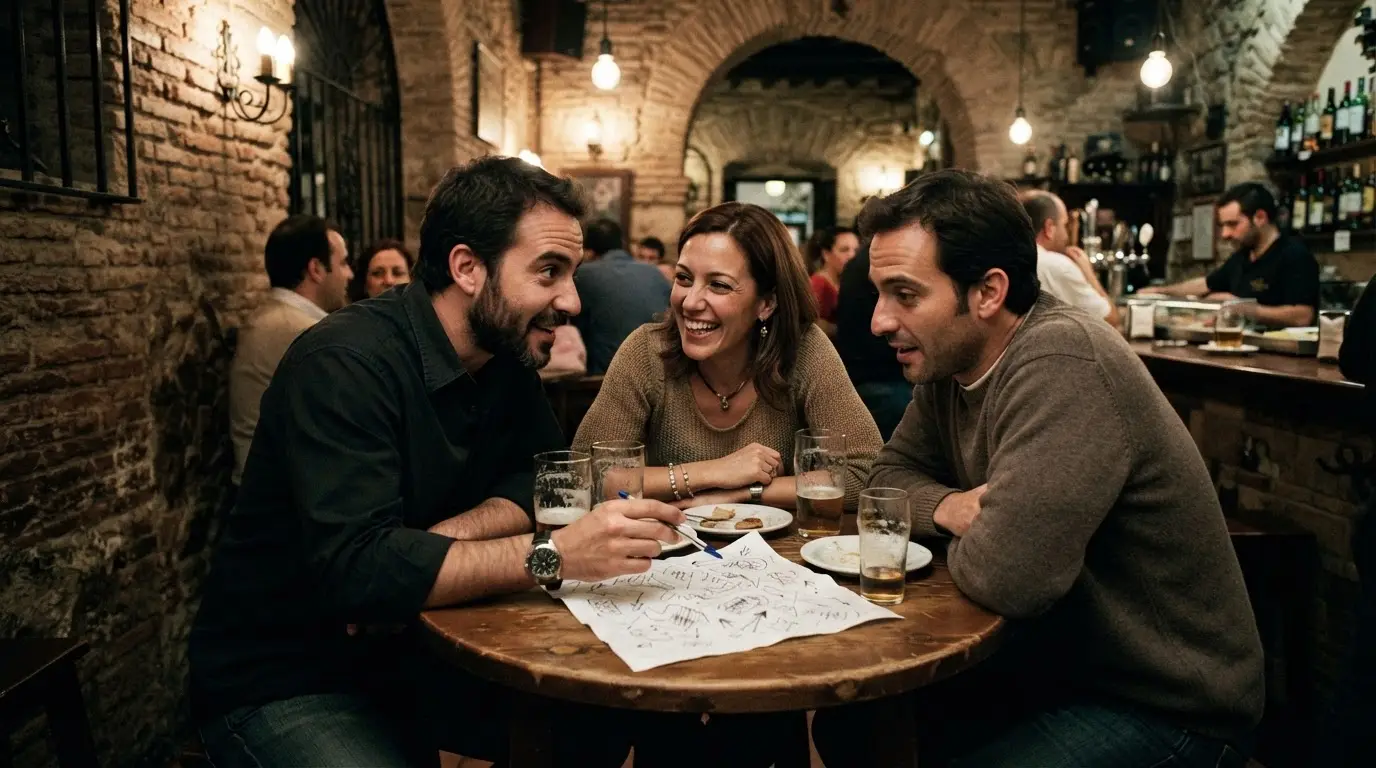

A consolation prize born over drinks
Córdoba spent the early 2000s chasing a title: European Capital of Culture, the EU designation that funnels prestige and funding toward whichever city wins it. The city didn't have a plan for what to do if it lost. Then, one evening in 2004, three friends over drinks came up with an idea anyway. Manolo Pérez, Javier Lucena and Rodolfo Serrano sketched out a poetry festival for Córdoba while the city was still dreaming of the Capital of Culture crown.[4] The bar where it happened, on Calle San Pablo, has since closed.[5]
The three weren't inventing an audience out of nothing. Córdoba, they reasoned, already had the raw material for a poetry festival: strong poets, an attentive public, and informal gatherings that had quietly built a scene for years, including the readings at the old inn on the Plaza del Potro and Pedro Rosso's long-running poetry workshop.[6] The city, already home to its own Baroque poet Luis de Góngora, had the appetite. What it lacked was a stage big enough to match it.
Explore nearby · Monument
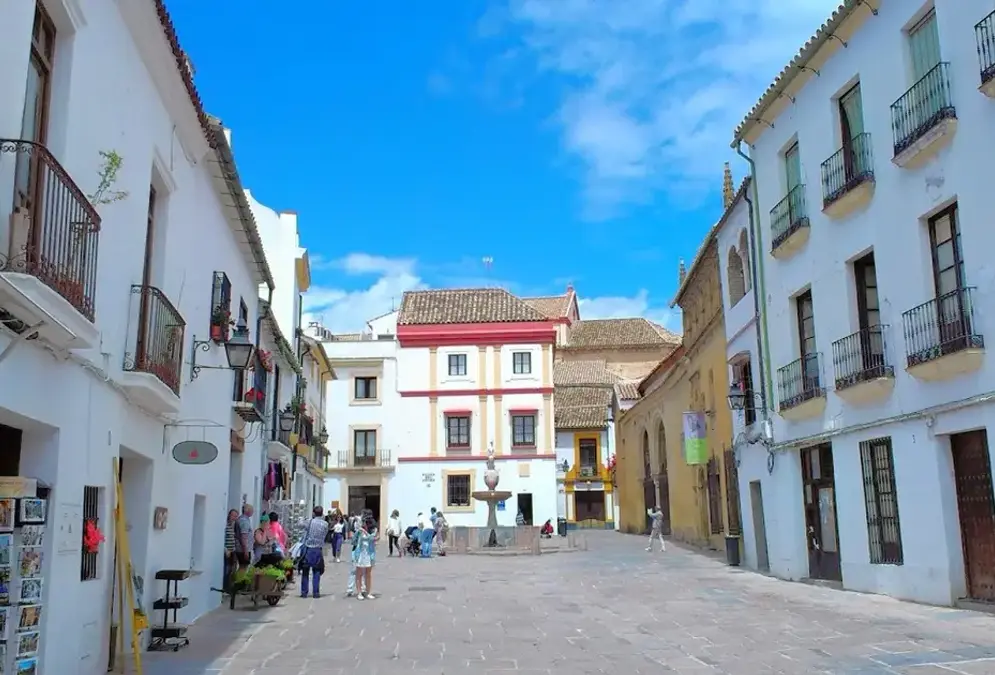
Plaza del Potro
Cited by Cervantes in Don Quixote. The 1577 fountain still stands; the Fine Arts Museum, Fosforito Flamenco Centre and Julio Romero Museum all face the square.
Borrowed from Murcia, kept afloat on favours
Córdoba's organisers didn't design their format from scratch. They copied it, openly, from Ardentísima, the international poetry gathering the poet José María Álvarez had been running for years in Murcia. Consulted about a joint edition, Álvarez didn't reply by letter; he got on a train and turned up in Córdoba one night to agree to it in person.[7] He also kept costs down in his own way, arranging for many visiting poets to be sponsored by universities, embassies or cultural centres rather than paid from Córdoba's own budget, so that, in his own words, as little public money as possible got spent.[8]
Naming the thing fell to Raúl Alonso, poet, editor of the journal Cántico, and already the man behind a successful reading series called Noches de Can Can. He became the festival's first literary director and gave it the name it has carried ever since.[9] The inaugural edition, titled Cosmopoética. Poetas del mundo en Córdoba, ran 24–27 April 2004, timed to overlap with Córdoba's own book fair, the Feria del Libro.[10]
The lineup was starry from the start. Among roughly forty poets bussed in from Murcia for the joint programme, poets shared with the parallel Murcia leg read in Córdoba that April, including:[11]
- Ko Un
- Maram Al Masri
- Alejandro Jodorowsky
- María Kodama
Not everyone was happy: some local poets left off the bill complained openly, and the organising team still remembers the friction over who had and hadn't been invited.[12] What nobody disputed was the noise the launch made. National outlets including Babelia, El Cultural and ABC covered it from day one, coverage its first director later called 'brutal.'[13]
From national prize to budget cuts, over a decade later
By its sixth edition in 2009, Cosmopoética's budget had passed €400,000, more than five times its 2004 launch figure, and enough that Cordobans started calling it the darling of the city's cultural calendar.[14] That same year the festival won Spain's National Prize for the Promotion of Reading (Premio Nacional al Fomento de la Lectura), an honour formally convened by the Ministry of Culture under Orden CUL/853/2009, with a jury appointed that September under Minister Ángeles González-Sinde Reig.[15] The citation credited the festival with making reading a distinctive mark of the city, judging the project capable of inspiring similar efforts elsewhere.[16]
€400,000
The prize didn't insulate the festival from what came next. The 2008 financial crisis reached its budget with a lag: within a little over a decade of its 2009 peak, funding had fallen back to roughly €200,000, about half of what it had been, even as the programme kept running every year.[17] A national prize and a halved budget landed within a little over a decade of each other, and the festival absorbed both without missing an edition.
Recommended tours
Tours are selected for quality, not commission. We earn a small fee if you book — at no extra cost to you.
The bid that failed, and the festival that didn't
Cosmopoética also outlived the very ambition that had created it. In 2011 it moved from its original spring dates to autumn, where it has stayed ever since, so when its 20th edition arrived, it marked twenty editions rather than twenty full years.[18] Literary direction changed hands more than once along the way. After Alonso's founding edition, a trio of poets, Fruela Fernández, Carlos Pardo and Juan Antonio Bernier, coordinated the festival for several years, and Joaquín Pérez Azaústre later took sole charge before direction was opened to public tender.[19]
None of that mattered as much as what happened to the dream Cosmopoética was consoling Córdoba for. The city's European Capital of Culture bid ultimately lost to San Sebastián, a turn that, one retrospective says, left Córdoba in a letargo it still hasn't shaken off.[20] Cosmopoética, the improvised, shoestring side project born to soften that disappointment, survived the disappointment itself. The bid is a closed chapter in Córdoba's civic history. Cosmopoética, the festival it inspired, is not.
Twenty-two years on, an unsettled question
The arithmetic runs the wrong way for anyone who assumes an official strategy outlasts an improvised one. Córdoba's Capital of Culture campaign is a closed chapter. Cosmopoética, the shoestring, borrowed-format festival three friends dreamed up to console themselves for a title they hadn't won yet, is still running every autumn, proof that an idea built on favours and a borrowed format can outlast the ambition it was meant to serve. For this year's programme and how to plan around it, see the Cosmopoética visitor guide.
Even how it started isn't fully settled. Cordópolis' own dedicated history of the festival credits the bar, the beer and the three friends named here; a separate retrospective marking its 20th edition traces the idea through a different lens, tied to Córdoba's wider young poetry scene of the time. Both versions agree on the year, the context, and who ran the first edition. Neither fully explains why this particular improvisation, rather than the official bid it grew out of, is the one still standing two decades later.
Deep dive · Article
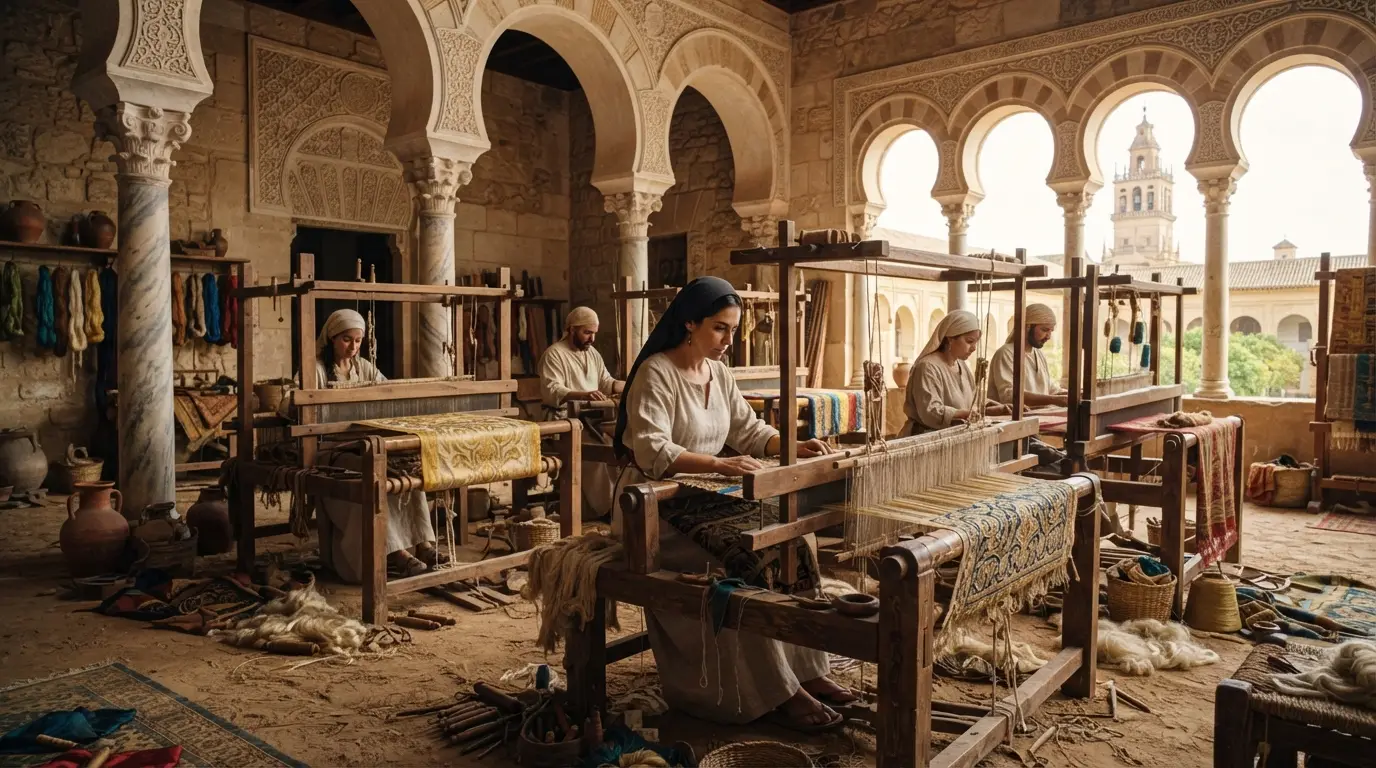
Córdoba Silk Industry History: The Rise of Tiraz
Córdoba ran al-Andalus's first state silk workshop, the dar al-tiraz, weaving robes of caliphal power before the industry shifted to Almería after 1031.