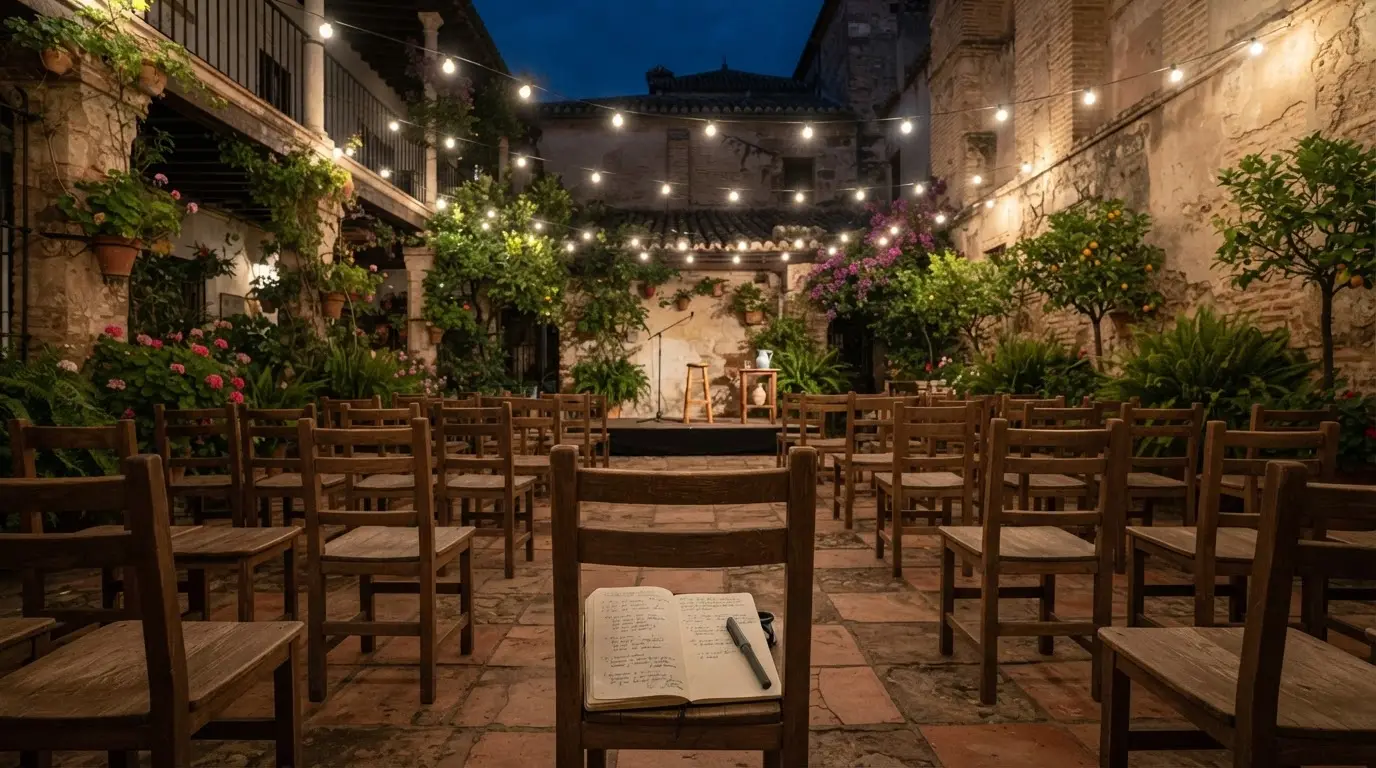
Poetry, talks & music · Nine days in Córdoba
Nine days of poetry, one Córdoba theatre, and a tribute to Borges
Cosmopoética fills Córdoba's historic centre with poetry recitals, literary talks and music every autumn. The 2026 edition, the 23rd, runs under this year's theme, «Inventar la alegría», alongside a season-long tribute to Jorge Luis Borges on the 40th anniversary of his death. This guide is about the decisions the event page doesn't answer: which day to go, what a reading actually feels like, and whether it's worth building a day of sightseeing around.

Written by
María Fernanda González Ten years covering Córdoba's UNESCO heritage sites, sourcing from Junta de Andalucía documentation.
Published
Cosmopoética has been running in Córdoba since 2004, when the poet Raúl Alonso set it up as its first literary coordinator. It won Spain's National Prize for the Promotion of Reading in 2009, and Nobel laureates Seamus Heaney, Derek Walcott and Dario Fo have all read here over the years. It has a genuine track record behind it, closer to a working literary institution than a casual weekend book fair.
The 2026 edition brings 73 poets and writers to the city across nine days, most of the programme free and open to walk-ins. What it doesn't come with is a single obvious itinerary: the readings run daily rather than as one big event, the two headline galas may or may not require advance planning depending on how quickly they fill, and a first-timer is usually left wondering which evening is worth their time.
This guide covers that gap: what to expect from a recital, which day suits your trip, whether Cosmopeque is worth it with kids, and what else to do the same day. For live dates, the confirmed lineup and booking details, see the Cosmopoética event page.
At a glance
- When
- 25 Sept – 3 Oct 2026 · 9 days · 23rd edition
- Main venues
- Teatro Góngora (galas), Sala Orive (daily strands)
- Entry
- Free until each venue reaches capacity
- Family strand
- Cosmopeque, 10th year, Sat 26 Sept morning
- Scale
- 73 poets: 60 from Spain, 13 international
- Getting around
- All main venues walkable in the historic centre
In this guide
Jump to a section
What makes Cosmopoética different from a typical literary event
Plenty of cities run a book fair or a one-off author talk during the autumn calendar. Cosmopoética is a different scale of thing: a nine-day international festival, held every year since 2004, with an open call that brought 73 confirmed authors to the 2026 edition, 60 from Spain, including 18 from Córdoba and its province, and 13 from abroad. It runs its own annual theme rather than a loose grab-bag of programming (2026's is «Inventar la alegría», invent joy), and it structures nine days of talks, recitals and music around it.
The pedigree backs up the scale. The festival won Spain's National Prize for the Promotion of Reading in 2009, a recognition aimed at initiatives that make reading part of a city's identity rather than a niche interest. Its guest list over the years has included Nobel laureates Seamus Heaney, Derek Walcott and Dario Fo. A visitor who assumes this is a small regional reading series is underestimating what they've walked into.
2026 also introduces something new: the first-ever Premio Cosmopoética Ciudad de Córdoba, a two-category prize recognising a poet's career (won by the Romanian poet Ana Blandiana) and the promotion of poetry more broadly (won by RNE's radio programme La Estación Azul). Both are announced at the closing gala on 3 October.
Understanding this year's Borges tribute
Cosmopoética runs a fresh theme every year, and 2026's is «Inventar la alegría». Layered on top of that, the 2026 edition carries something more specific: a season-long tribute to Jorge Luis Borges, timed to the 40th anniversary of the Argentine writer's death. That's worth knowing before you go, because it means a noticeable share of the talks, recitals and literary walks across the nine days circle back to Borges (his labyrinths, his libraries, his particular way of writing about infinity in a few pages) rather than staying purely abstract to the annual theme.
You don't need to have read Borges to enjoy the festival. But if you have, 2026 is a better year than most to come: expect his work referenced across multiple strands rather than confined to a single talk, and expect the festival's literary walks (paseos literarios) through Córdoba's neighbourhoods to lean on his imagery more than usual this time round.
The daily strands and their venues
Outside the two big-name galas, Cosmopoética's daily programming runs on three named strands, and all three are hosted at Sala Orive. Knowing what each one is designed to do makes it easier to pick an evening that matches what you want out of it, rather than walking in cold.
-
Poetas en el Espejo
Walk in here first if you want the simplest read on the festival: one poet at a time, working through their own material, the room quiet and paying attention. There's no format to figure out and nothing to follow beforehand, which makes it the easiest strand to drop into on a first visit.
-
Voces en el Aleph
Pick this one for an evening with more back-and-forth: authors in conversation, working through the year's theme together rather than each taking a solo turn. It suits a visitor who wants context and debate alongside the poetry, not the poetry on its own.
-
Noches del Laberinto
Choose this strand for mood over material: a poet shares the stage with a musician, and the evening drifts between the two registers rather than settling on either. It's the gentler entry point if straight recitals feel like too much commitment on a first night.
The two galas sit apart from all of this, at Teatro Góngora. The opening night on 25 September pairs writer Siri Hustvedt with a performance from Carmen Linares, who presents Verso a Verso. The closing gala on 3 October is the ceremonial half of the festival: the inaugural Premio Cosmopoética Ciudad de Córdoba awards, followed by Círculo vertical, a concert-recital bringing together Rocío Márquez, Carmen Camacho and Pedro Rojas Ogáyar.
Which day to plan around if you're not staying all nine
Most visitors aren't in Córdoba for the full nine days, so the real planning question is which single evening (or morning) to build a trip around. It comes down to what you're after.
-
Want the biggest occasion
Opening night, 25 September, Teatro Góngora. Siri Hustvedt and Carmen Linares, the festival's highest-profile pairing, and also its busiest night.
-
Want something quieter
Any weekday evening at Sala Orive for Poetas en el Espejo. Smaller room, no gala-night crowd, and it runs every day of the festival.
-
Traveling with children
Saturday 26 September morning, Biblioteca Central Antonio Gala. Cosmopeque's workshops are the only part of the festival actually designed for kids.
-
Want a sense of an ending
Closing gala, 3 October, Teatro Góngora. The first Premio Cosmopoética Ciudad de Córdoba awards plus the Círculo vertical concert-recital.
“A room quiets a particular way just before a poet starts reading — then someone begins, and the street noise outside seems to fall back a step.”
Cosmopeque: is it worth it for families?
Cosmopeque, the festival's children's strand, marks its 10th anniversary in 2026, and it's built specifically for families rather than adapted from the adult programme. The 2026 opener, on Saturday 26 September at 11:00 at the Biblioteca Central Antonio Gala, includes a workshop with children's author Leire Bilbao built around sound and rhythm, the kind of activity that works for a child who isn't reading fluently yet, not just older kids following along with a text.
Where it's worth being realistic: Cosmopeque is a morning of workshops and storytelling, not an all-day children's programme, and it's genuinely the only part of Cosmopoética designed with children in mind. The evening strands at Sala Orive and the Teatro Góngora galas are adult-paced literary events; don't expect a child to sit through a full recital or a concert-recital comfortably. If a family morning at the library fits your trip, it's worth the detour. If you're hoping the whole festival works for young kids, it doesn't; build the day around Cosmopeque specifically and treat the rest of the programme as an adults' evening out.
Getting around, and what the registration gap means for your plans
Cosmopoética doesn't ask much of you logistically. Teatro Góngora, Sala Orive and the Biblioteca Central Antonio Gala all sit inside Córdoba's historic centre, close enough that walking between any two takes well under fifteen minutes. The Mezquita-Catedral, host to one of the festival's accessible-visit activities, and the Filmoteca de Andalucía are a similarly short walk from either. Nobody needs to plan a bus route between events; the harder question is timing, not distance.
The one honest gap in the planning picture: as of this writing, the festival hadn't published a formal registration or ticketing process for the two Teatro Góngora galas beyond the general policy of free entry until each venue reaches capacity. That's a real constraint if you're building a single evening around one of them. The practical response is to treat a gala seat as likely rather than guaranteed: arrive twenty to thirty minutes before the 20:00 start, and if you're only in Córdoba for one night, don't stake it entirely on getting into Teatro Góngora. Sala Orive's daily recitals run at a smaller scale and are the steadier fallback if a gala fills before you're through the door.
The festival also runs literary walks (paseos literarios) and street-level artistic interventions that move outside the main venues and into Córdoba's neighbourhoods. These aren't fixed to one location on the map the way the readings are, so check the day's schedule at cosmopoetica.es rather than assuming everything happens around Sala Orive and Teatro Góngora.
What else to do the same day
Cosmopoética's evening events fill a couple of hours; they don't need a trip built around them alone. All the main venues sit inside Córdoba's historic centre, so a normal day of sightseeing folds a reading or a talk in without much rearranging.
The Mezquita-Catedral is the obvious pairing: it's a short walk from both Teatro Góngora and Sala Orive, and the festival itself runs one of its inclusion-focused activities there, an accessible guided visit organised with the ONCE Foundation for visually impaired attendees. For everyone else, it's simply a good excuse to see the Mezquita in late-September or early-October light, once the peak summer crowds have thinned.
Late September through early October also sits right at the edge of Córdoba's autumn season: milder days, cooler evenings, and lower hotel rates than you'll find in high summer. If you're already weighing a Córdoba trip around this time of year, Cosmopoética is a reasonable evening anchor for it rather than a separate reason to travel.
Before you go
- Check cosmopoetica.es the morning of Literary walks and street interventions aren't fixed to the same spot every day. Confirm the day's location before you set out, rather than assuming it's at Sala Orive or Teatro Góngora by default.
- Bring a layer for the evening Late-September and early-October evenings in Córdoba typically cool into the mid-teens Celsius after a warm day. The venues themselves are indoors, so this only matters for the walk over.
- Arrive early for either gala With no published registration process yet for the Teatro Góngora nights, twenty to thirty minutes ahead of the 20:00 start is the safer margin, especially for the opening.
Frequently asked questions
What should I expect at a Cosmopoética reading if I've never been to a poetry recital?
The daily strands at Sala Orive are seated, conversational events rather than performances in the theatrical sense: a poet reads from their own work, often with a moderator or a second author in conversation, and the room stays quiet and attentive throughout. Poetas en el Espejo is built around the reading itself; Voces en el Aleph leans more toward discussion; Noches del Laberinto pairs a poet with a musician for a looser, more atmospheric evening. None of them require any background in poetry to follow. Arrive a few minutes early and expect an hour or so of your evening, not a whole night out.
Which day should I pick if I can only attend one?
It depends on what you want from it. For the biggest occasion, go to the opening night at Teatro Góngora on 25 September, where Siri Hustvedt reads and Carmen Linares performs Verso a Verso, but expect the heaviest crowd of the nine days. For something quieter and easier to walk into without planning around a specific ticket, any weekday evening at Sala Orive for Poetas en el Espejo is the lower-key option. Families should build the day around Saturday 26 September, when Cosmopeque runs its morning workshops. If you want the sense of an ending, the closing gala on 3 October pairs the festival's first-ever city prize with a concert-recital.
Is Cosmopeque suitable for young children, or only for a family with older kids?
Cosmopeque is pitched broadly, with activities aimed from around age four upward, and the 2026 workshops include a session with children's author Leire Bilbao built around sound and rhythm rather than reading comprehension, which works for children who aren't yet reading fluently. The evening strands at Sala Orive and Teatro Góngora are a different matter: they're adult-paced literary events, not designed with children in mind, so Cosmopeque's Saturday morning is the part of the festival to build a family day around rather than an evening recital.
How do the festival's venues relate to each other, and can I walk between them?
Yes. Teatro Góngora, Sala Orive and the Biblioteca Central Antonio Gala all sit within Córdoba's historic centre, close enough to cover on foot in well under fifteen minutes between any two of them. The Mezquita-Catedral, which hosts one of the festival's accessible-visit activities, and the Filmoteca de Andalucía are a similarly short walk away. There's no need to plan bus journeys between venues; the harder logistics question is timing your evening around a specific reading, not getting there.
What happens if I can't get a seat at one of the Teatro Góngora galas?
As of this writing, the festival hadn't published a formal registration or ticketing process for the two Teatro Góngora galas beyond the general free-entry-until-capacity policy, so a full house on the night is a real possibility, especially for the opening. Arrive twenty to thirty minutes ahead of the 20:00 start for either gala, and don't build your only evening in Córdoba around a seat that isn't guaranteed. Sala Orive's daily recitals run at a smaller scale and are the more dependable fallback if a gala fills before you're through the door.
Should I plan a trip to Córdoba around Cosmopoética alone, or combine it with other sightseeing?
Combine it. Cosmopoética's evening events fill a few hours of a nine-day window; they don't need a dedicated trip on their own. The festival's venues sit inside the same historic centre as the Mezquita-Catedral, so a normal day of sightseeing folds in a Cosmopoética evening without much extra planning. Late September and early October are also good months for the Mezquita itself, with the summer crowds thinning and the light softening.
What should I wear or bring to an evening reading?
Nothing formal is expected; the readings are neither black-tie nor beachwear-casual. Late-September and early-October evenings in Córdoba typically cool to somewhere in the mid-teens Celsius once the sun goes down, so a light layer is worth having even after a warm day. Sala Orive and Teatro Góngora are indoor venues, so weather only matters for the walk over.
What makes Cosmopoética worth building an evening around isn't scale for its own sake, it's that the festival treats poetry as something you sit and listen to rather than skim past on a shelf. A single recital at Sala Orive costs you an hour, asks nothing of you beforehand, and sits inside a programme with a genuine twenty-year record behind it. That's a fair trade for one evening of a Córdoba trip.
Continue exploring

Further reading
Sources and further reading
3 references Show Hide
- Cosmopoética: Official Site (opens in a new tab)
Official programme, confirmed lineup, and the Cosmopeque family schedule for the current edition
- Ayuntamiento de Córdoba: Agenda Cultural (opens in a new tab)
The city council's own listing for the festival, including organiser details
- Turismo de Córdoba (opens in a new tab)
Official Córdoba tourism portal with dates and practical visitor information