Free · 12–22 October 2026 · Theme: Ephemeral
Five artists. Five heritage courtyards. One theme: Ephemeral.
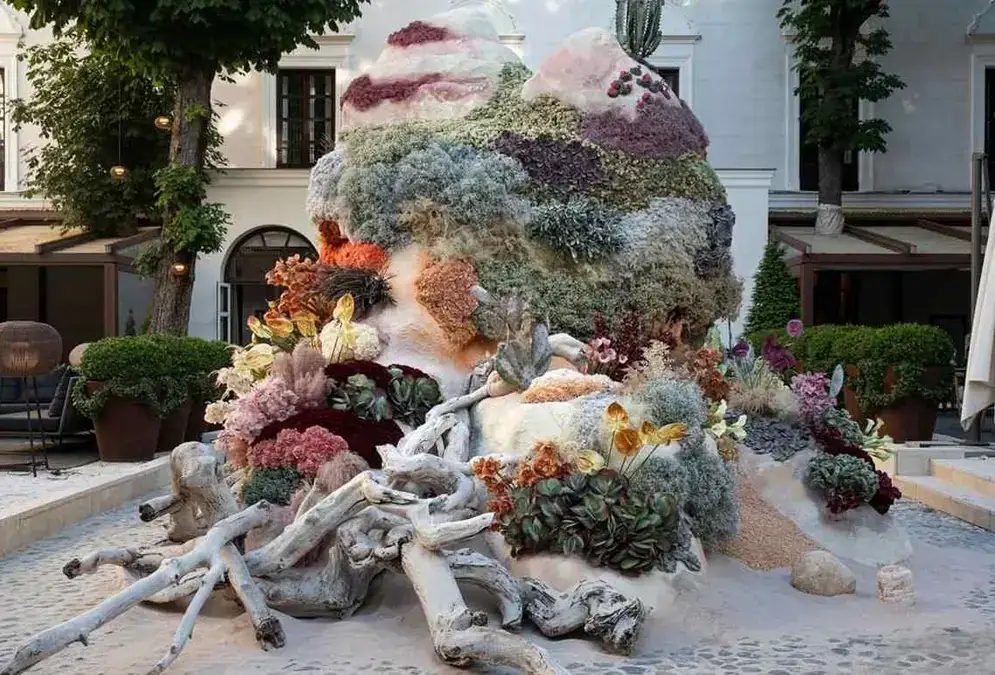
Each autumn, FLORA hands Córdoba's palaces and historic patios over to international floral artists who fill them with monumental contemporary installations. The 2026 edition — the 9th — explores the theme of «Ephemeral». It runs 12–22 October, the exhibition is free, and the results are genuinely unlike anything else on Córdoba's cultural calendar.

Written by
María Fernanda González Ten years covering Córdoba's UNESCO heritage sites, sourcing from Junta de Andalucía documentation.
Updated Published
FLORA is not a flower show. Organised by Zizai Cultura, it's a competition: international artists each create a site-specific installation inside one of Córdoba's heritage venues and compete for the I and II Premio FLORA. The 2026 edition — the 9th — explores the theme «Ephemeral», embracing the transience of both the materials and the contemporary moment.
The 2026 lineup: Sohee Park (South Korea) at the Mezquita's Patio de los Naranjos; FLOVER NYC (United States) at the Patio Barroco of the Palacio de la Merced, seat of the Diputación de Córdoba; Mas Rasa (France) at Palacio de Orive; Hamish Powell (United Kingdom) at Palacio de Viana; and Taller Banegas (Spain) at the Archaeological Museum. For the first time the programme also touches on Semana Santa, and Martirio performs «La flor cantada» on 17 October.
The exhibition is free. The circuit takes 2 to 3 hours on foot through the historic centre. This guide covers what to expect from each venue, how to order your visit, and what else to do on the same day. For the dates and programme, see the FLORA Festival event page.
At a glance
- When
- 12–22 October 2026 · 9th edition · Theme: Ephemeral
- Hours
- 11:00–20:00, Friday to Wednesday (exhibition 16–21 October)
- Entry
- Free exhibition; some activities need registration
- Venues
- Mezquita (Patio de los Naranjos), Palacio de la Merced (Diputación), Palacio de Orive, Palacio de Viana, Archaeological Museum
- Time needed
- 2–3 hours for the full circuit
- Format
- Competition · five artists · I and II Premio FLORA 2026
In this guide
Jump to a section
What makes FLORA different from other flower festivals
Córdoba already has the Patio Festival, the May UNESCO event where residents open their private courtyards to display centuries of floral decorating tradition. FLORA shares the city and the flowers, but almost nothing else. The Patio Festival is a living tradition, rooted in neighbourhood pride and amateur craft. FLORA is a professional art competition where the artists are specifically selected for their international standing.
Each FLORA artist transforms one heritage courtyard, so each work is made for a single space and no other. Five artists from five countries working against the same Andalusian architecture is part of what the festival is trying to show, and it is why the installations look nothing like each other.
The competition aspect also keeps the work from becoming decorative. The artists compete for the I and II Premio FLORA 2026, reported at €25,000 for first prize and €10,000 for second, so there are professional stakes.
Alongside the installations, the festival runs an extensive programme of workshops, talks and parallel «flora off» installations. The 2026 edition also brings Semana Santa into the programme for the first time, and Martirio performs «La flor cantada», a concert of flower-inspired songs, on 17 October. It closes with Guerrilla FLORA on 22 October. The event page holds the dated programme.
Meet the 2026 artists
Five artists from South Korea, France, Spain, the United States and the United Kingdom each transform one courtyard and compete for the I and II Premio FLORA 2026.
-
Sohee Park · South Korea
Installs «Halcyon» in the Patio de los Naranjos of the Mezquita-Catedral.
-
Mas Rasa · France
Installs «Cataclismo» at Palacio de Orive.
-
FLOVER NYC · United States
A New York-based floral studio. Installs «No puedo esperar más al futuro» in the Patio Barroco of the Palacio de la Merced, seat of the Diputación de Córdoba.
-
Hamish Powell · United Kingdom
Installs «El murmullo» at the Palacio de Viana. The press names the palace but not a specific courtyard.
-
Taller Banegas · Spain
Installs «Interludio» in Patio II of the Archaeological Museum.
The five venues: 2026 edition
Each year the festival assigns artists to a rotating set of heritage venues. The 2026 edition brings five distinct spaces across the historic centre, each with its own artist.
-
Patio de los Naranjos
Mezquita-Catedral · Sohee Park (South Korea)
The orange-tree courtyard of the Mezquita is one of the most recognisable medieval Islamic outdoor spaces in Europe, and it hosts Sohee Park's «Halcyon». The FLORA exhibition is free to visit; the Mezquita interior requires a separate ticket. The contrast between a contemporary floral intervention and the Islamic-era courtyard it sits in is as direct as the festival gets.
-
Palacio de la Merced (Diputación de Córdoba)
Patio Barroco · FLOVER NYC (United States)
The Palacio de la Merced is the seat of the Diputación de Córdoba, and its Patio Barroco hosts FLOVER NYC's «No puedo esperar más al futuro». If you visited in a previous edition, check the official programme rather than assuming the same courtyard.
-
Palacio de Orive
Mas Rasa (France)
Palacio de Orive, a Renaissance palace in the heart of the historic centre, hosts Mas Rasa's «Cataclismo». Guerrilla FLORA closes the programme on 22 October in the nearby Jardines del Huerto de Orive.
-
Palacio de Viana
Hamish Powell (United Kingdom)
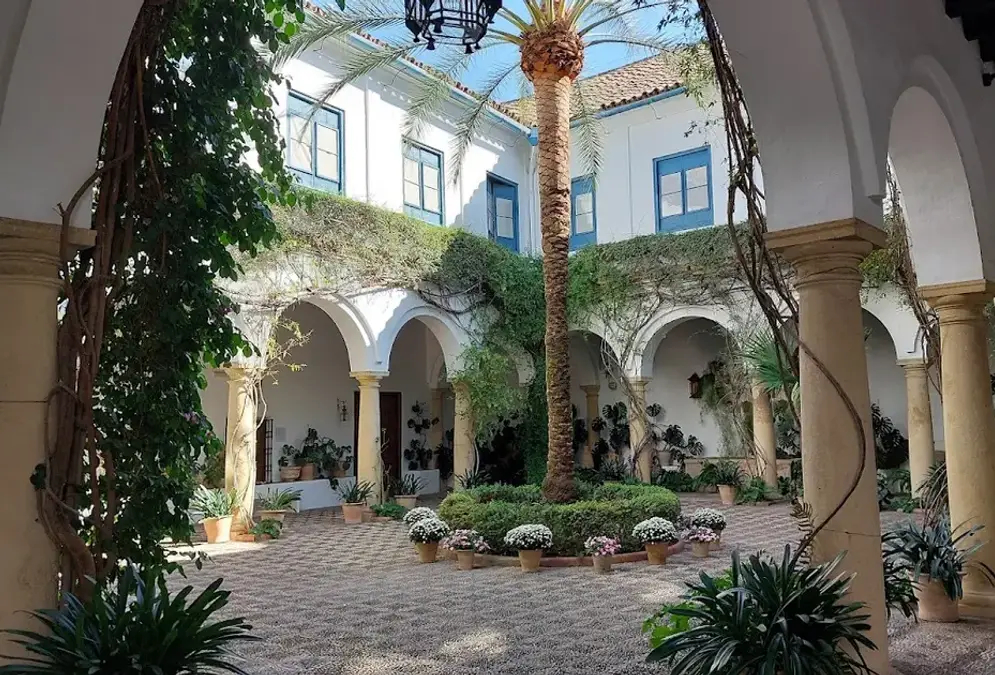
Viana's twelve patios are already a destination, and Hamish Powell's «El murmullo» is installed in the palace; the press does not name the courtyard. Allow more time here regardless: the resident plantings alone are worth the visit.
-
Archaeological Museum
Taller Banegas (Spain)
The Archaeological Museum's Patio II, a courtyard of the Renaissance palace, hosts Taller Banegas's «Interludio», a reinterpretation of the historic space from a plant's point of view. Roman and Moorish artefacts in the museum make this one of the more conceptually layered pairings.
Note: The programme on the official website festivalflora.com is the authoritative source for venue details and any late changes.
See FLORA in motion
Short clips filmed inside the festival's courtyards during the 2024 and 2025 editions — the scale and setting the 2026 installations will work with
Patio de los Naranjos installation — FLORA 2025
Palacio de Viana — FLORA 2025 first prize
Palacio de Orive — FLORA 2025
Archaeological Museum patio — FLORA 2025
Diputación de Córdoba — FLORA 2025
First-prize installation — FLORA 2024
Workshops and the Martirio concert
The festival's accompanying activities, workshops, talks and the parallel «flora off» installations, are the part visitors most often miss. The festival says access to all activities is free except where otherwise indicated, but some require prior registration and many ask for a reservation on its website, while others are free until capacity is reached. Check festivalflora.com for each activity before you travel.
The single event worth planning around in advance is Martirio's «La flor cantada» on Saturday 17 October at 20:30, with pianist Jesús Lavilla: songs she had not sung before, all inspired by flowers. Reports differ on the venue, so confirm the venue and any reservation on the official site before you plan your evening. As a rule for the whole programme, reserve a workshop or talk the day you see it announced.
How to order your route
Most visitors start at the Patio de los Naranjos because it's the best-known landmark. That's also where the largest midday crowds accumulate, since it is the Mezquita's own courtyard. The practical move is to reverse the standard circuit: begin at Palacio de Viana in the north of the historic centre, then walk south-east to Palacio de Orive, continue to the Archaeological Museum, then to the Palacio de la Merced (Diputación de Córdoba), and finish at the Patio de los Naranjos in the early afternoon when the morning Mezquita rush has thinned.
Walking time between venues is roughly 10 to 15 minutes each. The entire circuit, five installations and walking included, takes 2 to 3 hours at a comfortable pace. The venues are clustered in the historic centre, so the route is essentially a loop rather than a linear trail.
If you have only one morning: start with the two installations that sit inside Córdoba's best-known monuments, Sohee Park at the Naranjos and Hamish Powell at Palacio de Viana, then add Orive, the Archaeological Museum and the Palacio de la Merced as time allows.
Midday on weekends is likely to be the busiest time at all five venues. A Tuesday or Wednesday morning before noon is the least congested time across the circuit; the installations are open Friday to Wednesday, so Thursday is not an option. Timing also matters by phase: 12–15 October is set-up week, when the artists are still building, which suits visitors who enjoy watching the process but requires prior registration at festivalflora.com; 16–21 October is when every installation is finished and open to all without registration, and it's the best window if you want to see the finished pieces; 22 October's Guerrilla FLORA closes the programme.
Photography at FLORA
October light in Córdoba runs at a lower angle than in summer, roughly 40 degrees at midday versus 70 degrees in July. Courtyard installations made of stems and plant material throw long shadows across stone floors and walls at specific hours, and photographing them at noon, when the light is at its most neutral, flattens the effect.
Morning light enters from the east at the Patio de los Naranjos, which faces the Mezquita's east wall. Before 12:00, the orange trees cast long shadows across the courtyard floor and the installation catches direct light. After 2pm, the courtyard is in shade. Plan accordingly.
At Palacio de Viana, the patios face different directions: some catch morning light, others afternoon. Spend time in each courtyard before setting up a shot: the best angle becomes obvious once you're there. Check Viana's photography rules on the day.
At Palacio de Orive, the Renaissance central patio catches direct light from mid-morning through early afternoon. The arched galleries on three sides create alternating bands of light and shadow that shift visibly between 11:00 and 14:00 — worth arriving early and watching the space change before committing to a shot.
Best conditions
- Morning 11:00–13:00 across all venues
- Patio de los Naranjos: direct light before noon
- Weekday morning for clean shots without crowds
Practical notes
- Rules differ by venue: check on arrival, and avoid flash
- Wide angle (24mm) for full courtyard context; 50mm for botanical detail
- Arrive before 12:00 at the Patio de los Naranjos for direct light
Avoid
- Midday on weekends: crowded and flat light
- Weekend crowds at the Patio de los Naranjos
What to shoot
- Detail of botanical materials against old stone
- Light patterns on courtyard floors in the morning
- Wide establishing shot before moving in close
What to do the same day
FLORA's circuit runs through the Judería and the northern edge of the historic centre, connecting the Mezquita to Viana, with Orive and the Archaeological Museum along the way. If you start at Viana in the morning, the natural route south passes through the Judería's alleys before reaching the Patio de los Naranjos.
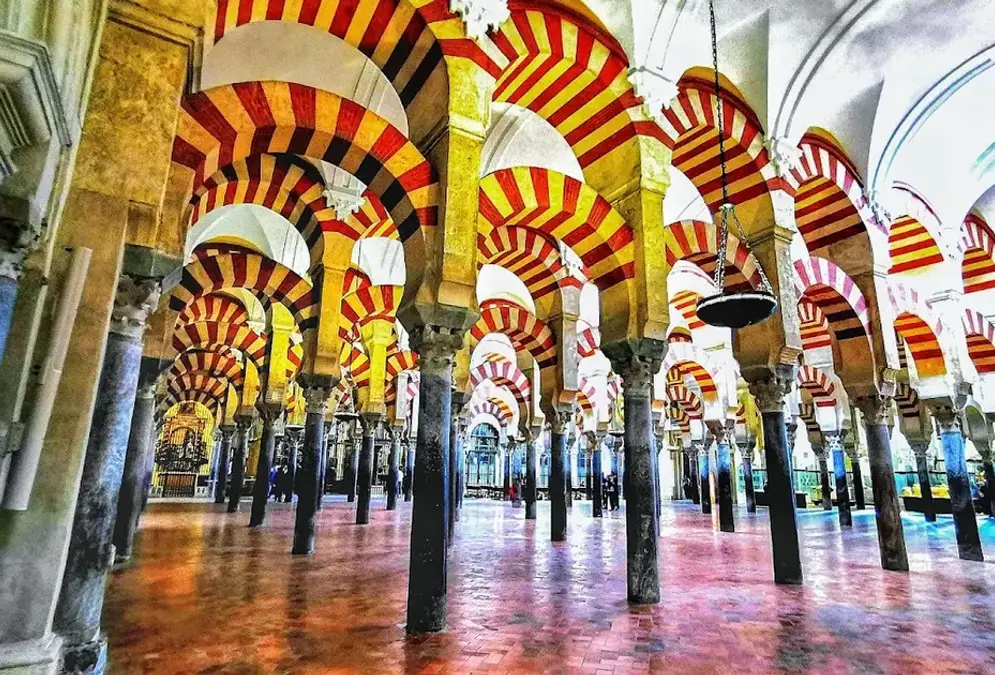
October is also one of the best months for the Mezquita-Cathedral. Temperatures are manageable, the crowds thinner than in summer, and the autumn light inside the hypostyle hall is different from what you get in June. If you plan to visit the Mezquita interior on the same morning as the FLORA courtyard installation, book your timed entry slot in advance.
Lunch after the circuit: Plaza de la Corredera is 10 minutes east of the Mezquita on foot. The square's cafes and restaurants are less tourist-facing than those immediately surrounding the monument. A glass of fino and a plate of salmorejo while the morning's installations settle in your head is a reasonable way to end it.
If you have an afternoon: the San Basilio neighbourhood is five minutes south of the Alcázar and worth walking through in October light. The geraniums in the window boxes are different from May, when the Patio Festival brings people specifically for flowers. In October, the street is quieter and the colour is still there.
Before you go
- Check the official site before arriving festivalflora.com carries registration for set-up week and for activities that ask for a reservation. Mobile signal in some of Córdoba's older courtyards is unreliable, so save the venue list offline.
- Reserve activities as soon as you see them Many activities ask for a reservation on the festival website, and others are free only until capacity is reached. Check the programme on festivalflora.com and sign up for anything that interests you early.
- Wear comfortable shoes The circuit covers 2 to 3 km on uneven historic cobblestones. Courtyard stone floors that are slippery after overnight rain, which does happen in mid-October.
Frequently asked questions
What is FLORA Festival in Córdoba?
FLORA is a contemporary floral art competition held each October in Córdoba's historic heritage venues. International artists create monumental ephemeral installations inside palaces and patios. The 2026 edition — the 9th — explores the theme of «Ephemeral». The festival is organised by Zizai Cultura, and the exhibition of the installations is free to visit.
When does FLORA take place in 2026?
FLORA runs from 12 to 22 October 2026. Installation of the artworks happens 12–15 October, the finished pieces are on public exhibition 16–21 October, and Guerrilla FLORA closes the official programme on 22 October. For the dated programme, see the FLORA event page.
How long should I allow for the FLORA circuit?
Budget 2 to 3 hours to walk the full circuit of five venues: the Patio de los Naranjos at the Mezquita (Sohee Park), the Patio Barroco of the Palacio de la Merced, seat of the Diputación de Córdoba (FLOVER NYC), Palacio de Orive (Mas Rasa), Palacio de Viana (Hamish Powell), and the Archaeological Museum (Taller Banegas). Each installation warrants 20 to 30 minutes; add time for walking between sites.
Do you need to book tickets for FLORA?
Not for the installations: the exhibition (16–21 October) is free and open without interruption from 11:00 to 20:00. Visits to the set-up work on 12–15 October need prior registration, and many other activities ask for a reservation on the festival website, while some are free until capacity is reached. Check each activity on festivalflora.com, including Martirio's one-off concert on 17 October.
What is the best time of day to visit the FLORA installations?
Tuesday or Wednesday before noon give you the quietest courtyards and the best photography conditions. October's low-angle morning light flatters stone courtyards. Weekend afternoons draw the heaviest crowds. The installations are open Friday to Wednesday.
Can I combine FLORA with the Mezquita visit?
Yes, easily. The Patio de los Naranjos, where Sohee Park's installation goes up in 2026, is the Mezquita's own courtyard. The FLORA exhibition itself is free; the Mezquita interior requires a separate ticket, so check current prices on its monument page. Book your Mezquita timed slot first, then see the FLORA installation in the courtyard either just before or just after.
Who are the 2026 FLORA artists?
Five artists from South Korea, France, Spain, the United States and the United Kingdom: Sohee Park (South Korea) at the Mezquita's Patio de los Naranjos, FLOVER NYC (United States) at the Patio Barroco of the Palacio de la Merced, Mas Rasa (France) at Palacio de Orive, Hamish Powell (United Kingdom) at Palacio de Viana, and Taller Banegas (Spain) at the Archaeological Museum. They compete for the I and II Premio FLORA 2026. Martirio (Spain) performs «La flor cantada» on 17 October, a separate concert in the programme.
What is Guerrilla FLORA?
Guerrilla FLORA is the closing event of the official programme on 22 October, from 16:00 to 19:00 in the Jardines del Huerto de Orive.
Is FLORA Festival suitable for families with children?
Yes, the exhibition is free and the installations are in courtyards you walk through, so it works as a short outing. Some activities need registration, so check the programme on festivalflora.com. October weekday mornings are the easiest time to visit with young children.
Are the FLORA workshops included in free entry?
The festival says access to all its activities is free except where otherwise indicated. The catch is registration: some activities require it, and many ask for a reservation on the festival website, while others are free until capacity is reached. Check each activity on festivalflora.com.
How long does it take to see all the FLORA installations?
Walking the circuit itself takes 2 to 3 hours. Doing the festival properly, with workshops, the Martirio concert, and time to let each installation breathe, is a different scale: plan at least two days, or ideally four, to also enjoy the city's cultural richness at a calmer pace.
FLORA works because of the specificity of the assignment. Each artist knows the dimensions and orientation of their courtyard, the colour of the stone, the quality of light at different hours. What they make is for that space and no other. Photographed and transplanted to Instagram it looks like any other flower festival. In the courtyard itself, in October light, the dialogue between a 15th-century palace and a contemporary intervention from another country is something else. That's worth the 2 to 3 hours.
Continue exploring
FLORA venues to explore

Further reading
Sources and further reading
3 references Show Hide
- Festival FLORA: Official Site (opens in a new tab)
Official programme, artist lineup, route maps, and workshop schedules for FLORA Córdoba
- Turismo de Córdoba (opens in a new tab)
Official Córdoba tourism portal with October cultural calendar and practical visitor information
- Zizai Cultura: Festival Organisation (opens in a new tab)
The production company behind FLORA, including archive material from previous editions