City comparison
Córdoba or Cádiz?
One is a landlocked caliphate capital with Europe's greatest Islamic monument. The other is an Atlantic city older than Rome. Here's how to choose, and why most visitors end up doing both.

Written by
María Fernanda González Ten years covering Córdoba's UNESCO heritage sites, sourcing from Junta de Andalucía documentation.
Updated Published
At a glance
- Between cities
- 2.5–3h by train (via Sevilla)
- Córdoba duration
- 2–3 days
- Cádiz duration
- 2–3 days
- Córdoba wins
- Islamic heritage, medieval gastronomy, caliphate history
- Cádiz wins
- Atlantic beaches, seafood, oldest city in the West
- Best strategy
- Both cities in one Andalusian trip; they complement each other
In this guide
Jump to a section
Side-by-side comparison
| Category | Córdoba | Cádiz |
|---|---|---|
| Flagship monument | Mezquita-Cathedral (€15) | Cathedral de Cádiz (€8) |
| Ideal duration | 2–3 days | 2–3 days |
| Daily budget | €65–75 | €65–80 |
| Double room | €60–100 | €60–110 |
| Beach | None | Atlantic: La Caleta, La Victoria |
| UNESCO heritage | Historic centre (1984) | Not listed |
| Historical identity | Caliphate capital (8th–10th c.) | Phoenician foundation (~1100 BC) |
| Atmosphere | Compact, layered, introspective | Breezy, maritime, open |
| Food scene | Salmorejo, rabo de toro, oxtail | Pescaíto frito, almadraba tuna |
| Famous festival | Patio Festival (May, UNESCO) | Carnival (Feb/Mar, most famous in Spain) |
| Population | 325,000 | 115,000 |
So which one should you visit?
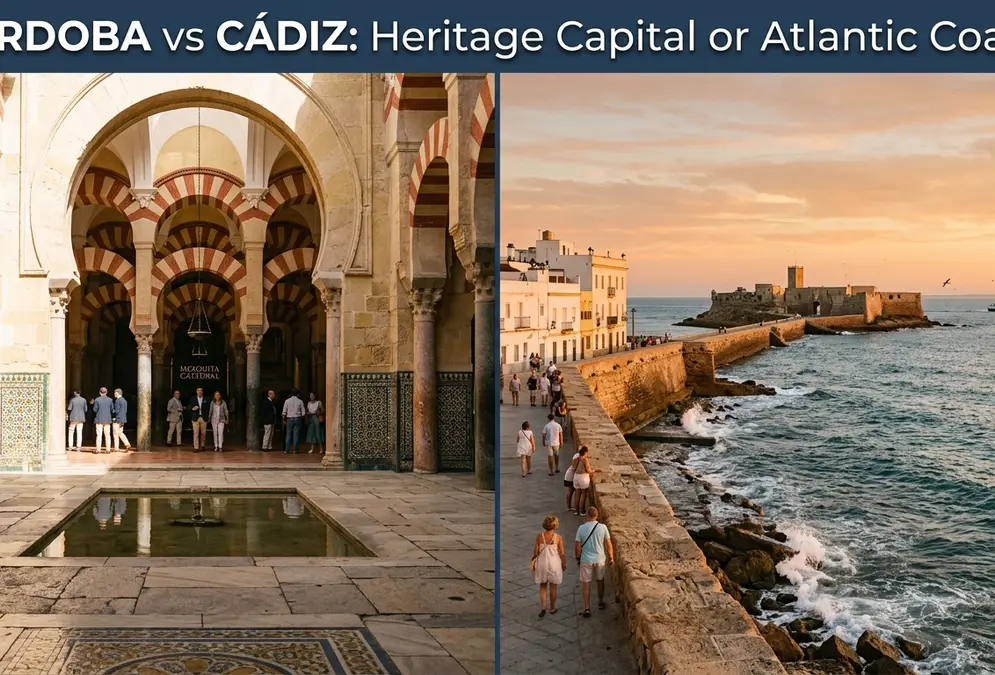
The question is usually framed as a choice. It shouldn't be. Córdoba and Cádiz are the two most distinct cities in Andalusia precisely because they face different directions (one into the past, one toward the Atlantic), and that contrast makes a combined trip more interesting than either city alone.
If you have to choose: Cádiz wins if beaches and seafood are primary motivations, or if you're timing a visit around Carnival in February. Córdoba wins if monuments and history drive your itinerary.
“The Mezquita-Cathedral is simply one of the three or four greatest buildings in Europe, and nothing in Cádiz competes with it architecturally.”
With 2.5–3 hours between them by train, most visitors to Andalusia do both. Fly into Seville or Málaga, spend two nights in Córdoba, two nights in Cádiz, and you've covered inland Andalusia and its Atlantic edge in a single trip without repeating yourself once.
Córdoba: the caliphate's capital
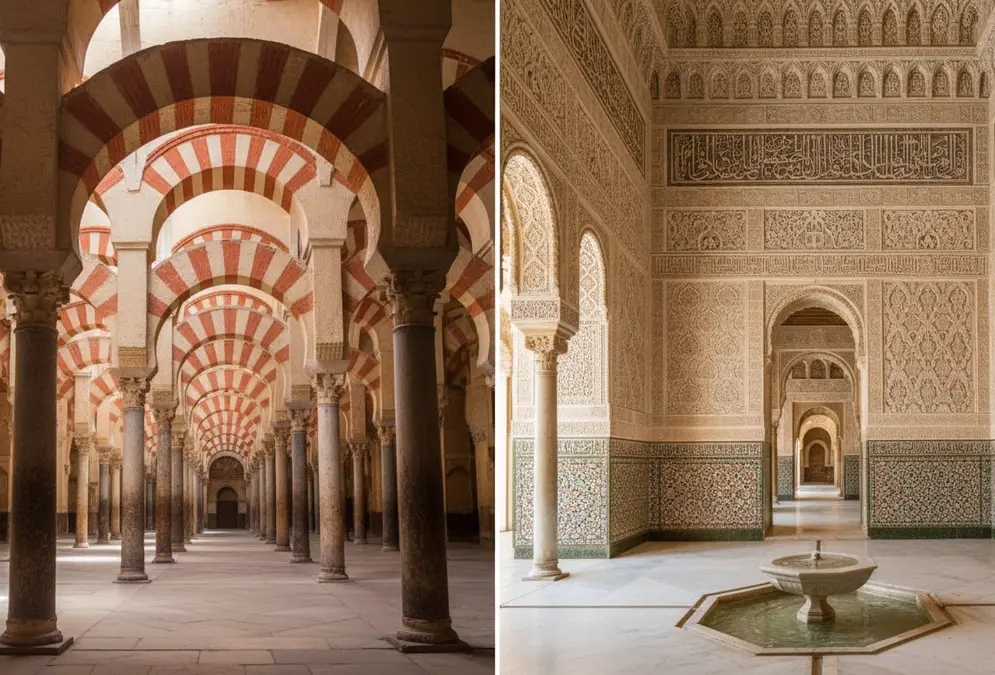
In the 10th century, Córdoba was the largest city in the Western world: a caliphate capital with 500,000 people, 300 mosques, running water in the palaces, and a library of 400,000 manuscripts when most of Europe was functionally illiterate. That past is not abstract here. It's in the geometry of the Mezquita's 856 columns, in the flower-filled courtyard houses of the Judería, in the ruins of Medina Azahara spread across the sierra eight kilometres west of the city.
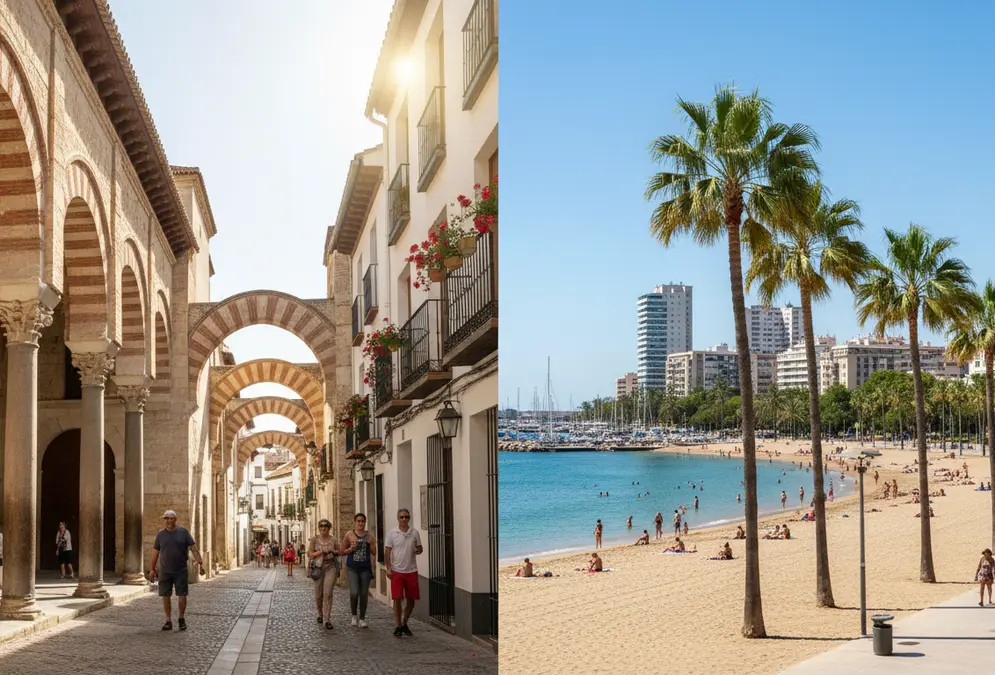
The historic centre is remarkably walkable: train station to Mezquita in 20 minutes on foot. Accommodation in the old city runs €60–100 for a decent double. The set lunch at a serious restaurant (not the tourist strip) is €10–13. In May, the UNESCO-listed Patio Festival opens private courtyard houses that are normally closed to visitors.
Must-sees
- • Mezquita-Cathedral: 856 double arches, caliphal mihrab, Gothic nave inside (€15)
- • Alcázar de los Reyes Cristianos: Roman mosaics, terraced gardens (€7)
- • Judería: UNESCO-listed Jewish quarter, 14th-century synagogue
- • Medina Azahara: caliphal palace city built 936 AD (€3)
Best for
History buffs, architecture enthusiasts, food lovers (meat and wine tradition), slow travel, couples, anyone visiting Spain for the first time.
Córdoba's strengths
- + The Mezquita: no building in Europe compares architecturally
- + UNESCO World Heritage historic centre
- + Authentic Andalusian cuisine (salmorejo, rabo de toro, flamenquín)
- + Compact old city, everything walkable from the centre
- + Lower tourist volumes than Seville or Granada
- + Medina Azahara: no Cádiz equivalent exists
Watch out for
- - Summer heat: 40°C+ in July and August (brutal inland)
- - No beach, no seafront walks
- - Quieter nightlife than Seville or Cádiz
Cádiz: the Atlantic city time forgot
Cádiz claims to be the oldest continuously inhabited city in Western Europe, founded by the Phoenicians around 1100 BC, older than Rome by several centuries. The evidence is everywhere: Punic sarcophagi in the city museum, a Roman theatre discovered under the old town in 1980, Moorish fortifications folded into later Spanish walls. The city sits on a narrow peninsula jutting into the Atlantic, which gives it a quality unlike any other Andalusian city: you are never more than a few minutes from the sea.
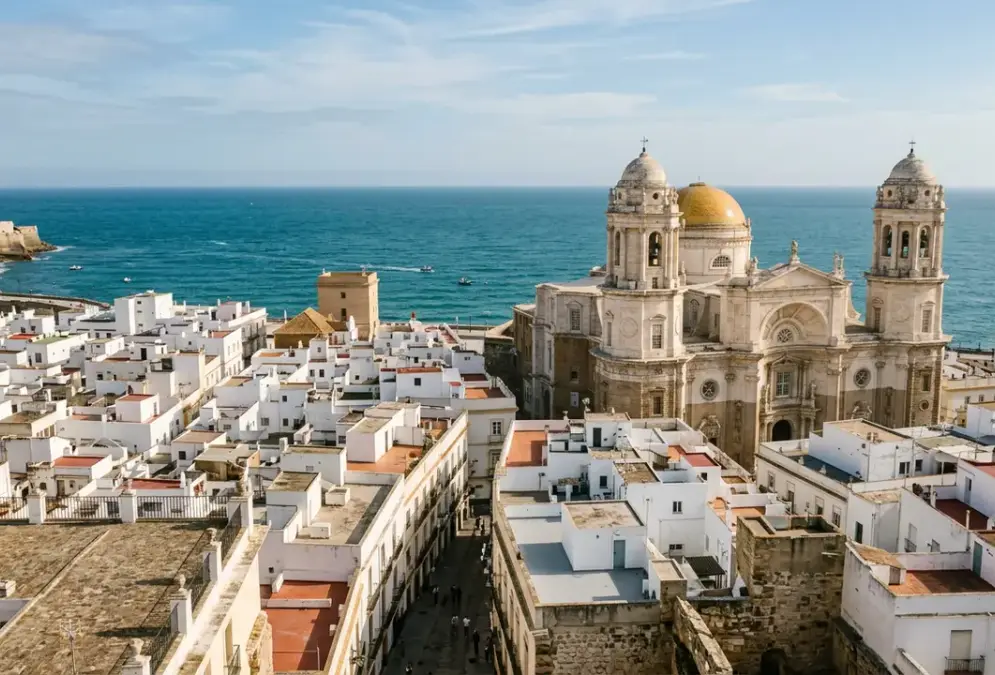
The character is maritime and particular. The gaditano accent is distinct. The light is different: Atlantic flat rather than Andalusian harsh. The baroque cathedral's gold dome, visible from across the bay, is one of the great silhouettes in Spain. And the city's annual Carnival, held in February, is the most celebrated in the country: a week of chirigotas (satirical singing groups) and costumed street theatre that bears no resemblance to the commercial carnivals of northern Europe.
Must-sees
- • Cathedral de Cádiz: baroque neoclassical, gold dome, crypt with Manuel de Falla (€8)
- • Teatro Romano: Roman theatre under the old town, partially excavated (free)
- • Torre Tavira: city's highest tower, camera obscura with live city projection (€8)
- • Barrio del Pópulo: medieval quarter, oldest neighbourhood in the city
- • Playa de la Caleta: small city beach between two forts, iconic Cádiz image
Best for
Seafood lovers, beach holidays, Carnival visits, couples, solo travellers, those wanting Atlantic Spain rather than Mediterranean or inland Andalusia.
Cádiz's strengths
- + Atlantic beaches within walking distance of the old town
- + Best seafood in Andalusia: fritas, almadraba tuna, shrimp fritters
- + Spain's most celebrated Carnival (February)
- + Oldest city atmosphere: 3,000 years of continuous habitation
- + Cooler in summer than inland Andalusia
- + Compact old city on a peninsula, genuinely different feel
Watch out for
- - Fewer marquee monuments than Córdoba, Seville, or Granada
- - Atlantic wind can be strong, not always beach weather
- - Hotels fill early during Carnival (book 3+ months ahead)
Monuments head to head
Mezquita-Cathedral vs Cathedral de Cádiz
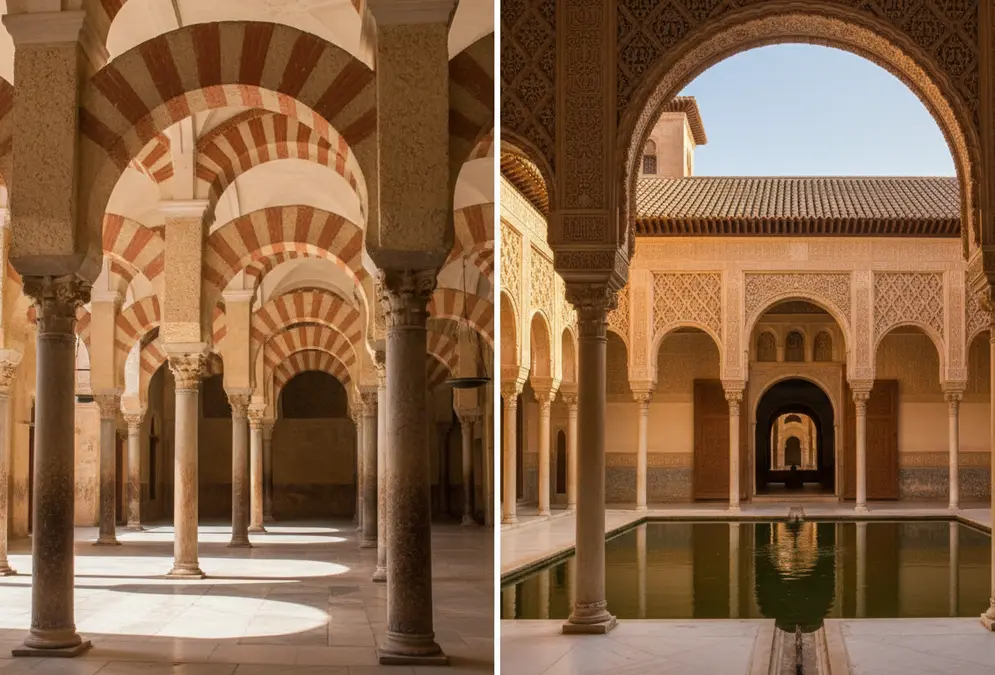
The Mezquita was begun by Abd al-Rahman I in 785 on the site of a Visigothic church. Subsequent caliphs expanded it across two centuries until it covered nearly 24,000 square metres, the rows of jasper and marble columns extending in every direction, the alternating red-and-white voussoirs, the gold mosaic mihrab at the south end. A Gothic cathedral was built inside it in the 16th century; the result is architecturally singular, the only building of its kind in the world. Entry is €15.
Cádiz Cathedral was begun in 1722 and took 116 years to complete, long enough for the style to shift from baroque to neoclassical partway through construction. Its most striking feature is the gold-tiled dome, visible from across the bay and from the upper reaches of the old city. The crypt contains the tomb of Manuel de Falla, the Cádiz-born composer. Entry is €8; free on Monday mornings. It's a fine cathedral, but not in the same category as the Mezquita.
What Cádiz has that Córdoba doesn't
Three thousand years of continuous habitation compress into a small peninsula. The Roman Theatre of Cádiz (discovered in 1980 beneath a residential block) is one of the largest Roman theatres in the Iberian Peninsula, viewable from a dedicated interpretation centre (free). The Phoenician remains in the city museum include two sarcophagi, among the oldest funerary objects in Iberia. And the Atlantic itself: Playa de la Caleta, the small city beach flanked by two 17th-century fortifications, is one of the most atmospheric beaches in Spain.
What Córdoba has that Cádiz doesn't
Medina Azahara, a caliphal city built from scratch in 936 AD, excavated and partially reconstructed 8km west of the centre, has nothing equivalent in Cádiz. The Alcázar gardens hold Roman mosaics. The density of Islamic architecture in the Judería (including the 14th-century Synagogue, one of only three remaining in Spain) gives Córdoba a layered quality Cádiz's open city cannot replicate.
Where you'll eat better
Cádiz and Córdoba represent two entirely different Andalusian food traditions. Cádiz is about the Atlantic catch: pescaíto frito (a plateful of mixed fried fish, delicately battered, eaten standing at a bar) is the city's signature contribution to Spanish food. Tortillitas de camarones (crispy shrimp fritters) are endemic to Cádiz. In spring and early summer (April to June), the almadraba bluefin tuna, caught in the ancient trap-net fishery off the coast between Tarifa and Conil, arrives fresh in city restaurants. This is one of the great seasonal eating experiences in Spain.
Córdoba's food is agricultural, meat-forward, and deeply tied to inland Andalusian tradition. Salmorejo (a thick cold tomato soup finished with olive oil, ham, and hard-boiled egg) is made properly here, not as a tourist concession. Rabo de toro (braised oxtail) has appeared on menus since the city's bullring opened in 1765. Flamenquín (ham and cheese rolled in pork loin, breaded and fried) is local to Córdoba. The wines are from Montilla-Moriles, an appellation that rarely travels: nutty, oxidative, and worth drinking here rather than nowhere. Córdoba's gastronomy runs deep.
For seafood, Cádiz is better than anywhere in inland Andalusia. For depth of culinary tradition and variety, Córdoba has more to offer across several days. If you eat both cities, eat seafood in Cádiz and go inland in Córdoba; the contrast sharpens each.
Getting between the two cities
By train (via Sevilla)
2h30–3h
€20–40 · Change in Sevilla · most common route
By car
~2h30
Petrol + tolls · 215km via A-4 then A-48
By train: Most routes require a change in Sevilla. Take an AVE from Córdoba to Sevilla (about 45 minutes), then a regional train from Sevilla to Cádiz (about 1h40). Book the two legs together via Renfe. The total journey is typically 2h30–3h depending on connection time. Check the Renfe website for current timetables and to compare direct options.
Planning tip: If you're combining both cities, consider routing through Sevilla. Spend a few hours there between trains, or base yourself there for a night. Sevilla is midway between Córdoba and Cádiz and connects to both in under an hour by AVE or regional train. See our Córdoba, Granada and Seville circuit guide for full multi-city routing options.
Pick your city
Choose Cádiz if...
- • Beaches and seafood are your primary motivation
- • You're visiting in February for Spain's best Carnival
- • You want Atlantic Spain, not Mediterranean or inland
- • You've already seen Córdoba, Seville, and Granada
- • You want cooler temperatures; Cádiz is significantly less brutal in summer
Choose Córdoba if...
- • Architecture and Islamic history drive your itinerary
- • You want the single most impressive monument in Moorish Spain
- • Food tradition matters: Andalusian gastronomy at its most distinctive
- • You're visiting in spring (March–May), Córdoba's best season
- • This is your only trip to Andalusia
Have five or six days? Visit both
Fly into Málaga or Seville. Take the train to Córdoba first; two nights covers the Mezquita, Medina Azahara, and a proper dinner in the old city. Then continue to Cádiz via Sevilla (spend a few hours there if time allows): two or three nights on the Atlantic peninsula, beaches in the morning, fritas and wine in the evening. The contrast between the two cities, landlocked caliphate versus open ocean city, is what makes the combination work. Check our Córdoba vs Seville guide, Córdoba vs Granada, Córdoba vs Málaga, or Córdoba vs Toledo to complete your Andalusian planning.
Decided on Córdoba?
Plan your visit with our detailed itineraries, from a single packed day to a three-day deep dive into caliphal history and Andalusian food.
Common questions about Córdoba vs Cádiz
Should I visit Córdoba or Cádiz?
Different trips, different answers. Cádiz is for Atlantic beaches, seafood, and the oldest city atmosphere in Western Europe. Córdoba is for the Mezquita, Islamic heritage, and Andalusian gastronomy. Both are in Andalusia and connect by train in about 2.5–3 hours; most visitors who come this far do both.
Can I do Córdoba as a day trip from Cádiz?
It's long but doable. Take an early train via Sevilla (depart by 7–8am, arrive Córdoba by 10–11am), spend 5–6 hours on the Mezquita, Judería, and old town, return by early evening. The train requires a change in Sevilla in most timetables. An overnight in Córdoba is more comfortable and gives you Medina Azahara the next morning. See our getting to Córdoba guide for full timetable info.
Which city is cheaper: Córdoba or Cádiz?
Both are among the most affordable cities in Andalusia. Cádiz accommodation can be slightly higher in summer (beach demand), while Córdoba charges more in May during the Patio Festival. Day-to-day costs are similar: expect €60–75 per day including food and one monument entry. Córdoba's set lunches (€10–13) compare well with Cádiz's seafood bars (€12–18 for fritas and a drink).
Which has better food: Córdoba or Cádiz?
Different strengths. Cádiz has exceptional seafood: pescaíto frito (fried fish), tortillitas de camarones (shrimp fritters), and almadraba bluefin tuna in season (April–June). Córdoba's food is meat-forward and agricultural: salmorejo, rabo de toro (braised oxtail), and montilla-moriles wines. If you eat seafood, Cádiz wins on its home turf. If you want a full Andalusian table, Córdoba's tradition runs deeper.
Further reading
Official sources
3 references Show Hide
- Turismo de Córdoba (opens in a new tab)
Official information on Córdoba's monuments, events and visitor services
- Turismo de Cádiz (opens in a new tab)
Official tourism website for the city of Cádiz
- Renfe (opens in a new tab)
Timetables and fares for trains between Córdoba, Sevilla and Cádiz