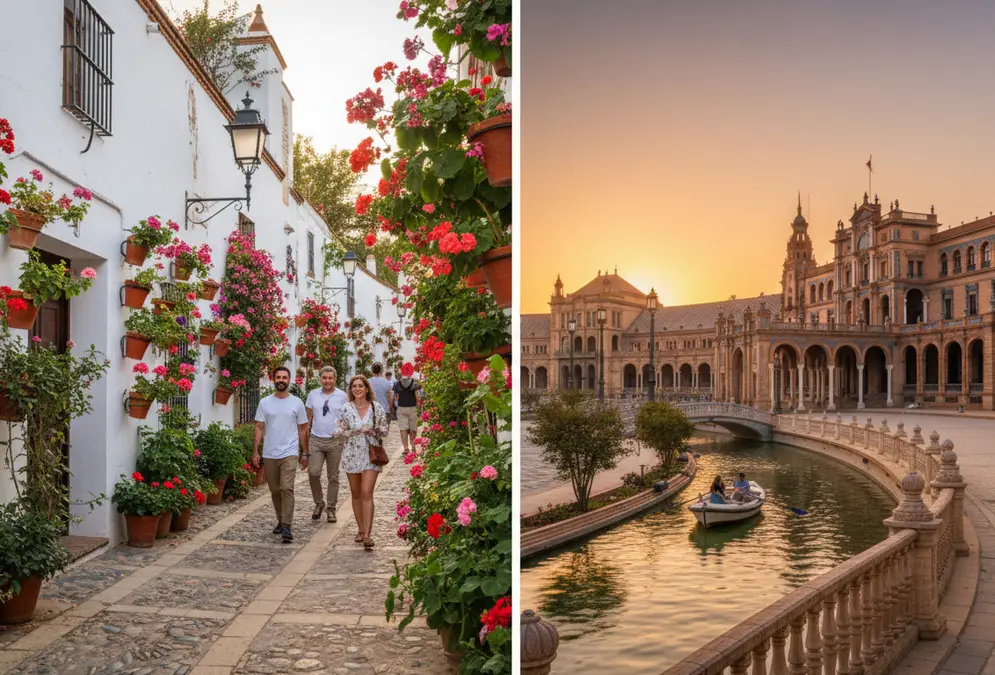
City comparison
Córdoba vs Seville
Most visitors treat Córdoba as a day trip from Seville. Here is why that is a mistake, and what the extra night actually gives you.

Written by
María Fernanda González Ten years covering Córdoba's UNESCO heritage sites, sourcing from Junta de Andalucía documentation.
Updated Published
At a glance
- Distance
- 45 min by AVE
- Córdoba duration
- 1–2 days
- Seville duration
- 3–4 days
- Córdoba cheaper?
- Yes, 30–40% lower on hotels
- Córdoba wins
- Mezquita, Medina Azahara, less crowded
- Seville wins
- Alcázar, Giralda, flamenco scene, size
In this guide
Jump to a section
Which city suits you?
Choose Córdoba if…
- • Budget matters: 26% cheaper than Seville
- • You want fewer crowds and a quieter pace
- • Islamic architecture and history are your priority
- • You are happy staying 2–3 nights somewhere compact
- • You want the densest UNESCO heritage in Andalusia
Choose Seville if…
- • You are flying in or out (Seville has the only international airport)
- • Nightlife, flamenco shows, and late bars are non-negotiable
- • You want more restaurants, museums, and shopping
- • A longer stay (4–5 days) suits your trip
- • You enjoy big-city energy and shopping
The AVE train covers the 140 km between them in 45 minutes for €10–25. In most itineraries, the real question is not which one but how many nights each. See the combining both cities section for suggested splits.
Side-by-side comparison
| Category | Córdoba | Seville |
|---|---|---|
| Flagship monument | Mezquita-Cathedral (€15) | Cathedral + Real Alcázar (€31) |
| Ideal duration | 2–3 days | 3–5 days |
| Budget/day | €70 | €95 |
| Hotel (double) | €60–90 | €80–120 |
| Set lunch menu | €10–13 | €12–16 |
| Train between cities | AVE 45 min, €10–25 | |
| Atmosphere | Intimate, authentic | Vibrant, cosmopolitan |
| Best season | Mar–May, Oct | Mar–May, Oct–Nov |
| Crowds | Moderate | Very heavy |
| International airport | No (use Seville or Málaga) | Yes (28 airlines) |
Córdoba: the intimate one
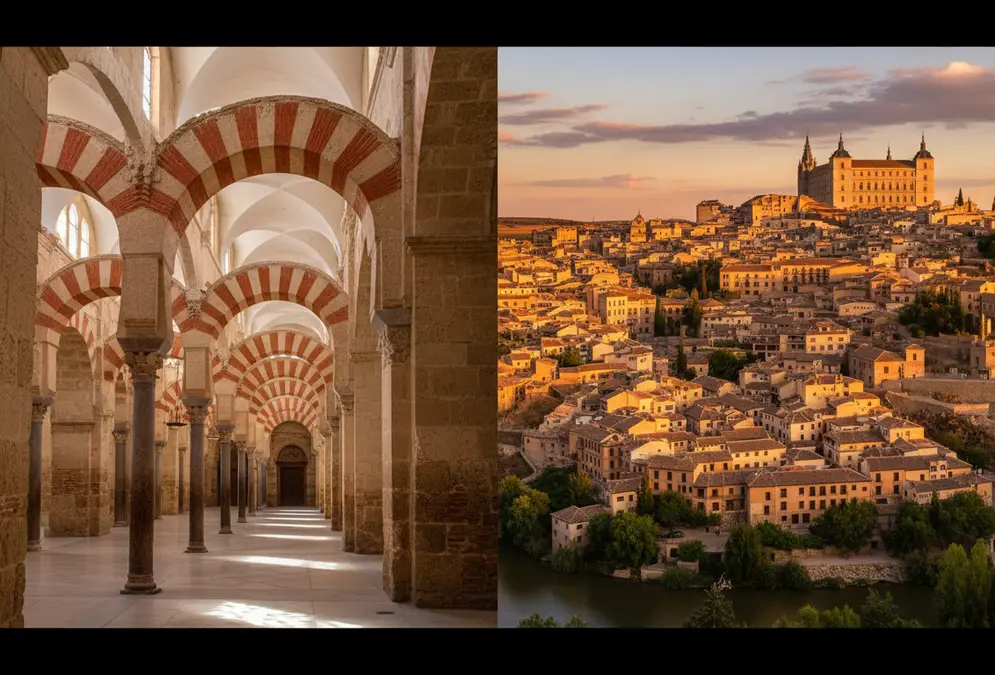
In 929 AD, Córdoba was the largest city in Western Europe. The Mezquita-Cathedral, begun in 785 by Abd al-Rahman I and expanded for two centuries, is the physical record of that era. Its 856 columns of jasper and marble, lit by a forest of hanging lanterns, stop people in their tracks in a way no photograph captures. The cathedral inserted inside it in the 16th century adds a layer of architectural collision that still provokes arguments about whether it was genius or vandalism. If the Alhambra is on your agenda too, see our Mezquita vs Alhambra guide.
The city around it is small (the historic centre fits inside a 20-minute walk), and that compactness is one of its strongest points. The Judería, the old Jewish quarter, is a UNESCO World Heritage Area of whitewashed lanes and orange trees. Eight kilometres west, Medina Azahara, the 10th-century caliphal palace city, sits largely unrestored on a hillside, which gives it a raw quality that more heavily reconstructed sites lack.
Must-sees
- • Mezquita-Cathedral: 856 columns, forest of arches (€15, free 8:30–9:30am)
- • Judería: UNESCO Jewish quarter, flower-lined lanes
- • Medina Azahara: 10th-century palace city, half-day excursion (€3)
- • Roman Bridge: sunset views, free, no queues
- • Patio Festival (May): private courtyards open to the public
Best for
History enthusiasts, budget travellers, couples, photographers, anyone wanting authentic Andalusia without the tourist pressure of Seville.
Strengths
- + 26% cheaper than Seville across all categories
- + Compact and entirely walkable
- + Richer historical layers: Roman, Islamic, Jewish, Christian
- + Salmorejo homeland: the food heritage is real
- + Moderate crowds even in high season
Limitations
- - No international airport
- - Limited nightlife compared to Seville
- - Summer heat is brutal (40°C+ in July–August)
Seville: the big one
Seville does everything loudly. The Cathedral is the world's largest Gothic church. The Real Alcázar's Mudéjar tilework is among the most technically intricate in Europe. The Feria de Abril fills an entire neighbourhood with casetas for a week every spring. Flamenco here is not a tourist show; it is woven into the city's fabric in ways that neighbourhood tablaos make evident. Most visitors to Andalusia fly into Seville, which naturally shapes itineraries around it.
The trade-off is scale and price. Seville requires more time to do properly: 3 to 5 days versus Córdoba's 2 to 3. Tourist prices in the Santa Cruz neighbourhood are noticeably higher than anywhere in Córdoba. In April and October, the city is extremely busy; queues at the Real Alcázar run to two hours without a timed ticket.
Must-sees
- • Real Alcázar: Mudéjar palace and gardens (€16, book ahead)
- • Cathedral and Giralda tower: world's largest Gothic cathedral (€12)
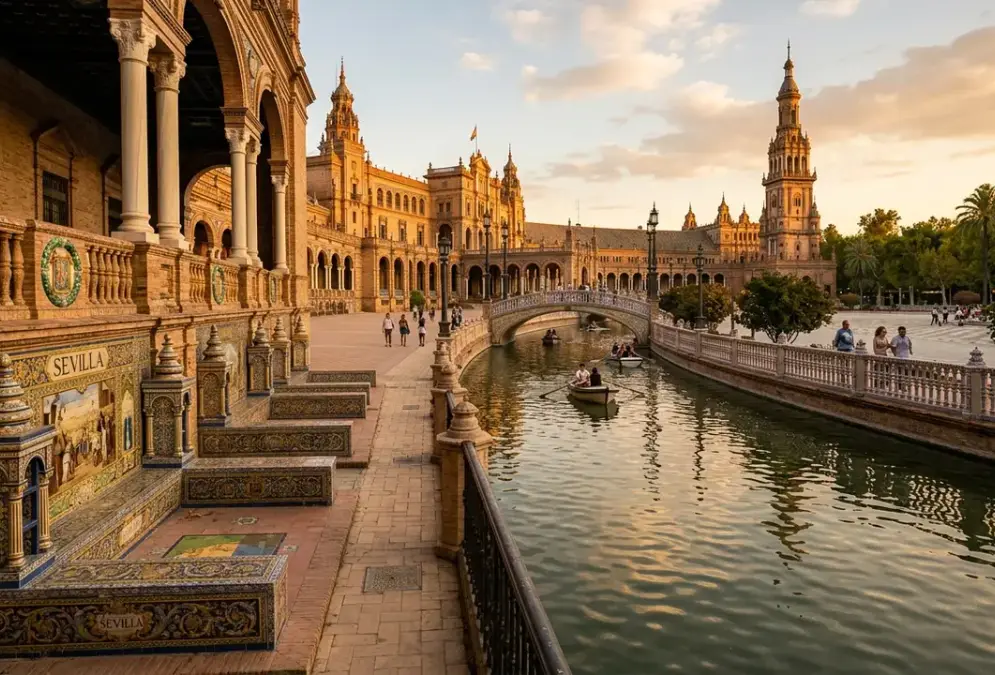
- • Plaza de España: 1929 neo-Mudéjar monument (free)
- • Triana: ceramics, tapas, flamenco bars across the river
- • Metropol Parasol (Las Setas): panoramic views (€5)
Best for
First-time visitors to Andalusia flying in direct, nightlife and gastronomy lovers, flamenco enthusiasts, shoppers, 4–5 day stays.
Strengths
- + International airport (direct routes from 28 airlines)
- + Best nightlife and restaurant range in Andalusia
- + Feria de Abril and Semana Santa
- + More museums (fine art, flamenco, maritime)
- + Good base for day trips (Cádiz, Jerez, Huelva)
Limitations
- - Most expensive city in Andalusia
- - Very heavy tourist crowds, especially in spring
- - Spread out — Triana and La Macarena need bus or taxi
Food and tapas
What Córdoba does best
Córdoba punches above its weight on food. Salmorejo — the thick cold tomato and bread soup that most visitors mistake for gazpacho — originated here, and the versions served in local restaurants bear little resemblance to the thin imitations found elsewhere. Córdoba's gastronomy also centres on rabo de toro (slow-braised oxtail), flamenquín (fried pork roll), and a regional wine tradition from the Montilla-Moriles DO — bone-dry finos and amontillados that pair naturally with the local cooking.
The restaurant scene is concentrated and manageable. A set lunch menu at a good local restaurant — three courses, bread, and a glass of wine — runs €10–13. The tapas circuit around the Judería and Tendillas areas offers serious food at bar prices.
What Seville does best
Seville has more restaurants, more variety, and more innovation — but also more tourist-trap menus near the Cathedral and Real Alcázar. The real Sevillian food scene lives in Triana, La Macarena, and the Alameda neighbourhood, where a generation of chefs have updated traditional tapas with sharper technique. The city's montaditos (small open sandwiches) culture and the sheer density of good tapas bars in the right neighbourhoods give it an edge on volume.
Budget note: set lunch menus in Seville run €12–16, roughly 20–30% more than equivalent meals in Córdoba. Near the Cathedral, expect to pay considerably more.
What the day-trippers miss
Most day-trippers arrive around 10am, see the Mezquita, walk the Judería, and catch the return train by 3–4pm. By that point the tour groups have cleared out. The streets around the Judería quiet down. Café chairs scrape on stone as locals settle in for the evening. That Córdoba — the one that actually belongs to the city — runs from 4pm onwards, and day-trippers never see it.
What you gain depends on how many nights you add.
Typical day trip
- • Mezquita-Cathedral (10am–2pm, with 800+ others inside)
- • Judería streets (quick pass before lunch)
- • Alcázar gardens (if time permits)
- • Lunch near the tourist zone
- • Return train 3–4pm
Night 1 unlocks
- • Mezquita at 8:30am: free entry, 20 people inside instead of 800. The forest of columns reads completely differently in the quiet.
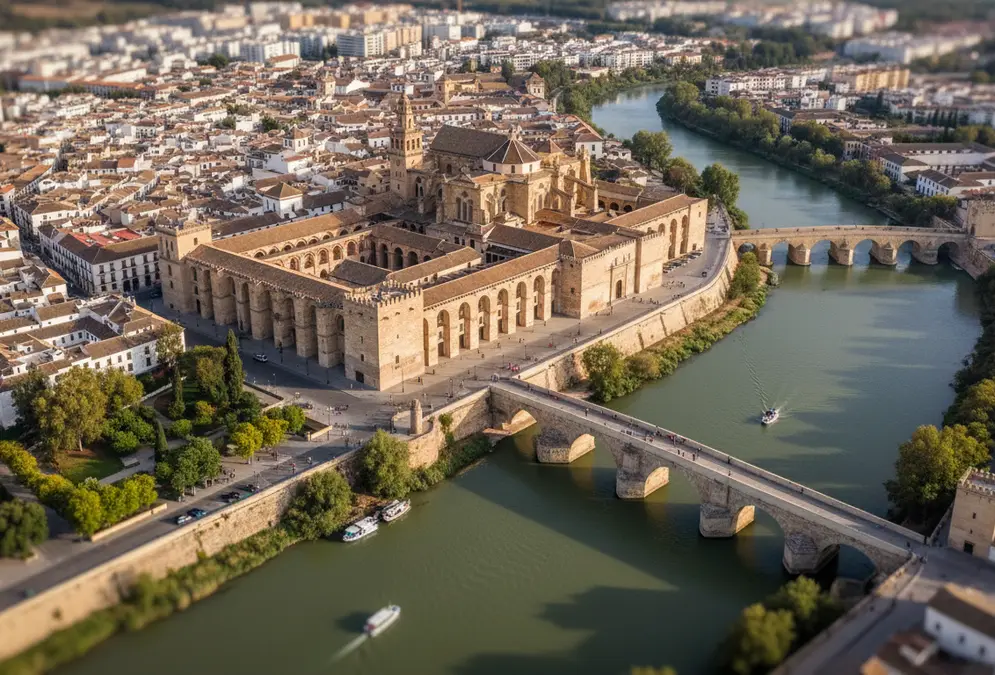
- • Sunset from the Roman Bridge: the tower and mosque turn copper as the light drops. No ticket, no queue.
- • San Basilio and San Lorenzo: residential neighbourhoods day-trippers never reach. Bars with no English menus. Locals eating at 9–10pm.
- • Dinner at local hours: kitchens in Córdoba don't take food seriously before 9pm.
- • Patio Festival (approx. 5–18 May 2027): day-trippers from Seville leave before the patios hit golden hour and before 9pm, when queues thin and the courtyards go quiet. This is the clearest argument for staying the night in May.
Night 2 unlocks
- • Medina Azahara: give it the full half-day it needs. The 10th-century caliphal palace city, built by Abd al-Rahman III from 936 and destroyed just 70 years later, is 8 km west of town. There is a shuttle bus. It takes at minimum two hours to walk properly. No day-trip itinerary from Seville can include it.
- • Plaza de la Corredera and Tendillas tapas. The central areas away from the Judería, where the food is better and the prices are lower.
- • The city's rhythm, rather than a forced march through monuments. Córdoba is a city that opens up when you stop trying to see everything in one go.
Our overnight guide makes a fuller case for staying, including which hotel neighbourhoods put you closest to the morning Mezquita and the best evening spots.
Crowd levels: why Córdoba feels different
Córdoba receives roughly 1.8 million visitors a year. Seville handles around 5 million. The raw numbers understate the difference in how those visitors are distributed through space and time.
Córdoba's tourism runs almost entirely on day-trippers. Visitors arrive by AVE from Seville (45 minutes) or Madrid (1 hour 45 minutes). The wave hits between 9am and 11am, concentrates on a triangle of maybe 800 metres (Mezquita, Judería, Alcázar) and drains back to the station by 4pm. By 5pm, the streets around the Calleja de las Flores are quiet. Not quiet for a tourist city. Quiet.
Walk 10 minutes from the Mezquita into San Basilio or San Lorenzo and the infrastructure of mass tourism disappears. The bar menus are handwritten in Spanish and change with the season. Lunch service runs 2pm to 4pm because that is when locals eat, not because anyone is performing tradition for visitors. The neighbourhood has a post office, a pharmacy, a fruit stall. The buildings have washing lines. This is what Seville's Santa Cruz looked like before it became almost entirely tourist-facing: souvenir shops, roof terraces, English-language menus.
Choose which version of a city you want: one that stays manageable, where a working Andalusian life still happens around you, or one where the visitor layer has become the city itself.
When Córdoba is crowded
Two periods break this pattern entirely: Festival de los Patios (early to mid-May, when private courtyards compete for the best blooms and the whole city mobilises around it) and Semana Santa, which falls in late March or April depending on the year. Both events bring genuine crowds, higher hotel prices, and advance booking requirements. Outside these two windows, the city returns to its normal rhythm, and visiting just before or just after either festival often combines cultural momentum with manageable streets.
Budget comparison
| Expense | Córdoba | Seville |
|---|---|---|
| Flagship monument(s) | €15 (Mezquita) | €31 (Cathedral + Alcázar) |
| Hotel, double room | €60–90 | €80–120 |
| Set lunch menu | €10–13 | €12–16 |
| Evening tapas (2 people) | €20–30 | €28–40 |
| Average daily budget | €70 | €95 |
3-day trip total costs
| Category | Córdoba budget | Córdoba mid | Seville budget | Seville mid |
|---|---|---|---|---|
| Accommodation (3 nights) | €120–180 | €210–270 | €165–240 | €270–360 |
| Meals (3 days) | €60–80 | €90–120 | €80–100 | €120–160 |
| Attractions | €15–20 | €25–35 | €31–45 | €50–70 |
| Local transport | €0–5 | €5–10 | €15–25 | €20–35 |
| Evening out (bars, wine) | €20–35 | €40–60 | €30–50 | €55–80 |
| 3-day total (per person) | €213–320 | €370–495 | €321–460 | €515–705 |
Saving money in Córdoba
- Free Mezquita entry: 8:30–9:30am Monday to Saturday (check current schedule on arrival). The €15 ticket covers the rest of the day.
- Set lunch menus: €10–13 for three courses in restaurants around Plaza de la Corredera and Tendillas, far from the tourist zone and far better value.
- Walk everywhere: The entire historic centre is under 1.5 km across. You will not need a taxi, a bus, or a ride-share for three days.
- Medina Azahara: €3 for EU residents (free for some). Take the shuttle bus (€3 return) rather than a taxi.
Saving money in Seville
- Book Real Alcázar timed tickets online: The walk-up queue regularly runs two hours, and last-minute tickets carry a €5 convenience markup. Book 2–3 days ahead on the official site.
- Eat in Triana, not Santa Cruz: Cross the river. The same quality of tapas costs 30–40% less in Triana than in the streets around the Cathedral.
- Get a bus pass: Seville's neighbourhoods are spread out. A 10-trip bus pass costs €9.30 and covers most crossings you will need.
- Plaza de España is free: One of the most photographed places in Andalusia. No ticket, no queue, and less crowded before 10am.
For a detailed breakdown of how to keep costs down in Córdoba, including free sights, cheap eats, and timing the Mezquita free entry, see our Córdoba on a budget guide.
Match your trip style
First time in Andalusia, flying into Seville
Add 2 nights in Córdoba before Seville. The Mezquita is the stronger first monument, and Córdoba's quieter streets are an easier entry point than Seville's intensity.
Budget-conscious, 5–7 days
Weight your nights toward Córdoba. Three nights there costs about the same as two in Seville, and you get more monuments per euro.
Nightlife and dining come first
Seville. The Alameda de Hércules, Triana, and La Macarena neighbourhoods have a genuine late-night culture. Córdoba's bar scene is enjoyable but smaller. Our Córdoba bars guide covers the best options.
Drawn to Islamic architecture
Córdoba, without question. The Mezquita is the most complete surviving example of Umayyad architecture outside Syria. Medina Azahara adds another layer. Seville's Mudéjar monuments are excellent but later and less singular.
Travelling with young children
Córdoba for the walkability and manageable scale. The Alcázar gardens hold attention, and the city's flat historic centre is pushchair-friendly.
Have a week or more, want both
2–3 nights in Córdoba, then 3–4 in Seville. The train takes 45 minutes. See the combining section below. Also comparing with Granada? See our Córdoba vs Granada guide. For a wider Andalusia loop, our Córdoba, Granada and Seville comparison adds the third city.
Combining Córdoba and Seville
The AVE connects Córdoba Central and Seville Santa Justa in exactly 45 minutes, with around 40 services daily from 6am to 11pm. Tickets booked in advance start at €10; walk-up fares run €20–25. This frequency makes the combination easy to build around.
D1–D3
Córdoba (2–3 nights)
Arrive on an AVE times and fares from Madrid (1h45) or fly into Seville and connect. Mezquita, Judería, Alcázar, Medina Azahara. See our 2-day Córdoba itinerary. Extending to Granada afterwards? See the Córdoba to Granada day trip.
AVE Córdoba → Seville (45 min, €10–25, book ahead)
D4–D8
Seville (3–4 nights)
Real Alcázar, Cathedral, Plaza de España, Triana, flamenco. Book the Alcázar in advance; timed slots sell out. See the Seville–Córdoba day trip itinerary if you are based in Seville first.
Transport tip: If flying home from Seville airport, finish there. If flying from Málaga, you can end the trip in Córdoba (Málaga airport is 1h30 by AVE). See our getting to Córdoba guide for all transport options.
Planning your Córdoba stay?
Our hotel guide covers the best accommodation in the historic centre. Our itineraries handle the rest.
Common questions
Should I visit Córdoba or Seville?
Both, if your schedule allows. The AVE covers the 140 km in 45 minutes for as little as €10. If you have to pick one: choose Seville for international flights, more museums, and nightlife. Choose Córdoba for a quieter pace, a lower budget, and the Mezquita-Cathedral, the monument most visitors rank as their top Andalusia experience. The two cities complement each other well.
Is Córdoba worth more than a day trip from Seville?
Yes, and it is not close. Day-trippers arrive around 10am, see the Mezquita, rush through the Judería, and catch the train back by 3pm. What they miss: empty streets at sunset, the early-morning Mezquita (free 8:30–9:30am with almost nobody inside), Medina Azahara palace city 8 km west, the San Basilio and San Lorenzo neighbourhoods, and dinner at the hour locals actually eat (8–10pm). Even one night transforms the experience.
Is Córdoba cheaper than Seville?
Yes, roughly 26% cheaper across the board. A double hotel room costs €60–90 vs €80–120 in Seville. The Mezquita admission is €15; Seville's Cathedral plus Real Alcázar combined is €31. A set lunch menu runs €10–13 vs €12–16. Average daily budget: €70 in Córdoba, €95 in Seville. See our budget guide for a full breakdown.
How do you get from Seville to Córdoba?
AVE high-speed train: 45 minutes, 40+ daily services, €10–25 depending on how far ahead you book. Trains run from around 6am to 11pm between Seville Santa Justa and Córdoba Central. The bus takes about 2 hours and costs €12–15. Driving is 1h30 on the A-4 motorway.
Can you visit both Seville and Córdoba on the same trip?
Absolutely. The 45-minute train makes it simple. The classic combination: 2–3 nights in Córdoba first, then 3–4 nights in Seville. Starting with Córdoba's quieter pace before Seville's energy works well as a sequence. Alternatively, use Seville as a base with a day trip to Córdoba, though a night in Córdoba reveals far more than a day visit.
Further reading
Official sources
3 references Show Hide
- Turismo de Córdoba (opens in a new tab)
Official tourism information for Córdoba, monuments, and events
- Visit Seville (opens in a new tab)
Official tourism office of Seville
- Renfe (opens in a new tab)
Timetables and fares for AVE high-speed trains between Córdoba and Seville
Before committing to Córdoba, read our guide to whether Córdoba is worth visiting — with an honest look at who loves the city and who might prefer Seville.
Recommended Tours & Activities
Tours are selected for quality, not commission. We earn a small fee if you book — at no extra cost to you.
Best Seller
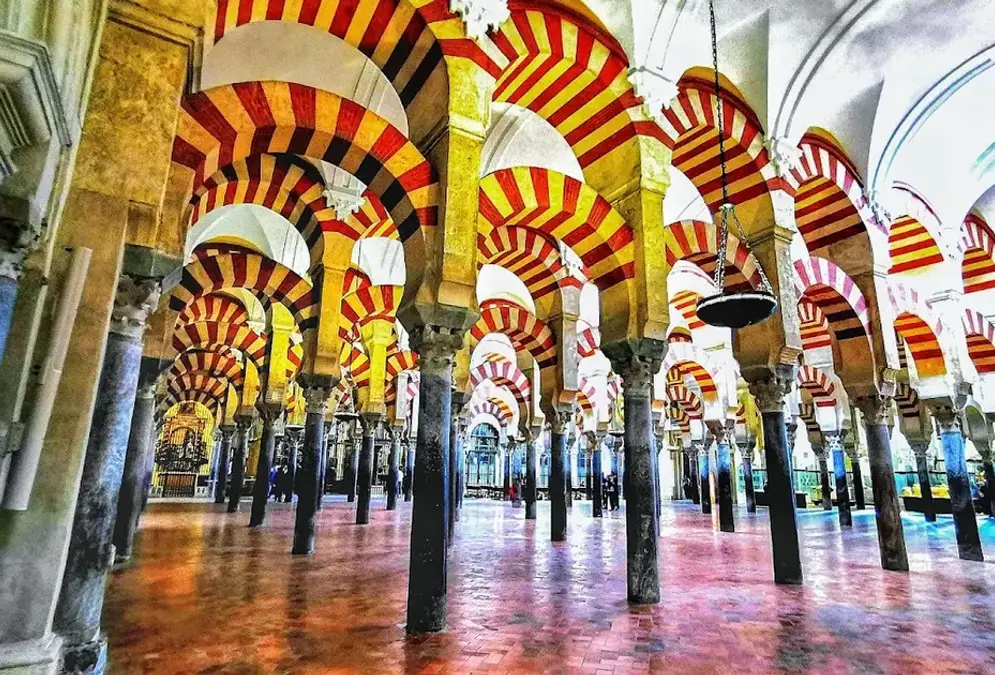
Mosque-Cathedral Skip-the-Line Guided Tour
Skip the queue and explore the Mezquita-Cathedral with a knowledgeable local guide. Discover 13 centuries of layered history in one of Spain's most iconic monuments.
Skip the line 1.5 hours
From €29
4.7 (7,293 reviews)
Reserve Your Spot
✓ Verified GetYourGuide reviews
Books up weeks ahead in peak season
From Seville: Córdoba Full-Day Tour
Discover Córdoba on a guided full-day trip from Seville. Visit the Mezquita-Cathedral, stroll the Jewish Quarter, and explore the Alcázar with a knowledgeable guide. Transport included.
10 hours
From €55
4.6 (781 reviews)
Reserve Your Spot
✓ Verified GetYourGuide reviews