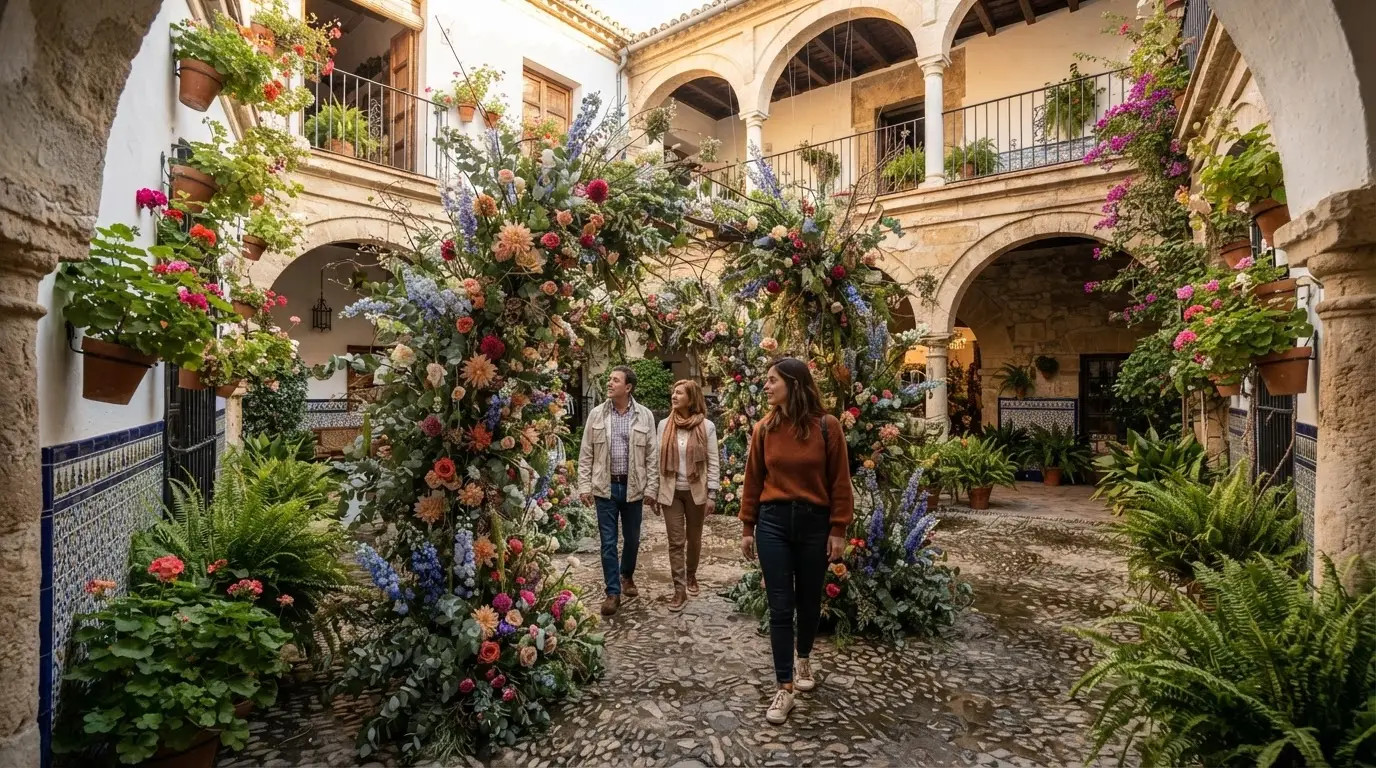

FLORA costs nothing to attend. Its economic impact does not.
Entry to FLORA's floral installations is free[5]: no ticket line, no box-office revenue, nothing that would appear as festival income on a balance sheet. That absence of ticket revenue is exactly why the festival needs an economic-impact study at all: without one, the only number anyone could point to would be what the city and its partners spend to stage it, not what the festival actually returns to Córdoba's economy.
For the 2025 edition, the festival's eighth, that spending came to €613,031, split evenly between goods and services and salaries.[2] Universidad Loyola Andalucía's report, published in February 2026, puts what that budget generated at €66.9 million in gross-production terms for the province, equivalent to €32.9 million in GDP terms, plus 127 full-time-equivalent jobs.[1] Total visits over the festival's run reached 197,773.[4]
That gap, a budget just above half a million euros producing an output over a hundred times larger, is not evidence of inflated accounting. It is the entire point of an economic-impact study: to trace how an initial injection of public and private spending ripples outward into sectors that never appear on the festival's own books. Readers planning an actual visit should check the practical guide to visiting FLORA for dates, tickets and venues; this piece is about the money, not the itinerary.
How economists actually measure what a free festival is worth
Loyola's method is a Social Accounting Matrix (Matriz de Contabilidad Social, MCS), built specifically for Córdoba province and run through a multisectoral general equilibrium model.[3] That structure is what lets researchers separate a festival's effects into three distinct layers rather than reporting one blended number:
- Direct effects: the festival organiser's own spending, on wages, contracted artists and site fitting.[6]
- Indirect effects: what attendees spend because the festival exists, on hotel nights, restaurant meals, transport and shopping.[7]
- Induced effects: the further rounds of spending, as the waiters, hoteliers and suppliers who were just paid spend those wages elsewhere in the local economy.[8]

Explore nearby · Monument
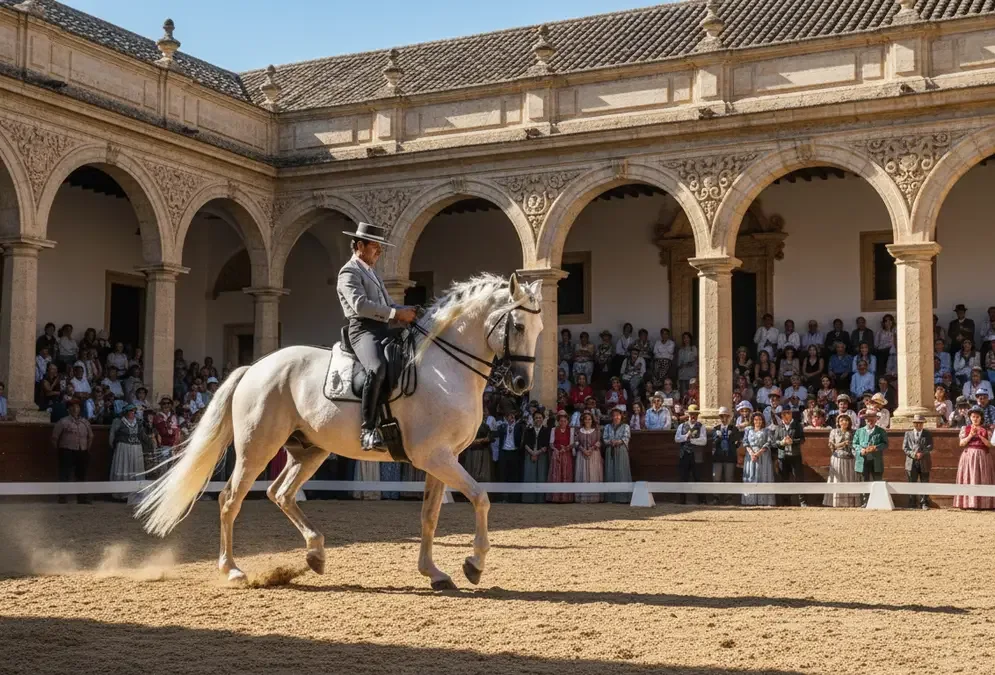
Caballerizas Reales de Córdoba
Philip II's 1568 Royal Stables, birthplace of the Andalusian horse. Evening show combining classical dressage, vaquera riding and flamenco. UNESCO heritage.
The underlying mathematics predates FLORA by decades. Economist Wassily Leontief's input-output tables, built to map how sectors buy from and sell to each other, remain the standard instrument for tracing how tourism spending cascades through an economy's supply chains.[9] The tourism multiplier effect itself, the coefficient measuring how much total economic activity a unit of tourist spending generates, was first defined by economist Harry G. Clement in 1961.[10] Get the boundaries wrong, though, and a report inflates itself: the most common trap in an event's economic-impact study is double counting, booking the same euro of spending under two different effect categories.[11]
Applied to FLORA, that discipline turns a hunch that the festival is good for tourism into a number a city council can budget against, and it is why the 2023 and 2025 reports, produced two editions apart by the same research team using the same model, can be compared at all.
From €613,031 to €66.9 million: how the multiplier works
Three ratios do the actual translating. FLORA's 2025 budget attracted tourist spending 16.16 times its own size, the efecto tractor ('tractor effect'), and earned media coverage worth 19.36 times that budget in advertising-equivalent value, the efecto de difusión ('diffusion effect').[12] On top of both, Loyola's general-equilibrium model found that every euro attributable to the festival generated €2.98 of economic activity across the province, unchanged from the ratio recorded the year before.[13]
Recommended tours
Tours are selected for quality, not commission. We earn a small fee if you book — at no extra cost to you.
Two years earlier, the ratios were smaller but told the same story. The 2023 edition's tourist spending of €7.6 million was 15.2 times that year's budget[14]; its €6.7 million in earned media value was 13.4 times the same budget[15]; and its multiplier stood at 2.7, meaning every attributable euro then generated €2.70 in provincial activity.[16] Both ratios grew between 2023 and 2025: proof, in Loyola researcher Pilar Campoy's words, of an event reaching 'return ratios near three times its direct spending,' something she calls strategically relevant for territorial and tourism planning.[17]
The 2023 report also introduced the split that matters for reading every FLORA figure since: that edition's impact came out at €40.2 million in gross-production terms and, from the very same report, €16.4 million in GDP terms, two measurements of one edition, not two competing estimates.[18][19] The 2024 edition added €52.5 million in production terms and 103 jobs, though no GDP-terms figure appears in Loyola's published reporting for the 2024 edition.[20] Laid side by side, the three most recent editions show a clear upward line on whichever metric each of them actually reports:
| Edition | Production terms | GDP terms | Jobs |
|---|---|---|---|
| 2023 (6th) | €40.2M | €16.4M | 59 |
| 2024 (7th) | €52.5M | Not reported | 103 |
| 2025 (8th) | €66.9M | €32.9M | 127 |
Where the money lands: hotels, restaurants, transport and jobs
Around 40,000 of FLORA 2025's visitors were directly linked to cultural tourism, meaning they came to Córdoba because of the festival rather than for other reasons, and their spending came to approximately €9.9 million, 60% of it from other Spanish regions and 40% from abroad.[21]
More than 80% of that spending went straight into the tourism sector, followed by retail, transport and food.[22] Loyola's 2023 report described the same pattern in broader terms: FLORA significantly affects services tied directly to tourism activity, accommodation, restaurants and transport, but its reach also extends into commerce and the rest of the supply chain behind them.[23]
The employment side of that spending is concrete: 127 full-time-equivalent jobs across the province from the 2025 edition, more than double the 59 jobs the 2023 edition generated.[1][24] Set against the whole of Córdoba province, FLORA's 2025 footprint equals roughly 0.13% of provincial production, 0.18% of provincial GDP and 0.21% of provincial employment, a single festival week moving a fraction of a percentage point that a city council can point to and defend.[25]
One edition, three editions, or an average? Reading FLORA's figures correctly
A separate study, published by economists Pilar Campoy and Luz Dary Beltrán through the Asociación Española de Ciencia Regional (AECR), adds a third kind of number to the pile: not a single edition's result, but a three-edition annual average covering 2022 to 2024.[27] On that basis, an average yearly budget of about €550,000 attracted roughly €8 million a year in tourist spending, translating into a total impact of €15.5 million a year, additional production of €42.2 million a year, and more than 61 jobs created annually.[28]
The AECR study's own ratios sit close to, but not identical with, Loyola's single-edition figures: an average production multiple of 2.7 times what was invested, a media effect 12.9 times the budget, and a tourist-spending tractor effect of 14.6 times the budget across those three years, with each edition adding roughly 0.1% to the province's production, GDP and employment.[29][30]
Loyola's own most recent report adds yet another aggregate on top of these: a cumulative 2023 to 2025 average of €53.6 million a year in production and more than 103 jobs a year, which is neither the AECR figure above nor any single edition's total, and should not be quoted as either.[31]
Is FLORA worth it, and is the return growing?
Córdoba's city council did not wait for three editions of data before acting on the first one. After the 2023 report landed, the council raised its annual sponsorship for FLORA to €400,000, a public bet that the return the study measured was real.[33] By 2025 that public money sat inside a total direct budget of €613,031, meaning the council covered roughly two-thirds of what FLORA spent before a single euro of multiplier effect was counted.[2]
The number behind that bet is FLORA's raw draw. The 2023 edition ran 11 days and drew more than 150,000 visits across its six exhibition-open days, despite rain that depressed turnout that year.[34] The 2025 edition, running 13 to 23 October across sites including the Palacio de Viana, the Patio de los Naranjos and the Archaeological Museum, drew 197,773 visits to a city of roughly 325,000 people, a visit count equivalent to more than 60% of the city's population, a scale comparison rather than a participation rate, since the total counts repeat visits by the same people alongside first-time ones.[35]
For scale, Edinburgh's International Festival, one of Europe's most established arts festivals, drew almost 400,000 spectators over about 24 days in 2010 and generated close to £21 million in impact on a production-terms basis, the same basis as FLORA's own headline figure, plus 437 jobs.[36] FLORA, run on a fraction of that budget and over less than half as many days, is already producing comparable output relative to its size.
Deep dive · Article
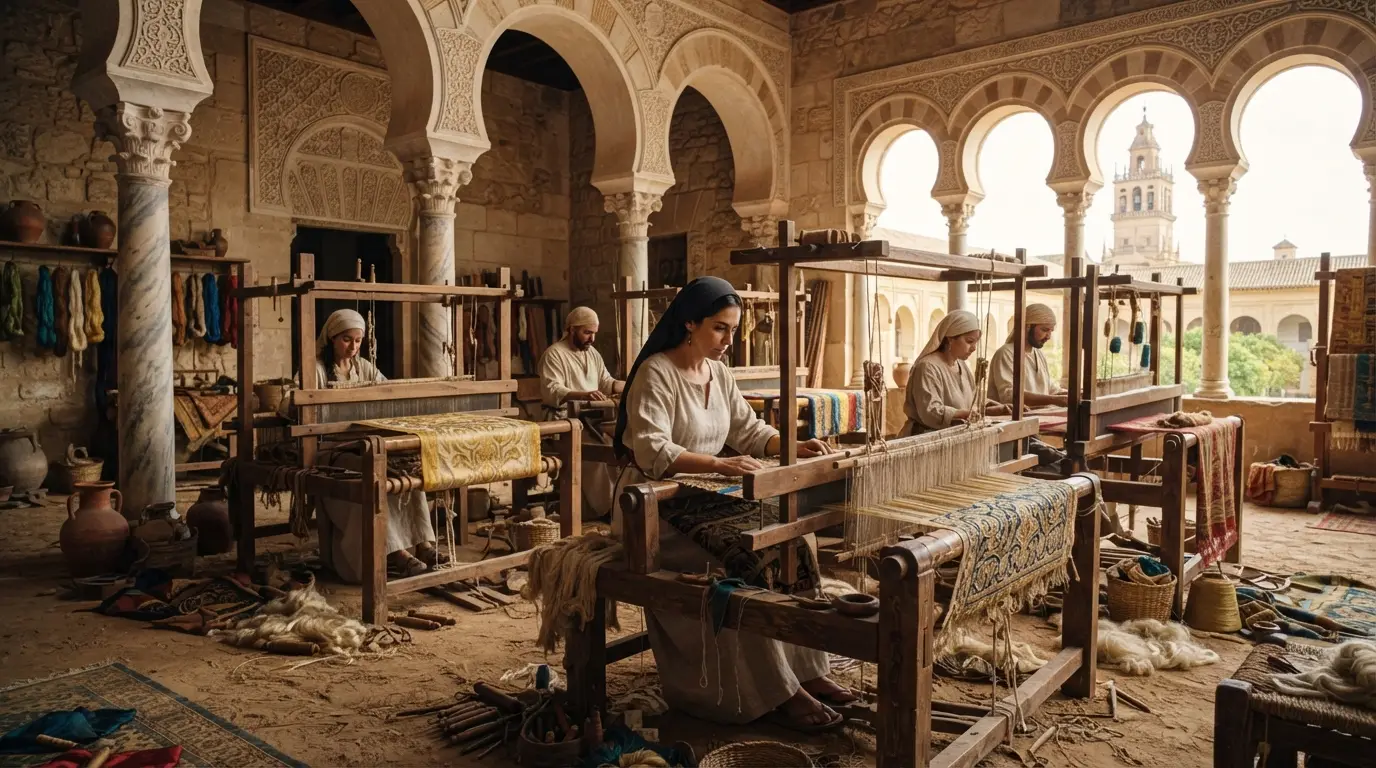
Córdoba Silk Industry History: The Rise of Tiraz
Córdoba ran al-Andalus's first state silk workshop, the dar al-tiraz, weaving robes of caliphal power before the industry shifted to Almería after 1031.
None of this tells a visitor when the gates open or which artists are showing this year; FLORA, the Festival Internacional de las Flores carries that detail. What the numbers tell a city weighing whether to keep funding a free festival is that the return has grown every edition Loyola has measured, on the metric that actually matters: real provincial economic activity, not a press release's rounding. For the wider story of how heritage-driven tourism is reshaping Córdoba's visitor economy, see our analysis of the Al-Andalus tourism boom.